GitHub updated the Copilot usage metrics API on July 2, 2026, to improve reporting accuracy for enterprise and organization administrators by adding CLI suggested-line telemetry, filling in IDE details for some server-side-only users, and correcting AI credit attribution that previously showed real usage as 0.0. The change is less a cosmetic dashboard fix than an admission that AI developer tooling has outgrown the neat accounting models built for seat-based software. Copilot now lives in editors, terminals, cloud-side workflows, pull requests, and agentic features, and the billable surface area has become harder to observe cleanly. For IT leaders, the headline is simple: Copilot usage reports should now look more complete, but historical comparisons may get messier before they get more trustworthy.
For years, developer productivity tooling was sold like most enterprise software: count seats, enforce entitlement, and let management worry about whether the tool was worth it. Copilot helped shift that bargain. The product is still licensed, but the meaningful question has moved from “who has access?” to “who is consuming inference, where, and for what kind of work?”
That is why this changelog matters. GitHub is not announcing a new model, a new chat surface, or a flashy agent demo. It is announcing that some of the numbers administrators use to justify, govern, and allocate Copilot spend were incomplete.
The three fixes are narrow on paper. Copilot CLI now contributes suggested lines of code to fields that previously returned zero for that surface. Users observed only through server-side telemetry now have IDE and plugin versions surfaced in the
Taken together, those changes point to the new operational reality of AI coding assistants. The telemetry layer is becoming just as important as the assistant itself. If the meter is wrong, the procurement model is wrong, the adoption model is wrong, and the governance story starts to wobble.
That is not a small detail for teams that have embraced terminal-native workflows. Modern development is not confined to Visual Studio Code, Visual Studio, JetBrains IDEs, or Neovim. Developers use CLIs to scaffold projects, generate commands, rewrite files, ask for shell help, work inside containers, and operate against remote environments where the terminal is the durable interface.
A metric that counted IDE suggestions but treated CLI suggested lines as zero effectively underweighted a whole class of Copilot usage. It made terminal-heavy teams look less assisted than they were. It also made cross-team comparisons suspect, because a backend infrastructure team living in the shell could appear less engaged than an application team doing the same amount of AI-assisted work inside an editor.
GitHub had already been moving CLI activity into broader Copilot usage reports earlier this year. Previous updates added per-user CLI breakdowns and integrated CLI activity into top-level totals and feature breakdowns. This latest fix tightens the line-of-code side of that story, which is where many organizations instinctively look when trying to describe developer-assistant impact.
That instinct deserves caution. Suggested lines are not delivered value, accepted lines are not necessarily good lines, and deleted lines can be as meaningful as generated code. But if an organization is going to use these numbers at all, it is better for the CLI to be counted honestly than silently flattened to zero.
This is the kind of detail that causes dashboard owners pain. A single product change can alter the meaning of a trend line even if user behavior has not changed. A spike may represent better measurement rather than higher adoption; a dip may reflect de-duplication rather than reduced usage.
For administrators, the practical lesson is to treat Copilot metrics as an evolving instrumentation system, not an immutable ledger. The API is still stabilizing around a product that is changing quickly. Agent modes, chat panels, inline edits, terminal suggestions, and server-side activity do not all emit the same signals in the same way.
That matters when reports are used for executive storytelling. A CIO deck that says Copilot adoption rose 14 percent quarter over quarter may be directionally useful, but it should not pretend to be a laboratory measurement unless the underlying telemetry definitions stayed constant. In this case, they did not.
The version thresholds are especially important. If different developer populations are running different CLI versions, their reported activity may not be directly comparable. A team standardized on 1.0.64 or later will be measured differently from a team still sitting in the transitional 1.0.57-to-1.0.64 window.
Corporate proxies interfere. Developers work from secured networks. Endpoint controls block or reshape traffic. Extensions fail, update, or operate under settings that do not emit the richest possible telemetry. A user may be very active with Copilot while leaving only partial traces in the reporting pipeline.
The drawback was that server-side-only users could appear in higher-level counts without the same dimensional richness as users captured through client-side telemetry. In plain English, GitHub could know that someone used Copilot but not show enough detail about where the usage happened. That created unattributed activity in breakdowns that administrators rely on to understand tool distribution.
The July 2 update narrows that gap by surfacing IDE and plugin versions for users who were previously visible only through server-side telemetry. As a result,
This sounds mundane until you consider how enterprises use those breakdowns. IDE and plugin-version data informs rollout planning, support readiness, compatibility checks, and migration work. If a company is trying to phase out outdated extensions or understand whether JetBrains users are adopting Copilot differently from VS Code users, missing IDE attribution turns a governance problem into guesswork.
That is the line administrators will notice first. GitHub explicitly warns that AI credit totals for previously missed usage will increase as a result of the attribution fixes, while values that were already reported remain unchanged.
In other words, this is not GitHub retroactively saying existing nonzero values were inflated or rewritten. It is saying some real usage had been missing from the reporting view and will now appear. For organizations watching AI credits closely, that can look like a sudden rise even if developer behavior is stable.
The distinction matters. An increased total after this update may not mean developers are suddenly burning through more Copilot capacity. It may mean the reporting system is finally catching consumption that was already happening. Finance teams hate that kind of sentence, but it is better than the alternative: billing-adjacent data that silently excludes part of the estate.
GitHub’s documentation also frames
Copilot’s growth across surfaces has created a measurement problem that older software categories rarely faced. A word processor does not need to explain whether a paragraph was generated in the desktop app, the browser, a mobile client, or an automation agent before the license owner can understand usage. AI coding assistants do.
A single developer might use Copilot chat in an IDE, ask the CLI for a command, accept an inline completion, trigger a code review feature, and rely on an agentic workflow that modifies files in the background. Each action has different telemetry, cost, and governance implications. Rolling all of that into one clean “active user” number is convenient, but it hides the operational mess that administrators actually need to manage.
The July 2 changes make that mess more visible. CLI suggested-line reporting helps with surface coverage. IDE attribution for server-side-only users reduces unattributed activity. AI credit attribution fixes bring consumption analysis closer to reality. None of those improvements makes Copilot measurement simple.
If anything, they show that mature Copilot administration now requires version discipline, telemetry literacy, and a healthy skepticism toward month-over-month charts. The better the API gets, the more teams must annotate their own dashboards with product-change dates, client-version cutovers, and reporting-definition shifts.
That sprawl creates value, but it also creates accountability pressure. Microsoft and GitHub are asking organizations to trust AI assistants with source code, corporate context, and developer time. In return, enterprises increasingly expect metering that is explainable enough for procurement, security, compliance, and engineering leadership.
Windows-heavy organizations feel this particularly sharply because their developers and administrators often live across Microsoft-controlled surfaces. A sysadmin might use Windows Terminal, PowerShell, GitHub CLI, VS Code, Azure tooling, and Copilot-powered services in the same day. The neat boundary between “developer assistant” and “operations assistant” is already fading.
That is why CLI telemetry deserves attention. The command line is not a niche interface for greybeards. It is the connective tissue of automation, cloud administration, DevOps, and incident response. If Copilot is useful there, its usage has to be measured there with the same seriousness as in the IDE.
Security teams should also care. Better attribution by IDE, plugin version, and user gives administrators a clearer map of where Copilot is actually operating. That does not answer every governance question, but it helps organizations separate approved, supported usage from murkier patterns that need policy work.
There is a danger that better telemetry will encourage worse management. If leaders fixate on suggested lines of code, developers may be nudged toward volume theater. If leaders fixate on AI credits, teams may underuse valuable assistance to avoid looking expensive. If leaders rank IDEs or teams without context, they may punish workflow differences rather than identify genuine adoption gaps.
The useful reading is more nuanced. Copilot metrics can reveal whether a rollout is reaching the intended population. They can show whether CLI usage is material enough to support with training. They can identify teams with unusually high consumption that may need guidance or governance. They can help connect billing trends with actual product surfaces rather than treating AI spend as a mysterious pool.
But the reports should be paired with qualitative evidence. Are pull requests easier to review? Are junior developers getting unstuck faster? Are platform teams reducing toil? Are generated changes introducing security review burden? The API cannot answer those questions by itself.
This is where IT leadership has to resist both vendor triumphalism and reflexive cynicism. Copilot is neither magic productivity dust nor an accounting scam just because the reporting pipeline needed fixes. It is a fast-evolving tool whose measurement model is catching up with its usage model.
They should also expect
Dashboard owners should annotate July 2, 2026, as a reporting-definition change. If a company has already been tracking Copilot usage over time, this is one of those dates that belongs in the chart notes. The more executive the audience, the more important the caveat becomes.
There is also a governance opportunity here. More complete IDE and plugin-version attribution can help admins identify outdated clients and prioritize upgrade campaigns. That is not glamorous work, but in AI tooling, stale clients can mean stale features, incomplete telemetry, inconsistent policy behavior, and support friction.
The bigger shift is cultural. Copilot administration is becoming a real operational discipline. It sits somewhere between SaaS management, developer experience, FinOps, and security governance. The organizations that treat it that way will have a cleaner story than those that simply buy seats and hope the dashboards explain themselves.
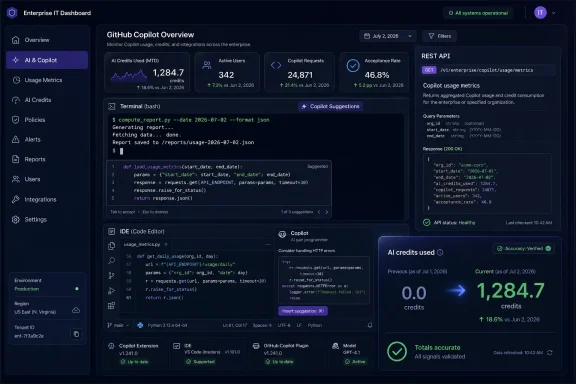 GitHub Is Fixing the Meter After the Meter Became the Product
For years, developer productivity tooling was sold like most enterprise software: count seats, enforce entitlement, and let management worry about whether the tool was worth it. Copilot helped shift that bargain. The product is still licensed, but the meaningful question has moved from “who has access?” to “who is consuming inference, where, and for what kind of work?”That is why this changelog matters. GitHub is not announcing a new model, a new chat surface, or a flashy agent demo. It is announcing that some of the numbers administrators use to justify, govern, and allocate Copilot spend were incomplete.
The three fixes are narrow on paper. Copilot CLI now contributes suggested lines of code to fields that previously returned zero for that surface. Users observed only through server-side telemetry now have IDE and plugin versions surfaced in the
totals_by_ide breakdown. AI credit consumption that had been dropped or unmatched now flows into the correct organization or enterprise totals.Taken together, those changes point to the new operational reality of AI coding assistants. The telemetry layer is becoming just as important as the assistant itself. If the meter is wrong, the procurement model is wrong, the adoption model is wrong, and the governance story starts to wobble.
The Command Line Was a Blind Spot Hiding in Plain Sight
The most concrete fix is for GitHub Copilot CLI. Starting with Copilot CLI version 1.0.57, CLI activity now contributes toloc_suggested_to_add_sum and loc_suggested_to_delete_sum. Before this update, those fields always reported zero for CLI usage, even when developers were receiving suggested edits at the terminal.That is not a small detail for teams that have embraced terminal-native workflows. Modern development is not confined to Visual Studio Code, Visual Studio, JetBrains IDEs, or Neovim. Developers use CLIs to scaffold projects, generate commands, rewrite files, ask for shell help, work inside containers, and operate against remote environments where the terminal is the durable interface.
A metric that counted IDE suggestions but treated CLI suggested lines as zero effectively underweighted a whole class of Copilot usage. It made terminal-heavy teams look less assisted than they were. It also made cross-team comparisons suspect, because a backend infrastructure team living in the shell could appear less engaged than an application team doing the same amount of AI-assisted work inside an editor.
GitHub had already been moving CLI activity into broader Copilot usage reports earlier this year. Previous updates added per-user CLI breakdowns and integrated CLI activity into top-level totals and feature breakdowns. This latest fix tightens the line-of-code side of that story, which is where many organizations instinctively look when trying to describe developer-assistant impact.
That instinct deserves caution. Suggested lines are not delivered value, accepted lines are not necessarily good lines, and deleted lines can be as meaningful as generated code. But if an organization is going to use these numbers at all, it is better for the CLI to be counted honestly than silently flattened to zero.
De-Duplication Is the Quiet Correction That Dashboards Needed
GitHub also says code generation counts are more accurate on newer Copilot CLI versions because suggested and accepted edits are de-duplicated so the same edit is not counted twice. That improvement applies from CLI version 1.0.64 onward. Between versions 1.0.57 and 1.0.64, CLI code generation activity may be slightly undercounted.This is the kind of detail that causes dashboard owners pain. A single product change can alter the meaning of a trend line even if user behavior has not changed. A spike may represent better measurement rather than higher adoption; a dip may reflect de-duplication rather than reduced usage.
For administrators, the practical lesson is to treat Copilot metrics as an evolving instrumentation system, not an immutable ledger. The API is still stabilizing around a product that is changing quickly. Agent modes, chat panels, inline edits, terminal suggestions, and server-side activity do not all emit the same signals in the same way.
That matters when reports are used for executive storytelling. A CIO deck that says Copilot adoption rose 14 percent quarter over quarter may be directionally useful, but it should not pretend to be a laboratory measurement unless the underlying telemetry definitions stayed constant. In this case, they did not.
The version thresholds are especially important. If different developer populations are running different CLI versions, their reported activity may not be directly comparable. A team standardized on 1.0.64 or later will be measured differently from a team still sitting in the transitional 1.0.57-to-1.0.64 window.
Server-Side Telemetry Is Filling the Gaps Client Telemetry Left Behind
The IDE-identification fix is part of a broader GitHub effort to use server-side telemetry where client-side signals are incomplete. Earlier reporting changes expanded active-user coverage by including users who could be confirmed from server-side activity even when client telemetry did not arrive. That was a sensible move, because client telemetry is fragile in the real world.Corporate proxies interfere. Developers work from secured networks. Endpoint controls block or reshape traffic. Extensions fail, update, or operate under settings that do not emit the richest possible telemetry. A user may be very active with Copilot while leaving only partial traces in the reporting pipeline.
The drawback was that server-side-only users could appear in higher-level counts without the same dimensional richness as users captured through client-side telemetry. In plain English, GitHub could know that someone used Copilot but not show enough detail about where the usage happened. That created unattributed activity in breakdowns that administrators rely on to understand tool distribution.
The July 2 update narrows that gap by surfacing IDE and plugin versions for users who were previously visible only through server-side telemetry. As a result,
totals_by_ide should reflect more of an organization’s actual Copilot population.This sounds mundane until you consider how enterprises use those breakdowns. IDE and plugin-version data informs rollout planning, support readiness, compatibility checks, and migration work. If a company is trying to phase out outdated extensions or understand whether JetBrains users are adopting Copilot differently from VS Code users, missing IDE attribution turns a governance problem into guesswork.
AI Credits Made Accuracy a Budget Issue, Not Just an Analytics Issue
The most financially sensitive fix involvesai_credits_used. GitHub says it corrected two issues that caused some users to show 0.0 AI credits despite real usage. Some AI credit consumption that was not associated with an organization was being dropped; GitHub now attributes it to the correct organization or enterprise. Separately, users seen only through server-side telemetry were not being matched to billing data; their consumption is now included.That is the line administrators will notice first. GitHub explicitly warns that AI credit totals for previously missed usage will increase as a result of the attribution fixes, while values that were already reported remain unchanged.
In other words, this is not GitHub retroactively saying existing nonzero values were inflated or rewritten. It is saying some real usage had been missing from the reporting view and will now appear. For organizations watching AI credits closely, that can look like a sudden rise even if developer behavior is stable.
The distinction matters. An increased total after this update may not mean developers are suddenly burning through more Copilot capacity. It may mean the reporting system is finally catching consumption that was already happening. Finance teams hate that kind of sentence, but it is better than the alternative: billing-adjacent data that silently excludes part of the estate.
GitHub’s documentation also frames
ai_credits_used as a consumption-analysis metric rather than an invoicing total. That caveat is important. Enterprises should not treat the Copilot usage metrics API as the sole source of billing truth. It is better understood as the operational telemetry layer that helps administrators explain consumption patterns, identify outliers, and correlate usage with teams, tools, and adoption phases.The Dashboard Is Now a Moving Target
The obvious risk is that better data can make organizations feel worse about their data. A report that becomes more complete may also become less comparable to last month’s report. That is an awkward but necessary phase for a product moving from enthusiasm-driven rollout to enterprise-scale cost management.Copilot’s growth across surfaces has created a measurement problem that older software categories rarely faced. A word processor does not need to explain whether a paragraph was generated in the desktop app, the browser, a mobile client, or an automation agent before the license owner can understand usage. AI coding assistants do.
A single developer might use Copilot chat in an IDE, ask the CLI for a command, accept an inline completion, trigger a code review feature, and rely on an agentic workflow that modifies files in the background. Each action has different telemetry, cost, and governance implications. Rolling all of that into one clean “active user” number is convenient, but it hides the operational mess that administrators actually need to manage.
The July 2 changes make that mess more visible. CLI suggested-line reporting helps with surface coverage. IDE attribution for server-side-only users reduces unattributed activity. AI credit attribution fixes bring consumption analysis closer to reality. None of those improvements makes Copilot measurement simple.
If anything, they show that mature Copilot administration now requires version discipline, telemetry literacy, and a healthy skepticism toward month-over-month charts. The better the API gets, the more teams must annotate their own dashboards with product-change dates, client-version cutovers, and reporting-definition shifts.
Windows Shops Should Read This as a Microsoft Ecosystem Signal
Although this is a GitHub changelog, WindowsForum readers should see it as part of a larger Microsoft ecosystem pattern. Copilot is no longer a single assistant bolted onto a developer workflow. It is becoming a family of AI surfaces spread across Windows, Microsoft 365, GitHub, Azure, the command line, and enterprise management planes.That sprawl creates value, but it also creates accountability pressure. Microsoft and GitHub are asking organizations to trust AI assistants with source code, corporate context, and developer time. In return, enterprises increasingly expect metering that is explainable enough for procurement, security, compliance, and engineering leadership.
Windows-heavy organizations feel this particularly sharply because their developers and administrators often live across Microsoft-controlled surfaces. A sysadmin might use Windows Terminal, PowerShell, GitHub CLI, VS Code, Azure tooling, and Copilot-powered services in the same day. The neat boundary between “developer assistant” and “operations assistant” is already fading.
That is why CLI telemetry deserves attention. The command line is not a niche interface for greybeards. It is the connective tissue of automation, cloud administration, DevOps, and incident response. If Copilot is useful there, its usage has to be measured there with the same seriousness as in the IDE.
Security teams should also care. Better attribution by IDE, plugin version, and user gives administrators a clearer map of where Copilot is actually operating. That does not answer every governance question, but it helps organizations separate approved, supported usage from murkier patterns that need policy work.
Better Numbers Will Not Settle the Productivity Debate
GitHub’s improvements make Copilot reports more complete, but they do not solve the deeper argument over what Copilot metrics mean. Lines suggested, lines accepted, interactions counted, and credits consumed are proxy measures. They are useful, but they are not the same as maintainable code, faster incident resolution, fewer defects, or happier developers.There is a danger that better telemetry will encourage worse management. If leaders fixate on suggested lines of code, developers may be nudged toward volume theater. If leaders fixate on AI credits, teams may underuse valuable assistance to avoid looking expensive. If leaders rank IDEs or teams without context, they may punish workflow differences rather than identify genuine adoption gaps.
The useful reading is more nuanced. Copilot metrics can reveal whether a rollout is reaching the intended population. They can show whether CLI usage is material enough to support with training. They can identify teams with unusually high consumption that may need guidance or governance. They can help connect billing trends with actual product surfaces rather than treating AI spend as a mysterious pool.
But the reports should be paired with qualitative evidence. Are pull requests easier to review? Are junior developers getting unstuck faster? Are platform teams reducing toil? Are generated changes introducing security review burden? The API cannot answer those questions by itself.
This is where IT leadership has to resist both vendor triumphalism and reflexive cynicism. Copilot is neither magic productivity dust nor an accounting scam just because the reporting pipeline needed fixes. It is a fast-evolving tool whose measurement model is catching up with its usage model.
The New Copilot Admin Job Is Part Accountant, Part Telemetry Engineer
The immediate administrative response should be boring, which is usually a good sign. Organizations should inventory Copilot CLI versions, especially if they rely on CLI metrics for adoption or consumption reporting. They should note the 1.0.57 and 1.0.64 thresholds in internal dashboards and avoid overinterpreting data from the transition window.They should also expect
ai_credits_used totals to rise where previously missed usage is now attributed. That change needs explanation before it reaches finance. A quiet metric correction can look like a cost spike if nobody prepares the people reading the report.Dashboard owners should annotate July 2, 2026, as a reporting-definition change. If a company has already been tracking Copilot usage over time, this is one of those dates that belongs in the chart notes. The more executive the audience, the more important the caveat becomes.
There is also a governance opportunity here. More complete IDE and plugin-version attribution can help admins identify outdated clients and prioritize upgrade campaigns. That is not glamorous work, but in AI tooling, stale clients can mean stale features, incomplete telemetry, inconsistent policy behavior, and support friction.
The bigger shift is cultural. Copilot administration is becoming a real operational discipline. It sits somewhere between SaaS management, developer experience, FinOps, and security governance. The organizations that treat it that way will have a cleaner story than those that simply buy seats and hope the dashboards explain themselves.
The Numbers That Changed Tell Admins Where to Look First
GitHub’s update is best read as a set of practical warnings disguised as improvements. The metrics are getting better, but better metrics can change the apparent shape of reality.- Copilot CLI version 1.0.57 and later now reports suggested lines of code into the relevant added-and-deleted suggestion fields.
- Copilot CLI version 1.0.64 and later improves code generation counts by de-duplicating suggested and accepted edits so the same edit is not counted twice.
- Organizations with developers between CLI versions 1.0.57 and 1.0.64 should treat CLI code generation figures as potentially slightly undercounted.
- Users previously visible only through server-side telemetry should now contribute more useful IDE and plugin-version detail to
totals_by_ide. - AI credit totals may increase where real usage had previously been dropped or unmatched, but already reported values are not being changed.
- Enterprise administrators and organization owners using the REST API should annotate July 2, 2026, as a measurement-change date in any long-running Copilot reports.
References
- Primary source: The GitHub Blog
Published: Thu, 02 Jul 2026 23:19:06 GMT
Improved accuracy and coverage in Copilot usage metrics reports - GitHub Changelog
We’ve made three improvements to the Copilot usage metrics API that make its reports more complete and accurate: GitHub Copilot CLI now reports suggested lines of code, users seen only…github.blog
- Official source: docs.github.com
Data available in Copilot usage metrics - GitHub Docs
Copilot usage metrics data is available through the dashboard and APIs, using a consistent set of fields to represent adoption, usage, and code generation activity. docs.github.com
- Related coverage: usagebox.com

Tracking GitHub Copilot AI Credits in 2026: The Usage API and What It Still Hides | UsageBox
GitHub Copilot bills in AI Credits (1 credit = $0.01) since June 1, 2026, and the June 19 usage metrics API added ai_credits_used per user. But it's a per-user total only - no per-model, feature, or project breakdown. How to track AI Credit spend and how to actually attribute it.
usagebox.com
- Related coverage: qatechtools.com
GitHub Copilot Usage Metrics Add Per-User AI Credits - QATechTools
GitHub added per-user AI credit reporting to Copilot usage metrics on June 19, 2026. Here is why QA leaders and automation teams should care.qatechtools.com - Related coverage: apis.io
GitHub Copilot Usage Metrics API — Documentation, OpenAPI | APIs.io APIs
GitHub Copilot Usage Metrics API is one of 12 APIs that GitHub Copilot publishes on the APIs.io network, described by a machine-readable OpenAPI specificatio...apis.io - Official source: github.com
GitHub - github-copilot-resources/copilot-metrics-viewer: Tool to visualize the Copilot metrics provided via the Copilot Business Metrics API · GitHub
Tool to visualize the Copilot metrics provided via the Copilot Business Metrics API - GitHub - github-copilot-resources/copilot-metrics-viewer: Tool to visualize the Copilot metrics provided via the Copilot Business Metrics API github.com
- Related coverage: zenn.dev
- Official source: microsoft.com
- Official source: microsoft.ai