 GitHub Discovers That AI Demand Looks Better on a Meter
For most of Copilot’s public life, GitHub sold a simple idea: pay per seat, put an AI assistant in the editor, and watch software development become faster. That pitch worked because it sounded familiar to enterprises already buying SaaS by headcount. It also hid the inconvenient part of generative AI: one developer’s “seat” might mean a handful of autocomplete suggestions, while another’s might mean hours of model-driven code generation, review, debugging, and refactoring.
The June 1 pricing change forced that difference into the open. Copilot moved away from a flatter request-based structure and toward billing tied to actual AI consumption through GitHub AI Credits. In plain English, the heaviest users now look more like cloud customers than software subscribers.
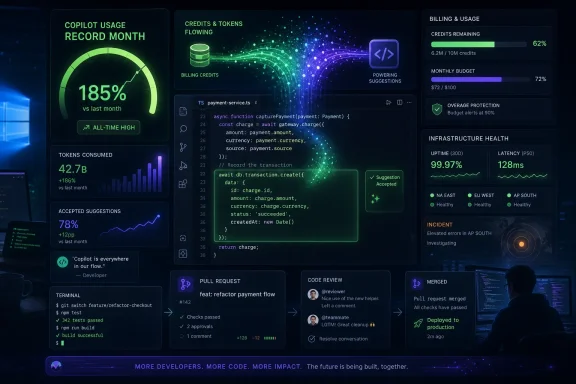
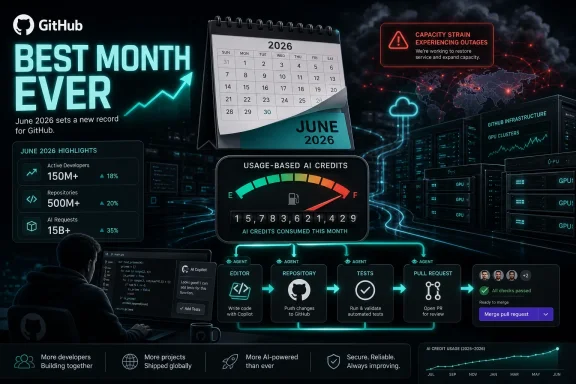
That is why Fedorov’s “best month ever” comment matters. It suggests GitHub did not merely raise an accounting lever and scare users away. Instead, at least in the first month, demand expanded or remained strong enough that usage-based pricing translated into a record internal business signal.
But the celebration has a shadow. If June was GitHub’s best month because developers suddenly used Copilot more, that is a product success. If it was GitHub’s best month because existing users crossed into expensive overage territory, that is a billing success. The distinction will matter a great deal once CIOs and engineering directors start treating Copilot spend the way they treat cloud bills.
The Old Copilot Model Could Not Survive Agentic Coding
The original Copilot bargain made sense when AI coding mostly meant autocomplete, inline suggestions, and chat. Those features could be expensive at scale, but they mapped neatly to a human workflow. A developer typed, the model suggested, and the cost curve was at least loosely attached to the cadence of human work.
Agentic coding breaks that model. A tool that can inspect a repository, propose changes, run tests, revise patches, explain failures, and repeat the cycle is no longer just answering a prompt. It is consuming compute across a chain of steps that may be invisible to the person who clicked “go.”
That is the economic problem GitHub is now trying to solve. A quick question and a long-running coding session cannot cost the platform the same amount forever. If the company absorbs the difference, heavy users are subsidized by light users. If it meters the difference, developers get a more honest bill and a more complicated product.
The shift also reflects a broader industry reset. Cursor, Claude Code, OpenAI’s Codex-style workflows, and other AI development environments have trained users to expect more than completions. Developers now want tools that understand whole projects and act on them. That means more context, more tokens, more model calls, more tool execution, and more infrastructure pressure.
GitHub’s advantage is distribution. It owns the repository gravity well for much of modern software development. Its disadvantage is that distribution alone is no longer enough when developers are willing to bring rival AI tools into their editor, terminal, pull request flow, and CI pipeline.
Competition Has Moved From the Editor to the Workflow
Copilot’s early lead came from being where developers already were. It lived inside Visual Studio Code, JetBrains IDEs, and GitHub itself. It felt less like a new platform than a feature that had materialized in the existing one.
That advantage has narrowed. Cursor has turned the editor into a more explicitly AI-native environment. Anthropic’s Claude Code has appealed to developers who want a terminal-first agent. OpenAI has pushed coding agents as part of a broader model and product strategy. The field is no longer about whether an AI can suggest the next line; it is about which system can safely and cheaply operate across an entire development loop.
This is where GitHub’s June becomes strategically interesting. A surge in Copilot usage after a billing change means customers are not simply experimenting with AI coding because it is bundled or novel. They are generating enough activity to make the meter spin.
The danger for GitHub is that usage-based billing makes comparison easier. A flat subscription can blur differences between products because the marginal cost of trying one more feature feels low. A consumption model invites teams to ask sharper questions: Which assistant produces the best patch per dollar? Which agent wastes the least context? Which tool burns credits on dead ends? Which one can be governed centrally without slowing developers to a crawl?
Once AI coding becomes a metered workflow, GitHub is no longer selling magic. It is selling productivity per unit of compute.
The Record Month Arrives With an Outage Hangover
GitHub’s record June is harder to read because it comes amid reports of capacity strain and repeated service incidents. Business Insider reported that GitHub experienced dozens of major outages in 2026 as AI usage increased. It also reported that Microsoft has turned to Amazon Web Services, its largest cloud rival, to help address GitHub capacity constraints.
That is an extraordinary detail even if it is not, by itself, a scandal. Large technology companies routinely use rival infrastructure in limited contexts. But Microsoft has spent years positioning Azure as the cloud backbone for its AI ambitions, and GitHub is one of its most strategically important developer assets. When GitHub needs help from AWS to absorb AI-driven load, it says something about how quickly demand has outrun planning assumptions.
The operational challenge is not merely “more users.” It is a different shape of traffic. Human developers produce bursts during work hours. AI coding agents can generate sustained, high-volume activity, especially when they are embedded in automated workflows or used to iterate on large repositories.
That creates a capacity-planning problem that looks less like a consumer app spike and more like cloud infrastructure whiplash. The same product features that make Copilot more valuable also make it harder to provision. More context windows, deeper repository understanding, asynchronous agents, and automated code review all push GitHub into a heavier compute profile.
For WindowsForum readers who live in the world of endpoints, servers, identity, and change windows, this should sound familiar. The product team creates a breakthrough workflow; the infrastructure team inherits a new failure mode. The business team celebrates revenue; the operations team starts counting incident minutes.
Microsoft’s AI Flywheel Now Has a Very Real Friction Problem
Microsoft’s acquisition of GitHub in 2018 looks smarter with every passing year. The company bought not just a code-hosting service but a social and operational layer for software development. In the AI era, that layer becomes even more valuable because models need context, workflows, permissions, repositories, issues, and pull requests.
But the Copilot surge also highlights Microsoft’s recurring AI bottleneck: capacity. The company has repeatedly told investors and customers that demand for AI services is enormous. That is good news until the platform cannot serve all of it cleanly, predictably, and profitably.
GitHub sits at the intersection of Microsoft’s strongest and most strained assets. It benefits from Azure, OpenAI ties, Visual Studio Code, enterprise identity, and Microsoft’s enormous sales machine. It also competes for compute against every other Microsoft AI priority, from Microsoft 365 Copilot to Azure OpenAI Service to internal model workloads.
If GitHub must borrow capacity from AWS because demand arrived faster than Azure-side provisioning, that is less a humiliation than a warning. AI infrastructure is not infinitely elastic just because the marketing deck says “cloud.” GPUs, networking, inference optimization, region placement, reliability engineering, and cost controls all impose hard limits.
The next phase of AI coding will reward the companies that can make those limits boring. Developers do not want to think about model-routing economics when they are fixing a production bug. Enterprises do not want an outage page to become part of the software delivery lifecycle. The winner will not necessarily be the assistant with the flashiest demo; it may be the one that turns agentic coding into dependable infrastructure.
The Billing Change Rewrites the Admin Playbook
For IT departments, Copilot’s usage-based model changes the governance problem. Buying AI coding tools used to look like licensing: decide who gets access, assign seats, negotiate price, review adoption. Now it increasingly looks like cloud financial management: forecast usage, set budgets, monitor consumption, and explain spikes.
That shift is not cosmetic. A developer can burn through a fixed allotment quickly if they lean on more expensive models or long-running agentic workflows. A team can create unexpected costs if automated review, code generation, and debugging loops become routine. A department can find itself asking whether an AI-generated pull request was worth the credits it consumed.
GitHub has tried to soften the transition with included credits, pooled usage for organizations, billing previews, and monitoring tools. Those are necessary features, but they also confirm the new reality. Copilot is no longer just a developer productivity app. It is a metered AI service with budget controls.
That will change procurement conversations. Engineering leaders will still argue that Copilot saves time, reduces boilerplate, accelerates onboarding, and improves code review. Finance teams will ask for proof. Security teams will ask what code and context are being sent where. Platform teams will ask how usage policies map to identity groups, repositories, and regulated workloads.
The more Copilot behaves like a cloud resource, the more it will be managed like one. That means chargeback, showback, quotas, dashboards, exception processes, and uncomfortable meetings after a team discovers that an enthusiastic experiment became a line item.
Developers Will Learn to Optimize for the Meter
The social contract between developers and AI tools is changing. Under a flat plan, the rational behavior is to use the tool whenever it helps. Under a usage model, the rational behavior is to decide when the tool helps enough.
That does not mean developers will abandon AI coding. The opposite may be true. If Copilot had its best month ever after the meter arrived, many developers clearly value the capability. But they will also become more selective, especially when budgets become visible.
A senior developer may use an agent to explore a legacy subsystem but avoid spending credits on trivial formatting changes. A junior developer may lean heavily on Copilot for explanations and scaffolding, which could be a great productivity investment or a costly training pattern, depending on the organization’s view. A platform team may route certain workflows to cheaper models and reserve frontier models for complex refactors.
This is where product design becomes economic design. If Copilot makes it easy to understand what a task will cost before it runs, developers may trust the meter. If costs appear only after the fact, resentment will build. If cheaper models are good enough for most tasks, GitHub can preserve value while controlling spend. If expensive agentic workflows become the default, budget owners will intervene.
The best AI coding tools will not merely generate code. They will help users reason about when generation is worth it.
GitHub’s Best Month Is Also a Test of Trust
GitHub’s challenge is not simply to maximize AI usage. It must convince customers that the usage is legible, controllable, and worth paying for. That is a harder job than selling a $10 or $19 seat.
Developers are unusually sensitive to changes that feel like bait-and-switch pricing. Many remember when cloud services, CI minutes, package registries, observability tools, and API platforms became indispensable before their bills became painful. Copilot risks falling into that same emotional category if users feel the product has trained them into a workflow and then charged them unpredictably for continuing it.
To be fair, GitHub has a real cost problem. Frontier models and agentic workflows are expensive. A pricing model that ignores usage would either force GitHub to degrade the product, throttle heavy users, or raise everyone’s subscription fees. Usage-based billing is not inherently anti-user; in many cases, it is the only honest way to price scarce compute.
The trust question is whether GitHub can make the meter feel fair. That means clear reporting, sane defaults, hard caps, admin controls, predictable model pricing, and explanations that do not require a finance degree. It also means being candid when features consume multiple resources, such as AI credits and automation minutes.
If GitHub gets that right, June may mark the beginning of a more sustainable Copilot business. If it gets it wrong, June may be remembered as the month users discovered how much their new development habits really cost.
Windows Shops Should Treat Copilot as Part of the Platform Stack
For Windows-heavy enterprises, GitHub’s Copilot moment is not isolated from the broader Microsoft ecosystem. Many organizations are already evaluating Microsoft 365 Copilot, Security Copilot, Azure AI services, Power Platform AI features, and developer copilots at the same time. The bills may arrive through different portals, but the governance problem is shared.
That matters because developer AI is often the first place where organizations see tangible productivity gains. Code is structured, testable, and versioned. Developers are comfortable with tools. The feedback loop is fast. If AI proves itself anywhere inside the enterprise, software teams are a likely candidate.
But software development is also a high-risk domain. AI-generated code can introduce vulnerabilities, licensing concerns, architectural drift, and operational surprises. A Copilot-generated patch still needs review. An agentic refactor still needs tests. A faster development loop can become a faster incident loop if governance does not keep pace.
Windows administrators and enterprise architects should therefore treat Copilot not as a toy for developers but as part of the platform stack. It touches identity, billing, source control, CI/CD, compliance, and security review. It changes how code is written and how much infrastructure is consumed along the way.
The practical question is not whether AI coding tools are coming. They are already here. The question is whether organizations will manage them deliberately or discover their policies through invoices and outages.
The June Surge Leaves a Short Checklist for IT
GitHub’s record month should not be dismissed as executive cheerleading, but neither should it be read as proof that the AI coding market has stabilized. It is a signal that demand is real, pricing is changing, and infrastructure is under pressure at the same time. For teams deciding what to do next, the immediate lessons are concrete.
- GitHub’s June usage surge suggests developers are willing to keep using Copilot even after the move to usage-based billing.
- Copilot should now be budgeted as a metered AI service, not merely as a per-seat developer subscription.
- Organizations should review caps, credit pools, reporting access, and alerting before agentic workflows become everyday practice.
- Engineering leaders should measure Copilot value by completed work, review quality, and cycle-time improvements rather than by raw usage.
- Reliability concerns around GitHub’s AI growth deserve attention because outages in the developer platform can quickly become outages in the software delivery pipeline.
The most important thing about GitHub’s “best month ever” is that it compresses the entire AI software story into a single moment: huge demand, changing prices, strained infrastructure, and unresolved trust. Copilot is no longer just a clever assistant sitting beside the developer; it is becoming a consumption layer inside the software factory. If GitHub can make that layer reliable, transparent, and economically defensible, June 2026 will look like the month AI coding grew up. If not, it will look like the month the meter finally caught up with the demo.