

Global PC shipments closed out 2025 with an unexpectedly strong holiday push: fourth-quarter volumes rose 9.6% year‑over‑year to 76.4 million units, capping a full year of recovery that saw roughly 284.7 million PCs ship worldwide. The surge — confirmed by multiple industry trackers — was driven by a convergence of forces rarely seen together: the formal end of support for Windows 10 in October, early‑year tariff fears that prompted vendors to front‑load inventory, and an emerging memory‑supply squeeze that pushed buyers to secure parts and finished systems ahead of anticipated 2026 price rises. What looked like a routine seasonal uplift became a strategic scramble, and its consequences will shape PC pricing, product mix, and vendor economics well into next year.
This was not a speculative factor. The October cut‑off converted latent replacement demand into immediate purchases, particularly among businesses with large fleets on aging Windows 10 images and consumers who preferred a vendor‑tested migration path rather than DIY upgrades.
The tariff‑led pull‑in had two knock‑on effects: first, it redistributed some shipment volumes forward in the year (blunting some mid‑year demand), and second, it left vendors wary of re‑entering procurement cycles until price visibility — particularly for memory and storage components — stabilized.
That memory squeeze materially changed purchasing behavior during the holiday quarter: buyers purchased earlier and in larger quantities to avoid paying higher component prices or risking component shortages in early 2026. The memory dynamic is the central reason many analysts believe the industry faces a distinct upcycle in average selling prices (ASPs) even if unit growth stalls in 2026.
For consumers, IT buyers, and vendors, the practical arithmetic is clear: act proactively on critical purchases, prioritize components and configuration over flash sales, and assume memory and storage will be the defining constraints of the next buying window. The 2025 holiday quarter proved the industry can pivot quickly — but the lesson that will stick is this: in a world where software deadlines, tariffs, and memory markets converge, timing and procurement strategy are as important as product design.
Source: EE Times Asia https://www.eetasia.com/2025-holida...set-and-supply-fears-capping-a-volatile-2025/
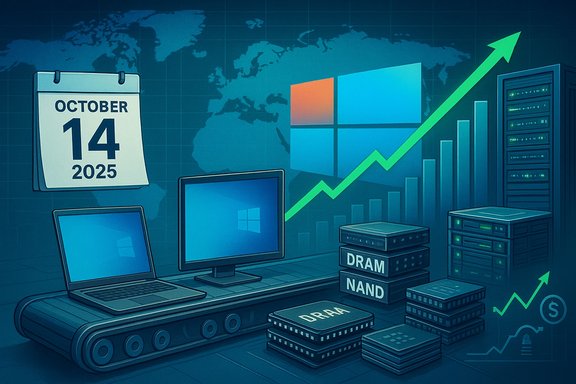 Background: the three drivers that remade 2025
Windows 10 sunset: a calendar‑driven refresh cycle
Microsoft’s long‑announced end of support for Windows 10 — which formally occurred on October 14, 2025 — created a hard deadline that pushed both consumers and IT buyers into action. For organizations the choices were straightforward but costly: upgrade eligible machines to Windows 11, buy new hardware that meets Windows 11 requirements, or pay for extended security updates (ESU) while planning a migration. For consumers, the end‑of‑support message and Microsoft’s persistent upgrade nudges translated into a meaningful refresh impulse across both retail and commercial channels.This was not a speculative factor. The October cut‑off converted latent replacement demand into immediate purchases, particularly among businesses with large fleets on aging Windows 10 images and consumers who preferred a vendor‑tested migration path rather than DIY upgrades.
Tariff concerns and front‑loading
Early 2025 brought substantial policy uncertainty around U.S. import tariffs. Announcements and threats of broader tariff measures prompted PC vendors and retailers to pull forward shipments and move inventory into the U.S. distribution channel ahead of expected cost increases. The practical effect was a Q1–Q2 stocking and a noticeable acceleration of shipments earlier in the year — a behavior that amplified seasonality later on as channel inventories were adjusted.The tariff‑led pull‑in had two knock‑on effects: first, it redistributed some shipment volumes forward in the year (blunting some mid‑year demand), and second, it left vendors wary of re‑entering procurement cycles until price visibility — particularly for memory and storage components — stabilized.
Memory shortages and price inflation
By late 2025 the market faced a memory story that outstripped normal cyclical swings. Demand from AI infrastructure, expanded server deployments, and hyperscaler contracts strained DRAM and NAND capacity. The upshot: manufacturers and large OEMs began to prioritize supply to higher‑margin enterprise and server segments, SSD and DRAM contract prices moved higher, and vendors that depend on commodity DDR and NAND for mainstream notebooks and desktops looked to lock in allocations.That memory squeeze materially changed purchasing behavior during the holiday quarter: buyers purchased earlier and in larger quantities to avoid paying higher component prices or risking component shortages in early 2026. The memory dynamic is the central reason many analysts believe the industry faces a distinct upcycle in average selling prices (ASPs) even if unit growth stalls in 2026.
The numbers: what the market trackers are reporting
- Q4 2025 global PC shipments: 76.4 million units, up 9.6% YoY.
- Full‑year 2025 PC shipments: ~284.7 million units, up ~8.1% YoY.
- Market leadership for Q4 and the year: Lenovo, HP, Dell, with Apple and ASUS rounding out the top five.
- Vendor highlights: Lenovo shipped approximately 19.3 million units in Q4 and led full‑year volume with roughly 70.8 million units.
What vendors did — and why it matters
Stockpiling, allocation deals, and supply prioritization
Top OEMs reacted to tariff and memory risk by re‑allocating purchasing priorities. Large vendors with negotiating leverage and advance purchase agreements secured allocations for DDR and NAND, while smaller OEMs and regional brands found themselves competing for leftover capacity. The immediate outcomes included:- OEMs increasing component inventory on hand to stabilize production plans.
- Some manufacturers prebuilding systems and routing them to key markets to avoid tariff exposure.
- Larger brands prioritizing server/HPC memory allocations to maintain relationships with hyperscalers, which can leave client PC lines more constrained.
Memory specification changes and product re‑spec’ing
Industry research teams warned of a likely tactical response: manufacturers may lower base memory or storage configurations on certain SKUs to stretch limited inventories. That could mean:- More entry‑level laptops shipping with 8 GB instead of 16 GB as the mainstream memory pool tightens.
- Increased reliance on soldered LPDDR configurations for ultrabooks to reduce module dependency.
- Longer OEM lead times for configurable SKUs and custom builds.
Impact on pricing and margins: ASPs rise as unit growth moderates
A critical dynamic for 2026 is the separation of unit and revenue growth. The shortage in memory and NAND is pushing component costs higher; the easiest way vendors and channel partners can protect margins is to let ASPs rise rather than sacrifice profitability. Expect these patterns:- System ASPs to increase even if unit volumes flatten or dip.
- Vendors to focus on midrange and premium configurations (AI‑capable or higher memory systems) where margins are better and memory allocations are easier to secure.
- Reduced competitiveness in low‑end segments — fewer thin‑margin, heavily discounted SKUs.
Risks and structural implications
Security and operational risk from Windows 10 EOL
The sunset of Windows 10 carries longer‑term operational and security implications. Enterprises that delay migrations face an expanded threat surface as security updates cease. Although Microsoft offers Extended Security Updates (ESU) as a mitigation, ESU is costly and temporary, meaning delayed migrations simply defer a necessary capital expenditure. The security risk is not hypothetical: unsupported platforms are a persistent target for attackers, and vulnerability exploitation windows widen after EOL.Consolidation risk for smaller vendors
Memory scarcity and contract prioritization favor large OEMs. Smaller PC brands with thin margins and weaker supplier relationships are at real risk of losing market share — and in some cases, viability. The expected market outcome is consolidation: bigger firms take share, niche firms either exit or are acquired.Inflation squeezing consumers and enterprise budgets
Higher component costs translate to higher prices for buyers. For enterprises, this compels procurement teams to:- Prioritize essential refreshes.
- Revisit TCO models for device lifecycles.
- Consider lease or subscription alternatives to shift capital expenditure.
Spec and feature trade‑offs
To preserve margins and ship units, manufacturers may ship devices with reduced memory or storage at launch. That directly affects user experience, particularly for power users and those who adopt on‑device AI features that are memory hungry. The practical result will be a bifurcated market: compelling premium AI‑capable systems and a more austere low‑cost tier where buyers must explicitly upgrade later (if possible).Strengths and positive signals
Despite the turbulence, the market displayed noteworthy strengths:- Demand elasticity around clear upgrade triggers (Windows 10 EOL) remains high. A defined deadline mobilizes purchases in a way seasonality alone rarely does.
- The channel and OEMs demonstrated nimbleness: front‑loading inventory, diversifying logistics, and securing component allocations helped prevent outright stockouts during the holiday quarter.
- Turnover toward AI‑capable hardware provides an innovation tailwind. Vendors are packaging device capabilities that match new workload needs, and that helps drive ASP uplift that can fund R&D and improved platforms.
Practical advice for buyers and IT planners
For consumer buyers
- If a new PC is needed now, buy sooner rather than later. Current inventories and promotional windows still offer choice; prices for similar configurations may rise if memory and NAND remain constrained.
- Prioritize memory and SSD size at purchase. Upgradability matters: buy a model with serviceable RAM and storage if future upgrades are important.
- Look for trusted brands with robust warranties and clear upgrade paths. Post‑purchase support and guaranteed parts availability will matter in a tight supply environment.
For IT procurement teams
- Accelerate essential refreshes tied to Windows 10 EOL. Where ESU is unacceptable, buying new Windows 11‑capable hardware earlier reduces exposure.
- Lock memory and storage requirements into procurement contracts. Explicitly negotiate allocation commitments with vendors.
- Re‑evaluate leasing or device‑as‑a‑service options to smooth budgetary impacts and reduce upfront capital pressure.
- Consider workspace virtualization or cloud alternatives for non‑endpoint workloads if device replacement is delayed.
- Build contingency for longer lead times; avoid single‑source dependencies for critical configurations.
For DIY builders and system integrators
- Source critical components (DRAM, NVMe) early. Retail channel availability for specific modules may be constrained.
- Consider alternative memory suppliers or compatible module families, but validate compatibility thoroughly.
- Raise customer expectations around lead times and potential price adjustments.
Forecasts and cautionary notes
Industry analysts and market research houses broadly agree that the memory upcycle could continue into 2026, with some forecasts predicting further double‑digit increases in DRAM and certain NAND segments. However, precise magnitude and timing differ across forecasters. Key uncertainties include:- Hyperscaler capex: continued aggressive buying by cloud and AI firms could stretch memory tightness; conversely, any moderation would ease prices.
- New fab capacity timelines: planned capacity additions are multi‑year projects; expectations of relief in 2026–2027 are plausible but not guaranteed.
- Policy shifts: tariff resolutions or trade policy changes could materially alter pricing and logistics cost assumptions.
Strategic takeaways for the PC ecosystem
- The 2025 holiday spike shows the market still responds to clear, time‑bound triggers: EOL dates and policy moves have outsized, predictable impacts on volumes.
- Component markets have become more closely tied to hyperscaler behavior; memory supply is no longer a pure consumer market story. That structural shift benefits firms that can secure long‑term allocations.
- Expect product portfolios to bifurcate sharply: premium AI‑capable systems with ample memory and high margins, and leaner, lower‑spec commodity models that protect OEM inventories by trading down base configurations.
- Channel strategy and supplier relationships will determine winners and losers. Procurement sophistication is as important as product design in 2026.
Conclusion
The PC market’s dramatic finish to 2025 was not a simple seasonal rebound; it was the product of calendar, policy, and component cycles intersecting at once. Windows 10’s end of support provided a hard deadline, tariff anxieties accelerated buying behavior, and a deepening memory squeeze transformed inventory management into a competitive advantage. The consequence is a market that shipped more units in 2025 than many expected, yet now faces a 2026 where units may flatten while average selling prices and supply risks climb.For consumers, IT buyers, and vendors, the practical arithmetic is clear: act proactively on critical purchases, prioritize components and configuration over flash sales, and assume memory and storage will be the defining constraints of the next buying window. The 2025 holiday quarter proved the industry can pivot quickly — but the lesson that will stick is this: in a world where software deadlines, tariffs, and memory markets converge, timing and procurement strategy are as important as product design.
Source: EE Times Asia https://www.eetasia.com/2025-holida...set-and-supply-fears-capping-a-volatile-2025/
