

Background
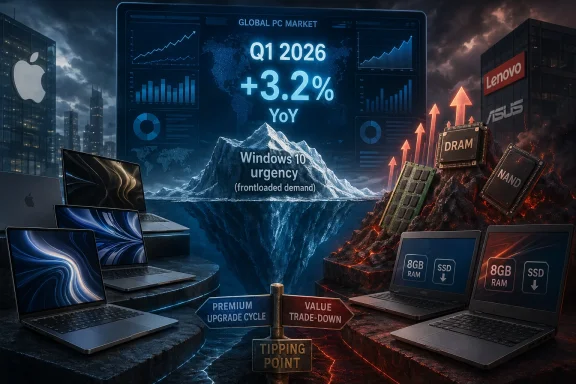
The PC industry has spent much of 2025 and early 2026 living with a strange combination of demand pull and cost shock. On one side, Microsoft’s Windows 10 end-of-support timeline has pushed a wave of upgrades, with many buyers and businesses rushing to replace older systems before they fall off the security cliff. On the other side, the AI build-out has soaked up memory capacity, driving up DRAM and NAND costs and forcing OEMs to rethink the economics of budget laptops and mainstream desktops. Those two trends are not separate stories; together they explain why shipment growth can coexist with a market that feels increasingly fragile.
Counterpoint’s Q1 2026 readout captures that tension neatly. Lenovo remains the largest PC maker by a wide margin, ASUS posted the sharpest year-over-year growth among the top vendors, and Apple continued to gain ground with double-digit growth of its own. Yet the broader “other” category — the long tail of smaller brands — declined sharply, which suggests the market is concentrating around the companies best able to absorb higher component costs, negotiate supply, and sustain premium pricing. In other words, the pie is not necessarily getting healthier just because it is still being eaten.
That matters because the PC market has historically depended on a large and lively mid-market. The sub-$1,000 Windows laptop segment is where most consumers live, and it is also where margin pressure is most brutal. When DRAM prices rise, OEMs can respond in only a few ways: raise the sticker price, reduce the memory and storage included in the box, or simply ship fewer low-end models. None of those choices are good news for buyers who were already waiting for value to improve.
There is also an important historical backdrop. Windows 10’s retirement has created a one-time replacement wave, but one-time waves are not the same as sustained demand. Once the most urgent upgraders have bought, the market is left with the slower, harder part of the cycle: convincing ordinary users to replace hardware earlier than they want to, and persuading businesses to refresh fleets in a pricing environment that keeps moving against them. That is why analysts are careful not to confuse a strong quarter with a durable trend.
The most interesting part of the current cycle is that it does not reward every vendor equally. Brands with stronger supply chains, stronger balance sheets, and stronger premium portfolios can survive longer, and may even gain share if weaker rivals stumble. Smaller brands, by contrast, are being forced toward the hardest kind of competition: lower volume, thinner margins, and much less room for error. That is the real story hiding behind the “PC shipments are up” headline.
What the Q1 2026 Numbers Actually Show
Counterpoint’s headline number — 3.2% year-over-year growth — sounds encouraging until you unpack the mechanism behind it. A gain of roughly 63.3 million shipped units versus 61.4 million a year earlier is not a sign that the market has solved its problems. It is a sign that the market is still being pulled forward by a very specific set of forces, including Windows 10 replacement demand and inventory behavior shaped by the memory-price shock.
The vendor ranking tells a second story. Lenovo stayed in first place with 16.5 million units shipped and about 26% share, showing that scale still matters in a market where procurement leverage is becoming a weapon. ASUS jumped 20%, which is especially notable because it suggests that brands with better product momentum and cleaner positioning can still expand even under pressure. HP slipped 5%, Dell rose 8%, and Apple climbed 11%, indicating that the market is not moving in lockstep. It is sorting vendors by execution as much as by volume.
The top-tier vendors are not winning for the same reasons
Lenovo’s continued dominance is not just about being large. It reflects a distribution and channel machine that can ride out turbulence better than smaller competitors, particularly when pricing gets messy and the OEM has to decide which models deserve scarce memory allocations. ASUS, meanwhile, appears to be benefiting from stronger consumer perception and a sharper premium story, which helps when buyers are being asked to accept higher prices.
Apple’s growth also deserves attention because it complicates the Windows OEM narrative. If Windows machines get more expensive, buyers start comparing them not only with each other, but with Macs that increasingly look stable on battery life, performance, and pricing logic. That does not mean Apple is about to take over the PC market, but it does mean the value conversation is no longer exclusively a Windows-to-Windows fight.
- Lenovo’s scale gives it room to absorb shocks.
- ASUS is turning premium credibility into share gains.
- HP is feeling the squeeze of a more price-sensitive market.
- Dell is holding position, but not by much.
- Apple’s growth increases pressure on Windows value perception.
The sharpest warning sign may be the decline in the smaller-brand bucket. Counterpoint says that category fell 7% year-over-year, which is brutal in a market that already rewards large players. When the long tail contracts, it often means the system is moving toward consolidation, not just cyclical weakness.
Why This Is Not a Healthy Rebound
The most important phrase in Counterpoint’s explanation is essentially the idea of frontloaded demand. In plain English, that means consumers and businesses bought sooner than they otherwise would have, because they feared missing the Windows 10 transition window or getting trapped in a more expensive market later. That can produce a strong quarter while setting up a weaker one later, because it steals demand from the future rather than creating new demand.
That is why analysts are not celebrating. The Q1 uptick is not a sign that the PC market solved its pricing problem. It is a sign that the market is still digesting an unusual overlap of end-of-support urgency, AI-driven component inflation, and the reality that many buyers would rather wait than pay more for less. If demand is being pulled forward, the industry gets a temporary bump, but not a durable expansion.
Memory inflation changes the math
Memory shortages are the deepest force behind this cycle. AI training and inference workloads consume enormous amounts of memory, and that demand shifts production priorities away from mainstream consumer parts. When DRAM and NAND become more expensive, the first place the pain shows up is often the mainstream Windows notebook, where margins are thin and bill-of-materials flexibility is limited.
OEMs have a familiar response when the parts bill rises: they trim specifications to keep the retail price looking stable. That means a laptop that used to ship with 16GB of RAM may now arrive with 8GB, or with slower storage, or with a display panel that looks a bit less ambitious than last year’s model. The machine still exists, but the value proposition is weaker, and the buyer often does not notice until after the purchase.
- Demand can be pulled forward without being sustained.
- Memory costs are the key pressure point.
- Lower-end systems are the first to lose features.
- Higher prices can coexist with lower perceived value.
- Waiting does not necessarily restore affordability.
The industry has seen similar cycles before, but the current one is more stubborn because the cost shock is structural. As long as AI-related memory demand remains elevated, consumer PC supply is competing for capacity with much larger and more lucrative infrastructure buyers. That means the “normal” pricing baseline may reset upward even if conditions later improve.
The Growing Divide Between Premium and Value PCs
The most visible market consequence of all this pressure is a widening divide between premium systems and value systems. Premium notebooks can survive higher memory costs because the buyer is already paying for design, battery life, materials, and brand trust. Entry-level systems, by contrast, live on very thin margins, which means every component increase has to be absorbed somewhere — in the bill, in the spec sheet, or in the product strategy itself.
This is why brands are leaning harder into AI PC messaging, battery life, and premium positioning. Those ideas are not just marketing fluff; they are the narrative tools vendors use to justify higher price tags. The risk is that when the hardware underneath the story is still modest, the pitch sounds more like rationalization than innovation. That disconnect can be corrosive if buyers begin to feel they are paying more for the same basic experience.
Premium systems can hide the pain longer
A premium Windows laptop can often absorb cost increases through a mix of better margins, higher consumer tolerance, and more flexible configurations. That is why the high-end end of the market is likely to remain comparatively stable, even as the mainstream grows more uncomfortable. Buyers in that bracket are more likely to value industrial design, OLED panels, longer battery life, and AI features enough to swallow a higher bill.
The issue is that the entire market cannot live at the top. If the entry tier becomes too expensive, the ecosystem loses the volume base that keeps Windows ubiquitous across schools, homes, and small businesses. That is where the market becomes strategically dangerous, because it stops being a pricing problem and becomes a platform-health problem.
- Premium buyers can tolerate more price inflation.
- Value buyers are far more sensitive to spec cuts.
- AI branding helps justify higher-end SKUs.
- The low end is where ecosystem volume lives.
- The market becomes more fragile when the middle collapses.
It is also worth noting that “premiumization” can be a trap. If vendors move too aggressively upmarket, they may improve margins but lose the customers who keep the ecosystem broad. The result is a healthier-looking balance sheet for OEMs and a less accessible PC market for everyone else. That is a trade-off many executives will accept, but consumers will not.
Why Smaller Brands Are in the Danger Zone
The smaller-brand category is where this story becomes especially severe. Counterpoint’s data showing a 7% decline in that segment is a loud signal that the market is punishing companies without scale, without deep channel relationships, and without the financial flexibility to absorb inventory volatility. In a normal year, smaller players can survive by undercutting the big brands. In a memory shortage, that advantage gets harder to sustain.
Smaller PC vendors also tend to depend more heavily on commodity parts and aggressive pricing. That becomes risky when memory and SSD prices are both unstable. Even if these companies can still source product, they may not be able to offer the clean, attractive configurations that once separated them from the giants. That is a brutal position to be in, because the consumer sees the same box on the shelf, but with less value inside it.
Consolidation becomes more likely
When a market starts favoring scale, consolidation tends to follow. The largest vendors can buy better, negotiate better, and ship more predictably, which means they are better positioned to preserve shelf presence while others fall behind. That does not always produce a monopoly-like outcome, but it does tend to compress the field.
The long tail also suffers because it is usually the most exposed to discounting. If promotions become less effective due to rising costs, smaller brands lose one of their core weapons. A niche hardware maker can still stand out through design or specialization, but the days of winning simply by being cheap get a lot harder in an inflationary component cycle.
- Smaller brands rely more heavily on low-cost configurations.
- Discount-driven competition weakens when component costs rise.
- Scale buyers get stronger leverage over suppliers.
- Consolidation becomes more attractive to investors and distributors.
- Niche differentiation matters more than ever.
This is also where the risk of market fatigue shows up. If smaller brands disappear or retreat, the PC market becomes less diverse, less experimental, and less forgiving for buyers who want unusual form factors or ultra-low-cost options. That may not bother enterprise procurement teams, but it matters a great deal to enthusiasts, students, and budget-conscious households.
The Windows 10 Factor Is Still Distorting Demand
The Windows 10 retirement remains one of the biggest hidden drivers of current shipments. The deadline has created a hard sense of urgency that pushes consumers and businesses into purchase decisions they might otherwise postpone. It also explains why some of the current volume is likely to be temporary rather than structural: once the migration pressure eases, the market loses a major source of urgency.
That is particularly important for the enterprise side of the market. Businesses do not just buy hardware; they buy managed refresh cycles, supportability, and predictability. If the next wave of Windows 11-ready PCs costs more than planned, IT departments may stretch replacement cycles longer, even if they know the old machines are less ideal. In many companies, budget discipline beats technical enthusiasm.
The migration wave is real, but finite
Dell’s earlier commentary on the enormous installed base of Windows PCs underscores why this migration is such a big deal. A large population of machines is either unable or unwilling to move quickly, which means there is a temporary demand pool that vendors can harvest. But after that pool is tapped, the industry has to stand on its own underlying appeal again.
That is the key distinction between a policy-driven upgrade cycle and a healthy consumer market. A healthy market grows because people want the product. A policy-driven market grows because they feel they have to buy the product. Those are not the same thing, and investors should be careful not to confuse them.
- Windows 10 urgency is pulling purchases forward.
- Enterprise refreshes may still slow if budgets tighten.
- The migration wave is large, but temporary.
- Demand can fall back once the deadline effect fades.
- Vendor forecasts should not assume the bump lasts.
This creates a timing problem for OEMs. If they load too much production into the migration window, they risk a weaker second half. If they underproduce, they leave money on the table in the one quarter where demand is still relatively healthy. That balancing act is exactly what makes the current period so hard to read.
How Apple, Qualcomm, AMD, and Intel Change the Story
The competitive landscape is also in flux, which makes the next phase of the PC market more interesting than a simple supply story. Intel still dominates the Windows ecosystem, but it no longer operates in a comfortable pricing environment. Qualcomm has become a credible force in ARM-based Windows laptops, AMD continues to pressure Intel on performance and efficiency, and Apple remains the most important benchmark for users comparing premium notebooks.
That matters because when component prices rise, platform costs matter more. If Intel systems get more expensive, OEMs can look at alternatives more seriously. If Qualcomm’s battery-first Windows designs keep improving, they become more attractive in ultrathin categories. If AMD can keep building value and performance-per-watt momentum, it gets stronger in both mainstream and gaming segments. The cost shock does not affect all chips equally, but it does force every vendor into a more competitive posture.
Pricing power is becoming a strategic weapon
Intel’s position is especially delicate because a CPU price move can alter the economics of an entire laptop design. In a market already dealing with memory inflation, any added platform cost can push OEMs toward lower-spec systems, higher price bands, or rival silicon. That is why chip pricing is no longer just a margin story; it is a market-structure story.
Apple’s role is subtler but powerful. By offering a polished Mac experience with tightly controlled hardware and pricing discipline, Apple gives buyers a reference point for what premium value can look like. When Windows machines become pricier without a corresponding leap in obvious benefit, Apple’s products start to look more rational to a broader slice of shoppers.
- Intel is balancing margin protection against market share risk.
- Qualcomm benefits when battery life and efficiency matter most.
- AMD gains when buyers seek value without giving up performance.
- Apple raises the standard for premium laptop pricing.
- OEMs can use rival platforms as leverage in negotiations.
The larger implication is that platform diversity may increase, but only because pressure is forcing it. That is not always bad for innovation. However, it can also lead to more fragmented SKUs, more confusing product stacks, and more inconsistent buyer experiences across the Windows market.
What Enterprise Buyers Need to Understand
For consumers, rising PC prices are annoying. For enterprises, they are budget events with operational consequences. Fleet refreshes become harder to justify when every system costs more and every configuration decision is more sensitive to memory pricing. That means procurement teams may delay refreshes, standardize more aggressively, or accept weaker baseline specs than they would prefer.
That is not just a financial issue. Older hardware is often harder to support, less secure, and less efficient. If businesses extend replacement cycles too far, they may save money in the short term but pay it back through support overhead, reduced performance, or more frequent compatibility issues. The very thing that looks prudent on a spreadsheet can become expensive in day-to-day IT management.
Procurement strategies are likely to change
The easiest response for enterprises is to become more conservative about configuration choices. More buyers will insist on locking in memory and storage early, even if it raises the quote, because post-purchase upgrades are less attractive when component pricing is volatile. Leasing and managed-device programs may also become more appealing, since they spread the pain over time and reduce the risk of buying at the wrong point in the cycle.
Enterprises may also split their fleets more aggressively. Knowledge workers who need better memory and battery life will get premium machines, while lower-demand users may receive the cheapest acceptable Windows PC. That is a rational response to inflation, but it also creates a more stratified workplace computing experience.
- Refresh timing is becoming harder to manage.
- Baseline specs may no longer be enough for future workloads.
- Leasing may look better than outright purchase.
- Mixed fleet strategies will become more common.
- Older PCs may stay in service longer than planned.
The challenge for IT leaders is that this is not a normal procurement cycle. The combination of Windows 10 migration pressure and memory inflation means there are very few genuinely cheap decisions left. Buying too early can mean overpaying; buying too late can mean missing the migration window or inheriting more risk.
Strengths and Opportunities
The upside of a painful cycle is that it can force the industry to become more disciplined. Vendors with strong execution may come out stronger, and buyers may eventually get better-defined product tiers rather than the old race-to-the-bottom chaos. That will not make the market cheaper, but it could make it clearer.
- Stronger supply-chain discipline among top vendors.
- More meaningful differentiation between entry, mid-tier, and premium systems.
- Better incentive to build laptops that actually improve battery life and efficiency.
- Greater adoption of managed-device and leasing models for enterprises.
- More pressure on OEMs to reduce waste in SKU planning.
- Incentives to build machines with real AI utility rather than decorative branding.
- A possible long-term shift away from unsustainable bargain-bin hardware.
The premium end of the market may also become healthier in a product sense. When vendors can no longer hide bad hardware behind aggressive discounting, they have to justify their prices with better design, better thermals, and better user experience. That is a good outcome for buyers who can afford it, even if it is a poor outcome for the budget segment.
Risks and Concerns
The biggest risk is that the market normalizes “more expensive, less capable” machines. If buyers start associating Windows PCs with higher prices and reduced specs, the long-term damage could be larger than any one quarter’s shipment growth suggests. That would be especially harmful to the ecosystem’s entry tier, where first-time buyers and price-sensitive households live.
There is also a real danger that the current bump masks structural weakness. A strong Q1 created by migration urgency and panic buying can lull vendors into overconfidence, even if the rest of the year softens. If the industry misreads the signal, it may overbuild inventory, misallocate channel support, or make pricing assumptions that do not hold.
- Consumers may delay upgrades if the value story worsens.
- OEMs may quietly reduce RAM and storage to hold prices.
- Smaller brands may face margin collapse or exit pressure.
- Enterprise refresh cycles may stretch beyond ideal timelines.
- Windows platform loyalty may weaken if alternatives look better.
- AI branding may lose credibility if it becomes a pricing excuse.
- The market could become more concentrated and less competitive.
The final concern is ecosystem trust. If users repeatedly encounter laptops that cost more but feel less generous in the box, they stop believing in the upgrade cycle. Once that happens, rebuilding demand becomes much harder than preserving it in the first place.
Looking Ahead
The next few quarters will reveal whether Q1 2026 was a temporary distortion or the beginning of a more durable reshaping of the PC market. The safest interpretation right now is that the market is still being driven by urgency, not confidence. Until memory prices settle and the Windows 10 migration rush passes through the system, it is hard to call this anything other than a market under strain.
What happens next will depend less on one report and more on a series of interconnected moves: memory supply, OEM pricing discipline, Windows 11 adoption, and the continuing evolution of AI PC positioning. If those forces keep pulling in the wrong direction, then the second half of 2026 could look much softer than the first. If they stabilize, the market may avoid a deeper contraction — but it still may not return to the easy value era buyers remember.
- Watch whether Q2 and Q3 2026 shipments hold up after the migration wave.
- Track DRAM and SSD pricing through the summer.
- Monitor whether baseline memory in mainstream Windows laptops falls back to 8GB more often.
- Look for more aggressive moves into premium and AI PC tiers.
- Pay attention to whether smaller brands keep losing ground.
- Watch enterprise procurement behavior as budgets reset.
The larger conclusion is simple: shipment growth alone is not victory. A market can ship more PCs and still become less welcoming, less affordable, and more concentrated. That is the paradox of 2026 — the industry is moving more units, but it is doing so in a way that may leave consumers with fewer good choices and smaller vendors with even less room to breathe.
References
- windowscentral.com windowscentral.com