

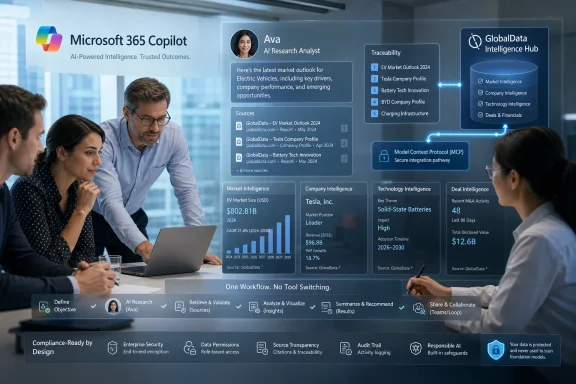
GlobalData Plc announced on 8 July 2026 that its AI research analyst Ava is being integrated into Microsoft 365 Copilot. The integration involves GlobalData, Ava, Microsoft 365 Copilot, and the Model Context Protocol, and is intended to let enterprise users access GlobalData’s market and company intelligence from within Copilot rather than switching to a separate research environment. For strategy, finance, and procurement teams, the practical promise is straightforward: faster access to source-backed business intelligence at the point where decisions, documents, and analyses are already being prepared.
The announcement, reported by Travel Daily Media from original press material, says Ava will be embedded into Microsoft 365 Copilot using MCP so Copilot can request and deliver insights from GlobalData’s proprietary data. That is the verified news. The significance is not that Copilot gains another generic chatbot-style feature, but that a specialist market-intelligence provider is making its research accessible inside a mainstream enterprise AI workspace.
The stated benefit is efficiency: users can ask business questions in the flow of work and receive GlobalData-backed insight without leaving Microsoft 365 Copilot. The stated audience is also clear: strategy, finance, and procurement teams that need market, company, sector, competitor, or supplier intelligence to support business decisions. The open enterprise question is how organizations should govern the use of embedded external intelligence in decision documents, forecasts, sourcing recommendations, and executive materials.
Market intelligence has traditionally lived in specialist platforms. Those platforms can be valuable, but they often depend on users knowing where to look, how to search, and when to bring external research into a business process. GlobalData’s Ava is being positioned differently: as an AI research analyst that can support enterprise users when they ask questions about markets, companies, sectors, or competitors.
The Copilot integration extends that positioning. Instead of requiring users to leave their work environment and open a separate research portal, GlobalData is placing Ava inside Microsoft 365 Copilot, where many enterprise users already draft documents, analyze information, prepare presentations, and collaborate. In practical terms, the integration is about reducing friction between the business question and the research needed to answer it.
Jonathan Hardinges, Chief Strategy Officer at GlobalData, framed the move this way: “By embedding Ava into Copilot, we are making GlobalData’s trusted, source-backed intelligence available at the point of need, so teams can move faster from question to evidence-based insight, with confidence and traceability.”
That quote captures the most important part of the announcement: GlobalData is emphasizing source-backed intelligence, evidence-based insight, confidence, and traceability. Those are not minor details. They are central to whether AI-assisted research can be used responsibly in business settings where a polished answer is not enough.
For a strategy team, the value is not simply getting a quick paragraph about a market. It is getting a response that can help support a market-entry discussion, competitor review, investment case, or executive briefing. For a finance team, the value is not merely summarizing a sector. It is having research that can inform assumptions, forecasts, risk assessments, or capital-allocation discussions. For procurement, the value is not just supplier background information. It is being able to bring relevant company or market context into sourcing and vendor-evaluation workflows.
The announcement does not prove that every one of those outcomes will be achieved automatically. It does, however, show where GlobalData wants Ava to sit: not as a separate destination consulted after the fact, but as a research resource available inside the environment where business work is already happening.
That is enough to understand the basic product story, but it is not enough to infer undocumented implementation details. The announcement should not be read as confirmation of any particular Microsoft 365 Copilot connector architecture, indexing behavior, tenant-level data handling, entitlement model, logging design, retention policy, or administrative control. Those details may matter greatly to customers, but they are not established by the provided facts.
What can be said safely is this: GlobalData is presenting MCP as the integration layer that allows Ava’s intelligence to be reached from Copilot. The business result described in the announcement is that users can access GlobalData intelligence inside the Microsoft 365 Copilot experience. The announcement’s emphasis is on convenience, speed, evidence-based insight, and collaboration, not on a detailed technical governance model.
That distinction matters for enterprise readers. It is reasonable for business leaders to see the integration as a way to reduce tool-switching and speed research-backed decision-making. It is also reasonable for IT, legal, procurement, and compliance teams to ask for implementation details before approving broad use. Those questions should be answered through customer documentation, contractual terms, tenant configuration guidance, and internal rollout planning rather than inferred from a launch announcement.
The phrase “without switching tools” is important because it describes the workplace problem the integration is trying to solve. Enterprise knowledge work is often fragmented. A team may draft a recommendation in one place, discuss it in another, pull evidence from a separate research platform, build numbers in a spreadsheet, and turn the result into a presentation. Each handoff creates friction. Each tool switch increases the chance that useful evidence is left out, poorly summarized, or added too late.
The Ava integration is meant to reduce that distance. A procurement team evaluating supplier options could benefit from company and market context while working on a sourcing decision. A finance team building assumptions could benefit from external sector intelligence while preparing planning materials. A strategy team drafting a market view could benefit from research without interrupting the workflow to search a separate platform.
That is the practical enterprise value: Copilot becomes more useful when it can act as an access point for specialist data and analysis, not just as a drafting or summarization assistant. In this case, the specialist source is GlobalData, and the AI research analyst is Ava.
At the same time, users should not treat “inside Copilot” as a synonym for “automatically final,” “automatically approved,” or “automatically suitable for every business use.” The announcement highlights source-backed intelligence and traceability, but any enterprise still needs internal rules for how AI-assisted research is reviewed before it appears in formal documents or decisions.
The best reading of the announcement is therefore balanced. It is a meaningful workflow integration for organizations that already rely on Microsoft 365 Copilot and need GlobalData intelligence closer to daily work. It is not a substitute for enterprise governance, source review, commercial entitlement checks, or professional judgment.
Strategy teams need external evidence to test assumptions about markets, competitors, sector trends, growth opportunities, and threats. Their work often ends up in executive decks, planning documents, market-entry recommendations, and business-case materials. Having source-backed intelligence available through Copilot could help them move more quickly from a question to a first structured answer.
Finance teams need market and company context when preparing forecasts, reviewing assumptions, assessing risk, or supporting investment decisions. They may not need a separate research journey for every question, but they do need credible inputs when external conditions affect planning. If Ava can provide relevant GlobalData intelligence from within Copilot, finance users may be able to incorporate research earlier in the planning cycle.
Procurement teams need supplier, company, and market intelligence to support sourcing decisions. They may need to understand vendor strength, market dynamics, sector risks, or competitive alternatives. For procurement users, the value of the integration is not just speed. It is the ability to connect external intelligence to the decision process while a sourcing recommendation or supplier review is still being shaped.
Caroline Vojdani, Global Head of Customer Success at GlobalData, described the Microsoft partnership this way: “With Microsoft, we are unlocking a massive opportunity for our enterprise clients to drive efficiency, foster collaboration, and achieve significant advancements in their digital transformation journey.”
That quote is broad, but it fits the announced use cases. The collaboration angle matters because strategy, finance, and procurement work is rarely individual work. These teams create shared artifacts, review evidence together, and make recommendations that other stakeholders must trust. If Ava’s GlobalData-backed insight becomes easier to access inside Copilot, the potential benefit is not only faster individual research, but a more consistent way for teams to bring external intelligence into shared work.
Still, the integration should be treated as an aid to analysis, not the end of analysis. A source-backed answer can accelerate a team’s first pass. It can also help identify areas that need deeper review. But major decisions still require human judgment, context, and accountability.
A business user does not only need a fluent response. They need to know whether the response is grounded in credible information. They need to know whether it is suitable for the decision at hand. They need to know when an answer is a useful starting point and when it needs review by an analyst, lawyer, finance leader, procurement specialist, or executive sponsor.
GlobalData’s announcement places Ava on the research side of that equation. Ava is not being described merely as a writing assistant. It is being presented as an AI research analyst connected to GlobalData’s proprietary intelligence. That positioning is important because it differentiates the integration from generic AI assistance. The selling point is not just that Copilot can generate text. It is that Copilot can request and deliver GlobalData-backed insight through the Ava integration.
The phrase “traceability” in Hardinges’ quote is also important. In business use, traceability is what helps teams move from an AI-generated answer to a defensible conclusion. A procurement committee, finance leadership group, or strategy team may accept AI assistance in drafting or summarizing, but they still need to understand the evidence behind claims that appear in formal recommendations.
The announcement does not specify the exact user experience for reviewing sources or tracing answers. It does, however, make clear that confidence and traceability are part of GlobalData’s stated value proposition. Enterprises evaluating the integration should therefore make traceability a practical test during rollout: can users understand where a conclusion came from, how to review it, and when to escalate it?
That is the difference between AI as a convenience layer and AI as a trustworthy decision-support tool.
Enterprises should treat the integration as more than a feature toggle. It introduces external research intelligence into workflows where employees may draft recommendations, support forecasts, evaluate suppliers, or prepare executive materials. That makes rollout planning important even if the user experience is simple.
The key governance question is not whether employees can ask Ava useful questions through Copilot. The key question is how the organization wants employees to use Ava-assisted answers in real work products. A quick answer may be appropriate for early research. A board-facing slide, supplier recommendation, or investment case may require source review, analyst validation, or approval from a responsible business owner.
This does not require organizations to slow the integration to a halt. It does require clear expectations. Users should know when an Ava-assisted response is a starting point, when it can be cited in internal work, and when it needs deeper review. Managers should know whether a decision document relied on external intelligence retrieved through Copilot. Procurement, finance, and strategy leaders should decide which workflows are suitable pilots.
A research platform can be high quality and still underused if employees do not open it at the right moment. A market dataset can be valuable and still miss the decision window if it is consulted only after a recommendation is mostly written. By integrating Ava with Microsoft 365 Copilot, GlobalData is trying to make its intelligence available earlier in the workflow.
That has clear advantages for enterprise users. If a business question arises while a team is drafting a memo, preparing a presentation, reviewing a supplier, or building a planning document, the ability to ask for GlobalData-backed insight from within Copilot could reduce delay. It could also make it more likely that external research appears in ordinary business work rather than remaining confined to specialist teams.
There is also a trade-off. When specialist intelligence is surfaced through a general AI workspace, the user experience may become more convenient, but the organization must remain careful about provenance. Users need to know that the source of an insight matters. They need to understand whether a statement comes from GlobalData intelligence, internal company material, Copilot synthesis, or a combination of inputs. The announcement’s emphasis on source-backed intelligence and traceability speaks directly to that need, but the practical test will be how clearly users experience those distinctions during real work.
For GlobalData, the integration increases the chance that its intelligence becomes part of day-to-day enterprise decision-making. For Microsoft, it gives Copilot a more concrete business use case: not just helping users write, but helping them bring specialist market and company intelligence into the flow of work. For customers, the value will depend on whether the integration saves time while preserving the evidence discipline required for serious decisions.
The announcement gives Copilot a clearer role in decision support. A user can work inside Copilot and request market or company insight backed by GlobalData. That can help teams move from question to evidence more quickly, especially when they are working under deadlines or across functions.
The integration is also a reminder that enterprise AI value is not only about the model. It is about the information the model can reach, the workflow where the answer appears, and the trust users can place in the result. A general assistant becomes more useful when it can draw on specialist sources. A specialist source becomes more useful when it appears inside common work tools. The GlobalData-Ava and Microsoft 365 Copilot announcement sits exactly at that intersection.
That does not mean organizations should treat the integration as self-governing. The announcement does not provide enough detail to support claims about specific administrative controls, logging, permissions, retention, indexing, or entitlement behavior. Those questions remain important, but they should be answered with official product documentation, customer agreements, and tenant-specific rollout planning.
What the announcement does establish is narrower and still meaningful: GlobalData is integrating Ava into Microsoft 365 Copilot using MCP; Ava will provide access to GlobalData’s proprietary market and company intelligence; and the stated goal is to help enterprise users, particularly in strategy, finance, and procurement, move faster from business questions to evidence-based insight.
The strongest promise is reduced friction: fewer tool switches, faster research access, and more opportunity to bring external intelligence into the documents and decisions where it matters. The strongest caution is equally simple: enterprises should not assume governance details that the announcement does not state. Before broad rollout, organizations should confirm user eligibility, define review expectations, and make sure employees understand how to use Ava-assisted insight responsibly.
If GlobalData and Microsoft execute well, Ava inside Copilot could make specialist intelligence more visible and useful in everyday business workflows. If customers roll it out without clear expectations, the same convenience could blur the line between research, synthesis, and decision approval. The opportunity is real, but the value will come from combining speed with evidence, traceability, and disciplined use.
The announcement, reported by Travel Daily Media from original press material, says Ava will be embedded into Microsoft 365 Copilot using MCP so Copilot can request and deliver insights from GlobalData’s proprietary data. That is the verified news. The significance is not that Copilot gains another generic chatbot-style feature, but that a specialist market-intelligence provider is making its research accessible inside a mainstream enterprise AI workspace.
The stated benefit is efficiency: users can ask business questions in the flow of work and receive GlobalData-backed insight without leaving Microsoft 365 Copilot. The stated audience is also clear: strategy, finance, and procurement teams that need market, company, sector, competitor, or supplier intelligence to support business decisions. The open enterprise question is how organizations should govern the use of embedded external intelligence in decision documents, forecasts, sourcing recommendations, and executive materials.
 GlobalData Is Moving Ava Closer to the Point of Work
Market intelligence has traditionally lived in specialist platforms. Those platforms can be valuable, but they often depend on users knowing where to look, how to search, and when to bring external research into a business process. GlobalData’s Ava is being positioned differently: as an AI research analyst that can support enterprise users when they ask questions about markets, companies, sectors, or competitors.The Copilot integration extends that positioning. Instead of requiring users to leave their work environment and open a separate research portal, GlobalData is placing Ava inside Microsoft 365 Copilot, where many enterprise users already draft documents, analyze information, prepare presentations, and collaborate. In practical terms, the integration is about reducing friction between the business question and the research needed to answer it.
Jonathan Hardinges, Chief Strategy Officer at GlobalData, framed the move this way: “By embedding Ava into Copilot, we are making GlobalData’s trusted, source-backed intelligence available at the point of need, so teams can move faster from question to evidence-based insight, with confidence and traceability.”
That quote captures the most important part of the announcement: GlobalData is emphasizing source-backed intelligence, evidence-based insight, confidence, and traceability. Those are not minor details. They are central to whether AI-assisted research can be used responsibly in business settings where a polished answer is not enough.
For a strategy team, the value is not simply getting a quick paragraph about a market. It is getting a response that can help support a market-entry discussion, competitor review, investment case, or executive briefing. For a finance team, the value is not merely summarizing a sector. It is having research that can inform assumptions, forecasts, risk assessments, or capital-allocation discussions. For procurement, the value is not just supplier background information. It is being able to bring relevant company or market context into sourcing and vendor-evaluation workflows.
The announcement does not prove that every one of those outcomes will be achieved automatically. It does, however, show where GlobalData wants Ava to sit: not as a separate destination consulted after the fact, but as a research resource available inside the environment where business work is already happening.
What MCP Means Here — and What the Announcement Does Not Say
The announcement says the integration uses the Model Context Protocol. In this specific context, the supported claim is limited: MCP is the mechanism named in the announcement for connecting Ava with Microsoft 365 Copilot so Copilot can request and deliver insights from GlobalData’s proprietary data.That is enough to understand the basic product story, but it is not enough to infer undocumented implementation details. The announcement should not be read as confirmation of any particular Microsoft 365 Copilot connector architecture, indexing behavior, tenant-level data handling, entitlement model, logging design, retention policy, or administrative control. Those details may matter greatly to customers, but they are not established by the provided facts.
What can be said safely is this: GlobalData is presenting MCP as the integration layer that allows Ava’s intelligence to be reached from Copilot. The business result described in the announcement is that users can access GlobalData intelligence inside the Microsoft 365 Copilot experience. The announcement’s emphasis is on convenience, speed, evidence-based insight, and collaboration, not on a detailed technical governance model.
| Verified point from the announcement | Practical meaning for readers | What should not be assumed |
|---|---|---|
| GlobalData announced the integration on 8 July 2026 | This is a new GlobalData-Ava and Microsoft 365 Copilot development | Do not assume broad availability terms beyond the announcement |
| Ava is being integrated into Microsoft 365 Copilot | Users are intended to access Ava-backed intelligence from within Copilot | Do not assume how every Microsoft 365 app or workflow will expose it |
| The integration uses MCP | MCP is the named protocol in the announcement | Do not infer specific indexing, retention, logging, or access-control behavior |
| Copilot can request and deliver insights from GlobalData’s proprietary data | GlobalData intelligence is intended to be reachable through Copilot prompts or workflows | Do not assume all GlobalData content is available to all users |
| The stated beneficiaries include strategy, finance, and procurement teams | The use cases are business decision support, planning, analysis, and sourcing-related work | Do not assume the integration replaces human review or specialist analysis |
Microsoft 365 Copilot Becomes More Useful When It Can Reach Specialist Intelligence
Rob Howard, Corporate Vice President at Microsoft, said the integration allows organisations to make informed decisions without switching tools. That is the clearest Microsoft-side value proposition in the announcement.The phrase “without switching tools” is important because it describes the workplace problem the integration is trying to solve. Enterprise knowledge work is often fragmented. A team may draft a recommendation in one place, discuss it in another, pull evidence from a separate research platform, build numbers in a spreadsheet, and turn the result into a presentation. Each handoff creates friction. Each tool switch increases the chance that useful evidence is left out, poorly summarized, or added too late.
The Ava integration is meant to reduce that distance. A procurement team evaluating supplier options could benefit from company and market context while working on a sourcing decision. A finance team building assumptions could benefit from external sector intelligence while preparing planning materials. A strategy team drafting a market view could benefit from research without interrupting the workflow to search a separate platform.
That is the practical enterprise value: Copilot becomes more useful when it can act as an access point for specialist data and analysis, not just as a drafting or summarization assistant. In this case, the specialist source is GlobalData, and the AI research analyst is Ava.
At the same time, users should not treat “inside Copilot” as a synonym for “automatically final,” “automatically approved,” or “automatically suitable for every business use.” The announcement highlights source-backed intelligence and traceability, but any enterprise still needs internal rules for how AI-assisted research is reviewed before it appears in formal documents or decisions.
The best reading of the announcement is therefore balanced. It is a meaningful workflow integration for organizations that already rely on Microsoft 365 Copilot and need GlobalData intelligence closer to daily work. It is not a substitute for enterprise governance, source review, commercial entitlement checks, or professional judgment.
The Immediate Audience: Strategy, Finance, and Procurement
The announcement specifically points to strategy, finance, and procurement teams. That list is useful because it keeps the integration grounded in practical business problems rather than broad AI rhetoric.Strategy teams need external evidence to test assumptions about markets, competitors, sector trends, growth opportunities, and threats. Their work often ends up in executive decks, planning documents, market-entry recommendations, and business-case materials. Having source-backed intelligence available through Copilot could help them move more quickly from a question to a first structured answer.
Finance teams need market and company context when preparing forecasts, reviewing assumptions, assessing risk, or supporting investment decisions. They may not need a separate research journey for every question, but they do need credible inputs when external conditions affect planning. If Ava can provide relevant GlobalData intelligence from within Copilot, finance users may be able to incorporate research earlier in the planning cycle.
Procurement teams need supplier, company, and market intelligence to support sourcing decisions. They may need to understand vendor strength, market dynamics, sector risks, or competitive alternatives. For procurement users, the value of the integration is not just speed. It is the ability to connect external intelligence to the decision process while a sourcing recommendation or supplier review is still being shaped.
Caroline Vojdani, Global Head of Customer Success at GlobalData, described the Microsoft partnership this way: “With Microsoft, we are unlocking a massive opportunity for our enterprise clients to drive efficiency, foster collaboration, and achieve significant advancements in their digital transformation journey.”
That quote is broad, but it fits the announced use cases. The collaboration angle matters because strategy, finance, and procurement work is rarely individual work. These teams create shared artifacts, review evidence together, and make recommendations that other stakeholders must trust. If Ava’s GlobalData-backed insight becomes easier to access inside Copilot, the potential benefit is not only faster individual research, but a more consistent way for teams to bring external intelligence into shared work.
Still, the integration should be treated as an aid to analysis, not the end of analysis. A source-backed answer can accelerate a team’s first pass. It can also help identify areas that need deeper review. But major decisions still require human judgment, context, and accountability.
Source-Backed Intelligence Is the Core Claim
The strongest part of the announcement is GlobalData’s emphasis on trusted, source-backed intelligence. That matters because enterprise AI tools are most valuable when users can understand the basis for an answer.A business user does not only need a fluent response. They need to know whether the response is grounded in credible information. They need to know whether it is suitable for the decision at hand. They need to know when an answer is a useful starting point and when it needs review by an analyst, lawyer, finance leader, procurement specialist, or executive sponsor.
GlobalData’s announcement places Ava on the research side of that equation. Ava is not being described merely as a writing assistant. It is being presented as an AI research analyst connected to GlobalData’s proprietary intelligence. That positioning is important because it differentiates the integration from generic AI assistance. The selling point is not just that Copilot can generate text. It is that Copilot can request and deliver GlobalData-backed insight through the Ava integration.
The phrase “traceability” in Hardinges’ quote is also important. In business use, traceability is what helps teams move from an AI-generated answer to a defensible conclusion. A procurement committee, finance leadership group, or strategy team may accept AI assistance in drafting or summarizing, but they still need to understand the evidence behind claims that appear in formal recommendations.
The announcement does not specify the exact user experience for reviewing sources or tracing answers. It does, however, make clear that confidence and traceability are part of GlobalData’s stated value proposition. Enterprises evaluating the integration should therefore make traceability a practical test during rollout: can users understand where a conclusion came from, how to review it, and when to escalate it?
That is the difference between AI as a convenience layer and AI as a trustworthy decision-support tool.
Inference for Enterprises: Treat Ava as an External Intelligence Source Inside a Business Workflow
The following guidance is an inference from the announcement, not a statement of undocumented Microsoft or GlobalData implementation behavior. It is based on the fact that Ava is being integrated into Microsoft 365 Copilot to provide access to GlobalData’s proprietary market and company intelligence.Enterprises should treat the integration as more than a feature toggle. It introduces external research intelligence into workflows where employees may draft recommendations, support forecasts, evaluate suppliers, or prepare executive materials. That makes rollout planning important even if the user experience is simple.
The key governance question is not whether employees can ask Ava useful questions through Copilot. The key question is how the organization wants employees to use Ava-assisted answers in real work products. A quick answer may be appropriate for early research. A board-facing slide, supplier recommendation, or investment case may require source review, analyst validation, or approval from a responsible business owner.
This does not require organizations to slow the integration to a halt. It does require clear expectations. Users should know when an Ava-assisted response is a starting point, when it can be cited in internal work, and when it needs deeper review. Managers should know whether a decision document relied on external intelligence retrieved through Copilot. Procurement, finance, and strategy leaders should decide which workflows are suitable pilots.
Inference-based rollout checklist for admins and business owners
- Identify the teams that have the clearest use case first, especially strategy, finance, and procurement groups named in the announcement.
- Confirm internally which users are licensed or otherwise approved to use the relevant GlobalData intelligence.
- Start with a limited pilot before expanding use across the organization.
- Define when Ava-assisted outputs may be used as informal research and when they require human review.
- Require users to preserve source context when moving Ava-assisted findings into presentations, forecasts, supplier evaluations, or executive materials.
- Train users to distinguish between GlobalData-backed insight, Copilot-generated synthesis, and internal company information.
- Ask vendors or account teams for the current product documentation before making assumptions about data handling, retention, administrative controls, or access behavior.
- Review the rollout with business, IT, procurement, legal, or compliance stakeholders if Ava-assisted outputs may influence formal decisions.
The Competitive Meaning: Research Providers Want to Be Where Questions Start
The GlobalData-Ava integration points to a broader pattern that can be stated without overstating the announcement: specialist intelligence providers have an incentive to appear inside the work environments where business questions start.A research platform can be high quality and still underused if employees do not open it at the right moment. A market dataset can be valuable and still miss the decision window if it is consulted only after a recommendation is mostly written. By integrating Ava with Microsoft 365 Copilot, GlobalData is trying to make its intelligence available earlier in the workflow.
That has clear advantages for enterprise users. If a business question arises while a team is drafting a memo, preparing a presentation, reviewing a supplier, or building a planning document, the ability to ask for GlobalData-backed insight from within Copilot could reduce delay. It could also make it more likely that external research appears in ordinary business work rather than remaining confined to specialist teams.
There is also a trade-off. When specialist intelligence is surfaced through a general AI workspace, the user experience may become more convenient, but the organization must remain careful about provenance. Users need to know that the source of an insight matters. They need to understand whether a statement comes from GlobalData intelligence, internal company material, Copilot synthesis, or a combination of inputs. The announcement’s emphasis on source-backed intelligence and traceability speaks directly to that need, but the practical test will be how clearly users experience those distinctions during real work.
For GlobalData, the integration increases the chance that its intelligence becomes part of day-to-day enterprise decision-making. For Microsoft, it gives Copilot a more concrete business use case: not just helping users write, but helping them bring specialist market and company intelligence into the flow of work. For customers, the value will depend on whether the integration saves time while preserving the evidence discipline required for serious decisions.
What This Means for Copilot Adoption
Microsoft 365 Copilot adoption is often easiest to understand through specific workflows. Drafting text, summarizing meetings, and helping with documents are useful, but many enterprises want AI to support higher-value business processes. The Ava integration is an example of that higher-value direction because it connects Copilot to external business intelligence rather than limiting it to generic productivity assistance.The announcement gives Copilot a clearer role in decision support. A user can work inside Copilot and request market or company insight backed by GlobalData. That can help teams move from question to evidence more quickly, especially when they are working under deadlines or across functions.
The integration is also a reminder that enterprise AI value is not only about the model. It is about the information the model can reach, the workflow where the answer appears, and the trust users can place in the result. A general assistant becomes more useful when it can draw on specialist sources. A specialist source becomes more useful when it appears inside common work tools. The GlobalData-Ava and Microsoft 365 Copilot announcement sits exactly at that intersection.
That does not mean organizations should treat the integration as self-governing. The announcement does not provide enough detail to support claims about specific administrative controls, logging, permissions, retention, indexing, or entitlement behavior. Those questions remain important, but they should be answered with official product documentation, customer agreements, and tenant-specific rollout planning.
What the announcement does establish is narrower and still meaningful: GlobalData is integrating Ava into Microsoft 365 Copilot using MCP; Ava will provide access to GlobalData’s proprietary market and company intelligence; and the stated goal is to help enterprise users, particularly in strategy, finance, and procurement, move faster from business questions to evidence-based insight.
Bottom Line
The 8 July 2026 announcement is best understood as a focused enterprise AI integration rather than a broad technical architecture reveal. GlobalData is bringing Ava, its AI research analyst, into Microsoft 365 Copilot using MCP. The integration is designed to let users access GlobalData’s source-backed market and company intelligence from within Copilot, with stated benefits for strategy, finance, and procurement teams.The strongest promise is reduced friction: fewer tool switches, faster research access, and more opportunity to bring external intelligence into the documents and decisions where it matters. The strongest caution is equally simple: enterprises should not assume governance details that the announcement does not state. Before broad rollout, organizations should confirm user eligibility, define review expectations, and make sure employees understand how to use Ava-assisted insight responsibly.
If GlobalData and Microsoft execute well, Ava inside Copilot could make specialist intelligence more visible and useful in everyday business workflows. If customers roll it out without clear expectations, the same convenience could blur the line between research, synthesis, and decision approval. The opportunity is real, but the value will come from combining speed with evidence, traceability, and disciplined use.
References
- Primary source: Travel Daily Media
Published: Thu, 09 Jul 2026 04:38:24 GMT
Loading…
www.traveldailymedia.com - Related coverage: globaldata.com
Loading…
www.globaldata.com - Related coverage: research-live.com
Loading…
www.research-live.com - Related coverage: techcrunch.com
Microsoft starts paying publishers for content surfaced by Copilot | TechCrunch
Microsoft is paying publishers for content as part of a new Copilot feature, Copilot Daily, which gives a spoken summary of current events.techcrunch.com - Related coverage: digitalassets.avanade.com
Loading…
digitalassets.avanade.com - Official source: techcommunity.microsoft.com
Federated Copilot connectors - bringing real-time enterprise data within Microsoft 365 Copilot | Microsoft Community Hub
Announcing federated Copilot connectors. Bring real-time data within Copilot via connectors from partners like Moody's, HubSpot, LSEG (London Stock Exchange... techcommunity.microsoft.com
- Related coverage: eglobaltravelmedia.com.au
Loading…
eglobaltravelmedia.com.au - Related coverage: morningstar.com
Loading…
www.morningstar.com - Related coverage: ilag.nordnorge.com
Loading…
ilag.nordnorge.com - Related coverage: windowscentral.com
AI video goes corporate — Microsoft 365 Copilot adds OpenAI’s viral Sora 2 | Windows Central
Microsoft expanded Copilot with Sora 2, the controversial yet powerful AI video generator.www.windowscentral.com - Related coverage: techradar.com
From code-first to intent-first: Microsoft Build 2026 could be the end of programming as we know it | TechRadar
Redefining what it means to be a developer with agentic AIwww.techradar.com - Related coverage: itpro.com
Accenture has been trialling Microsoft Copilot since 2023 – now it’s rolling out the AI tool to all 743,000 staff | IT Pro
Accenture will roll out Microsoft Copilot to 743,000 employees after years of testing.www.itpro.com