

Core & More Technologies’ launch of the GlobalSphere™ AI Authority Index is a clear sign that the marketing industry’s long-running conversation about “search” has entered a new phase: the question is no longer just where a brand ranks on a results page, but whether AI systems know the brand well enough to mention, summarize, or recommend it when users ask generative engines. The GlobalSphere Index promises a quantified AI Authority Score, a prioritized remediation plan, and three service tiers aimed at helping organizations translate existing SEO and content investments into signals that modern AI agents can reliably interpret. The announcement crystallizes several urgent industry realities: AI-driven overviews and agentic recommendations are changing discovery behavior, brands need repeatable identity signals that travel beyond their own websites, and agencies are packaging this pivot into audit-and-remediation products tailored to the “answer layer” of search.
The last two years saw generative AI features expand across mainstream interfaces—from conversational assistants to “AI Overviews” embedded in traditional search. The result has been a rapid shift in how discovery happens: in many contexts, users now receive synthesized answers and recommended options from AI systems before—or instead of—clicking through to a traditional search results page. That change has real consequences for referral traffic, brand exposure, and customer acquisition economics.
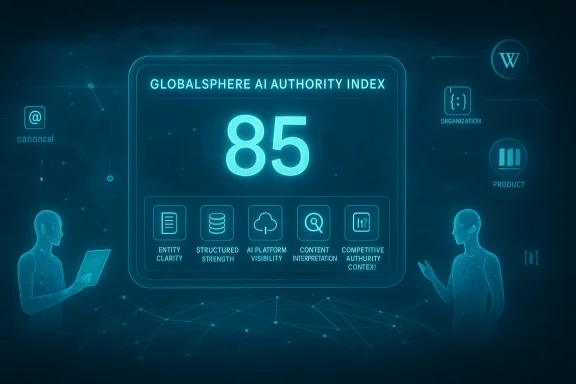
Core & More’s GlobalSphere Index arrives against that backdrop. The company frames the product as a response to a specific problem: established brands with healthy SEO profiles are being omitted from AI-generated recommendations because current ranking signals and site structures are not optimized for AI interpretation. The Index evaluates five dimensions—Entity Clarity, Structured Data Strength, AI Platform Visibility, Content Interpretation, and Competitive Authority Context—and outputs an AI Authority Score plus a remediation roadmap. Pricing ranges from a Foundation Index at $3,500 to an Enterprise Index beginning at $10,000, with delivery windows from one week to five weeks depending on tier.
This shift is driven by two core technical realities:
Independent industry analyses and SEO vendor reports from 2024–2026 paint a consistent directional picture: AI-driven answers and “AI Overviews” have, in many observed datasets, reduced click-through rates to traditional results and shifted where traffic comes from. However, the precise magnitude of that shift varies widely by dataset, by query type (informational vs. transactional), and by the measurement methodology used. Some enterprise trackers recorded double-digit declines in organic clicks for queries where AI overviews appear; other studies measured even larger reductions for purely informational queries. Conversely, other analyses caution that total search volume remains dominated by traditional interfaces for many categories, and claim that AI still represents a minority share of overall discovery in some verticals.
Translation for brands: the exact percentage of discovery “driven” by AI depends on query mix, industry, and geography. What is indisputable is the directional risk—the presence of an answer layer that can remove clicks or divert attention—and the operational challenge: AI platforms expose limited feedback, so teams must approximate visibility with new tools and methodologies.
At the same time, measurement is noisy. Platforms do not provide exhaustive, standardized logs of which sources an LLM used or prioritized when generating a response. Different tools use their own scraping, sampling, and labeling techniques to estimate what an AI answer contains. Those methodological differences explain a wide range of published effect sizes. The prudent path for brands is to accept the signal of disruption (that AI alters discovery) but to treat headline percentage figures as directional, not definitive.
However, buyers should calibrate expectations. Any authority score is a point-in-time estimate built on sampling and proprietary heuristics. The more valuable outputs are the tangible, repeatable fixes—clean Organization schema, canonical identity pages, improved content structure, and a monitoring program that tracks whether AI engines begin to cite a brand more often. Those are durable investments; the score itself is a diagnostic and should be treated as such.
The real work is not buying a score, but building durable identity signals and measurement capacity: a single, canonical identity graph, clear schema deployed across the estate, authoritative third‑party references, and a monitoring mindset that treats AI visibility as an ongoing signal, not a one-off project. Done right, these changes protect and extend discovery in the AI era. Done poorly—overfitting to current models or outsourcing explainability—brands risk paying for transient gains and losing long-term trust. The smartest playbook combines vendor expertise, internal capability building, and investment in high-quality, verifiable signals that both humans and machines can trust.
Source: The Manila Times Core & More Technologies Announces the GlobalSphere™ AI Authority Index - an Industry-First, Full Brand Visibility Product for the AI-Driven Search Era
 Background
The last two years saw generative AI features expand across mainstream interfaces—from conversational assistants to “AI Overviews” embedded in traditional search. The result has been a rapid shift in how discovery happens: in many contexts, users now receive synthesized answers and recommended options from AI systems before—or instead of—clicking through to a traditional search results page. That change has real consequences for referral traffic, brand exposure, and customer acquisition economics.Core & More’s GlobalSphere Index arrives against that backdrop. The company frames the product as a response to a specific problem: established brands with healthy SEO profiles are being omitted from AI-generated recommendations because current ranking signals and site structures are not optimized for AI interpretation. The Index evaluates five dimensions—Entity Clarity, Structured Data Strength, AI Platform Visibility, Content Interpretation, and Competitive Authority Context—and outputs an AI Authority Score plus a remediation roadmap. Pricing ranges from a Foundation Index at $3,500 to an Enterprise Index beginning at $10,000, with delivery windows from one week to five weeks depending on tier.
Why “AI Authority” is meaningfully different from classic SEO
Not ranking—being recognized
Traditional SEO measures success by positions in keyword SERPs and organic traffic. AI Authority reframes the problem: modern engines synthesize answers that may cite or recommend a small set of sources. If a brand isn’t in that citation set, it effectively becomes invisible for that query—even if it historically ranks well in the 10-blue-link world.This shift is driven by two core technical realities:
- Generative responses compress multiple sources into a single synthesized output; that output is selective and often limited to a handful of trusted signals.
- Many AI systems operate with partial or opaque telemetry: they don’t publish a public, query-by-query log of which documents drove a recommendation, making direct attribution and performance measurement harder.
Signals that matter to machines (and therefore to brands)
Where SEO once focused on keywords, links, and page-level relevance, AI Authority requires an identity-first approach. Machines “understand” brands through consistent entity signals: canonical organization markup, stable identity URLs (@id), reputable third‑party references (Wikidata/Wikipedia, verified profiles), and schema that clearly describes products, services, and people. In short, you need to make your brand machine-readable in a world where answers are constructed from linked knowledge rather than simple ranking scores.What the GlobalSphere™ AI Authority Index claims to measure
Core & More summarizes the Index as a five-dimension framework:- Entity Clarity: Do AI systems identify the brand and its offerings unambiguously?
- Structured Data Strength: Are schema signals present, accurate, and consistent (Organization, Product, Article, FAQ, etc.)?
- AI Platform Visibility: Is the brand consistently present across major generative platforms and “answer engines”?
- Content Interpretation: Does AI correctly interpret topical expertise, context, and unique differentiators?
- Competitive Authority Context: How does AI position this brand relative to competitors when synthesizing answers?
Verifying the claim: is AI already reshaping discovery?
Core & More’s announcement includes a headline claim: that “AI agents now influence 33% of organic discovery.” That number is framed as an industry-level reality in the release. It’s important to treat such figures critically.Independent industry analyses and SEO vendor reports from 2024–2026 paint a consistent directional picture: AI-driven answers and “AI Overviews” have, in many observed datasets, reduced click-through rates to traditional results and shifted where traffic comes from. However, the precise magnitude of that shift varies widely by dataset, by query type (informational vs. transactional), and by the measurement methodology used. Some enterprise trackers recorded double-digit declines in organic clicks for queries where AI overviews appear; other studies measured even larger reductions for purely informational queries. Conversely, other analyses caution that total search volume remains dominated by traditional interfaces for many categories, and claim that AI still represents a minority share of overall discovery in some verticals.
Translation for brands: the exact percentage of discovery “driven” by AI depends on query mix, industry, and geography. What is indisputable is the directional risk—the presence of an answer layer that can remove clicks or divert attention—and the operational challenge: AI platforms expose limited feedback, so teams must approximate visibility with new tools and methodologies.
Independent evidence and the limits of measurement
Multiple SEO vendors and research teams have published analyses showing that AI-generated answer features reduce click-through or re-route discovery paths for certain query types. Enterprise SEO tools have rapidly added visibility modules that try to track when AI-overview features appear and whether a domain is being cited. Academic research has also documented a “discovery gap” where many smaller or newer brands are seldom surfaced by LLM-driven discovery queries—even when they otherwise have strong SEO signals.At the same time, measurement is noisy. Platforms do not provide exhaustive, standardized logs of which sources an LLM used or prioritized when generating a response. Different tools use their own scraping, sampling, and labeling techniques to estimate what an AI answer contains. Those methodological differences explain a wide range of published effect sizes. The prudent path for brands is to accept the signal of disruption (that AI alters discovery) but to treat headline percentage figures as directional, not definitive.
Critical analysis: where GlobalSphere addresses real problems
Core & More’s GlobalSphere proposition aligns with three real, actionable needs:- An identity-first audit approach. Brands often have fragmented identity signals: different legal names across registries, inconsistent logos, multiple social profiles with mismatched bios. A centralized identity audit that normalizes Organization schema, @id usage, and canonical pages is a low-hanging win.
- Practical schema remediation. Many sites still lack clean JSON-LD Organization, Product, Article, and FAQ markup. Those are concrete, testable fixes that reduce ambiguity for crawlers and knowledge-graph builders.
- Platform-aware monitoring. Knowing whether your brand is getting cited by ChatGPT, Gemini, Perplexity, or Copilot is different from rank-tracking. Tools that approximate citation visibility give teams the ability to prioritize content updates where they’ll matter most.
Potential risks and weaknesses in the product pitch
While the GlobalSphere offering is timely, there are important caveats and risks brands should weigh before buying any packaged “AI visibility” audit or remediation program.- Opaque ground truth. No vendor can produce a perfectly accurate map of how every generative model will treat your brand tomorrow. AI models change rapidly and platforms control their training data and retrieval pipelines. Any score is therefore a snapshot—useful for prioritization but not a permanent guarantee.
- Comparability and methodology variance. Different providers use distinct methods to measure “AI visibility.” Without standardized benchmarks, scores from different vendors are not always comparable. Brands should ask for methodology transparency and sample queries used to generate scores.
- Overfitting to current platform behavior. Optimization designed to increase citations in today's models may produce brittle wins. If platforms change their citation heuristics or weighting, overly tailored fixes may lose value. A robust program focuses on durable signals—clear identity, canonical data, authoritative backlinks—not just prompt-engineered tweaks.
- Cost/benefit trade-offs. The Index’s price points are within the expected agency range for specialized audits, but enterprise buyers should assess mixed strategies: internal workstreams plus ongoing tool subscriptions may be more cost-efficient than repeated audits.
- Ethical and compliance concerns. Aggressive manipulation of AI outputs—e.g., creating networks of pseudo-authoritative pages to game citation heuristics—risks reputational harm and could be penalized by platforms. Focus on legitimate, verifiable signals.
What a sensible remediation roadmap looks like (recommended by editorial synthesis)
Below is a prioritized, platform-agnostic remediation playbook any brand should consider. These steps mirror many of the actions a product like GlobalSphere promises, but presented here as a vendor-agnostic blueprint.Quick wins (0–30 days)
- Deploy a canonical, site-level Organization JSON-LD with a stable @id fragment and consistent name, url, logo, and sameAs array.
- Validate and fix canonical tags and hreflang (if applicable); ensure crawling is not blocked for critical identity assets.
- Add or standardize Product, Service, and FAQ schema on high-intent pages; prefer JSON‑LD and test with validator tools.
- Audit business listings and authoritative profiles (Wikidata, Wikipedia, industry directories) for consistent naming and links.
- Create a “Brand Identity” hub page that clearly defines the company, products, and unique differentiators in short, machine-liftable blocks.
Mid-term (30–90 days)
- Build or restructure content into topical hubs that make it easy for extractive models to find concise, quote-ready statements (definitions, stats, differentiators).
- Implement an internal identity graph: reuse the Organization @id across LocalBusiness, Product, and Person graphs.
- Run a backlink and reference audit to strengthen third-party signals—case studies, press mentions, and industry citations that support entity authority.
- Establish monitoring: add AI visibility tracking for a curated set of high-priority queries across major LLMs and an AI-overview tracker.
Long-term (3–12 months)
- Invest in authoritative references: thought leadership, industry research, whitepapers, and partnerships that create stable external signals.
- Build a routine AI visibility review cadence: weekly monitoring, monthly remediation sprints, and quarterly knowledge-graph checks.
- Where appropriate, work with platform partnerships to improve verification (verified business profiles, platform partner programs).
- Diversify discovery channels to reduce dependence on any single platform—voice assistants, marketplaces, specialist aggregators.
Tactical recommendations for developers and technical SEO teams
- Use JSON‑LD consistently and prefer a single, canonical Organization @id (for example, site.com/#org). Reuse that @id in LocalBusiness, Product, or Service graphs.
- Include sameAs links to authoritative external identity pages, with emphasis on stable registries (Wikidata, official press pages, major social profiles).
- Keep logos at crawlable, publicly accessible URLs and reference them in Organization markup as ImageObject when possible.
- Create crisp, short, machine-liftable answers for common questions: AI systems favor concise, factual snippets that are easy to extract.
- Test structured data with official validator tools before deploying and monitor for schema validation errors as part of CI/CD releases.
How to evaluate an AI Authority audit vendor
When you’re comparing offers (agency audits, productized Indexes, or in-house programs), ask for the following before you sign:- Methodology transparency: What queries, platforms, and sampling methods produced the score? Ask for the query list.
- Repeatable measurement: Can the audit be re-run and produce a delta report so you can see improvement over time?
- Actionability: Does the roadmap include specific, prioritized fixes with estimated effort and expected impact?
- Deliverable clarity: Will you receive the JSON-LD snippets, content templates, and testing scripts, or just a PDF?
- Ongoing monitoring options: Does the vendor provide an ongoing visibility monitoring service, or do they hand off recommendations and leave?
Alternatives and complementary investments
An Index and remediation service is one way to address AI visibility. Brands should consider combining:- Subscription tools that track AI citations and AI overview occurrences (enterprise SEO platforms have added modules for this).
- In-house engineering to deploy stable identity graphs and integrate schema testing into release pipelines.
- PR and editorial programs that generate high-quality third-party references and data-driven content—these feed knowledge graphs and live outside any single domain.
Final assessment: does GlobalSphere fill a market need?
Yes—GlobalSphere’s framing is timely and aligns with a real, measurable pain point for many organizations: the need to be machine-understandable across a proliferating set of discovery interfaces. The Index’s five dimensions reflect the crucial elements of that challenge. For organizations that lack internal SEO engineering capacity, or who want a structured approach to the answer-layer problem, a productized audit plus remediation roadmap is a reasonable purchase.However, buyers should calibrate expectations. Any authority score is a point-in-time estimate built on sampling and proprietary heuristics. The more valuable outputs are the tangible, repeatable fixes—clean Organization schema, canonical identity pages, improved content structure, and a monitoring program that tracks whether AI engines begin to cite a brand more often. Those are durable investments; the score itself is a diagnostic and should be treated as such.
What brands should do next (practical checklist)
- Run a quick inventory: do you have a single, canonical Organization JSON‑LD on your site? If not—fix it within 7 days.
- Identify 20–50 high-value queries where AI citations matter (brand terms, product categories, and top-of-funnel informational queries).
- Begin weekly AI visibility checks over those queries and record which domains are cited by major LLMs and overview features.
- Prioritize fixes that increase clarity—short answer blocks, FAQ schema, clean product markup—rather than manipulative tactics.
- Consider a third-party diagnostic if internal resources can’t deliver the identity graph and monitoring required; insist on methodology transparency and deliverables that you can reuse.
Conclusion
The GlobalSphere™ AI Authority Index is a logical commercial response to the structural change in discovery: AI systems now synthesize and recommend, and brands that want to be part of those synthesized answers must present themselves in ways machines can consistently interpret. Core & More’s productized audit follows the right instincts—an identity-first evaluation, structured-data remediation, and platform-aware monitoring—but buyers should approach scores as diagnostic snapshots rather than immutable truths.The real work is not buying a score, but building durable identity signals and measurement capacity: a single, canonical identity graph, clear schema deployed across the estate, authoritative third‑party references, and a monitoring mindset that treats AI visibility as an ongoing signal, not a one-off project. Done right, these changes protect and extend discovery in the AI era. Done poorly—overfitting to current models or outsourcing explainability—brands risk paying for transient gains and losing long-term trust. The smartest playbook combines vendor expertise, internal capability building, and investment in high-quality, verifiable signals that both humans and machines can trust.
Source: The Manila Times Core & More Technologies Announces the GlobalSphere™ AI Authority Index - an Industry-First, Full Brand Visibility Product for the AI-Driven Search Era
