

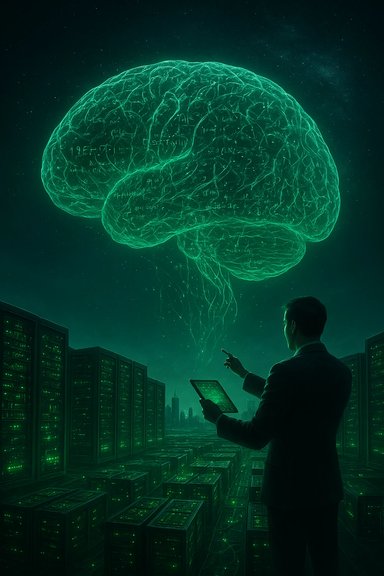
NVIDIA’s CEO Jensen Huang has given the AI debate a new, combustible metaphor — “God AI” — calling the idea possible someday but placing it on “biblical” or even “galactic” timescales, and his remarks have reopened a high‑stakes conversation about corporate incentives, realistic timelines for artificial general intelligence (AGI), and what governments and enterprises should prioritize now.
Jensen Huang made the remark in a long, wide‑ranging No Priors podcast interview where he pushed back against what he called the “doomer narrative” around AI and argued that the industry should focus on today’s engineering and infrastructure problems rather than sensationalist end‑of‑the‑world scenarios. Huang described a hypothetical “God AI” as a single intelligence that understands natural language, genome and molecular languages, protein and amino‑acid structures, and physics — but he was explicit that such a system “simply doesn't exist” today and that its arrival wo far beyond practical planning horizons. That soundbite landed inside a larger chorus of executive voices with widely divergent takes on AGI. Some leaders — notably Google DeepMind’s Demis Hassabis — have warned publicly that the world could be close enough to warrant urgent caution and coordinated governance. Others, including OpenAI’s Sam Altman, have described the AGI milestone as something that might “whoosh by” within a continuous trajectory of progress. Bill Gates recently used his annual letter to highlight specific real‑world dual‑use risks, warning that AI tools could enable biological threats if left ungoverned. This article parses Huang’s statements, verifies the core technical and policy claims against the public record, explains why his wording matters to the enterprise and Windows‑user audience, and offers a measured, evidence‑based assessment of the strengths and risks of the “God AI” framing.
(If you want to dig into the original interview, the No Priors episode is publicly available, and multiple outlets summarized Huang’s key passages and the surrounding debate for easy cross‑checking.
Source: Windows Central NVIDIA fuels AI arms race with talk of “God AI” — but admits it’s far away
 Background / Overview
Jensen Huang made the remark in a long, wide‑ranging No Priors podcast interview where he pushed back against what he called the “doomer narrative” around AI and argued that the industry should focus on today’s engineering and infrastructure problems rather than sensationalist end‑of‑the‑world scenarios. Huang described a hypothetical “God AI” as a single intelligence that understands natural language, genome and molecular languages, protein and amino‑acid structures, and physics — but he was explicit that such a system “simply doesn't exist” today and that its arrival wo far beyond practical planning horizons. That soundbite landed inside a larger chorus of executive voices with widely divergent takes on AGI. Some leaders — notably Google DeepMind’s Demis Hassabis — have warned publicly that the world could be close enough to warrant urgent caution and coordinated governance. Others, including OpenAI’s Sam Altman, have described the AGI milestone as something that might “whoosh by” within a continuous trajectory of progress. Bill Gates recently used his annual letter to highlight specific real‑world dual‑use risks, warning that AI tools could enable biological threats if left ungoverned. This article parses Huang’s statements, verifies the core technical and policy claims against the public record, explains why his wording matters to the enterprise and Windows‑user audience, and offers a measured, evidence‑based assessment of the strengths and risks of the “God AI” framing.What Jensen Huang actually said — and why it matters
The quote, the context, the subtext
Huang’s “God AI” phrasing is rhetorical: he framed a monolithic intelligence as a thought experiment and then immediately placed it far beyond short‑term horizons —next year, and not even this decade” — while insisting that the world still needs to move forward building practical AI infrastructure now. The interview’s hosts and subsequent reporting make clear Huang’s emphasis was on infrastructure, open source, and integrating AI into business workflows, not on denying existential risk as an intellectual possibility. Why that matters: when the CEO of the company that supplies most of the GPUs running today’s foundation models frames AGI as far away, the statement performs both technical explanation and strategic signaling. On the technical side, Huang highlights the real engineering gaps between powerful domain‑specific systems (e.g., language models or protein predictors) and a single, all‑purpose intelligence. On the strategic side, his messaging implicitly pushes investment and regulatory attention toward the stacks that benefit NVIDIA: racks, switches, power, and interconnects.Two independent corroborations
The No Priors podcast transcript and subsequent coverage are consistent: the quote appears in the original interview and was summarized independently by multiple outlets that covered the episode and Huang’s remarks. This makes the attribution credible and cross‑verifiable.Technical reality‑check: is a single “God AI” plausible, and how soon?
Domain wins do not equal unified generality
The last five years have seen dramatic, domain‑specific AI advances:- Language and multimodal models have grown in scale and competence, and continue to push capabilities such as code generation, summarization, and multimodal reasoning.
- Biology produced a marquee success: AlphaFold and subsequent proteinfamily and related systems) transformed protein‑structure prediction and accelerated biological discovery. Those specialized models demonstrate huge gains, but they are optimized for narrow tasks and require bespoke pipelines and validation.
Key technical barriers
- Data heterogeneity and grounding. Text tokens, experimental wet‑lab traces, protein sequences, and high‑fidelity physical simulations are fundamentally draining a model to be authoritative across those modalities requires not just scale but principled grounding and often costly domain‑specific instrumentation.
- Computation, energy, and infrastructure. Frontier models cost immense sums to train and require substantial power and specialized datacenter design. Those economics shape who can build the largest models and how fast capability can be scaled. The industry is currently in an infrastructure phase where r GPUs, networking, and energy are the gating problems.
- Evaluation and safety. We lack universal, empirically validated metrics that certify “general reasoning” across all human disciplines. Without robust evaluation and alignment, any purported “God AI” claim must be treated skeptically.
Emerging counterpoints: scaling laws, algorithmic breakthroughs, and surprises
Two important caveats temper the “far away” view:- Algorithmic surprises can shorten timelines. History shows breakthroughs sometimes come from new ideas (not just more compute). A novel algorithmic paradigm that dramatically reduces training compute per capability would materially alter the picture. Planning must be robust to that low‑probability, high‑impact possibility.
- Capability leakage across domains. Practitioners are actively combining modalities (text + protein + structure embeddings; language + simulation), and results are improving. But current multi‑domain integrations are incremental, not the single‑system universality Huang warned was missing. For the moment, worrying about misuses of current systems — inclks — is far more concretely actionable than preparing for a single omniscient model that we don’t yet know how to build.
The business angle: is Huang doing corporate myth‑making?
Incentives matter
NVIDIA is the dominant supplier of the GPUs and rack‑scale systems that power modern training and inference. Messaging that emphasizes the distance to a monolithic AGI and the urgency of infrastructure now aligns with NVIDIA’s economic self‑interest: more datacenters, more GPU orders, and more long‑term enterprise spending. It’s a natural and defensible industry posture — but it is also a posture that merits scrutiny when used to shape public policy or to downplay governance urgency.Is it spin, or is it technically grounded?
The verdict: both. Huang’s engineering points (infrastructure constraints, cross‑domain difficulty) are technically grounded and supported by independent evidence. At the same time, the choice to anchor debate around “biblical” or “galactic” timescales functions rhetorically; it reduces regulatory pressure in the short term and reframes policy towards enabling infrastructure buildout. That rhetorical move can be persuasive — and intentionally so — which is why readers should treat timeline claims from corporate executives as informed judgments shaped by incentives.Safety, governance, and the real near‑term risks
Bill Gates’s warning on bioterrorism: concrete dual‑use risk
Bill Gates, in his annual letter, highlighted a specific and practical danger: AI tools — especially open and widely distributed models — could lower the technical barriers for designing biological agents, enabling non‑state actors to attempt bioterrorism. That is a domain‑specific and actionable risk: how do we secure biological research workflows, manage data access, and coordinate international detection and emergency response? Gates argues for governance and guardrails focused precisely on these dual‑use channels. Why this matters: a lot of policy work (research funding for biosecurity, model access controls, and cross‑sector incident reporting pipelines) can reduce real, near‑term harm far more effectively than debating metaphysical AGI timelines. Huang’s “far away” phrasing should not be read as permission to ignore these concrete dangers.The “whoosh” vs. “stop” debate: why both views have merit
- The “whoosh” camp (Sam Altman) frames AGI as a continuous progression where capability thresholds may pass quietly and require institutional adaptation rather than emergency measures. That view encourages iterative regulation and continuous safety practices.
- The “stop or slow” camp (some alignment researchers and policymakers) argues for precaution given high‑impact tails and the difficulty of controlling more capable systems. Both approaches can be combined: pragmatic, continuous risk management for near‑term harms; dedicated, resourced programs for long‑term alignment research.
Practical guidance for enterprises, Windows admins, and communities
- Prioritize risk‑relevant governance. Focus on concrete dual‑use channels (biosecurity, fraud, deepfakes, supply‑chain automation) and institute tripwires and red‑team testing for deployed models.
- Plan infrastructure with portability in mind. Negotiate vendor portability, data export rights, and hybrid clouds to avoid single‑vendor lization increases.
- Embed safety in CI/CD. Add lightweight safety and privacy checks to model deployment pipelines rather than postponing safety audits for future “AGI” phases.
- *Invest in monitoring a Make detection and remediation for model misuse part of operational budgets — not an afterthought.
- Support open, independent benchmarking. Demand third‑party, reproducible evaluations for major capability claims before altering procuremend roadmap for IT leaders:
- Inventory AI assets and dependencies (models, runtimes, hardware).
- Create a “deploy with guardrails” checklist including red‑team results and DLP policies.
- Negotiate vendor SLAs that include portabi
- Run tabletop exercises for misuse scenarios (fraud, data exfiltration, bio‑design).
- Fund continuous monitoring and a small, dedicated incident response team.
Strengths and weaknesses of Huang’s message — a frank assesswhat he’s right about)
- Grounding in engineering reality. He correctly highlights that today’s model performance gains are tightly coupled to large, specialized infrastructure. That is a practical constraint for capability scaling.
- Useful policy framing for pragmatic action. By separating sensational speculation from near‑term deployment challenges, Huang helps direct energy toward implementable governance and industrial planning.
Weaknesses (where his framing risks harm)
- Downplaying governance urgency. Publicly framing AGI as “biblical” or “galactic” risks reducing political will for near‑t and international coordination on dual‑use risks.
- Corporate alignment bias. As the head of a dominant hardware supplier, Huang has a clear, structural incentive to emphasize infrastructure spending; readers should triangulate his timeline assessments with independent research.
What we can verify — and what remains speculative
Verified:- Jensen Huang’s “God AI” phrasing and the immediate context of hisre on the public record and reported by multiple outlets.
- Large, domain‑specific AI achievements (e.g., AlphaFold and protein language models like ESM) are real and transformative, but they are specialized rather than monolithic general intelligences.
- Bill Gates’s bioterrorism warning and his call for governance are documented in his public writing.
- Whether a single, unified “God AI” will ever exist, and on what timeline — this remains an open scientific and philosophical question. Any specific calendar prediction about a truly omniscient AGI is speculative and should be treated with caution.
Conclusion — pragmatic realism without panic
Jensen Huang’s “God AI” soundbite performed several roles at once: technical claim, strategic signal, and rhetorical provocation. His engineering critiquem mastering language, biology, chemistry, and physics is a different class of problem than the specialized systems we see today — is defensible and backed by how research is actually organized. At the same time, the public conversation must distinguish between two tasks: (1) realistic engineering and procurement planning for present‑day AI deployments (energy, datacenter, software supply chains); and (2) rigorous governance and safety work to manage dual‑use risks and long‑tail possibilities. It is both irresponsible and risky to treat Huang’s timescale as an excuse to reduce investment in safety, oversight, and independent benchmarking. The near‑term harms — misuse of models in fraud, attacks on elections, and dual‑use biological tooling — are concrete and actionable today; they deserve immediate policy and operational responses. For Windows administrators, IT buyers, and community moderators: treat corporate timeline claims as one input among many, prioritize auditability and portability when you buy AI products, and make safety engineering part of normal deployment practice. That pragmatic posture advances both innovation and resilience — and it’s the most reliable path through an AI arms race where the hardware vendors, software firms, policy wonks, and the public all have real and sometimes conflicting interests.(If you want to dig into the original interview, the No Priors episode is publicly available, and multiple outlets summarized Huang’s key passages and the surrounding debate for easy cross‑checking.
Source: Windows Central NVIDIA fuels AI arms race with talk of “God AI” — but admits it’s far away
