

Gong Moves From Sales Tool to Enterprise Plumbing
For years, revenue intelligence has been sold as a way to make sales organizations more honest with themselves. Gong’s original promise was simple enough: record the calls, analyze the conversations, surface the patterns, and give managers a clearer view of what is really happening in the pipeline. That pitch worked because customer conversations were often richer than CRM fields, and CRM fields were often late, incomplete, or massaged for internal consumption.
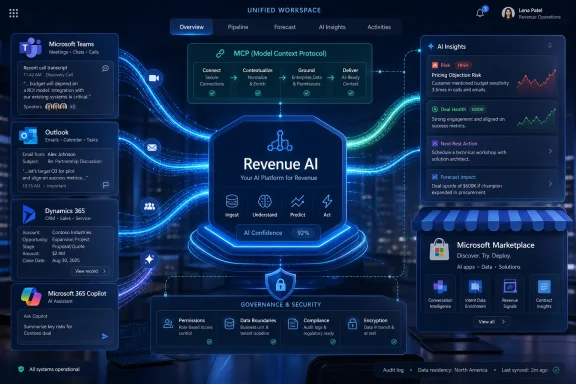
The Microsoft Marketplace announcement pushes Gong into a different category. A point solution that lives beside the CRM is one thing; a platform that pipes meeting intelligence, email context, deal risk, and recommended actions into Microsoft 365 Copilot and Dynamics 365 is another. Gong is arguing, implicitly and explicitly, that revenue data should become part of the enterprise AI substrate.
That matters because the sales stack has long suffered from fragmentation masquerading as specialization. Teams talk in Microsoft Teams, managers inspect dashboards in Gong, sellers update opportunities in Dynamics or Salesforce, executives consume forecasts in yet another layer, and everyone hopes the connective tissue holds. Gong’s Microsoft integration strategy is an attempt to make that connective tissue less manual.
TipRanks framed the week as a combination of deeper Microsoft alignment and brand-building through Gong’s 2026 Golden Gong Awards. The award program is the softer story. The marketplace and Copilot integration are the harder one, because they tell us where enterprise software is going: toward fewer standalone destinations and more embedded intelligence inside the productivity suite where workers already spend the day.
Microsoft Marketplace Is the New Enterprise Distribution Fight
The most concrete part of Gong’s announcement is procurement. By listing in Microsoft Marketplace, Gong can be purchased through established Microsoft commercial channels, including the ability for eligible customers to apply Azure Consumption Commitments. That may sound like accounting trivia, but in enterprise software, procurement mechanics often decide whether a promising tool gets piloted, delayed, or killed.
Large organizations rarely lack curiosity about AI tools. They lack patience for new vendor reviews, security assessments, contract negotiations, budget exceptions, and separate approval chains. A product that can be bought through a familiar marketplace, charged against an existing commitment, and reviewed through a known Microsoft procurement motion has an immediate advantage over a product that requires a brand-new purchasing path.
This is why Microsoft Marketplace has become more than a catalog. It is a distribution layer for vendors trying to ride Microsoft’s enterprise footprint, and it is a control point for Microsoft as it builds out the Copilot ecosystem. For Gong, availability through the marketplace lowers the friction between sales interest and actual deployment. For Microsoft, Gong’s presence helps make Copilot and Dynamics feel less like isolated Microsoft products and more like an extensible enterprise AI environment.
There is a defensive angle as well. Revenue intelligence vendors compete not only with one another, but with native CRM features, call recording tools, sales engagement platforms, and the growing assumption that generative AI will summarize everything eventually. By embedding itself into Microsoft workflows, Gong is trying to make its data and models part of the operating rhythm rather than another browser tab competing for attention.
The risk is that marketplace availability can be mistaken for adoption. Procurement gets easier; value realization does not. A Gong deployment still depends on clean permissions, user trust, CRM discipline, meeting capture coverage, management behavior, and the willingness of sellers to let AI-mediated systems inspect their work. Microsoft can reduce the purchasing headache, but it cannot magically fix the sociology of sales operations.
Copilot Needs Context, and Gong Wants to Sell It
The most important phrase in the announcement is not “marketplace.” It is context. Gong’s pitch to Microsoft customers rests on the idea that Microsoft 365 Copilot becomes more useful when it can reason over real customer interactions, not just documents, calendars, chats, and emails. In Gong’s telling, revenue teams can connect Microsoft 365 Copilot to Gong’s MCP Server so Copilot can draw on Gong’s revenue AI, agents, and deal intelligence.
That is a notable shift in how vendors are positioning themselves around Copilot. Early Copilot adoption often centered on personal productivity: summarize this meeting, draft this email, find this document, prepare me for this call. Useful, yes, but generic. The next phase is domain-specific context, where Copilot’s value depends on its ability to reach into systems that understand a business process deeply.
Gong’s domain is the revenue cycle. It has transcripts, call summaries, objections, buyer sentiment, next steps, competitive mentions, account risks, and deal-stage signals. If that information can be made available inside Copilot, the assistant can move closer to the questions sellers and managers actually ask: Why is this deal slipping? What did the buyer object to? Which stakeholder has gone quiet? What should the account team do before the renewal meeting?
That is why support for the Model Context Protocol is more than a standards checkbox. MCP has become a shorthand for letting AI systems connect to external tools and data sources in a more structured way. In Gong’s case, MCP support is meant to let Microsoft 365 Copilot query Gong’s context rather than forcing users to jump into Gong every time they need a revenue-specific answer.
But context is also where the hard questions begin. Which conversations should Copilot be allowed to query? Which sellers, managers, executives, and support teams should see which insights? How are sensitive customer discussions governed? How does an organization audit whether an AI-generated recommendation came from a call transcript, a CRM field, an email thread, or a model inference? The more useful the integration becomes, the more governance stops being a compliance afterthought and becomes a product requirement.
Dynamics 365 Gets the Benefit, but Also the Burden
The Dynamics 365 angle is especially important for WindowsForum readers because it places the Gong story inside Microsoft’s broader business applications strategy. Microsoft wants Dynamics, Teams, Outlook, and Copilot to feel like one revenue workspace rather than a loosely connected collection of products. Gong’s integrations support that strategy by moving enriched customer interaction data and AI-generated summaries into Dynamics 365 and related applications.
For sales teams, this addresses a familiar pain point: CRM systems are supposed to be the source of truth, but the truth often lives in conversations. A seller may know that a procurement blocker emerged on a call, that a technical evaluator expressed concern, or that a champion changed jobs. If those signals never make it into the CRM, the forecast becomes theatrical.
Automated capture and synchronization can improve that picture. Calls, emails, and meetings can be structured, summarized, and associated with accounts or opportunities. Managers can inspect deal health with less dependence on weekly verbal updates. Revenue operations teams can see patterns across teams and territories without asking sellers to manually tag every interaction.
Still, automation can create its own false confidence. A summarized call is not the same thing as a complete understanding of a customer relationship. AI-generated deal insights can be wrong, incomplete, or biased toward whatever was captured. If a key negotiation happens over a private phone call, a hallway conversation, or a customer’s internal meeting, the system may still miss the decisive context.
That means Gong’s Microsoft integration should be treated as an instrumentation upgrade, not an oracle. It can reduce the amount of manual CRM hygiene required, but it does not eliminate the need for human judgment. The best revenue organizations will use these signals to ask better questions, not to pretend that pipeline risk can be fully automated away.
The “Flow of Work” Is Becoming the New Lock-In
Every enterprise software vendor now claims to meet users “in the flow of work.” The phrase has become so common that it risks sounding empty. In this case, though, it captures a real platform shift: the winning interface may no longer be the application where the data originated, but the assistant or collaboration tool where the user asks for the next action.
For Gong, appearing inside Teams, Outlook, Dynamics 365, and Microsoft 365 Copilot reduces the danger that sales teams will treat revenue intelligence as a periodic reporting destination. If deal insights show up while a seller prepares for a meeting, drafts a follow-up, reviews an opportunity, or asks Copilot for an account summary, Gong becomes part of the daily workflow rather than a weekly inspection ritual.
For Microsoft, this is exactly the point. Copilot becomes more defensible when third-party systems enrich it with domain-specific data. Teams becomes stickier when it is not just a meeting app but a place where customer intelligence is captured and acted upon. Dynamics becomes more competitive when it can absorb richer signals from conversation intelligence platforms.
The resulting lock-in is subtler than the old version. It is not just that customers buy a suite and find it hard to leave. It is that workflows, permissions, summaries, AI agents, CRM updates, and procurement commitments begin to braid together. Once that braid is in place, replacing a single strand becomes harder than replacing a standalone application.
This can be good for customers if the integration reduces swivel-chair work and improves data quality. It can be bad if organizations wake up to find that their revenue operations are dependent on a chain of opaque AI-mediated handoffs. The practical question for IT is not whether the integration is convenient. It is whether the organization can understand, govern, export, and unwind the data flows if business needs change.
The Golden Gong Awards Are Marketing, but Not Just Marketing
The second part of the weekly recap — Gong opening nominations for its 2026 Golden Gong Awards — is easier to dismiss. Awards programs are familiar SaaS theater: celebrate customers, flatter executives, generate case studies, and create a reason for prospects to associate the vendor with best practices. The awards target revenue operations leaders and chief revenue officers, precisely the audience Gong needs to influence.
Yet this kind of community-building matters in enterprise software because buying committees do not trust vendor claims in isolation. They look for peer validation, operating models, and evidence that other organizations have solved similar problems. An awards program can turn customer success into a repeatable narrative: disconnected systems were unified, data-driven execution improved, and predictable growth followed.
That does not mean the financial impact is immediate or measurable. TipRanks was right to avoid overstating it. A recognition program does not by itself increase annual recurring revenue, improve retention, or expand contract sizes. It can, however, support the social infrastructure around those outcomes.
The more interesting point is that Gong is pairing product embedding with executive community-building. One motion pushes the technology deeper into Microsoft workflows. The other pushes the brand deeper into the professional identity of revenue leaders. Together they suggest Gong understands that enterprise adoption is both technical and cultural.
For Windows and Microsoft ecosystem watchers, the awards are less important than the audience they reveal. Gong is not merely courting individual sellers who want better call notes. It is courting the executives who define revenue process, approve workflow standardization, and decide whether AI becomes a sanctioned operating layer or a scattered set of experiments.
Enterprise IT Gets Another AI Integration to Govern
The Gong-Microsoft story will sound attractive to sales leadership, but IT and security teams will hear a different set of implications. Customer conversations can contain pricing discussions, legal concerns, product roadmap details, personally identifiable information, negotiation strategy, and competitive intelligence. Feeding that material into AI-assisted workflows raises legitimate questions about access control, retention, auditability, and data boundaries.
Microsoft’s enterprise posture helps here. Many organizations already have identity, compliance, and governance investments around Microsoft 365, Entra ID, Purview, Teams, and Dynamics. A Gong integration that respects those structures may be easier to defend than a separate AI tool with its own permissions model and unclear data handling.
But “inside Microsoft” should not be confused with “automatically safe.” Third-party connectors and AI agents still require careful scoping. Administrators need to understand what content is indexed, what metadata is exposed, how permissions are inherited, whether summaries are stored, and how downstream systems can reuse generated outputs. The governance surface expands with every useful integration.
There is also a human dimension. Sales calls are sensitive not only because of customer data but because they expose employee performance. Conversation intelligence can be used for coaching, forecasting, compliance, and accountability. When AI summaries and recommendations flow into everyday Microsoft tools, organizations need clear policies about how those outputs will be used.
The worst deployment pattern would be to treat Gong-plus-Copilot as a magic productivity feature and roll it out broadly without defining rules of engagement. The better pattern is slower and more deliberate: pilot with specific teams, map data flows, validate permission behavior, test summary accuracy, align with legal and HR policies, and only then scale. AI adoption in revenue operations is too consequential to be left entirely to sales enablement enthusiasm.
The Competitive Market Is Collapsing Into Platforms
Gong’s move also says something about the competitive future of revenue intelligence. The category once looked like a specialized analytics market layered on top of sales calls and CRM records. Now it is being pulled into a broader platform contest involving Microsoft, Salesforce, HubSpot, Zoom, sales engagement vendors, data providers, and AI-native workflow startups.
That platform gravity is unavoidable. Generative AI reduces the perceived uniqueness of some surface-level features, such as summarization, email drafting, and meeting note generation. If every productivity suite can summarize a call, vendors like Gong must prove that their advantage is not merely transcription plus a model. They must show differentiated data, domain tuning, workflow depth, and enterprise-grade governance.
Gong’s answer is the Revenue Graph and the broader Revenue AI platform. The company’s position is that revenue intelligence requires a living context layer built from real customer interactions, CRM data, and go-to-market workflows. In other words, the commodity layer may be summarization, but the defensible layer is structured revenue context.
That is a plausible argument. A generic assistant can tell you what was said in a meeting. A revenue-specific system should understand whether what was said changes deal risk, forecast confidence, next-best action, stakeholder mapping, competitive positioning, or renewal likelihood. The difference between those two capabilities is where vendors like Gong hope to preserve pricing power.
But the platform giants will not stand still. Microsoft has Copilot, Dynamics, Teams, Outlook, Power Platform, and an enormous partner ecosystem. Salesforce has its own AI strategy and a deep CRM installed base. HubSpot is pushing AI into its go-to-market suite. Gong’s challenge is to integrate deeply enough with these platforms to benefit from their reach without becoming a replaceable data source behind someone else’s interface.
The Real Test Is Whether Sellers Trust the Machine
Adoption in revenue teams tends to fail for reasons that are more behavioral than technical. Sellers resist tools that feel like surveillance, duplicate work, or management theater. Managers resist systems that produce more noise than insight. Executives lose interest when AI pilots create impressive demos but fail to change forecast accuracy, win rates, or cycle times.
Gong’s Microsoft integration has a chance to avoid some of that because it places intelligence in tools sellers already use. A seller who receives a useful pre-meeting brief in Outlook or a relevant action recommendation through Copilot may be less resistant than one asked to open another application and manually interpret another dashboard. Convenience can change behavior.
Trust, however, must be earned. If Copilot surfaces Gong-derived recommendations that are obviously wrong, stale, or out of context, users will learn to ignore them. If summaries miss nuance or misrepresent customer sentiment, managers may draw the wrong conclusions. If sellers believe every conversation is being turned into a performance dossier, they may change how they speak in recorded settings.
The strongest deployments will make the AI visibly useful to the frontline, not just to management. That means helping sellers prepare, follow up, prioritize, and avoid dropped commitments. If the system mainly helps leadership inspect the pipeline, users will experience it as another layer of control. If it helps sales teams win business with less administrative drag, adoption becomes much easier to sustain.
This is where Gong’s product strategy and Microsoft’s Copilot ambitions intersect. The promise is not that AI will replace sales judgment. The promise is that AI will reduce the distance between customer signal and team action. That is a narrower claim, but a more credible one.
The Procurement Win Does Not Eliminate the ROI Question
Marketplace availability can accelerate purchasing, but it also risks accelerating premature buying. Azure Consumption Commitments can make a product feel easier to justify because the money is already committed in some form. That does not mean the deployment will automatically generate measurable value.
Revenue AI ROI is difficult because the outcomes are influenced by many variables: territory quality, product-market fit, pricing, sales management, enablement, macroeconomic conditions, and customer demand. Gong can help surface risks and improve execution, but it cannot compensate for a weak go-to-market strategy. Nor can Copilot integration turn poor sales process into predictable revenue by itself.
CFOs and CIOs should therefore push for sharper success criteria. Are teams trying to reduce manual CRM updates? Improve forecast accuracy? Shorten sales cycles? Increase manager coaching effectiveness? Reduce deal slippage? Improve renewal preparation? Each goal implies different metrics, data requirements, and rollout patterns.
The most dangerous metric is user excitement after a demo. The most useful metrics are tied to operational behavior. Are follow-up actions completed faster? Are CRM fields more complete without manual nagging? Are managers identifying deal risk earlier? Are reps spending less time reconstructing meeting history? Are forecast calls becoming more evidence-based?
Gong’s Microsoft partnership improves the chances that these workflows can be measured inside an enterprise environment. But measurement still requires discipline. Without it, organizations may end up with a polished AI layer over the same old pipeline ambiguity.
The Week Gong Tried to Become Part of the Microsoft Workday
The practical readout from this week is not that Gong has suddenly transformed the revenue intelligence market. It is that the company has taken a meaningful step toward embedding itself in the Microsoft-centered workday, and that step aligns with where enterprise AI purchasing and usage are heading.
- Gong’s July 1, 2026 Microsoft Marketplace availability gives enterprise customers a simpler procurement path and may allow eligible purchases through Azure Consumption Commitments.
- The Microsoft integration strategy extends Gong’s relevance beyond its own application by pushing customer interaction data and deal intelligence into Teams, Outlook, Dynamics 365, and Microsoft 365 Copilot.
- Gong’s support for Model Context Protocol is strategically important because it lets Copilot-style assistants query domain-specific revenue context rather than relying only on generic productivity data.
- The operational upside is reduced manual data capture and better visibility into deal risk, but the system still depends on permissions, governance, data quality, and user trust.
- The Golden Gong Awards are a marketing program, but they also reinforce Gong’s attempt to build a community around revenue operations maturity and executive-level AI adoption.
- For IT leaders, the central question is not whether the integration is convenient, but whether it can be governed, audited, measured, and scaled without creating a new layer of opaque dependency.
Gong’s Microsoft push is best understood as part of a broader enterprise AI consolidation, where specialized vendors must plug into dominant productivity platforms or risk becoming side tabs in a Copilot-shaped world. The opportunity for Gong is obvious: get closer to the daily decisions that move revenue. The challenge is just as clear: once AI-generated sales intelligence lives inside Microsoft workflows, customers will expect it to be as governed, reliable, and measurable as the rest of their enterprise stack.
References
- Gong – Weekly Recap TipRanks · 2026-07-04T14:42:10.770249
- learn.microsoft.com learn.microsoft.com