

Google has begun rolling out Connected Apps in AI Mode for Search, letting U.S. users link Instacart, Canva and YouTube Music accounts to turn conversational searches into shopping carts, design starting points and saved playlists. The July 16 update, detailed by Google and reported by SiliconANGLE and Tekedia, is a meaningful change for anyone using Google Search on a Windows PC: AI Mode is no longer being positioned solely as an answer engine, but as a place to begin—and sometimes advance—a task inside another service.
The initial scope is deliberately narrow. Users can connect only three services, and the experience is limited to AI Mode in English in the United States. But the direction is clearer than the app count suggests: Google wants Search to become an orchestration layer that keeps intent, context and the next action in the same interface rather than sending users through a chain of tabs and standalone apps.
For Windows users who live in Chrome, Edge, or a managed browser environment, the practical appeal is familiar. Ask for help planning a meal, drafting promotional material or assembling a themed music queue, and Search can carry that request into an associated application. The question now is not whether Google can generate a useful response; it is whether users will trust it with connected accounts and whether organizations will allow it.
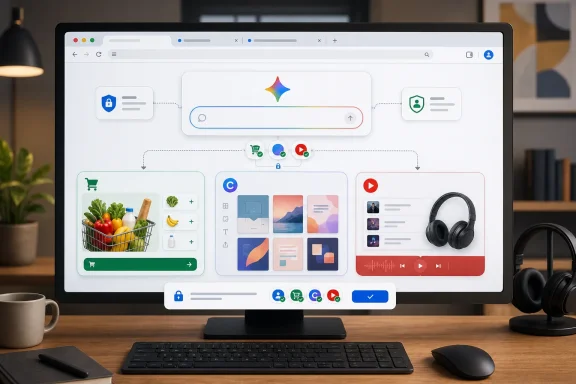
Google’s examples are purposefully ordinary. A user planning a barbecue can ask AI Mode to assemble a grocery list, then link Instacart to add the items to a cart. A user preparing a flyer can request Canva templates from within the search conversation. A music request can produce a playlist that is saved to YouTube Music.
Those flows still involve a destination service. Google is not processing a grocery transaction itself, nor is it replacing Canva’s editing environment or YouTube Music’s player. The change is in the handoff: Search supplies the conversational front end, while the connected app supplies the inventory, creative tools or media library.
That distinction matters. “AI agents” are often described as systems that autonomously complete end-to-end work, but this release looks more like a constrained, account-linked bridge between a query and an app action. In its Instacart guidance, Google indicates that AI Mode ultimately provides a link into the connected shopping service to complete the action. That is a more defensible model for purchases, where substitutions, delivery windows, fees and final confirmation still require a user’s attention.
It also means early expectations should be modest. AI Mode may help convert a rough intent into a structured cart or a set of templates, but it does not eliminate the need to review results. A vague prompt can still yield irrelevant items, unsuitable designs or a playlist that misses the brief. The quality of the resulting task is only as strong as the prompt, the underlying service’s data and the account permissions the user has granted.
AI Mode itself is distinct from the Gemini app. It is Google Search’s conversational interface, using Gemini models to respond to more complex prompts, carry a multi-turn interaction and, now, connect selected external services. For users, that distinction can appear increasingly artificial. A person may begin with a traditional query, switch into AI Mode, create a shopping list and open Instacart without necessarily caring which Google AI surface processed each step.
Google has been steadily filling out that Search experience. Recent AI Mode changes have included local product availability checks and a side-by-side browsing layout intended to preserve conversation context while users inspect web pages. The company has also introduced Personal Intelligence capabilities that, with permission, can draw on Gmail and Google Photos for tailored answers.
Connected Apps adds a different category of capability: it gives AI Mode an outward path. Search can now take a request beyond web results and Google-owned data into commercial and creative services. That is important competitively because OpenAI’s ChatGPT and Anthropic’s Claude have both made external tools and integrations central to their visions of useful AI assistants.
SiliconANGLE correctly frames the move as an effort to make AI Mode more useful for shopping and planning. But Google’s advantage is not merely that it has another chatbot with connectors. Its advantage is distribution. Search is still the starting point for an enormous number of product searches, troubleshooting sessions, trip plans and how-to queries. If users become accustomed to connecting apps there, Google can turn search intent into a much more persistent relationship with its AI products.
The technical security question is not whether Canva, Instacart or YouTube Music are inherently unsafe. It is what data is shared when an account is linked, what scopes are requested, how long authorization remains active, and which controls exist to revoke access. Users should read the consent screen rather than assuming that a connection is limited to one immediate task.
A Canva connection could be relatively low stakes for a personal flyer. The same pattern becomes more sensitive when an AI workflow touches work accounts, brand assets, shared design libraries or files that may contain customer information. Consumer services often become shadow IT when employees use personal accounts to move faster than approved tools allow.
Windows administrators should view this as another example of browser-based SaaS becoming the real endpoint. The relevant control points may include browser profile policies, Google Workspace account restrictions, conditional access rules, data-loss prevention tooling and employee guidance on when personal AI-connected services are acceptable. Blocking a desktop application does not address a workflow that begins in a browser tab and hands data to a web app.
There is also a governance difference between asking Search for general advice and authorizing Search to act through an account. The latter creates an operational trail, potentially changes a remote service’s state and can expose preferences or data to a broader collection of systems. In a managed environment, those are not interchangeable risk levels.
Users should take a few basic precautions as these integrations appear:
Instacart brings product catalogs, localized availability and fulfillment choices. Canva provides a visual output path that is more tangible than a text answer. YouTube Music lets Google demonstrate a low-friction result in a service it already owns. Together, the trio gives AI Mode a simple demonstration of its broader ambition: generate a useful plan, then move that plan into an application where it becomes something actionable.
The important limitation is that Google has not yet announced a broad catalog or a universal app-connection framework for AI Mode users. The company says more integrations are coming, but there is no published timetable or partner list beyond the initial rollout. That leaves the experience looking more like a curated pilot than a mature cross-app platform.
For the Windows ecosystem, it is also notable that the first integrations favor web services rather than native Windows applications. That is not a failure of the feature; it reflects where modern productivity workflows increasingly live. But it means Microsoft 365, Windows Copilot and browser management will remain central battlegrounds as Google attempts to make Search the default entry point for AI-assisted work.
Google has made the next move in the AI assistant race less about producing a better paragraph and more about making a search result do something useful. The test will come when Connected Apps expands beyond three consumer-friendly partners—and when users and administrators decide whether the saved clicks justify another layer of connected-account trust.
The initial scope is deliberately narrow. Users can connect only three services, and the experience is limited to AI Mode in English in the United States. But the direction is clearer than the app count suggests: Google wants Search to become an orchestration layer that keeps intent, context and the next action in the same interface rather than sending users through a chain of tabs and standalone apps.
For Windows users who live in Chrome, Edge, or a managed browser environment, the practical appeal is familiar. Ask for help planning a meal, drafting promotional material or assembling a themed music queue, and Search can carry that request into an associated application. The question now is not whether Google can generate a useful response; it is whether users will trust it with connected accounts and whether organizations will allow it.
 Search Starts Handing Work to Other Services
Google’s examples are purposefully ordinary. A user planning a barbecue can ask AI Mode to assemble a grocery list, then link Instacart to add the items to a cart. A user preparing a flyer can request Canva templates from within the search conversation. A music request can produce a playlist that is saved to YouTube Music.Those flows still involve a destination service. Google is not processing a grocery transaction itself, nor is it replacing Canva’s editing environment or YouTube Music’s player. The change is in the handoff: Search supplies the conversational front end, while the connected app supplies the inventory, creative tools or media library.
That distinction matters. “AI agents” are often described as systems that autonomously complete end-to-end work, but this release looks more like a constrained, account-linked bridge between a query and an app action. In its Instacart guidance, Google indicates that AI Mode ultimately provides a link into the connected shopping service to complete the action. That is a more defensible model for purchases, where substitutions, delivery windows, fees and final confirmation still require a user’s attention.
It also means early expectations should be modest. AI Mode may help convert a rough intent into a structured cart or a set of templates, but it does not eliminate the need to review results. A vague prompt can still yield irrelevant items, unsuitable designs or a playlist that misses the brief. The quality of the resulting task is only as strong as the prompt, the underlying service’s data and the account permissions the user has granted.
Google Is Closing the Gap Between Search and Gemini
The update matters because Google has been building similar third-party connections in Gemini, its standalone AI assistant. Google’s July announcement effectively moves that capability closer to the product with the largest built-in audience: Search.AI Mode itself is distinct from the Gemini app. It is Google Search’s conversational interface, using Gemini models to respond to more complex prompts, carry a multi-turn interaction and, now, connect selected external services. For users, that distinction can appear increasingly artificial. A person may begin with a traditional query, switch into AI Mode, create a shopping list and open Instacart without necessarily caring which Google AI surface processed each step.
Google has been steadily filling out that Search experience. Recent AI Mode changes have included local product availability checks and a side-by-side browsing layout intended to preserve conversation context while users inspect web pages. The company has also introduced Personal Intelligence capabilities that, with permission, can draw on Gmail and Google Photos for tailored answers.
Connected Apps adds a different category of capability: it gives AI Mode an outward path. Search can now take a request beyond web results and Google-owned data into commercial and creative services. That is important competitively because OpenAI’s ChatGPT and Anthropic’s Claude have both made external tools and integrations central to their visions of useful AI assistants.
SiliconANGLE correctly frames the move as an effort to make AI Mode more useful for shopping and planning. But Google’s advantage is not merely that it has another chatbot with connectors. Its advantage is distribution. Search is still the starting point for an enormous number of product searches, troubleshooting sessions, trip plans and how-to queries. If users become accustomed to connecting apps there, Google can turn search intent into a much more persistent relationship with its AI products.
The Convenience Comes With an Account-Linking Tradeoff
For consumers, Connected Apps reduces friction. For IT teams, it adds another account-to-AI relationship that may need scrutiny.The technical security question is not whether Canva, Instacart or YouTube Music are inherently unsafe. It is what data is shared when an account is linked, what scopes are requested, how long authorization remains active, and which controls exist to revoke access. Users should read the consent screen rather than assuming that a connection is limited to one immediate task.
A Canva connection could be relatively low stakes for a personal flyer. The same pattern becomes more sensitive when an AI workflow touches work accounts, brand assets, shared design libraries or files that may contain customer information. Consumer services often become shadow IT when employees use personal accounts to move faster than approved tools allow.
Windows administrators should view this as another example of browser-based SaaS becoming the real endpoint. The relevant control points may include browser profile policies, Google Workspace account restrictions, conditional access rules, data-loss prevention tooling and employee guidance on when personal AI-connected services are acceptable. Blocking a desktop application does not address a workflow that begins in a browser tab and hands data to a web app.
There is also a governance difference between asking Search for general advice and authorizing Search to act through an account. The latter creates an operational trail, potentially changes a remote service’s state and can expose preferences or data to a broader collection of systems. In a managed environment, those are not interchangeable risk levels.
Users should take a few basic precautions as these integrations appear:
- Review the permissions requested during account linking and disconnect services that are no longer needed.
- Treat generated carts, playlists and creative suggestions as drafts that require review before use or purchase.
- Avoid connecting personal consumer accounts to work tasks involving confidential data, customer material or licensed brand assets.
- Check whether a company’s browser and AI-use policies permit third-party connections from Google Search before enabling them.
The First Three Partners Reveal Google’s Priorities
Instacart, Canva and YouTube Music are not a random starter set. They cover commerce, creative work and entertainment—three high-frequency categories where users often have a clear goal but must otherwise cross multiple apps to complete it.Instacart brings product catalogs, localized availability and fulfillment choices. Canva provides a visual output path that is more tangible than a text answer. YouTube Music lets Google demonstrate a low-friction result in a service it already owns. Together, the trio gives AI Mode a simple demonstration of its broader ambition: generate a useful plan, then move that plan into an application where it becomes something actionable.
The important limitation is that Google has not yet announced a broad catalog or a universal app-connection framework for AI Mode users. The company says more integrations are coming, but there is no published timetable or partner list beyond the initial rollout. That leaves the experience looking more like a curated pilot than a mature cross-app platform.
For the Windows ecosystem, it is also notable that the first integrations favor web services rather than native Windows applications. That is not a failure of the feature; it reflects where modern productivity workflows increasingly live. But it means Microsoft 365, Windows Copilot and browser management will remain central battlegrounds as Google attempts to make Search the default entry point for AI-assisted work.
Google has made the next move in the AI assistant race less about producing a better paragraph and more about making a search result do something useful. The test will come when Connected Apps expands beyond three consumer-friendly partners—and when users and administrators decide whether the saved clicks justify another layer of connected-account trust.
References
- Primary source: Tekedia
Published: 2026-07-17T20:11:43+00:00
Loading…
www.tekedia.com - Independent coverage: SiliconANGLE
Published: 2026-07-17T02:00:15+00:00
Loading…
siliconangle.com - Related coverage: androidcentral.com
Loading…
www.androidcentral.com - Related coverage: blog.google
Loading…
blog.google - Related coverage: company.instacart.com
Loading…
company.instacart.com - Related coverage: androidauthority.com
Loading…
www.androidauthority.com