

Google’s pilot of in-conversation discounts and a new open commerce protocol marks a decisive step toward turning search and assistant replies into full shopping front-ends where discovery, incentives and checkout collapse into a single interaction.
The past 18 months have seen a rapid shift from link-based discovery to agentic commerce — AI assistants that don’t just recommend products but can assemble carts, verify availability, present offers, and complete settlement. Major platforms have moved beyond experimentation into production pilots that fold checkout into conversational surfaces. OpenAI introduced Instant Checkout in ChatGPT, Microsoft rolled out Copilot Checkout inside Copilot, and Google has now published its own playbook built around the Universal Commerce Protocol (UCP) and a pilot advert product called Direct Offers. Google frames UCP as an open, modular standard designed to make agent‑to‑merchant integrations easier and more reliable: canonical product records, consistent cart lifecycle semantics, tokenized delegated payments and provenance trails for auditability. The company says the pilot will initially be available to US retailers, with global expansion and additional features—bundles, loyalty integration, and custom shopping experiences—planned “in the coming months.”
This transition is not instantaneous. Expect incremental adoption, cautious regulation, and a pluralistic ecosystem of protocols and platform-specific experiences in the near term. The winners will be brands that treat their product metadata as marketing, build robust tokenized checkout integrations, and negotiate clear telemetry and commercial terms before they count on AI-driven discovery as a primary channel.
Source: Mumbrella Google joins the AI shopping race with exclusive discounts
 Background and overview
The past 18 months have seen a rapid shift from link-based discovery to agentic commerce — AI assistants that don’t just recommend products but can assemble carts, verify availability, present offers, and complete settlement. Major platforms have moved beyond experimentation into production pilots that fold checkout into conversational surfaces. OpenAI introduced Instant Checkout in ChatGPT, Microsoft rolled out Copilot Checkout inside Copilot, and Google has now published its own playbook built around the Universal Commerce Protocol (UCP) and a pilot advert product called Direct Offers. Google frames UCP as an open, modular standard designed to make agent‑to‑merchant integrations easier and more reliable: canonical product records, consistent cart lifecycle semantics, tokenized delegated payments and provenance trails for auditability. The company says the pilot will initially be available to US retailers, with global expansion and additional features—bundles, loyalty integration, and custom shopping experiences—planned “in the coming months.” What Google actually announced
Direct Offers: discounts inside AI Mode
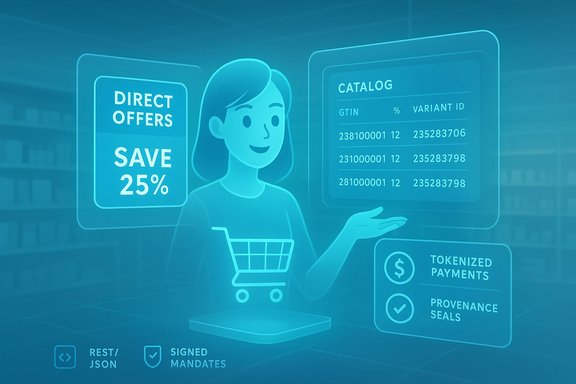
Direct Offers is an ad/product placement that lets merchants surface exclusive, contextually relevant discounts inside Google Search’s AI Mode and Gemini experiences. Retailers opt into campaign settings and Google’s AI decides when an offer is relevant to the user’s conversational intent. The pilot focuses on discounts at launch, with plans to extend offer attributes to bundles, free shipping and other value signals. Early participating advertisers named by Google include Petco, e.l.f. Cosmetics and Samsonite.Universal Commerce Protocol (UCP)
UCP is the technical backbone Google is promoting to standardize how agents, merchants and payment systems exchange product metadata, cart state, credentials and provenance metadata. Core goals include:- Canonical product representation (GTINs, SKUs, variants, images, shipping windows).
- Cart and checkout semantics (create/update/validate/submit lifecycle messages).
- Delegated, tokenized payments so agents can initiate settlement without handling raw card data.
- Provenance and auditability mapping conversational prompts to order artifacts.
Scope and geography
At launch, the Direct Offers pilot and UCP integrations are limited to eligible US merchants. Google has signalled a broader rollout “in the coming months,” but commercial availability will depend on merchant onboarding, feed quality, and PSP integration.How the technology works (a practical breakdown)
From a user’s perspective
The experience shortens the funnel: rather than “search → click → merchant site → checkout,” users interact with an assistant, accept a recommendation, see an immediate contextual discount and confirm a tokenized payment—in many cases without leaving the AI surface. That changes the shopping moment into a single conversational transaction.Key technical primitives
- Canonical product records: Machine-readable product entries (GTINs, variant IDs, dimensions, return policy) reduce the risk of recommending an item that isn’t actually available in the merchant’s inventory.
- Cart lifecycle semantics: Standardized messages for cart creation, updates and validation ensure merchant backends can process agent-generated carts reliably.
- Delegated payments and scoped tokens: Agents request short-lived payment tokens from PSPs (Google Pay, Stripe, PayPal) so the assistant never handles raw PANs; the PSP or merchant completes settlement and remains merchant-of-record.
- Provenance & auditable mandates: Signed credentials and mandate semantics (what the agent was allowed to do, who approved the cart) create an audit trail to resolve disputes and satisfy regulatory scrutiny—an approach Google and others describe as central to trust in agentic commerce.
Complementary standards and rails
Google’s UCP sits alongside related efforts: OpenAI and Stripe published an Agentic Commerce Protocol to power ChatGPT’s Instant Checkout, and Microsoft has published merchant templates and delegated checkout flows for Copilot Checkout. These protocols differ in emphasis (platform-led UX vs. protocol-driven merchant sovereignty), but they share the same primitives: canonical product data, tokenized delegation, and auditability.Who’s in the pilot and the partner ecosystem
Google lists a range of commerce and payments partners in the early UCP and Direct Offers rollouts: Shopify, Etsy, Wayfair, Target and Walmart for merchant/catalog collaboration; payment partners and networks including Amex and Mastercard are reported as endorsers; and brands like Petco, e.l.f. and Samsonite are participating in the Direct Offers pilot. Shopify’s Agentic Storefronts and automatic enrollment models are also woven into the merchant onboarding story. These partnerships are intended to accelerate coverage and give Google access to broad catalogs without bespoke connector work per retailer. But the onboarding model matters: automatic enrollment (Shopify-style opt-out) is fast, while opt-in models require merchants to elect participation and validate pricing, loyalty and return rules.Competitive context: OpenAI and Microsoft aren’t waiting
OpenAI’s Instant Checkout—built with Stripe—has already enabled single-item purchases from Etsy and select Shopify merchants inside ChatGPT, with plans for multi-item carts and wider merchant coverage. OpenAI emphasizes that merchants remain the merchant of record and that Instant Checkout is a merchant-paid, buyer-free service model (merchants pay a fee on successful purchases). Microsoft’s Copilot Checkout similarly embeds buy buttons and checkout flows inside Copilot chats, working with PayPal, Stripe and Shopify. Microsoft has publicly documented merchant templates and Brand Agents to speed onboarding. The practical difference between approaches is partly philosophical: platform‑centric models capture the UX entirely inside the assistant while protocol-driven models like UCP emphasize interoperability and merchant control.Why advertisers and brands should pay attention
Search + ads meets checkout: new monetization surface
Direct Offers is more than a conversion tool—it's an attempt to monetize the AI shopping moment itself. An advertiser can buy placement that not only influences discovery but also reduces friction to purchase with an immediate discount, effectively collapsing the last-click step into the ad impression. Google’s pitch to advertisers is pragmatic: as discovery moves into conversational and visual AI surfaces, brands that buy and optimize for those surfaces can capture higher-intent moments.The new optimization game: Generative Engine Optimization (GEO) / Answer Engine Optimization (AEO)
Merchants will need to treat product feeds as frontline marketing assets. The tactics that matter include:- Accurate GTINs and machine-readable attributes.
- Complete images, dimensions and return policy fields.
- Clean, descriptive product copy that answers the likely conversational queries.
- Rich, verified reviews and local inventory signals.
Practical benefits for merchants — and the trade-offs
Benefits
- Shorter funnels and higher intent: Agent-driven purchases can dramatically reduce drop-off between discovery and checkout.
- New conversion levers: Contextual discounts inside conversations can lift conversion and reduce cart abandonment.
- Syndication efficiency: Implementing UCP/Agentic Storefront once can expose product catalogs across multiple assistants and surfaces.
Significant trade-offs and risks
- Concentration of discovery: If a handful of agents control primary discovery moments, merchants may be beholden to platform rules and fee models.
- Data dependency and hygiene: Poor feeds lead to invisibility or failed orders; catalog hygiene becomes a gating factor for visibility.
- Operational complexity: Tokenized payments, mandate proofs and new settlement rails (including experiments with stablecoin rails) require PSP and merchant reconciliation changes.
- Publisher and traffic displacement: Publishers and media owners risk losing informational clicks as answers and commerce get captured inside AI surfaces, changing referral economics for the open web.
Regulatory, privacy and trust considerations
Auditability and mandate proofs
Google and other platform players highlight provenance, signed mandates and auditable trails as essential to managing disputes and regulatory expectations in agentic commerce. AP2-style mandate semantics and cryptographic proofs are being discussed as ways to make agentic buys non-repudiable and auditable for issuers and regulators. These mechanisms increase trust but also add integration complexity.Data sharing and privacy
Direct Offers and agent-aware placements rely on context signals from the user’s conversation and intent—platforms must ensure those signals aren’t misused for over-targeting. Google says it has an “agent-aware” privacy framework for Direct Offers, but the details of telemetry sharing, attribution models and the persistence of conversational context will be central to regulator and merchant scrutiny as pilots expand. Companies should expect questions from privacy bodies and card networks about data minimization, consent, and liability.Fraud, chargebacks and settlement rails
Delegated checkout and alternative settlement rails (including x402 stablecoin pilots described in some technical previews) can speed settlement and enable programmability, but they introduce reconciliation and chargeback complexities that merchants and PSPs must test thoroughly before letting agentic flows scale. Early pilot metrics supplied by platforms should be treated as directional until independently validated.What retailers, CMOs and technical teams should do now
Immediate checklist (practical and tactical)
- Audit and canonicalize product feeds: GTIN coverage, SKU normalization, image quality, clear return policy and shipping windows.
- Implement tokenized checkout endpoints: test delegated payment tokens and settlement flows with your PSP (Stripe, PayPal, Google Pay).
- Instrument provenance and telemetry: log conversational prompts, selected SKU IDs and mandate receipts to support dispute resolution.
- Run 60–90 day proof‑of‑value pilots: include conversion lift, false positive checkout tests, fraud posture and billing projections.
- Review commercial terms: opt‑in vs. opt‑out enrollment, placement fees, attribution and data-sharing contracts.
Longer-term capabilities to build
- Treat product feeds as marketing assets—invest in AEO/GEO work and structured metadata.
- Build playbooks for agent-origin orders: customer service scripts, fulfillment SLAs and return policies aligned with agentic checkout behaviors.
- Negotiate telemetry access for measurement and incrementality testing—don’t accept opaque attribution windows without auditability.
- Plan for platform variance: different assistants will favor different ranking signals; diversify presence across agents while maintaining feed quality.
Voices from the industry (what advertisers and agencies are saying)
Industry commentators describe the move as more than incremental: it’s a structural shift where discovery, recommendation and conversion collapse into a single interaction—what some executives call the “delegator economy.” Agencies and media groups highlight two immediate imperatives:- Brands must look beyond discounts to answer-engine readiness—optimizing for trust, machine-readability and authoritative product data.
- Test-and-learn budgets are important, but conversion uplift should be instrumented carefully; attractive discounts don’t guarantee sustainable media economics.
Measured optimism: where the biggest unknowns remain
- Adoption beyond pilots: merchant enrollment, especially among mid-market and long-tail sellers, will determine whether UCP’s “implement once, reach many” promise holds up in practice.
- Independent validation: platform-supplied conversion claims should be validated with neutral A/B tests and third-party incrementality studies before marketers reallocate large budgets.
- Regulator scrutiny and card network readiness: cryptographic mandates, alternative settlement rails and programmatic refunds will all draw attention from payments regulators and card networks; expect conservative rollouts in regulated markets until rules and reconciliation patterns stabilize.
Seven tactical moves for marketing and commerce leaders
- Prioritize feed quality: allocate the next quarter’s engineering backlog to canonicalizing SKUs, GTINs and required metadata.
- Run parallel pilots: test Direct Offers, Copilot Checkout and Instant Checkout where available to compare conversion and cost metrics.
- Instrument agent-origin orders: capture conversation context, offer ID, SKU and mandate receipt for every order.
- Design refund & dispute SLAs for agentic origin purchases: ensure customer support can reconcile conversational provenance with merchant systems.
- Negotiate opt-out protections: if your platform automatically enrolls merchants, insist on transparent opt-out processes and display rules for offers.
- Treat product listings as authority pages: add brand narratives, FAQ snippets and machine-friendly Q&A to reduce hallucination risk.
- Budget for measurement: institute incrementality testing and conversion lift measurement separate from platform analytics.
Conclusion: a new era of commerce, but not a frictionless switch
Google’s Direct Offers and the Universal Commerce Protocol are a bold, pragmatic attempt to solve the plumbing problem that has long blocked large-scale agentic commerce: inconsistent feeds, bespoke integrations, and fragile checkout handoffs. The pilot joins a broader industry movement—OpenAI’s Instant Checkout and Microsoft’s Copilot Checkout—that is actively reimagining where and how purchases happen. For retailers and advertisers, the opportunity is real: convert intent at the moment it forms and win customers with fewer clicks. But the work to make that conversion dependable, auditable and fair is largely operational: merchants must fix data, PSPs must prove settlement fidelity, and platforms must be transparent about targeting and attribution. Early tests will show whether these agentic flows lift growth sustainably or simply reallocate the same commerce pie under new rules.This transition is not instantaneous. Expect incremental adoption, cautious regulation, and a pluralistic ecosystem of protocols and platform-specific experiences in the near term. The winners will be brands that treat their product metadata as marketing, build robust tokenized checkout integrations, and negotiate clear telemetry and commercial terms before they count on AI-driven discovery as a primary channel.
Source: Mumbrella Google joins the AI shopping race with exclusive discounts
