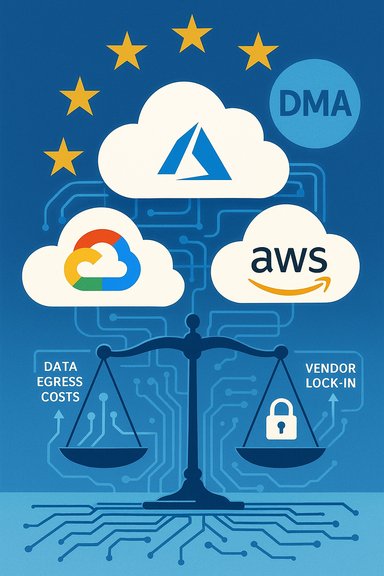
Google has quietly withdrawn its formal antitrust complaint against Microsoft in the European Union, a tactical pivot that hands the dispute over cloud competition to Brussels’ broader Digital Markets Act (DMA) market investigations and reframes the fight from private litigation to public regulatory reform.
The original complaint, filed by Google Cloud in 2024, alleged that Microsoft’s licensing and commercial practices — particularly around Windows Server, SQL Server and related enterprise software — created practical barriers that made it materially harder and more expensive for customers to run Microsoft workloads on rival clouds. Those allegations formed part of a wider industry narrative about vendor lock-in, differential pricing and self‑preferencing in hyperscale cloud markets.
Brussels’ intervention came at scale: on 18 November 2025 the European Commission launched three coordinated DMA-style market investigations — one focused on Microsoft Azure, one on Amazon Web Services (AWS), and a horizontal sectoral study to test whether DMA tools can be adapted to cloud infrastructure. The Commission signalled an accelerated, roughly 12‑month timetable for the company-level investigations.
Google’s withdrawal, announced on 28 November 2025, explicitly linked the move to the Commission’s decision to assess “problematic practices affecting the cloud sector under a separate process,” and framed it as a pragmatic reallocation of enforcement energy toward the DMA probes.
Key DMA characteristics that matter for cloud:
Regulators have additional policy motivations beyond pure competition economics:
From Microsoft’s perspective, the company argues the cloud market is dynamic and competitive, and that negotiated commercial remedies (rather than broad, ex‑ante obligations) are often the faster, less disruptive path to customer choice. Those arguments will now be tested in Brussels’ DMA-driven fact‑finding.
For IT leaders, the moment calls for pragmatic, defensive action: inventory your Microsoft‑centric dependencies, quantify migration risk, and demand stronger contractual portability protections. For vendors, the DMA probes signal a shift toward rule‑making that could alter product roadmaps and commercial models. And for the broader market, the Commission’s investigations may produce landmark precedents on how digital platform rules apply to infrastructure — precedents that will be relevant for cloud architecture, procurement, and the economics of AI for years to come.
The months ahead will be decisive: regulators must balance legal ambition with engineering realism, vendors must prepare for potential structural obligations, and enterprise buyers must shore up contractual and technical resilience. The regulatory chapter that now opens will shape not just competitive dynamics among hyperscalers, but the practical freedoms — and constraints — of IT teams running Windows and enterprise workloads in the cloud.
Source: Mobile World Live Google drops EU antitrust complaint against Microsoft
 Background
The original complaint, filed by Google Cloud in 2024, alleged that Microsoft’s licensing and commercial practices — particularly around Windows Server, SQL Server and related enterprise software — created practical barriers that made it materially harder and more expensive for customers to run Microsoft workloads on rival clouds. Those allegations formed part of a wider industry narrative about vendor lock-in, differential pricing and self‑preferencing in hyperscale cloud markets.Brussels’ intervention came at scale: on 18 November 2025 the European Commission launched three coordinated DMA-style market investigations — one focused on Microsoft Azure, one on Amazon Web Services (AWS), and a horizontal sectoral study to test whether DMA tools can be adapted to cloud infrastructure. The Commission signalled an accelerated, roughly 12‑month timetable for the company-level investigations.
Google’s withdrawal, announced on 28 November 2025, explicitly linked the move to the Commission’s decision to assess “problematic practices affecting the cloud sector under a separate process,” and framed it as a pragmatic reallocation of enforcement energy toward the DMA probes.
Timeline — key dates and moves
- September 2024: Google Cloud files an EU antitrust complaint against Microsoft alleging discriminatory licensing and lock‑in.
- Mid‑2024: Microsoft reaches a settlement with CISPE, a European trade body for cloud providers, reportedly worth around €20–22 million to resolve a separate complaint over cloud licensing practices.
- 18 November 2025: European Commission launches three DMA-based market investigations into cloud infrastructure, targeting AWS and Azure and conducting a horizontal sectoral review.
- 28 November 2025: Google formally withdraws its 2024 complaint, citing the Commission’s market investigations as a more appropriate vehicle for systemic remedies.
What Google alleged — the substance of the complaint
Google’s complaint crystallised around several technical and commercial themes that are central to cloud portability debates:- Differential licensing and surcharges: Claims that running Microsoft software on non‑Azure infrastructure is subject to higher effective costs or contractual constraints that disincentivise migration.
- Migration and egress friction: Allegations that data egress fees, export tooling shortcomings and contractual clauses materially increase the cost and complexity of moving production workloads off Azure.
- Proprietary control‑plane differences and API lock‑in: Assertions that managed services, control‑plane APIs and integration points are designed or packaged in ways that favour Azure‑native implementations over third‑party replacements, increasing engineering cost for rivals.
- Self‑preferencing and marketplace mechanics: Concerns that first‑party services or marketplace positioning within Azure can disadvantage independent vendors and distort customer choice.
Why Google withdrew: strategic logic, not surrender
Google’s withdrawal should be read as a strategic recalibration rather than an abandonment of its core concerns. The DMA probes give the Commission tools and a forum that a single private complaint cannot match:- The DMA process allows ex‑ante obligations and remedies that can be systemic (for example, mandated interoperability, non‑discrimination and portability rules), rather than case‑by‑case antitrust orders.
- Brussels can compel documents, testimony and market‑wide evidence across multiple providers and stakeholders, increasing the likelihood of comprehensive fact‑finding.
- Shifting to the Commission’s probe reduces the optics of a purely commercial rivalry and channels the dispute into public policy, where outcomes can set sector‑wide precedents.
The DMA as a different enforcement toolkit
The Digital Markets Act was designed for large platform gatekeepers in consumer markets, but Brussels is now testing whether its mechanics — designation, ex‑ante obligations, and direct enforcement — can be sensibly applied to cloud infrastructure.Key DMA characteristics that matter for cloud:
- Gatekeeper designation can impose affirmative obligations such as non‑discrimination, API exposure and data portability requirements. Applying these to cloud providers would be novel and consequential.
- Faster, prevention-focused enforcement contrasts with traditional antitrust’s retrospective remedies; DMA tools can address structural barriers before they calcify into irreversible lock‑in.
- Sectoral tailoring is likely to be required — cloud infrastructure is technically complex and enterprise‑oriented, and blunt platform rules risk unintended disruption to performance, security, and innovation.
Market context — concentration and why regulators care
Independent market estimates cited across reporting place the three major hyperscalers (AWS, Microsoft Azure and Google Cloud) as commanding a large share of global infrastructure spend — routinely aggregated to more than 60% of the market, with AWS near ~30%, Microsoft ~20% and Google Cloud in the low teens. Those concentration figures underpin regulatory concern about switching frictions, resilience and strategic sovereignty for AI workloads.Regulators have additional policy motivations beyond pure competition economics:
- Operational resilience and systemic risk: Highly concentrated infrastructure raises the stakes for large outages or supply‑side shocks.
- AI and accelerator access: Provider‑specific hardware and integrated AI stacks can magnify lock‑in for customers using vendor‑unique capabilities.
- Digital sovereignty: Governments and public buyers want assurance that strategic services are contestable and portable within European regulatory frameworks.
Microsoft’s posture and the settled cases
Microsoft has publicly denied the most sweeping accusations of anti‑competitive intent and pointed to prior settlements as evidence of responsiveness to European concerns. In mid‑2024 Microsoft reached a settlement with CISPE, a European cloud trade association, reportedly in the region of €20–22 million and accompanied by specific product and commercial commitments aimed at European hosters. Microsoft described that settlement as resolving similar complaints and expected regulators to dismiss other parallel claims.From Microsoft’s perspective, the company argues the cloud market is dynamic and competitive, and that negotiated commercial remedies (rather than broad, ex‑ante obligations) are often the faster, less disruptive path to customer choice. Those arguments will now be tested in Brussels’ DMA-driven fact‑finding.
Implications for major players
For Google
Withdrawing the complaint conserves political capital and shifts the fight to an arena where Google can lobby for systemic remedies without the cost and risk of being the adversarial complainant. It also keeps Google’s options open to supply evidence, technical analysis, and policy proposals to shape any DMA-based obligations.For Microsoft
The DMA probes pose a new and potentially more intrusive regulatory exposure than single-case antitrust litigation. If Azure were to be found an “important gateway” under a DMA interpretation, Microsoft could face ex‑ante obligations that reshape product roadmaps, marketplace rules and licensing models. Microsoft’s prior CISPE settlement may blunt some criticisms but will not immunise it from sector‑wide remedies.For AWS and other providers
AWS is directly targeted by the companion probe. Any designations or technical interoperability requirements would affect AWS’ architecture and commercial relations with ISVs and enterprise buyers, and could create symmetric obligations across hyperscalers. Smaller European cloud providers watch closely: remedies that improve portability or transparency could open commercial opportunities, but translating legal rules into technical standards will be decisive.Practical risks and trade‑offs regulators must grapple with
Regulators face a delicate engineering-policy balance. The top risks include:- Implementation complexity and compliance costs: Forcing API exposure, data interchange standards or mandatory portability primitives would require significant engineering investment and could raise costs that might be passed through to customers.
- Over‑broad remedies that harm performance or security: Cloud providers design managed services for performance and security at scale; blunt interoperability mandates risk weakening those properties if not carefully scoped.
- Time lag between rules and market effect: Contracts already signed may lock customers into terms for years; regulatory change is therefore slow to translate into commercial switching behaviour.
- Litigation and standardisation lag: Any DMA obligations are likely to be litigated and require technical standards work; the process may therefore be protracted and contentious.
What enterprise customers should do now
The regulatory turbulence creates both risk and opportunity for procurement, legal, and architecture teams. Practical, immediate steps:- Conduct a licensing and exit‑cost audit: identify where proprietary or conditional licensing could raise migration costs.
- Demand contractual transparency: secure rights to audit portability, documentation of APIs and egress pricing schedules.
- Build migration playbooks: run technical migration tests and capture performance, compatibility and cost data to reduce unknowns.
- Negotiate portability/escape clauses: include contractual exit windows, portable formats and vendor-neutral integration points.
- Pilot multi‑cloud patterns: where feasible, standardise on container, orchestration and data formats that ease workload mobility.
How the next 12 months are likely to play out
- Brussels will gather documentary evidence, issue information requests, and hold technical hearings with providers, customers and trade bodies. The company‑level assessments for AWS and Azure are likely to aim for completion within roughly 12 months.
- Expect a flood of whitepapers, technical briefings and industry submissions as providers seek to shape the Commission’s understanding and remedy design. Public procurement behaviour by European governments and large buyers may start shifting in response to regulatory signals.
- If the Commission concludes gatekeeper designations or tailored DMA obligations are needed, regulators will face the harder work of converting legal principles into enforceable technical specifications and compliance measures. That will likely involve standards bodies, industry fora and detailed technical negotiation.
Strengths of the current regulatory approach
- Systemic scope: A DMA‑led approach can deliver sector‑wide remedies that individual antitrust cases cannot, potentially fixing root causes of lock‑in.
- Faster preventive power: Ex‑ante obligations can limit anti‑competitive behaviour before it becomes entrenched, benefiting customers and challengers.
- Public accountability: Moving the dispute into a Commission process provides a transparent, multilateral forum for balancing competition, security and industrial policy goals.
Weaknesses and unresolved questions
- Translation to technical reality: The DMA was not written for cloud infrastructure; adapting its obligations to highly technical enterprise services risks mismatches and unintended consequences.
- Evidence quality and contested figures: Many headline numerical claims (e.g., very large markups) are drawn from selective contract examples; regulators must test these rigorously. Treat such figures as contested until validated.
- Compliance burden and competitiveness: New obligations could raise costs or constrain innovation if not carefully designed; regulators must avoid regulatory overreach that diminishes European competitiveness.
Final analysis — why this matters to WindowsForum readers
The cloud stack is now central to Windows‑centric enterprise workloads — from Windows Server to SQL Server to integrated identity and productivity services. Any regulatory outcome that affects licensing, portability or API openness will directly shape how Windows workloads are deployed, migrated and managed across public cloud providers.For IT leaders, the moment calls for pragmatic, defensive action: inventory your Microsoft‑centric dependencies, quantify migration risk, and demand stronger contractual portability protections. For vendors, the DMA probes signal a shift toward rule‑making that could alter product roadmaps and commercial models. And for the broader market, the Commission’s investigations may produce landmark precedents on how digital platform rules apply to infrastructure — precedents that will be relevant for cloud architecture, procurement, and the economics of AI for years to come.
Conclusion
Google’s withdrawal of its EU antitrust complaint against Microsoft is a calculated strategic move that hands the agenda to Brussels’ DMA-era enforcement machinery. The Commission’s market investigations offer the potential for systemic, ex‑ante remedies to long‑standing portability and self‑preferencing concerns — but they also raise difficult technical questions about how to translate platform-style obligations into the complex reality of cloud infrastructure.The months ahead will be decisive: regulators must balance legal ambition with engineering realism, vendors must prepare for potential structural obligations, and enterprise buyers must shore up contractual and technical resilience. The regulatory chapter that now opens will shape not just competitive dynamics among hyperscalers, but the practical freedoms — and constraints — of IT teams running Windows and enterprise workloads in the cloud.
Source: Mobile World Live Google drops EU antitrust complaint against Microsoft