

Google says active users of its Gemini app in Southeast Asia more than doubled over the past year, making the region the fastest adopter of a Google application to date. The claim comes from the company’s first Gemini Report: Southeast Asia 2026, covering Indonesia, Malaysia, the Philippines, Singapore, Thailand and Vietnam.
The figures are Google internal data, so they should be read as the company’s own measurement of Gemini engagement rather than an independent market-share study. Still, the scale matters: Google says Gemini now has more than 900 million monthly users globally, with Southeast Asia accounting for more than 100 million users.
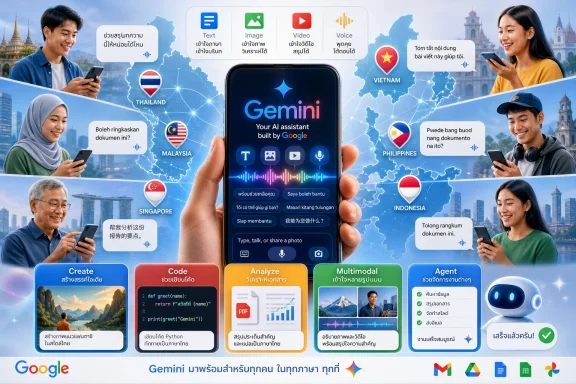
The report describes a usage pattern that is notably mobile-first. Nearly three quarters of Gemini requests in the region reportedly originate on phones, while more than 40% include voice, image or video input. More than 10% are voice-only conversations.
Language support appears central to the growth. Google says nearly 70% of regional prompts are written in local languages, rising to 89% in Vietnam, 87% in Thailand and 84% in Indonesia. AI Singapore’s SEA-HELM benchmark has ranked Gemini as the leading model across its Southeast Asian language evaluation, according to Google.
That is relevant beyond the region. AI assistants are increasingly judged less by English-only benchmark performance than by whether they can reliably handle local languages, mixed-language conversations, voice input and image-based requests. Google is clearly using Gemini’s localization work as a competitive selling point.
Younger users are driving much of the activity, Google says. Users under 25 submit more prompts, hold longer conversations and write more detailed requests than older cohorts. The company attributes some of that uptake to Southeast Asia’s demographics, where nearly 40% of the population is under 25.
Research and practical problem-solving are also common. The company lists summarizing documents, analyzing data, recommendations and troubleshooting among everyday Gemini uses. In Singapore, which Google says has the world’s highest per-capita Gemini adoption, nearly four in ten user journeys are work-related, including coding support and technical debugging.
The Bangkok Post reports that Thailand stands out for lifestyle use, with roughly one in three prompts falling into that category. It also reports that older Thai users make heavy use of voice and photo prompts, a reminder that multimodal AI adoption is not confined to younger users.
Google is pairing the report with a regional expansion of Gemini Spark, its permission-based agent feature. Spark is intended to carry out multi-step tasks rather than only answer questions, and Google says local-language support is beginning to roll out for Google AI Ultra subscribers.
For Windows users and IT admins, the practical change is limited for now: Gemini’s Southeast Asia growth is chiefly a mobile and consumer story, while Spark remains a paid, controlled rollout rather than a broadly available desktop automation tool.
The figures are Google internal data, so they should be read as the company’s own measurement of Gemini engagement rather than an independent market-share study. Still, the scale matters: Google says Gemini now has more than 900 million monthly users globally, with Southeast Asia accounting for more than 100 million users.
 Mobile, local languages and multimodal prompts
The report describes a usage pattern that is notably mobile-first. Nearly three quarters of Gemini requests in the region reportedly originate on phones, while more than 40% include voice, image or video input. More than 10% are voice-only conversations.Language support appears central to the growth. Google says nearly 70% of regional prompts are written in local languages, rising to 89% in Vietnam, 87% in Thailand and 84% in Indonesia. AI Singapore’s SEA-HELM benchmark has ranked Gemini as the leading model across its Southeast Asian language evaluation, according to Google.
That is relevant beyond the region. AI assistants are increasingly judged less by English-only benchmark performance than by whether they can reliably handle local languages, mixed-language conversations, voice input and image-based requests. Google is clearly using Gemini’s localization work as a competitive selling point.
Younger users are driving much of the activity, Google says. Users under 25 submit more prompts, hold longer conversations and write more detailed requests than older cohorts. The company attributes some of that uptake to Southeast Asia’s demographics, where nearly 40% of the population is under 25.
Productivity is only part of the story
About 40% of prompts are for content generation, including text, images, music and video, according to the report. Google says regional users created more than five billion images with its Nano Banana image model during the past year and generated nearly one million songs with Lyria 3.Research and practical problem-solving are also common. The company lists summarizing documents, analyzing data, recommendations and troubleshooting among everyday Gemini uses. In Singapore, which Google says has the world’s highest per-capita Gemini adoption, nearly four in ten user journeys are work-related, including coding support and technical debugging.
The Bangkok Post reports that Thailand stands out for lifestyle use, with roughly one in three prompts falling into that category. It also reports that older Thai users make heavy use of voice and photo prompts, a reminder that multimodal AI adoption is not confined to younger users.
Google is pairing the report with a regional expansion of Gemini Spark, its permission-based agent feature. Spark is intended to carry out multi-step tasks rather than only answer questions, and Google says local-language support is beginning to roll out for Google AI Ultra subscribers.
For Windows users and IT admins, the practical change is limited for now: Gemini’s Southeast Asia growth is chiefly a mobile and consumer story, while Spark remains a paid, controlled rollout rather than a broadly available desktop automation tool.
References
- Primary source: marketech apac
Published: 2026-07-14T09:52:49+00:00
Southeast Asia emerges as one of Gemini's fastest-growing regions: report - MARKETECH APAC
Google says active users of the Gemini app in Southeast Asia have more than doubled year-on-year, driven by Gen Z adoption.marketech-apac.com - Independent coverage: Bangkok Post
Published: 2026-07-15T00:10:00+00:00
Bangkok Post - Southeast Asia sets pace for Gemini usage
The number of active users on the Google Gemini app in Southeast Asia has more than doubled in a year, driven by Gen Z and local language capability.www.bangkokpost.com - Related coverage: grow.google
The Gemini Report | Southeast Asia 2026 | Indonesia
Dengan lebih dari 100 juta pengguna di Asia Tenggara, Laporan Gemini 2026 melihat dampak signifikan AI dalam mentransformasi cara orang bekerja, hidup, dan berkreasi.grow.google - Related coverage: neowin.net
Google expands Gemini Spark to SEA as Gemini usage more than doubles - Neowin
Google's latest AI rollout comes with fresh data on how millions are using Gemini across Southeast Asia. www.neowin.net
- Related coverage: itbrief.asia
Gemini app use in Southeast Asia more than doubles
Local language support and mobile-first use have helped drive Gemini adoption across a region where younger users are setting the pace. itbrief.asia
