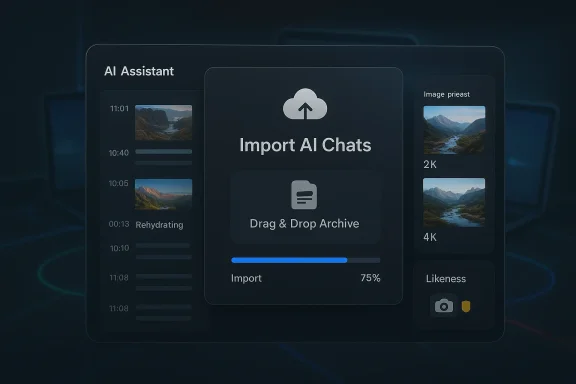
Google’s latest Gemini builds are quietly testing a set of features that could change the dynamics of the AI assistant market: a native “Import AI Chats” flow to bring entire conversation histories from rivals into Gemini, higher-resolution image download presets (2K and 4K), and a new “Likeness” control tied to video verification. Early evidence comes from TestingCatalog and multiple outlets that traced screenshots and popups inside Gemini’s UI, and the implications span user convenience, data portability, enterprise governance, and synthetic-media safety.
Switching costs are the hidden currency of conversational AI. Users accumulate months — even years — of context inside long-running threads for coding, research, writing projects, or personal knowledge management, and that context compounds: you don’t just lose messages, you lose the assistant’s built-in understanding of prior work. Google’s apparent test for an “Import AI Chats” option targets exactly this pain point by offering a path to bring exported conversations into Gemini so users can continue threads without rebuilding context from scratch. TestingCatalog spotted the UI elements in attachment menus and a popup that instructs users to download exports from other services and upload them into Gemini.
This is easily framed as both a product convenience feature and a strategic distribution play. If Google can remove the friction y and media when switching assistants, Gemini’s integrations across Search, Android, Workspace, and Chrome become far more attractive. Market trackers and long-form commentary already show that Gemini’s distribution advantage has moved the needle on user traffic and engagement; embedding a migration path amplifies that leverage.
From a competitive standpoint, exporting and importing conversations challenges the deep‑context lock-in that made early assistants sticky and positions Gemini not only as an alternative but as a destination for consolidatedT leaders the short-term imperative is governance: expect a flurry of questions about export/import policies, training guarantees, and DLP tooling as these features mature.
If Google ships an import flow that reconstructs threads with high fidelity while giving users and organizations robust privacy controls and audit trails, the feature could be a genuine inflection point for assistant churn dynamics. If the import is incomplete, opaque about training use, or lacks enterprise protections, it will be a marketing headline but a governance headache.
Source: findarticles.com Google Tests Easy Chat Imports For Gemini
 Background / Overview
Switching costs are the hidden currency of conversational AI. Users accumulate months — even years — of context inside long-running threads for coding, research, writing projects, or personal knowledge management, and that context compounds: you don’t just lose messages, you lose the assistant’s built-in understanding of prior work. Google’s apparent test for an “Import AI Chats” option targets exactly this pain point by offering a path to bring exported conversations into Gemini so users can continue threads without rebuilding context from scratch. TestingCatalog spotted the UI elements in attachment menus and a popup that instructs users to download exports from other services and upload them into Gemini. This is easily framed as both a product convenience feature and a strategic distribution play. If Google can remove the friction y and media when switching assistants, Gemini’s integrations across Search, Android, Workspace, and Chrome become far more attractive. Market trackers and long-form commentary already show that Gemini’s distribution advantage has moved the needle on user traffic and engagement; embedding a migration path amplifies that leverage.
Why chat imports matter: the problem of sticky context
- Context compounds. Power users keep multi-threaded projects in chat over months. The assistant’s usefulness increases the longer a thread persists because previous clarifications, domain definitions, saved variables, and iterative edits remain available.
- Manual migration is brittle. Exporting a single conversation, reformatting it, and trying to re-establish state in a new assistant is tedious and error-prone.
- Data portability is a growing expectation. Regulators and privacy frameworks emphasize user control over data; consumers increasingly expect the ability to take their information with them. That expectation has already reshaped messaging apps and cloud services; AI assistants are now next in line.
How the Gemini chat import flow appears to work
Where the control lives in the UI
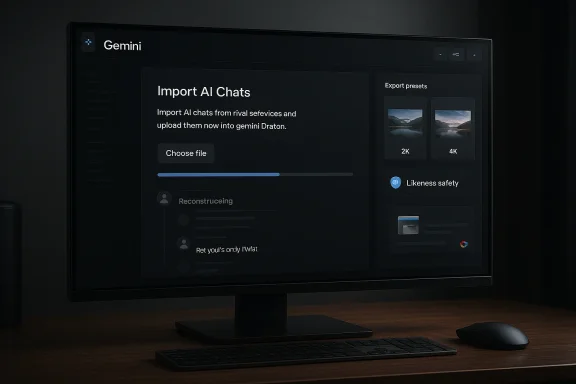
Screenshots shared by TestingCatalog and picked up by Android Authority and Android Central show an “Import AI Chats” entry inside Gemini’s attachment/menu controls. When triggered, a popup reportedly prompts the user to download chat data from the original service and then upload the exported archive into Gemini. The import is marked as a beta feature in these early builds.Supported formats and practical constraints
At present there’s no official list of supported source platforms or file formats. But the practical path looks familiar:- Request or export data from the origin assistant (OpenAI provides a downloadable ZIP for ChatGPT exports; Claude and others have export mechanisms too).
- Upload the exported archive to Gemini’s import control.
- Gemini ingests and reconstructs the thread, preserving text and attached media where possible.
Fidelity, formats, and the technical challenges
Accurate import isn’t just file I/O; it’s data interpretation. The following technical issues determine whether imports are useful in practice:- Format variability. Exports differ: ChatGPT provides HTML and JSON artifacts; Anthropic and Microsoft use different structures and variable metadata. A robust importer must parse multiple schemas and map them into Gemini’s conversation model.
- Thread reconstruction. Long multi-branch threads, forks, and threaded replies must be reassembled with chronology and participant metadata intact, including any inline code, tables, or attachments.
- Media handling. Embedded images, audio, or files must be re-linked or re-uploaded. If original links expire or are hosted behind access controls, imports must either include embedded blobs or gracefully handle missing media.
- Size and performance. Giant archives (GB-scale) require client-side processing or background ingestion flows with progress reporting and resumable uploads.
- Preserving provenance. Good imports should retain source labels and timestamps so users (and downstream audits) can verify where content originated.
Privacy, governance, and compliance: the elephant in the room
Conversation archives are often rich in sensitive information: client names, project secrets, API keys, personal data, or health information. Moving these archives across services raises immediate governance and legal questions.- User-level privacy controls. Expect Google to highlight client-side consent, clear prompts describing what will be imported, and options to scrub or filter content during import. Early testing indications show the import flow references account Activity and notes about using imported data to improve services — pointing to training and retention implications that users must understand.
- Organizational controls. Enterprises will want admin governance: disable-by-default at tenant level, audit trails, DLP scanning before imports, and policy enforcement to prevent exfiltration of regulated data. Many IT teams prohibit raw browser exports for this reason; exported archives often lack encryption or enterprise-grade audit records. Practical enterprise workflows will likely require managed import tools or admin-approved transfer channels.
- Regulatory alignment. Data portability is a central concept in privacy regimes like the GDPR. Allowing transfers is aligned with portability principles, but it also creates new obligations: ensuring lawful processing, keeping adequate records, and honoring deletion requests across platforms.
- Training and retention disclosures. Early reports indicate that imported content could be used to improve Google’s models (or at least be stored in Activity). That is a significant disclosure: if imports feed training sets, organizations and privacy-conscious users must get explicit assurances, opt-outs, or contractual guarantees.
Image quality upgrades: 2K and 4K download presets
Parallel to chat imports, testers reported new image-export options in Gemini labeled for sharing and print, offering 2K and 4K presets. That matters because high-resolution native outputs avoid the detour of exporting into a separate upscaler or desktop tool.- The technical upside: native 2K outputs reduce the need for post-processing and support quick delivery of marketing assets, mockups, and light print collateral.
- The practical limits: community threads and hands‑on reports indicate experience varies by model variant and UI flow — some users see reliable 2K downloads while 4K may still be gated behind APIs, paid tiers, or specific generation engines. Reddit posts and third-party sites documenting Nano Banana / Gemini image workflows show that 2K is now commonly available, while 4K can require the right model or API path.
Likeness controls and synthetic-media safety
Testers found a “Likeness” entry in settings that routed to a video verification tool. The label is consistent with broader industry moves to protect creators and public figures from unauthorized synthetic content.- YouTube already launched a creators-facing likeness detection/reporting feature that identifies potential deepfakes and supplies takedown workflows — an industry precedent that shows product-level provenance tools are feasible and necessary. Integrating a similar control into Gemini would let users check whether a video appears AI-generated and potentially flag or attach provenance metadata.
- Practical implementations vary. Likeness controls can:
- Detect probable synthetic origin and show confidence scores.
- Provide guidance for labeling or requesting takedowns on platforms.
- Offer creators a searchable registry of flagged videos for review.
Competitive stakes: what this means for the assistant market
If executed well, a low-friction import flow is a strategic accelerator for Gemini:- It lowers the psychological and practical cost of trying Gemini: users keep their history and can test integrations without losing work.
- It attacks the lock-in advantage of incumbents like ChatGPT by neutralizing the “my data is here” barrier that keeps users from switching.
- It strengthens Google’s distribution channel: once users import and continue threads inside Gemini, the assistant’s integrations across Search, Workspace, Android, and Chrome yield repeated touchpoints that can quickly re-anchor habits and workflows. Industry trackers and analyses show that distribution and embedding have already been key tailwinds for Gemini’s growth; migration tooling simply accelerates that process.
Risks, unknowns, and red flags
- Unclear training use. Early testing notes suggay be visible in Activity and potentially used to improve services. That raises lawful-basis and contractual questions, particularly for corporate data. Demand for explicit non-training guarantees and contractual protections will be high.
- Export reliability at origin platforms. Not all exports are perfect. OpenAI’s export tools work but have had community-reported reliability issues and limits; some users report incomplete exports. Enterprises often ban ad-hoc exports because they lack auditability and endpoint encryption. Migration needs reliable, documented source exports to work well.
- Fidelity gaps. Even with perfect file formats, reconstructing threaded context with branch metadata and third-party embeds can be brittle. Poorly reconstructed history could be worse than none: it creates false continuities and misattribution risks.
- Regulatory and contractual friction. Enterprises and regulated sectors may block imports or require DLP and admin approvals. A vanilla “upload and continue” experience is insufficient for organizations that must demonstrate compliance and governance.
What this means for users and IT teams (practical guidance)
For individuals:- Treat imports as powerful but potentially risky. Review the data you intend to import and redact sensitive items (API keys, credentials, medical or legal details) before transfer.
- Check account settings and model-improvement or data-sharing opt-ins; disable model training use if you don’t want uploads used for product improvement.
- Require documented business justification and an authorization workflow for any cross-platform import.
- Enforce DLP or pre-import scanning (scripts that parse exported JSON/HTML for sensitive tokens or regulated identifiers).
- Prefer managed transfer mechanisms with logging and role-based approvals over manual browser exports.
- If Gemini adds 2K/4K downloads as reported, test color profiles, metadata embedding, and print-ready outputs before shifting workflows. Native high-resolution outputs can save hours of downstream work if they’re consistent and color-managed.
Verifying the facts: what we checked and what remains unconfirmed
- The existence of an “Import AI Chats” control and associated popups was first documented by TestingCatalog and re-reported by Android Authority, Android Central, Business Standard, and other outlets; those accounts are based on early screenshots and hands-on testing notes, not an official Google announcement.
- Chat export capability from at least some rival services is real and documented: OpenAI’s help center describes how to export ChatGPT data as a downloadable archive, which many third-party tools already accept for import. However, users report export reliability issues in some cases.
- Higher-resolution image options (2K/4K) have been observed in testing builds and community reports; evidence suggests 2K is commonly available while 4K may be gated by model/API path or account tier. Community threads and third-party Gemini/Gempix pages corroborate the trend, but official product documentation is not yet published.
- The “Likeness” menu item appears to link to a video verification tool in testers’ builds; this aligns with Google and YouTube’s broader work on likeness detection and synthetic-media governance, though the exact capabilities in Gemini remain speculative.
The strategic takeaway
Google’s experiments with chat imports, higher-resolution image exports, and likeness verification represent a clear, three-pronged push: reduce switching friction, raise creative quality, and shore up safety controls. Each is valuable on its own; together they form a compelling product narrative that lowers barriers to adoption and addresses some of the main reticence points users — and enterprises — have about switching assistants.From a competitive standpoint, exporting and importing conversations challenges the deep‑context lock-in that made early assistants sticky and positions Gemini not only as an alternative but as a destination for consolidatedT leaders the short-term imperative is governance: expect a flurry of questions about export/import policies, training guarantees, and DLP tooling as these features mature.
If Google ships an import flow that reconstructs threads with high fidelity while giving users and organizations robust privacy controls and audit trails, the feature could be a genuine inflection point for assistant churn dynamics. If the import is incomplete, opaque about training use, or lacks enterprise protections, it will be a marketing headline but a governance headache.
Final recommendations for WindowsForum readers
- If you rely on long-running assistant threads for development, research, or client work: prepare a migration plan now. Export a representative archive, test third-party importers, and assess fidelity so you know what to expect if you test Gemini.
- For IT admins: update Acceptable Use Policies to cover chat exports and imports, and evaluate DLP tools that scan exported archives before allowing uploads to third-party services.
- For creators: keep an eye on Gemini’s higher-res exports. Test color and print outputs as they appear in the product preview so you can move production pipelines once quality and licensing are nailed down.
- For privacy-conscious users and enterprise buyers: demand contractual clarity on whether imported data will be used for model training and insist on administrative controls and audit logs before approving tenant-wide imports.
Source: findarticles.com Google Tests Easy Chat Imports For Gemini