

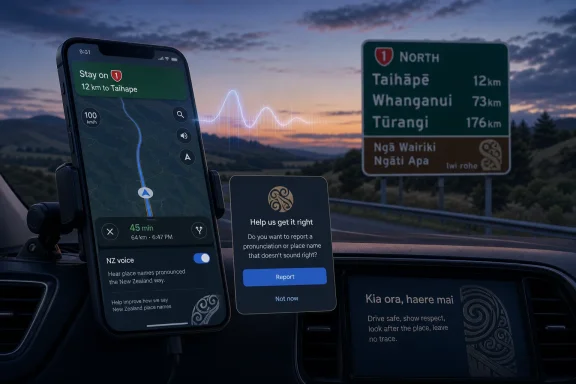
Google Maps is rolling out a new AI-powered New Zealand navigation voice in early July 2026 that speaks English with a Kiwi accent and is designed to pronounce te reo Māori cities and towns correctly. The update is small in the way software updates often are small: a voice changes, a setting appears, a familiar app sounds different on the drive home. But it also shows where consumer AI is becoming most consequential — not in grand demonstrations of machine intelligence, but in whether the machine can stop flattening local language into global default speech. For Google, this is a product localization story; for New Zealand, it is also a test of whether digital infrastructure can treat Indigenous language as something more than decorative metadata.
Navigation software has trained millions of people to hear place names as machine output. That is convenient until the machine repeatedly gets the name wrong, and the error becomes ambient: spoken at intersections, repeated in rental cars, overheard by children, normalized by tourists, and silently absorbed by anyone who relies on the app as an authority.
That is why Google’s New Zealand update matters. The company says the new Maps voice uses an AI-powered text-to-speech model that speaks English with a local accent while pronouncing towns and cities with te reo Māori names more accurately. It is not merely swapping an American or Australian-sounding voice for a Kiwi one; it is trying to solve the harder problem of placing Māori pronunciation inside an English navigation sentence without mangling either.
That distinction is important. A navigation voice does not speak in dictionary entries. It says “turn left toward…” or “continue on…” and drops a place name into a sentence at speed, under road noise, often while the driver is already making a decision. If the voice cannot handle the language switch cleanly, the result is not just awkward. It is wrong in a setting where wrongness is repeated at scale.
Google’s phrasing is careful, and it should be. The initial work focuses on cities and towns, with more street and road names planned. The company and its partners are not claiming perfection on day one. They are instead acknowledging something that technology companies usually prefer to hide: language localization is not a single release event, but a continuing relationship with speakers, institutions, data, and correction.
That matters because language technology is not neutral plumbing. A text-to-speech system encodes decisions about what counts as correct, whose accent is authoritative, how variant usage is handled, and whether data extracted from a language community returns value to that community. For an Indigenous language, those choices carry political and cultural weight that a conventional product team cannot responsibly wave away as “localization.”
The reported arrangement gives Te Taura Whiri an initial kaitiaki role over the Māori lexicon used in the system. That word, often translated in this context as a form of guardianship or stewardship, signals a different model from the usual platform bargain. Google is not simply vacuuming up pronunciations and pushing them into a black-box feature; at least in its public framing, it is treating the language resource as something that requires governance.
The long-term ambition is even more interesting. The plan described around the rollout is to establish a wider group of interested parties for the kaitiakitanga of the Māori data, with Māori academics, researchers, and communities able to access, contribute to, and benefit from it. That is the right direction, though the details will matter. Data stewardship sounds noble until it collides with licensing, API access, product priorities, and the commercial logic of a company whose maps are part of one of the most powerful advertising and mobile ecosystems on earth.
That is exactly why the update deserves attention. The most durable AI features may be the ones users stop noticing because they simply make the system less alien. A Maps voice that says local names correctly is not magic; it is infrastructure catching up with reality.
Text-to-speech has long been good at sounding fluent in major languages with large commercial datasets. It has been less good with languages that are underrepresented in training corpora, embedded in bilingual speech, or carried by communities that have good reason to distrust extractive data practices. Te reo Māori sits at the intersection of those issues: a living language with official status and deep cultural meaning, but also one that has had to fight for everyday visibility in institutions, media, and technology.
The technical challenge is not just phonetics. It is context. A system must know that a word is a Māori place name, apply the right pronunciation rules, preserve macrons and vowel length where relevant, and then blend the result into a natural English instruction. It must do this repeatedly, at consumer scale, across inconsistent map data and user settings. That is the sort of problem where AI is genuinely useful, not because it replaces human expertise, but because it can operationalize human-guided rules across millions of spoken directions.
For local drivers, correct pronunciation reduces friction. It makes audio directions feel less imported and less careless. For tourists, it provides a quiet form of education, one that happens in the exact moment a place name becomes useful. For new residents, it helps align what they see on road signs with what they hear in daily life.
There is also a safety and clarity argument. Voice navigation is valuable because drivers should not have to stare at the screen. If the spoken cue is confusing, comically distorted, or disconnected from the sign ahead, the driver is pushed back toward visual confirmation. Pronunciation will not solve every ambiguity in road guidance, but it can reduce one avoidable source of cognitive load.
The deeper point is that software products teach norms. When the most widely used map app in a country mispronounces Indigenous place names, it communicates that the mistake is acceptable because the machine made it. When the app improves, it communicates something else: that the local language is not an edge case, and that getting it right is part of product quality.
The company’s own caution makes the point. Users are being asked to report mispronunciations through Te Taura Whiri so the technology can be improved. That feedback loop is sensible, but it also turns the public into quality assurance for a system operated by one of the world’s largest technology companies. Community correction is valuable; community dependency is more complicated.
There is a familiar pattern in platform localization. A company launches a feature, celebrates local partnership, invites feedback, and then the hard maintenance work begins. Names change. Official data evolves. Communities disagree over usage. Edge cases pile up in suburbs, rural roads, historical names, and mixed-language contexts. The product team that championed the launch may move on, while the language community remains stuck with the consequences of whether maintenance is funded and prioritized.
That is why the governance language around kaitiakitanga should not be treated as ceremonial. The question is not only whether the first version sounds better. It is whether the system creates durable mechanisms for correction, access, accountability, and benefit-sharing after the press release fades.
This is especially true for younger users. If a child hears te reo Māori names correctly from family, school, broadcasters, and public institutions, but hears them mangled by the phone in the car, the device becomes a competing authority. The machine does not need to be intentionally disrespectful to do damage. Repetition is enough.
Google and Te Taura Whiri have already worked together under a memorandum of understanding signed in 2023, with earlier work including a localized Chromebook offering a reo Māori keyboard. The Maps voice now turns that relationship toward speech, which is both more intimate and more public. Keyboards make a language writable inside a computing environment. Navigation voices make it audible in the street.
That shift matters because speech technology is where many underrepresented languages have historically been weakest. It requires recordings, pronunciation validation, linguistic expertise, and enough product commitment to handle cases that do not fit dominant-language assumptions. When done badly, it can tokenize a language. When done well, it can make the language easier to use in ordinary moments.
That arrangement is more transparent than many AI projects, but it still raises the questions every language technology project should face. Who can inspect the data? Who can reuse it? What happens when the model improves because users submit corrections? Can Māori researchers and institutions build on the resource outside Google’s product environment? What limits exist on future uses?
These questions are not anti-technology. They are the price of taking language seriously. If the pitch is that AI can help secure te reo Māori in the digital age, then the data infrastructure behind that AI cannot be treated as a private byproduct of product development.
There is also the issue of commercial enclosure. Google Maps is a free consumer product at the point of use, but it is not a public utility. Its voice system sits inside Google’s ecosystem, governed by Google’s roadmap, licensing, privacy policies, and platform incentives. A successful collaboration can produce real public benefit while still leaving the underlying capability dependent on a private company’s priorities.
Every IT department knows this in less poetic terms. Names, scripts, keyboards, address formats, speech recognition, search indexing, compliance language, accessibility tooling, and identity systems all break in subtle ways when software assumes the world is smaller and more uniform than it is. Those failures are often dismissed as edge cases until they affect a customer, employee, citizen, or community at scale.
Microsoft has its own long history here, from language packs and input methods to speech services and regional settings in Windows and Azure. The arrival of AI assistants only raises the stakes. If Copilot, Google Assistant, Siri, Alexa, or any other interface becomes a front door to computing, then accent, pronunciation, and language handling become core accessibility and usability concerns.
The Google Maps update is a clean example because the output is so obvious. You can hear whether the product respects the place. In enterprise systems, the equivalent failures may be buried in garbled names, broken search, bad transliteration, inaccessible forms, or AI summaries that flatten multilingual context. The principle is the same: global software that cannot handle local language is unfinished software.
That model will not generalize neatly everywhere. Not every language has a single commission, and not every community will agree on who should speak for it. Some languages cross national borders. Some are primarily oral. Some have contested orthographies. Some are endangered precisely because institutions failed them.
Still, the principle is sound. For culturally significant language technology, the right partner is not just a vendor with recordings or a contractor with a spreadsheet. It is a governance structure capable of saying what accuracy means, how corrections should be handled, and who should benefit from the resulting data.
That is a harder path than scraping the web and shipping a model. It is slower, more political, and less convenient for product managers chasing quarterly metrics. It is also the path more likely to produce systems that communities actually trust.
 Google Maps Finally Learns That Place Names Are Not Just Labels
Navigation software has trained millions of people to hear place names as machine output. That is convenient until the machine repeatedly gets the name wrong, and the error becomes ambient: spoken at intersections, repeated in rental cars, overheard by children, normalized by tourists, and silently absorbed by anyone who relies on the app as an authority.That is why Google’s New Zealand update matters. The company says the new Maps voice uses an AI-powered text-to-speech model that speaks English with a local accent while pronouncing towns and cities with te reo Māori names more accurately. It is not merely swapping an American or Australian-sounding voice for a Kiwi one; it is trying to solve the harder problem of placing Māori pronunciation inside an English navigation sentence without mangling either.
That distinction is important. A navigation voice does not speak in dictionary entries. It says “turn left toward…” or “continue on…” and drops a place name into a sentence at speed, under road noise, often while the driver is already making a decision. If the voice cannot handle the language switch cleanly, the result is not just awkward. It is wrong in a setting where wrongness is repeated at scale.
Google’s phrasing is careful, and it should be. The initial work focuses on cities and towns, with more street and road names planned. The company and its partners are not claiming perfection on day one. They are instead acknowledging something that technology companies usually prefer to hide: language localization is not a single release event, but a continuing relationship with speakers, institutions, data, and correction.
The Partnership Is the Product
The most significant part of this update may not be the neural voice itself. It is the fact that Google built it with Te Taura Whiri i te Reo Māori, the Māori Language Commission, and used pronunciation rules guided by that body alongside publicly available New Zealand Geographic Board data.That matters because language technology is not neutral plumbing. A text-to-speech system encodes decisions about what counts as correct, whose accent is authoritative, how variant usage is handled, and whether data extracted from a language community returns value to that community. For an Indigenous language, those choices carry political and cultural weight that a conventional product team cannot responsibly wave away as “localization.”
The reported arrangement gives Te Taura Whiri an initial kaitiaki role over the Māori lexicon used in the system. That word, often translated in this context as a form of guardianship or stewardship, signals a different model from the usual platform bargain. Google is not simply vacuuming up pronunciations and pushing them into a black-box feature; at least in its public framing, it is treating the language resource as something that requires governance.
The long-term ambition is even more interesting. The plan described around the rollout is to establish a wider group of interested parties for the kaitiakitanga of the Māori data, with Māori academics, researchers, and communities able to access, contribute to, and benefit from it. That is the right direction, though the details will matter. Data stewardship sounds noble until it collides with licensing, API access, product priorities, and the commercial logic of a company whose maps are part of one of the most powerful advertising and mobile ecosystems on earth.
AI Localization Has Reached the Boring-But-Important Phase
This is not the AI story that dominates earnings calls. There is no chatbot pretending to be a lawyer, no image generator inventing a historical scene, no agent promising to complete your expense reports. Instead, the model does something both mundane and hard: it turns text into speech in a way that better fits the place where it is being used.That is exactly why the update deserves attention. The most durable AI features may be the ones users stop noticing because they simply make the system less alien. A Maps voice that says local names correctly is not magic; it is infrastructure catching up with reality.
Text-to-speech has long been good at sounding fluent in major languages with large commercial datasets. It has been less good with languages that are underrepresented in training corpora, embedded in bilingual speech, or carried by communities that have good reason to distrust extractive data practices. Te reo Māori sits at the intersection of those issues: a living language with official status and deep cultural meaning, but also one that has had to fight for everyday visibility in institutions, media, and technology.
The technical challenge is not just phonetics. It is context. A system must know that a word is a Māori place name, apply the right pronunciation rules, preserve macrons and vowel length where relevant, and then blend the result into a natural English instruction. It must do this repeatedly, at consumer scale, across inconsistent map data and user settings. That is the sort of problem where AI is genuinely useful, not because it replaces human expertise, but because it can operationalize human-guided rules across millions of spoken directions.
Correct Pronunciation Is a User-Experience Feature, Not a Cultural Ornament
It is tempting to file this update under cultural recognition and move on. That would undersell its practical importance. A navigation app that cannot pronounce the places it is navigating is a poorer navigation app.For local drivers, correct pronunciation reduces friction. It makes audio directions feel less imported and less careless. For tourists, it provides a quiet form of education, one that happens in the exact moment a place name becomes useful. For new residents, it helps align what they see on road signs with what they hear in daily life.
There is also a safety and clarity argument. Voice navigation is valuable because drivers should not have to stare at the screen. If the spoken cue is confusing, comically distorted, or disconnected from the sign ahead, the driver is pushed back toward visual confirmation. Pronunciation will not solve every ambiguity in road guidance, but it can reduce one avoidable source of cognitive load.
The deeper point is that software products teach norms. When the most widely used map app in a country mispronounces Indigenous place names, it communicates that the mistake is acceptable because the machine made it. When the app improves, it communicates something else: that the local language is not an edge case, and that getting it right is part of product quality.
The Rollout Also Exposes the Limits of Platform Goodwill
Google deserves credit for moving beyond a generic voice and working with a language authority. But this is still a platform company deciding when, where, and how a language becomes audible in its product. That power imbalance does not disappear because the update is welcome.The company’s own caution makes the point. Users are being asked to report mispronunciations through Te Taura Whiri so the technology can be improved. That feedback loop is sensible, but it also turns the public into quality assurance for a system operated by one of the world’s largest technology companies. Community correction is valuable; community dependency is more complicated.
There is a familiar pattern in platform localization. A company launches a feature, celebrates local partnership, invites feedback, and then the hard maintenance work begins. Names change. Official data evolves. Communities disagree over usage. Edge cases pile up in suburbs, rural roads, historical names, and mixed-language contexts. The product team that championed the launch may move on, while the language community remains stuck with the consequences of whether maintenance is funded and prioritized.
That is why the governance language around kaitiakitanga should not be treated as ceremonial. The question is not only whether the first version sounds better. It is whether the system creates durable mechanisms for correction, access, accountability, and benefit-sharing after the press release fades.
Google’s Maps Voice Joins a Broader Fight Over Digital Language Survival
The stakes are larger than one navigation app because digital assistants, search boxes, maps, keyboards, and translation tools increasingly define which languages feel usable in modern life. A language that is absent from everyday software is not merely missing a convenience feature. It is being made less visible in the interfaces where people now organize work, travel, school, and social life.This is especially true for younger users. If a child hears te reo Māori names correctly from family, school, broadcasters, and public institutions, but hears them mangled by the phone in the car, the device becomes a competing authority. The machine does not need to be intentionally disrespectful to do damage. Repetition is enough.
Google and Te Taura Whiri have already worked together under a memorandum of understanding signed in 2023, with earlier work including a localized Chromebook offering a reo Māori keyboard. The Maps voice now turns that relationship toward speech, which is both more intimate and more public. Keyboards make a language writable inside a computing environment. Navigation voices make it audible in the street.
That shift matters because speech technology is where many underrepresented languages have historically been weakest. It requires recordings, pronunciation validation, linguistic expertise, and enough product commitment to handle cases that do not fit dominant-language assumptions. When done badly, it can tokenize a language. When done well, it can make the language easier to use in ordinary moments.
The Data Question Will Outlive the Launch
The most unresolved part of the story is data. According to the material around the rollout, the New Zealand AI voice was trained using new recordings from a Kiwi voice actor selected for both local accent and strong te reo Māori pronunciation. Te Taura Whiri and Google worked together to select the voice and validate recording quality, while Google supported data collection through funding and infrastructure and holds a licence to use pronunciation data.That arrangement is more transparent than many AI projects, but it still raises the questions every language technology project should face. Who can inspect the data? Who can reuse it? What happens when the model improves because users submit corrections? Can Māori researchers and institutions build on the resource outside Google’s product environment? What limits exist on future uses?
These questions are not anti-technology. They are the price of taking language seriously. If the pitch is that AI can help secure te reo Māori in the digital age, then the data infrastructure behind that AI cannot be treated as a private byproduct of product development.
There is also the issue of commercial enclosure. Google Maps is a free consumer product at the point of use, but it is not a public utility. Its voice system sits inside Google’s ecosystem, governed by Google’s roadmap, licensing, privacy policies, and platform incentives. A successful collaboration can produce real public benefit while still leaving the underlying capability dependent on a private company’s priorities.
For Windows and IT Pros, This Is a Reminder That Localization Is Infrastructure
At first glance, a Google Maps voice in New Zealand may seem far from the usual WindowsForum beat of operating systems, enterprise administration, Copilot buttons, and patch management. It is not. The same underlying lesson applies across the software stack: localization is not a cosmetic layer applied after the real engineering is done.Every IT department knows this in less poetic terms. Names, scripts, keyboards, address formats, speech recognition, search indexing, compliance language, accessibility tooling, and identity systems all break in subtle ways when software assumes the world is smaller and more uniform than it is. Those failures are often dismissed as edge cases until they affect a customer, employee, citizen, or community at scale.
Microsoft has its own long history here, from language packs and input methods to speech services and regional settings in Windows and Azure. The arrival of AI assistants only raises the stakes. If Copilot, Google Assistant, Siri, Alexa, or any other interface becomes a front door to computing, then accent, pronunciation, and language handling become core accessibility and usability concerns.
The Google Maps update is a clean example because the output is so obvious. You can hear whether the product respects the place. In enterprise systems, the equivalent failures may be buried in garbled names, broken search, bad transliteration, inaccessible forms, or AI summaries that flatten multilingual context. The principle is the same: global software that cannot handle local language is unfinished software.
The Best AI Features May Be the Ones With Human Institutions Built In
There is a fashionable idea that AI systems improve mainly by scaling: more data, more parameters, more compute, more users. This Maps update points to a more grounded model. The voice improves because a platform company pairs machine learning with an institution that carries linguistic authority and community responsibility.That model will not generalize neatly everywhere. Not every language has a single commission, and not every community will agree on who should speak for it. Some languages cross national borders. Some are primarily oral. Some have contested orthographies. Some are endangered precisely because institutions failed them.
Still, the principle is sound. For culturally significant language technology, the right partner is not just a vendor with recordings or a contractor with a spreadsheet. It is a governance structure capable of saying what accuracy means, how corrections should be handled, and who should benefit from the resulting data.
That is a harder path than scraping the web and shipping a model. It is slower, more political, and less convenient for product managers chasing quarterly metrics. It is also the path more likely to produce systems that communities actually trust.
A Small Voice Update Carries a Very Large Product Lesson
Google’s new Maps voice should be judged by how it performs in the wild, not by how good the announcement sounds. The first version will likely make mistakes, and the most revealing measure will be how quickly and respectfully those mistakes are corrected. But even with that caveat, the update already offers several concrete lessons.- Google Maps users in New Zealand are getting a new AI-powered text-to-speech voice that uses a Kiwi accent and is designed to pronounce te reo Māori towns and cities correctly.
- The pronunciation approach has been guided by Te Taura Whiri i te Reo Māori and supported by public New Zealand Geographic Board data.
- The initial rollout focuses on cities and towns, while further work on street and road names is expected to follow.
- Users are being encouraged to report mispronounced te reo Māori place names so the system can be corrected over time.
- The most important precedent is not the voice alone, but the combination of AI engineering, language authority, data stewardship, and ongoing community feedback.
References
- Primary source: blog.google
Published: Fri, 03 Jul 2026 15:46:01 GMT
Google Maps has an authentic new voice in New Zealand
The new voice speaks English with a Kiwi accent while accurately pronouncing indigenous place names.blog.google - Independent coverage: Driven Car Guide
Published: 2026-07-03T13:50:10.318870
Google Maps employs AI to create Kiwi voice that speaks te reo Māori place names correctly
Google Maps is rolling out new text-to-speech (TTS) software for New Zealand that will correctly pronounce Aotearoa place names "the way they should sound".www.drivencarguide.co.nz
- Related coverage: 55a.info
ニュージーランドでGoogleマップ音声がマオリ語地名の発音改善! | ココア留学
ニュージーランド滞在中に欠かせないGoogleマップの音声案内で、マオリ語の地名をより正確に読み上げる新機能が発表されました。現地メディアのRNZが2026年7月2日付で報じています。55a.info
- Related coverage: en.tetaurawhiri.govt.nz
Google Text to Speech - Te Taura Whiri i te Reo Māori
Promoting the use of Māori as a living language and as an ordinary means of communicationen.tetaurawhiri.govt.nz - Related coverage: rnz.co.nz
Why Google Maps can't pronounce Māori place names | RNZ
It is unacceptable that AI tools and global tech companies are still lagging in te reo pronunciation, a Māori tech innovator says. www.rnz.co.nz
- Related coverage: tarmaclife.co.nz
Choyce - Google Maps Adds Kiwi Voice That Correctly Pronounces Māori Place Names | Tarmac Life | Motoring | Tech | Experiences
Google Maps has introduced a new navigation voice for New Zealand users that speaks English with a Kiwi accent and accurately pronounces indigenous Māori place names, developed in partnership with the Māori Language Commission.www.tarmaclife.co.nz
- Related coverage: tetaurawhiri.govt.nz
Google Maps - Te Taura Whiri i te Reo Māori
Ko te kaupapa e tū nei mātou, ko te whakaora ake i te reo Māoriwww.tetaurawhiri.govt.nz - Related coverage: the-independent.com
Why Google has launched a new voice for Maps in New Zealand | The Independent
www.the-independent.com
- Related coverage: teaonews.co.nz
Te reo Māori pronunciation to be improved on Google Maps – Te Ao Māori News
Google Maps and Te Taura Whiri launch a Kiwi-accent TTS to correctly pronounce Māori place names, aligned with Te Wiki o te Reo Māori 2026 theme.www.teaonews.co.nz
- Related coverage: fliki.ai
Free Maori Text to Speech: Realistic AI Voices | Fliki
Convert text to natural Maori speech with realistic AI voices. Free Maori text-to-speech in 80+ dialects with emotion control, voice cloning, and MP3 export. No credit card required. fliki.ai
- Related coverage: maorigis.nz
Place names | Māori GIS Mapping
Place names, ingoa wāhi, are not just labels. In Aotearoa they often carry whakapapa, history, rights, responsibilities, and ongoing relationships between people and whenua. Good naming practice improves map quality, supports te reo Māori, and reduces confusion in governance, engagement...maorigis.nz - Related coverage: mpp.govt.nz
