

Google Maps Is No Longer Content to Point at the Restaurant
For most of its life, Google Maps has been a spectacularly successful answer engine for physical space. It tells you where something is, how long it will take to get there, whether it is open, what the menu looks like, and whether strangers on the internet think the fries are worth the detour. That already gives Google enormous influence over where people spend money.
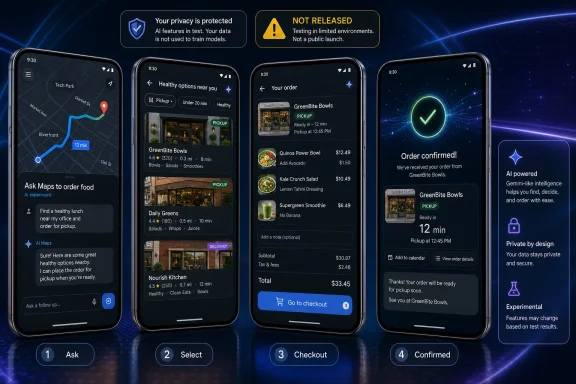
The possible “Ask Maps to order food” feature moves one step further down the funnel. Instead of helping you choose a restaurant and then sending you elsewhere to act, Maps could become the place where discovery, decision, ordering, payment confirmation, and pickup instructions live in one continuous flow. That is not a minor interface tweak. It is Google trying to collapse the distance between intent and transaction.
Android Authority’s teardown reportedly surfaced promotional language such as “Ask Maps to order food,” “say what you’re craving,” and “Maps will order for you — even while you’re on the go.” Those phrases sound like marketing copy, not merely internal plumbing. They suggest Google is at least experimenting with a consumer-facing pitch: tell Maps what you want, and Gemini will handle the messy bits.
That messy middle is where food ordering apps, restaurant websites, point-of-sale providers, and delivery marketplaces have built their businesses. Google already mediates attention. If Maps starts mediating action, the balance of power shifts again.
APK Teardowns Are Clues, Not Commitments
The first caveat is the least exciting and the most important: APK teardowns are not product announcements. Android Authority has made a long-running beat out of examining unreleased Android app code, and the method is useful precisely because modern apps often ship dormant strings, flags, and UI fragments before a feature is enabled. But unreleased code can represent experiments, abandoned ideas, limited dogfood tests, region-specific pilots, or scaffolding for something that changes completely before launch.
Google has not announced “Ask Maps to order food.” It has not published a support page, named launch markets, identified restaurant partners, or said whether the feature would support pickup, delivery, dine-in ordering, reservations, or some combination of those. Khaleej Times correctly noted that there is no official timeline and no indication of UAE availability. Reports suggesting early U.S. testing are speculation unless Google confirms them.
That uncertainty matters because the food-ordering market is operationally ugly. Menus change. Prices change. Restaurant hours are wrong. Delivery availability varies by geography, staffing, and platform contracts. Payment flows trigger fraud controls. Dietary notes and substitutions are easy for humans to misunderstand and easier for software to mangle. The gap between a demo and a dependable consumer service is wide.
Still, the teardown is newsworthy because it fits Google’s visible direction. This is not a random feature idea floating in isolation. It aligns with a year of messaging from Google in which Gemini becomes less of a chatbot and more of a system that acts across apps, surfaces, and services.
Gemini’s Real Job Is to Make Google’s Surfaces Transactional
Google’s AI strategy is often described as a race against OpenAI, Microsoft, Anthropic, Apple, or Meta. That framing is true but incomplete. Google is also racing against the limitations of its own products. Search, Maps, Gmail, Android, Chrome, and YouTube are extraordinary discovery systems, but each one has historically stopped at a boundary where the user must decide, click, install, compare, fill out, confirm, or pay.
Agentic AI is Google’s proposed bridge across those boundaries. The industry word agentic has been abused badly enough to deserve suspicion, but in this case it has a concrete meaning: an assistant that does not merely answer a question, but performs a sequence of actions toward a goal. Ordering food is a clean example. The user expresses intent, the agent interprets constraints, navigates options, prepares a transaction, and asks for confirmation before money moves.
That final confirmation is critical. According to the reporting around the teardown, payment approval would still require user confirmation. That is both a safety mechanism and a legal necessity. Nobody wants a hallucinating assistant ordering eight biryanis because it misunderstood “find me a place near the office that does biryani.”
But confirmation does not eliminate agency. If Gemini builds the cart, chooses the restaurant, selects the branch, applies the pickup time, and presents a final approval screen, the assistant has already done most of the economically meaningful work. The last tap becomes less a shopping decision than a sign-off on Google’s proposed answer.
That is why food ordering is strategically attractive. It turns Maps from a recommendation layer into an execution layer. Google does not need to own the kitchen, the courier fleet, or the point-of-sale terminal to capture influence. It only needs to become the trusted interface through which the user asks for dinner.
The Map Becomes the Checkout Lane
Google Maps already sits at an awkwardly powerful intersection. It knows where you are, where you are going, what is nearby, what is open, what is busy, what other users reviewed, what photos show, and which businesses have paid for visibility. Add an AI ordering layer, and Maps begins to resemble a checkout lane placed directly on top of the real world.
That has obvious consumer appeal. If you are driving home, Maps could know your route, show restaurants near the next exit, filter by closing time, suggest something based on past behavior, and prepare a pickup order that is ready shortly after arrival. The fewer screens involved, the better the experience feels.
But convenience is not neutral. Every simplification hides choices. Which restaurant is suggested first? Which menu provider is used? Are prices pulled from the restaurant, a third-party marketplace, or Google’s own structured data? Does Gemini favor places with direct ordering support, paid placement, better data hygiene, higher ratings, faster fulfillment, or some opaque blend of signals?
Those questions already exist in Maps search results, but ordering raises the stakes. A ranked list influences consideration. A prefilled cart influences spending. A suggested substitution influences what the restaurant prepares and what the customer pays.
For restaurants, this could be both opportunity and dependency. A small business that struggles to maintain its own mobile app may welcome orders from Maps. But if Google becomes the interface customers use, the restaurant’s relationship with the customer may become even more intermediated than it already is.
DoorDash and Uber Eats Should Worry, but Not Panic
It is tempting to describe this as Google Maps preparing to replace delivery apps. TechRadar’s coverage leaned into that possibility, and the phrase makes for a clean headline. The reality is likely more complicated.
DoorDash, Uber Eats, Deliveroo, Talabat, Zomato, Swiggy, Just Eat, and similar platforms are not just menus with checkout buttons. They handle courier logistics, restaurant onboarding, refunds, substitutions, support, promotions, batching, fraud, and local regulatory complexity. Google can integrate with those systems, compete with pieces of them, or route around them in pickup-first scenarios, but replacing them outright would require operational commitments Google may not want.
A more plausible first version is not “Google becomes DoorDash.” It is “Google becomes the front door.” Maps could let Gemini assemble an order and then hand off fulfillment to a partner, a restaurant’s direct ordering system, or a local commerce provider. That would still be significant, because the user may never consciously choose the intermediary. The marketplace becomes plumbing.
That is a familiar Google move. Chrome made the web feel like an app platform. Search made publisher pages feel like answer sources. Android made carriers and OEMs coexist inside Google’s service layer. Maps could do something similar to food ordering: leave the messy infrastructure to others while owning the user’s intent.
Delivery platforms can survive that world, but they would have to bargain from a different position. If Maps controls the first prompt — “I’m hungry, order something near me” — then food apps compete to fulfill an instruction rather than to capture attention. That is a colder, more commoditized place to live.
The Subscription Question Is the Shadow Over Every AI Feature
Khaleej Times noted the obvious possibility that advanced AI actions inside Maps could eventually intersect with Google’s paid AI offerings, though there is no evidence that this particular food-ordering feature would require a Gemini Advanced or Google AI subscription. That caveat is important. There is no confirmed pricing model because there is no confirmed feature.
Still, the question will not go away. AI features cost money to run, and the industry has spent the past two years training users to expect premium AI capabilities to live behind subscriptions. Google has to decide whether agentic Maps features are core utilities, premium upsells, ad-supported commerce tools, or some hybrid of all three.
Each model creates different incentives. If the feature is free, Google may monetize through commerce relationships, ads, promoted placements, or increased Maps engagement. If it is paid, the assistant becomes another reason to subscribe to Google’s AI bundle. If restaurants or ordering providers pay for privileged integration, Maps risks turning into a more transactional and less trusted local guide.
Trust is the scarce resource here. Users will tolerate ads in search results and sponsored pins in Maps because they understand the rough shape of the bargain. They may be less forgiving if an AI assistant quietly nudges them toward a worse restaurant because it is better integrated, more profitable, or easier for the system to complete.
That does not mean Google will do that. It means the design must be legible enough for users to know when they are receiving a recommendation, when they are seeing a paid opportunity, and when the assistant is selecting based on operational constraints rather than taste.
Privacy Is Not a Side Issue When the Assistant Knows Where You Eat
Food ordering through Maps sounds mundane, which is exactly why the privacy implications matter. Location, appetite, purchase history, payment confirmation, travel route, dietary preferences, religious or health-related restrictions, and household routines can all intersect in a single order. A map that orders food is not merely processing a transaction; it is observing behavior at a deeply personal level.
Google already has policies governing account data, location history, payment information, ad personalization, and Gemini interactions. But AI agents create new combinations of data that users may not intuitively understand. A person may be comfortable asking Maps for “Thai food near me” and separately comfortable saving a payment method. They may feel differently when an assistant uses location, reviews, prior behavior, menu data, and inferred timing to propose a specific order.
The most sensitive risks are not always dramatic. A shared phone could reveal repeated visits to a clinic-adjacent café. A work account could expose late-night food habits. A family device could surface order history that implies religion, health conditions, pregnancy, addiction recovery, or income stress. Food is ordinary until it becomes data.
Google will likely frame confirmation as a safety layer, and it is one. But confirmation mainly protects against unauthorized spending. It does less to answer broader questions about what data was used, what was retained, whether prompts train models, how third parties receive information, and how users can audit or delete the assistant’s transactional trail.
For WindowsForum readers, the parallel with enterprise AI should be obvious. The hard part is not making an assistant click buttons. The hard part is identity, consent, logging, data minimization, policy enforcement, and rollback when the assistant does the wrong thing.
Android Is the Test Bed, but the Implications Cross Platforms
This story starts with the Android version of Google Maps, but it should not be read as an Android-only curiosity. Google Maps is a cross-platform service. Gemini is a cross-surface strategy. The eventual target is not merely the Android phone in your pocket, but the broader set of places where Google can intermediate intent: car dashboards, browsers, watches, tablets, smart displays, and possibly desktop web experiences.
Android is simply where Google can move fastest. It controls more of the stack, can test deeper system integrations, and can tie Gemini to app actions in ways that are harder on iOS. The same pattern has shown up repeatedly: Android gets the ambitious assistant behavior first, while other platforms receive a constrained or delayed version.
For IT professionals, the platform angle matters because consumer AI behaviors tend to leak into workplace expectations. If users become accustomed to saying “order lunch near the client site” or “book the cheapest ride after this meeting,” they will soon expect similar agentic workflows in Outlook, Teams, Windows, Salesforce, ServiceNow, SAP, and internal portals. The consumer map becomes a training ground for enterprise automation.
Microsoft is pursuing a similar broad thesis with Copilot across Windows, Microsoft 365, Edge, and Azure. Google’s Maps experiment is narrower, but it may be more tangible. Ordering food is a small task that users understand instantly. If it works, it makes agentic AI feel less like a conference demo and more like a utility.
That is why this sort of feature matters even to people who never order takeout from Maps. It is a prototype for a new interface contract: tell the computer the outcome, let it negotiate the steps, approve the final action.
The Real Competition Is for the Last Human Click
The phrase “AI ordering food” invites sci-fi exaggeration, but the business contest is brutally practical. The most valuable moment in digital commerce is often the last human click before purchase. Whoever controls that moment can shape comparison, extract fees, steer demand, and collect data.
Historically, restaurants fought to appear in search results, then in Maps listings, then in delivery apps, then in social feeds. An agentic Maps feature compresses those battlegrounds. The user may not search “best shawarma near me” at all. They may simply tell Gemini, “Order something quick on my route that I’ll like.”
That prompt is a gold mine. It contains intent, context, timing, and preference in one sentence. Traditional search ads were built around keywords. Agentic commerce is built around goals.
The uncomfortable possibility is that users may stop browsing. Browsing is inefficient, but it is also where comparison happens. An agent that produces one confident answer can be delightful when the answer is right and quietly distorting when it is not.
This is the same tension that has defined AI search. A list of links distributes agency across the user, publisher, and platform. A synthesized answer centralizes it. In local commerce, a completed order centralizes it even more.
Restaurants Will Be Asked to Optimize for the Agent
If “Ask Maps to order food” becomes real, restaurants will face a new kind of search engine optimization. It will not be enough to have good food or good photos. Businesses will need clean structured menus, accurate prices, current hours, reliable fulfillment, clear allergen and dietary metadata, fast response times, and integration paths that an AI agent can execute without ambiguity.
That may reward professionalized operators and penalize smaller restaurants with messy but beloved menus. The family-run place with a scanned PDF menu, inconsistent hours, and a phone-only ordering workflow could become less visible to the agent than a chain restaurant with pristine data. In the old Maps world, a determined user might still find the quirky local favorite. In the agentic world, the assistant may route around friction.
Google can mitigate this by investing in better data ingestion and by making the assistant transparent about why it cannot order from a given place. But the commercial pressure will be real. Once users expect the assistant to act, businesses that cannot be acted upon may appear broken.
That is a major shift in the digital burden on local businesses. First they needed websites. Then they needed Google Business Profiles. Then they needed delivery app presence. Now they may need to be machine-readable enough for AI agents to transact on their behalf.
The Safety Model Needs More Than a Confirm Button
A payment confirmation screen is necessary, but it is not a full safety model. The assistant must also avoid ordering from the wrong branch, confusing pickup and delivery, ignoring allergy notes, selecting unavailable items, accepting price changes without clarity, or placing orders when the user’s context has changed. In food, small mistakes are not always small.
There are also social and legal edge cases. What happens when a minor uses a family device? How are alcohol orders handled? What about restricted items, delivery to workplaces with security rules, or orders that include medical dietary constraints? If the assistant misreads “gluten-free” as a preference rather than a requirement, the consequences can be serious.
The challenge is that agentic AI often looks best in demos where the world is clean. Real commerce is full of half-updated menus, unavailable ingredients, ambiguous modifiers, timeouts, third-party redirects, and human staff who improvise. The agent has to know when to stop and ask.
That may be the design principle that determines whether users trust it. A good AI agent is not the one that acts most aggressively. It is the one that understands the difference between routine automation and a decision that needs human judgment.
The Dinner Order Is a Preview of the Next Platform War
The most concrete facts are modest, but the direction is not. Android Authority found unreleased Google Maps code pointing to AI-assisted food ordering. Khaleej Times and other outlets reported the finding with appropriate caution. Google has not confirmed the feature, launch timing, regions, partners, or pricing. Yet the idea fits too neatly into Google’s Gemini strategy to dismiss as a stray experiment.
If Google ships this, the headline feature will be convenience. The strategic feature will be control. Maps would become a place where local intent turns into completed commerce, with Gemini acting as the interpreter between human desire and machine-executable systems.
Here is the short version of what is worth remembering:
- Google Maps has not officially launched AI food ordering, and the current evidence comes from unreleased Android app code examined by Android Authority.
- The reported strings suggest a Gemini-powered “Ask Maps to order food” experience that could prepare an order while still requiring user confirmation before payment.
- The feature would fit Google’s broader agentic AI push, in which Gemini moves from answering questions to completing multi-step tasks.
- Delivery apps are unlikely to be replaced overnight, but they could become less visible if Maps controls the user’s first instruction and routes fulfillment in the background.
- Restaurants may face pressure to keep menus, hours, pricing, and ordering integrations clean enough for AI agents to use reliably.
- Privacy, transparency, payment safety, and recommendation bias will matter as much as convenience if Maps becomes a transactional assistant.
The safest prediction is not that Google Maps will definitely order your next dinner, but that Google wants its products to stop handing off your intent at the moment money, movement, or commitment enters the picture. A map that can order food is not really about food; it is about turning Google’s knowledge of the world into the ability to act within it, and the next fight will be over how much of that agency users are willing to delegate.
References
- Google Maps could soon order food for you using AI - Khaleej Times Khaleej Times · Sun, 05 Jul 2026 14:08:56 GMT