

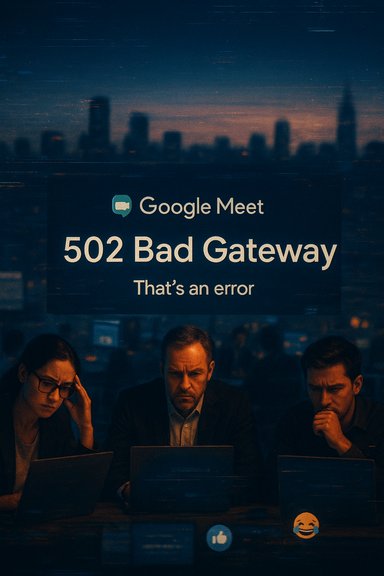
Google Meet users across India were abruptly locked out of scheduled meetings on Wednesday morning after a sudden service disruption left hundreds — and shortly thereafter thousands — reporting failures to join or host calls, with many screens showing the familiar web error message “502. That’s an error.”
Google Meet is one of the most widely used video-conferencing services for businesses, schools, and government agencies. It sits within the broader Google Workspace suite and is relied upon for everything from routine team meetings and client calls to high-stakes interviews and online classes. Outages on platforms of this scale ripple quickly: when core conferencing links fail, entire schedules and workflows can collapse for affected organizations.
This event unfolded during normal business hours, amplifying the impact. Outage-monitoring services recorded an initial surge of reports within minutes, and the incident became the dominant topic across social networks as users shared screenshots, complaints, and — in true internet fashion — memes celebrating an unexpected break from back-to-back calls.
Caveat: the precise root cause must come from the provider’s post-incident analysis. Any hypothesized cause above is grounded in typical engineering diagnostics for 502s at scale, but is not definitive for this particular incident.
Important limits of public telemetry:
What to expect next:
Two important caveats:
For IT teams, the practical steps are straightforward and actionable: keep a tested alternate conferencing option ready, maintain secure defaults so emergency switches do not weaken protections, integrate provider-status checks into your incident workflows, and record operational impact precisely for post-incident vendor discussions. For business leaders, the incident is a nudge to quantify the risk of concentrated dependencies and to invest in contingency that matches the organization’s operational criticality.
Until the provider’s full post-mortem is published, the exact technical pathway that produced this outage will remain speculative. The measured response now is to harden immediate practices, communicate consistently with stakeholders, and use the incident as a catalyst to strengthen long-term operational resilience.
Source: The Hans India Google Meet Outage in India: Users Unable to Join Meetings, 981 Reports on Downdetector
 Background
Google Meet is one of the most widely used video-conferencing services for businesses, schools, and government agencies. It sits within the broader Google Workspace suite and is relied upon for everything from routine team meetings and client calls to high-stakes interviews and online classes. Outages on platforms of this scale ripple quickly: when core conferencing links fail, entire schedules and workflows can collapse for affected organizations.This event unfolded during normal business hours, amplifying the impact. Outage-monitoring services recorded an initial surge of reports within minutes, and the incident became the dominant topic across social networks as users shared screenshots, complaints, and — in true internet fashion — memes celebrating an unexpected break from back-to-back calls.
What happened: an verified timeline
- Early morning / mid-day (local time): users attempting to join Google Meet sessions reported failures and were presented with a 502 Bad Gateway error. This message indicates an intermediary server received an invalid response when trying to fulfill a request — a sign the fault is likely on the service provider or intermediary layer rather than on individual user devices or home networks.
- Within minutes: an outage-tracking site began aggregating user-reported incidents. Reports quickly climbed into the hundreds; an early snapshot showed 981 reports logged by 11:49 AM in India.
- Peak reporting: the surge continued and later snapshots recorded peak reports in the region numbering in the mid-to-high thousands, with a common breakdown of complaints indicating most users could not access the website interface, a substantial fraction experienced server connection problems, and a small minority saw degraded video quality.
- Resolution window: the platform’s status monitoring indicated the incident affected traffic in the Asia region and that the issue was subsequently marked as resolved after engineers intervened. The company said it would publish an analysis once the internal investigation was completed.
Symptoms and user experience
The visible errors
- “502. That’s an error.” — This was the most-common message reported by affected users when accessing meet.google.com from desktop browsers.
- Failed meeting joins and login errors — many users reported being unable to enter scheduled meetings even when meeting links were valid.
- Desktop vs. mobile divergence — anecdotal reports suggested desktop web access was hit harder; mobile users were able to join in some cases via the smartphone app or mobile browser.
How people reacted
- Immediate business disruption: teams canceled or delayed meetings, and some organizations had to scramble to temporary alternatives such as phone bridges or other conferencing services.
- Social-media amplification: frustrated users posted screenshots and queries across social networks. Corporate workers contributed humor and memes — a small relief for those suddenly freed from video calls.
- IT frontlines: help-desks saw spikes in tickets. Many admins fielded basic troubleshooting calls even though the issue originated on the provider side.
Technical analysis — what a “502 Bad Gateway” typically means
A 502 Bad Gateway status is a generic HTTP response code returned when a server acting as a gateway or proxy (for example, load balancers, reverse proxies, or CDN edges) receives an invalid response from an upstream server. In large distributed services like Google Meet, a 502 can be symptomatic of several conditions:- Edge or caching layer failures (CDN or reverse proxy returns invalid or truncated responses).
- Overloaded upstream services: backend nodes failing to respond timely under load.
- Misconfiguration or a bad deployment that introduced an error into the request path.
- Networking or routing issues between critical clusters or service regions.
- Authentication or token validation services failing, which can manifest as login or join failures.
Caveat: the precise root cause must come from the provider’s post-incident analysis. Any hypothesized cause above is grounded in typical engineering diagnostics for 502s at scale, but is not definitive for this particular incident.
Verification and cross-checks
Independent monitoring services and multiple reporting outlets captured consistent signals: the outage was real, concentrated in India (with some cross-region spill), and surfaced quickly in user experience metrics. The platform’s official status dashboard acknowledged that customers had difficulties loading the Meet domain in the Asia region and later indicated the disruption had been resolved. These cross-checked data points help validate the timeline and scope described above, though they do not substitute for the provider’s internal incident report.Important limits of public telemetry:
- Outage-tracking sites and social reports are useful early indicators but reflect sample-based, user-submitted data rather than comprehensive backend telemetry.
- Report counts should be treated as indicative of user experience scale, not precise measurements of total affected sessions or users.
Impact assessment
Immediate operational impacts
- Work disruption: teams with heavy reliance on scheduled video calls — sales demos, interviews, client check-ins — faced delays and rescheduling headaches.
- Education and public services: remote classes and civic meetings were interrupted, which can have outsized effects when alternative arrangements are hard to mobilize quickly.
- Business continuity strain: smaller businesses and sole proprietors without multi-platform redundancy were pushed to either postpone or accept degraded communication via phone or chat.
IT and security considerations
- Rapid switchovers to alternative platforms increase surface area risk: hurriedly joining an alternate conferencing solution can bypass standard IT controls, potentially exposing meetings to weaker authentication or less-secure settings.
- SAML and SSO failures: if a company had SSO integration with the affected provider, a provider-side outage could cascade into login difficulties for other dependent services.
- Post-outage compliance: organizations should expect to review how the interruption affected contractual service levels and audit logs for any data integrity or policy concerns.
Practical workarounds and immediate steps for users and admins
When a primary conferencing provider experiences an outage, the following practical steps reduce disruption and preserve security posture.- Quick user-side workarounds:
- Attempt joining via the mobile app (Android/iOS) — some incidents show mobile paths are routed differently and can still function.
- Use dial-in (PSTN) options where available as a stopgap.
- Share meeting content via cloud document links with read-only permissions to continue discussions asynchronously.
- IT administrator checklist:
- Check the provider status dashboard for official updates and timeframe estimates.
- Communicate to staff via internal channels (email, chat) about the outage and approved fallback options to avoid shadow IT.
- Enable temporary guest access or phone dial-ins to critical meetings while preserving access controls.
- Monitor authentication logs and SSO dashboards for any abnormal behavior during the outage window.
- Document the incident’s operational impact for later SLA and vendor review.
- Longer-term resilience measures:
- Maintain a documented, tested failover plan that includes at least one alternate conferencing platform and procedures for secure migration.
- Keep staff trained on fallback options and conduct tabletop drills to simulate conferencing platform outages.
- Consider contractual SLAs and redundancy options when negotiating with critical communications vendors.
What this outage reveals about public cloud dependency
The incident is a reminder of the trade-offs in modern IT design. Cloud-hosted productivity stacks offer scale, feature velocity, and tight integration, but they also concentrate risk when a core component fails. Key takeaways:- Centralization risk: relying on a single vendor for core communications concentrates operational dependency.
- Supply-chain coupling: outages in network edge services, CDNs, or identity providers can have outsized knock-on effects.
- Need for robust runbooks: organizations that maintained tested fallback processes saw less disruption than those without contingency plans.
Corporate response and post-incident expectations
The platform acknowledged the issue on its status dashboard and indicated the disruption was resolved after engineering intervention. Official acknowledgments on provider status pages often include a brief timeline and a promise to publish a fuller incident analysis later. In previous incidents of a similar nature, root-cause posts have ranged from configuration regressions to software defects in edge caching systems, and the provider typically shares a post-mortem once internal audits conclude.What to expect next:
- A formal post-incident report clarifying the root cause, corrective actions, and preventive measures.
- Potential operational remediation (configuration changes, enhanced monitoring, rollback safeguards).
- Customer support guidance for organizations seeking credit for SLA breaches or detailed session logs showing impact windows.
Risks and downsides beyond immediate downtime
- Business continuity risk: repeated or prolonged outages can cause customer churn, lost revenue, and damaged reputation for companies that rely heavily on a single conferencing provider.
- Security posture drift: frequent switches to alternate platforms in the heat of the moment can lead to meetings using weaker security defaults (open meetings, lax authentication), increasing risk of unauthorized access.
- Contractual and regulatory exposure: service interruptions may trigger contractual remedies, but proving financial loss and measuring actual impact requires precise log data and time-stamped evidence from both the provider and the affected organization.
- Psychological and productivity cost: the cumulative effect of interruptions, rescheduling, and extra coordination imposes a non-trivial productivity tax on distributed teams.
Recommendations for Windows-focused IT teams and administrators
- Harden meeting policies: apply default secure meeting settings (waiting rooms, meeting locks, authenticated participants) on all platforms to avoid rushed, insecure setups during outages.
- Maintain a vetted secondary conferencing tool: ensure it is configured with company SSO, has approved security settings, and is accessible to all staff.
- Automate status checks: incorporate provider-status monitoring into your internal alerting systems to quickly notify users and trigger failover procedures.
- Update runbooks for the modern hybrid workplace:
- Define clear escalation thresholds for when to move to alternate tooling.
- Pre-approve alternate vendors and maintain license pools for emergency usage.
- Train staff quarterly on fast-switch procedures and secure configuration templates.
- Post-incident review: after the outage, hold a lessons-learned session with stakeholders to document impact, evaluate supplier performance, and revise continuity plans.
Strategic lessons for IT leaders
- Contractual clarity: verify SLAs and what constitutes compensable downtime; ensure the provider's contractual remedies are meaningful relative to your financial exposure.
- Multi-provider strategy: build an architecture where not all critical paths rely on a single external vendor. For communications, this might mean parallel accounts with a second provider or a hybrid redundancy model.
- Vendor transparency and telemetry: push for improved transparency on incident data and timely communication channels from providers; consider integrating provider status feeds into your own incident response dashboards.
- Resilience over convenience: as the hybrid workplace matures, resilience planning must be elevated from the IT backburner to board-level risk management.
Final analysis and caveats
This outage underscores the fragility that emerges when large numbers of users concentrate on a single cloud-hosted service for core business operations. The 502 error and the geographic concentration of reports point to a service-side failure that impacted web access pathways for many desktop users, while mobile paths sometimes remained available.Two important caveats:
- Public report counts and social-media signals are noisy and useful for early-warning, but they are not substitutes for vendor telemetry. The true scope — number of affected sessions, exact failure modes, and precise root cause — will be known only after the provider publishes a post-incident report.
- Any technical attribution here draws on typical causes for 502 errors in distributed systems; it is not an official root-cause statement.
Conclusion
The Google Meet disruption that left hundreds — and then thousands — of users unable to join scheduled meetings is a clear reminder that modern work infrastructure, while immensely powerful, is not immune to sudden failures. Quick mitigation (switching to mobile apps, phone bridges, or alternate platforms) limited some immediate damage, but the broader lesson is systemic: resilience needs deliberate planning.For IT teams, the practical steps are straightforward and actionable: keep a tested alternate conferencing option ready, maintain secure defaults so emergency switches do not weaken protections, integrate provider-status checks into your incident workflows, and record operational impact precisely for post-incident vendor discussions. For business leaders, the incident is a nudge to quantify the risk of concentrated dependencies and to invest in contingency that matches the organization’s operational criticality.
Until the provider’s full post-mortem is published, the exact technical pathway that produced this outage will remain speculative. The measured response now is to harden immediate practices, communicate consistently with stakeholders, and use the incident as a catalyst to strengthen long-term operational resilience.
Source: The Hans India Google Meet Outage in India: Users Unable to Join Meetings, 981 Reports on Downdetector
