

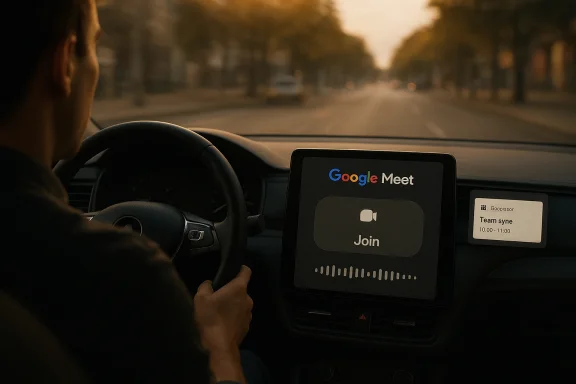
Google is moving Google Meet farther outside the confines of a phone screen and into the car cockpit, and that matters because it signals how aggressively the company now sees mobile productivity evolving. The new in-car experience is built around audio-first participation, a simplified control surface, and calendar-driven access that aims to make meeting joins feel almost frictionless. Just as importantly, it reflects Google’s long-running effort to make Android Auto and car infotainment systems useful without turning them into distractions. Google had already been pushing Meet’s on-the-go mode for mobile use in cars and transit, and the new car integration extends that safety-first philosophy into the dashboard itself (blog.google)
For years, the boundary between “workspace” and “vehicle” has been getting thinner. As hybrid work became normalized, users started expecting the same communication tools to follow them from desk to phone to car, especially during the commute window that used to be dead time. Google has been building toward this for a while: first by improving Meet on mobile, then by adding audio-only on-the-go mode with larger controls, and separately by expanding Android Auto with meeting support on the display. (blog.google)
The current announcement is therefore less of a surprise than a culmination. Google publicly said in 2023 that Android Auto would soon let users join meetings by audio from the car display, and later brought audio-only meeting apps such as Webex and Zoom to the platform. That established the precedent: if the experience is limited to audio and engineered to reduce friction, then the car can become a safe communications endpoint rather than a forbidden zone for work. (blog.google)
The broader context also includes Google’s move to make voice the primary interface for driving. In 2025, Google said Gemini would come to Android Auto, emphasizing natural language, hands-free help, and access to things like calendar and tasks. That matters here because an in-car Meet experience becomes much more practical when the car already has a mature voice assistant layer and a familiar Android Auto workflow. In other words, this is not just a Meet story; it is a Google in-car platform story. (blog.google)
There is also a competitive subtext. Microsoft has spent years positioning Teams as the meeting system that can live anywhere, including vehicles through automaker partnerships. Google’s move shows it is no longer content to leave in-car collaboration to third-party apps or enterprise-only partnerships. Instead, it wants Meet to feel native, immediate, and low-friction across the personal and professional spectrum. That is a classic platform move, and it is very much about retaining user attention where the day’s transitions happen. (blog.google)
One more point is worth underscoring: the promise of in-car conferencing is only acceptable if the safety case is credible. Google’s own Meet help pages describe On-the-Go as audio-only, with large buttons, muted video, and reduced distractions, and Android Auto has long centered voice commands and simplified interactions. That gives the new launch a supporting framework that is much more defensible than a video-heavy dashboard app would be.
Google’s earlier Meet rollout already established the key elements: larger buttons, easier call controls, and support for taking a call while in a car or on public transit. The new car integration is effectively the dashboard-native continuation of that same model. In practical terms, the user experience appears to be built around glanceability, not immersion, which is exactly the right instinct for a product living inside the driver’s line of sight. (blog.google)
The upside is obvious. Drivers can join a scheduled call, listen, respond when appropriate, and keep both hands and eyes where they belong. The trade-off is equally obvious: these meetings are better for status updates, check-ins, and low-bandwidth discussion than for collaborative work that depends on video, screen sharing, or visual cues. In that sense, the feature doesn’t replace normal Meet usage; it specializes it.
This is one of those features that sounds small until you imagine the routine friction it eliminates. No fumbling for a phone, no hunting for the meeting link, no awkward transition from navigation to conferencing while traffic is moving. The value comes from compression: less time spent switching contexts, more time spent staying on schedule. That is what modern productivity software is supposed to do. (blog.google)
The best news here is that the controls are deliberately simple. Meet’s on-the-go mode uses larger, easier-to-press buttons and strips away video, and Android Auto itself supports voice-led interaction through assistants and steering-wheel controls. If the new integration stays true to that model, it should preserve the core safety boundary that makes in-car communications possible in the first place.
It is also a practical response to the fact that meetings are inherently variable. Some are quick, some are complex, and some are better joined only for a few minutes. By keeping the experience lean, Google leaves room for the user to participate just enough to stay aligned without pretending the car is a workstation. That is a more realistic design philosophy than the “work from anywhere” hype cycle often allows. (blog.google)
That’s a meaningful shift because voice is not just an accessibility feature; it is a safety architecture. When the system can recognize calendar appointments, help with call controls, and respond to simple commands, it reduces the need for users to “navigate” their way into a meeting. In the car, the best interface is the one that gets out of the way fastest. (blog.google)
Google has also worked hard to keep Meet relevant in a multi-device world. Features such as call transfer, easier meeting control, and mobile-friendly layouts all point toward a broader strategy: if a user needs to move, Meet should move with them. The new dashboard integration is simply the most ambitious expression of that idea so far. (blog.google)
This also helps explain why the feature is being treated as an ecosystem move rather than a standalone novelty. Meet in the car is only compelling if it is tied to Google Calendar, Android Auto, and voice commands that users already understand. Google is trying to make the experience feel inevitable, not experimental. (blog.google)
That said, rollout reality matters. Google has repeatedly staged such features over time, and Android Auto support often depends on the right app versions and compatible vehicles. So while the headline is bold, the practical deployment will likely feel uneven at first, especially for users whose cars or phones are not on the latest software. (blog.google)
For consumers, the value proposition is more situational. Personal account holders may appreciate the convenience of joining family calls, club meetings, school discussions, or ad hoc audio check-ins without pulling over to manage the phone. But consumer uptake will depend heavily on how often people truly want meetings in the car, versus how often they simply want navigation and media. (blog.google)
It may also help Google defend Workspace against rival collaboration ecosystems. Microsoft Teams, Zoom, and Webex have all made in-car inroads, which means Google cannot afford for Meet to look like the least mobile-friendly option. If enterprise users start assuming Meet is only good at the desk, Google loses one of the best arguments for Workspace stickiness. (blog.google)
That said, niche conveniences can become habits quickly if they are frictionless enough. Google knows this well; most major platform changes start as “nice-to-have” features before they become expected defaults. If Meet can reliably make the transition from phone to car and back again, users may stop thinking about the vehicle as a separate device class entirely. That is a powerful behavioral shift. (blog.google)
It also strengthens Google’s broader device strategy. The company is trying to make Android Auto, Google built-in, Calendar, and Gemini feel like a single coordinated system that happens to move from phone to vehicle. That matters because the more seamless the handoff, the harder it is for rivals to lure users into switching communication habits at the exact moment they leave home. (blog.google)
The answer probably depends on the user segment. Large enterprises often standardize on Microsoft for governance reasons, while smaller firms and consumer-adjacent teams may find Google’s tighter phone-to-car-to-calendar story easier to live with. In that sense, the market is not winner-take-all; it is a battle over defaults. And defaults are where ecosystems are won. (blog.google)
That creates both opportunity and pressure for carmakers. The upside is richer functionality that consumers may value enough to choose one model over another. The downside is that platform leaders like Google can set expectations about what the dashboard should do, leaving automakers with less control over the user relationship. (blog.google)
The other watch item is whether the company keeps the experience tightly audio-focused or starts broadening into adjacent behaviors. Every platform team faces this temptation: once users like a useful feature, there is always pressure to add one more thing. In the car, though, the safest product often remains the simplest one. Restraint will be the measure of Google’s maturity here.
Source: IT Voice Media Pvt. Ltd. https://www.itvoice.in/google-meet-...carplay-and-android-auto-officially-launches/
 Background
For years, the boundary between “workspace” and “vehicle” has been getting thinner. As hybrid work became normalized, users started expecting the same communication tools to follow them from desk to phone to car, especially during the commute window that used to be dead time. Google has been building toward this for a while: first by improving Meet on mobile, then by adding audio-only on-the-go mode with larger controls, and separately by expanding Android Auto with meeting support on the display. (blog.google)The current announcement is therefore less of a surprise than a culmination. Google publicly said in 2023 that Android Auto would soon let users join meetings by audio from the car display, and later brought audio-only meeting apps such as Webex and Zoom to the platform. That established the precedent: if the experience is limited to audio and engineered to reduce friction, then the car can become a safe communications endpoint rather than a forbidden zone for work. (blog.google)
The broader context also includes Google’s move to make voice the primary interface for driving. In 2025, Google said Gemini would come to Android Auto, emphasizing natural language, hands-free help, and access to things like calendar and tasks. That matters here because an in-car Meet experience becomes much more practical when the car already has a mature voice assistant layer and a familiar Android Auto workflow. In other words, this is not just a Meet story; it is a Google in-car platform story. (blog.google)
There is also a competitive subtext. Microsoft has spent years positioning Teams as the meeting system that can live anywhere, including vehicles through automaker partnerships. Google’s move shows it is no longer content to leave in-car collaboration to third-party apps or enterprise-only partnerships. Instead, it wants Meet to feel native, immediate, and low-friction across the personal and professional spectrum. That is a classic platform move, and it is very much about retaining user attention where the day’s transitions happen. (blog.google)
One more point is worth underscoring: the promise of in-car conferencing is only acceptable if the safety case is credible. Google’s own Meet help pages describe On-the-Go as audio-only, with large buttons, muted video, and reduced distractions, and Android Auto has long centered voice commands and simplified interactions. That gives the new launch a supporting framework that is much more defensible than a video-heavy dashboard app would be.
What Google Actually Shipped
The most important detail is that this is not a full-screen video meeting experience. It is an audio-only workflow designed for the realities of driving, with a simplified interface that surfaces meeting choices and large controls rather than an active video grid. That design choice is the difference between a useful productivity feature and a dangerous gimmick. It also explains why Google can market it as a practical extension of Meet rather than a radical reinterpretation of car safety policy.Google’s earlier Meet rollout already established the key elements: larger buttons, easier call controls, and support for taking a call while in a car or on public transit. The new car integration is effectively the dashboard-native continuation of that same model. In practical terms, the user experience appears to be built around glanceability, not immersion, which is exactly the right instinct for a product living inside the driver’s line of sight. (blog.google)
The audio-first model
Audio-only conferencing is not a compromise here; it is the product. Google had already framed Meet’s on-the-go mode as a way to reduce distractions while still letting people participate in conversations from a car. That is an important distinction because it positions the feature as an accessibility and continuity tool, not as a way to turn the windshield into a second monitor. (blog.google)The upside is obvious. Drivers can join a scheduled call, listen, respond when appropriate, and keep both hands and eyes where they belong. The trade-off is equally obvious: these meetings are better for status updates, check-ins, and low-bandwidth discussion than for collaborative work that depends on video, screen sharing, or visual cues. In that sense, the feature doesn’t replace normal Meet usage; it specializes it.
Calendar integration as a workflow shortcut
The user-reported launch description says upcoming meetings surface through calendar sync, enabling one-touch entry from the car display. That idea is consistent with Google’s broader in-car and Workspace strategy, where Calendar and meeting actions already play a central role in Gemini and Android Auto experiences. Google has explicitly said Gemini can check calendar items and help with tasks while driving, which makes calendar-driven meeting joins feel like a natural next step. (blog.google)This is one of those features that sounds small until you imagine the routine friction it eliminates. No fumbling for a phone, no hunting for the meeting link, no awkward transition from navigation to conferencing while traffic is moving. The value comes from compression: less time spent switching contexts, more time spent staying on schedule. That is what modern productivity software is supposed to do. (blog.google)
Safety, Not Spectacle
Google’s decision to keep the experience audio-only is the key reason this launch can be framed as responsible. The company has spent years teaching users and regulators that Android Auto is about reducing cognitive load, not multiplying screens. That tradition matters because automotive software is judged by the same standard as any other safety-adjacent interface: if it encourages visual diversion, it quickly becomes a liability.The best news here is that the controls are deliberately simple. Meet’s on-the-go mode uses larger, easier-to-press buttons and strips away video, and Android Auto itself supports voice-led interaction through assistants and steering-wheel controls. If the new integration stays true to that model, it should preserve the core safety boundary that makes in-car communications possible in the first place.
Why simplicity matters
In-car interfaces fail when they try to do too much. Every extra tap increases the likelihood of attention drift, and every unnecessary visual element competes with road conditions, traffic, and navigation. Google’s approach recognizes that the car is not the office, even if the user occasionally wants it to behave like a very small one. That restraint is the entire product.It is also a practical response to the fact that meetings are inherently variable. Some are quick, some are complex, and some are better joined only for a few minutes. By keeping the experience lean, Google leaves room for the user to participate just enough to stay aligned without pretending the car is a workstation. That is a more realistic design philosophy than the “work from anywhere” hype cycle often allows. (blog.google)
Voice is the real interface
Voice control has become the backbone of Google’s in-car strategy. The company’s Android Auto guidance explains that users can invoke actions with “Hey Google,” microphone buttons, or steering-wheel controls, and Gemini now extends that with more conversational interactions. For Meet, that means the natural progression is not touch-heavy dashboards, but hands-free join, mute, and exit behavior that aligns with what drivers already do in the car.That’s a meaningful shift because voice is not just an accessibility feature; it is a safety architecture. When the system can recognize calendar appointments, help with call controls, and respond to simple commands, it reduces the need for users to “navigate” their way into a meeting. In the car, the best interface is the one that gets out of the way fastest. (blog.google)
Google Meet’s Mobile Evolution
The car launch makes more sense when viewed as the latest stage in Google Meet’s mobile redesign. In August 2024, Google introduced an updated Meet experience with a fresh interface and on-the-go mode for Android and iOS, explicitly describing it as an audio-only way to take calls with fewer distractions while walking, riding, or driving. That was the proof-of-concept phase; car dashboard integration is the productized version. (blog.google)Google has also worked hard to keep Meet relevant in a multi-device world. Features such as call transfer, easier meeting control, and mobile-friendly layouts all point toward a broader strategy: if a user needs to move, Meet should move with them. The new dashboard integration is simply the most ambitious expression of that idea so far. (blog.google)
The “work from anywhere” doctrine
The phrase “work from anywhere” can sound like corporate marketing, but there is real demand behind it. Hybrid workers now expect continuity between desktop, phone, and vehicle, especially when the day is broken into short trips and constant context changes. Google’s Meet additions are aimed squarely at that friction point, where a calendar alert and a commute overlap. (blog.google)This also helps explain why the feature is being treated as an ecosystem move rather than a standalone novelty. Meet in the car is only compelling if it is tied to Google Calendar, Android Auto, and voice commands that users already understand. Google is trying to make the experience feel inevitable, not experimental. (blog.google)
Compatibility and reach
The reach is potentially enormous because Android Auto already powers a very large installed base, and Google continues to describe it as available in over 250 million cars. That gives Meet an enormous addressable surface, even if the actual feature rollout remains dependent on phone, car, app, and regional compatibility. A feature like this scales not through novelty, but through ubiquity. (blog.google)That said, rollout reality matters. Google has repeatedly staged such features over time, and Android Auto support often depends on the right app versions and compatible vehicles. So while the headline is bold, the practical deployment will likely feel uneven at first, especially for users whose cars or phones are not on the latest software. (blog.google)
Enterprise vs Consumer Impact
For enterprise users, the appeal is obvious: less missed time between meetings, fewer calendar bottlenecks, and a smoother path from commute to conference call. Companies that live inside Google Workspace will see this as a natural extension of their existing communication stack, especially when managers and field workers spend significant time in transit. The feature does not create new work; it compresses dead time that employees already have. (blog.google)For consumers, the value proposition is more situational. Personal account holders may appreciate the convenience of joining family calls, club meetings, school discussions, or ad hoc audio check-ins without pulling over to manage the phone. But consumer uptake will depend heavily on how often people truly want meetings in the car, versus how often they simply want navigation and media. (blog.google)
Enterprise upside
The enterprise case is strongest where mobility is part of the job. Sales, consulting, service, logistics, and management roles all involve travel, and those users often work in the seams between appointments. A safe, audio-first meeting endpoint can shave minutes off transitions and reduce the chance of a missed join. (blog.google)It may also help Google defend Workspace against rival collaboration ecosystems. Microsoft Teams, Zoom, and Webex have all made in-car inroads, which means Google cannot afford for Meet to look like the least mobile-friendly option. If enterprise users start assuming Meet is only good at the desk, Google loses one of the best arguments for Workspace stickiness. (blog.google)
Consumer behavior will be more selective
Consumer adoption will likely be more modest and more personal. A parent calling into a school conference while parked, a commuter catching a team huddle, or a freelancer joining a client check-in between sites are all plausible use cases. But for many consumers, the idea of a meeting in the car will still feel like a niche convenience rather than a daily habit.That said, niche conveniences can become habits quickly if they are frictionless enough. Google knows this well; most major platform changes start as “nice-to-have” features before they become expected defaults. If Meet can reliably make the transition from phone to car and back again, users may stop thinking about the vehicle as a separate device class entirely. That is a powerful behavioral shift. (blog.google)
Competitive Implications
This launch intensifies the long-running contest over who owns the collaboration layer in the car. Microsoft has been building an automotive productivity story around Teams and broader Microsoft 365 integrations, while Zoom and Webex have already established audio-only meeting presence in Android Auto. Google’s move is a direct reminder that Meet is not merely a browser tab with a camera; it is a communications platform with transport ambitions. (blog.google)It also strengthens Google’s broader device strategy. The company is trying to make Android Auto, Google built-in, Calendar, and Gemini feel like a single coordinated system that happens to move from phone to vehicle. That matters because the more seamless the handoff, the harder it is for rivals to lure users into switching communication habits at the exact moment they leave home. (blog.google)
Google versus Microsoft
Microsoft still has a strong enterprise position, especially where Teams is already the default meeting fabric. But Google’s advantage may be distribution simplicity: Meet lives naturally inside Android, Calendar, and Workspace, and now increasingly inside the in-car experience too. The practical question is whether that integration is enough to overcome Teams’ entrenched enterprise footprint. (blog.google)The answer probably depends on the user segment. Large enterprises often standardize on Microsoft for governance reasons, while smaller firms and consumer-adjacent teams may find Google’s tighter phone-to-car-to-calendar story easier to live with. In that sense, the market is not winner-take-all; it is a battle over defaults. And defaults are where ecosystems are won. (blog.google)
The auto industry becomes a software battlefield
Automakers increasingly need to think like platform operators. As vehicles become software-defined, the dashboard becomes a venue for competing ecosystems rather than a passive screen. Google’s move underscores that the car is now part of the app economy, not just the transportation economy. (blog.google)That creates both opportunity and pressure for carmakers. The upside is richer functionality that consumers may value enough to choose one model over another. The downside is that platform leaders like Google can set expectations about what the dashboard should do, leaving automakers with less control over the user relationship. (blog.google)
Strengths and Opportunities
Google’s rollout has several obvious strengths, but the biggest one is that it solves a real problem rather than inventing a flashy one. It makes meeting access easier during the commute window, aligns with existing Android Auto behavior, and extends a feature set Google has already been shaping through Meet’s mobile redesign and Gemini’s in-car ambitions. If executed well, it can become a durable habit-forming feature rather than a one-off announcement. (blog.google)- Audio-first design keeps attention on the road and reduces cognitive load.
- Calendar integration shortens the path from alert to join.
- Voice control makes the workflow more natural and less fumbly.
- Workspace continuity helps hybrid workers maintain momentum between locations.
- Android Auto reach gives the feature a massive potential footprint.
- Competitive parity with Teams, Zoom, and Webex strengthens Google’s position.
- Platform coherence ties Meet more tightly to Calendar, Assistant, and Gemini.
Risks and Concerns
The biggest concern is obvious: even with safety-first design, in-car meetings can create pressure to stay engaged when the user should be disengaged. Audio-only is safer than video, but it still asks the driver to split attention, and some work conversations are simply too complex for a moving vehicle. Google will need to keep the feature constrained in ways that prevent overuse.- Driver distraction remains the core safety risk.
- Uneven rollout may confuse users on unsupported devices or vehicles.
- Feature creep could tempt the platform toward less-safe functionality over time.
- Meeting etiquette may suffer if users join from noisy or unpredictable environments.
- Enterprise compliance could become more complex if policies don’t clearly address in-car use.
- Regional compatibility may limit the practical value of “global rollout” language.
- User expectations may outpace what the car interface can responsibly deliver.
Looking Ahead
The next phase will be defined less by the announcement itself and more by how Google integrates this into the rest of its in-car stack. If Meet, Calendar, Android Auto, and Gemini work together smoothly, Google will have something more valuable than a single feature: it will have a mobility productivity layer that feels native across the commute. That could influence how users think about everything from meeting scheduling to voice interaction in the car. (blog.google)The other watch item is whether the company keeps the experience tightly audio-focused or starts broadening into adjacent behaviors. Every platform team faces this temptation: once users like a useful feature, there is always pressure to add one more thing. In the car, though, the safest product often remains the simplest one. Restraint will be the measure of Google’s maturity here.
- Regional rollout pace and supported vehicle lists.
- How well voice controls handle common meeting actions.
- Whether Meet and Calendar appear as a single smooth workflow.
- Enterprise policy support for in-car meeting use.
- User adoption patterns across commuters, field workers, and consumers.
Source: IT Voice Media Pvt. Ltd. https://www.itvoice.in/google-meet-...carplay-and-android-auto-officially-launches/
