

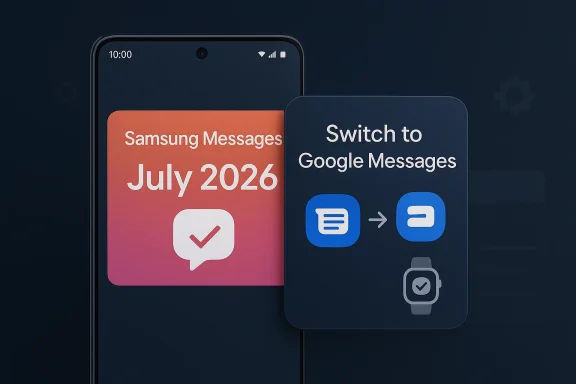
Samsung’s decision to end support for its Messages app in the United States in July 2026 is more than a housekeeping note buried in a support page. It marks another clear step in Samsung’s long-running retreat from maintaining a separate messaging stack on Android, and it further cements Google Messages as the default conversation layer for Galaxy phones. At the same time, the move arrives in a broader industry moment defined by operating system churn, AI branding contradictions, and platform owners tightening control over the software users actually keep. Samsung’s own announcement says the app will be discontinued in July 2026, that Galaxy S26 devices already cannot download it, and that older Android 11-and-below devices are unaffected.
Samsung Messages has been living on borrowed time for years, even if many Galaxy owners only now feel the deadline becoming real. Android’s messaging ecosystem moved decisively toward RCS, richer spam protection, and closer integration with Google’s services, while Samsung increasingly chose to align its phones around a shared Android messaging experience rather than maintain a fully independent alternative. That shift did not happen overnight; it was the result of years of ecosystem pressure, carrier support changes, and the practical reality that most users just want one reliable default app for texts, photos, and verification codes. Samsung is now making that preference official in the US, with a published end-of-service notice and a guided migration path to Google Messages.
The most important historical context is that Samsung once treated first-party software as a key differentiator on Galaxy devices. Its messaging app, notes app, calendar integrations, and device-to-device features helped create a sense that Galaxy phones were not merely Android phones with a Samsung logo, but a distinct software layer on top of Android. Over time, however, the industry’s center of gravity shifted toward Google’s core apps and cloud-synced services, especially as messaging interoperability, anti-spam tools, and RCS became more important than brand-specific chat UIs. Samsung’s latest announcement reflects that shift by explicitly telling users to move to Google Messages “to maintain a consistent messaging experience on Android.”
There is also a pragmatic hardware angle. Samsung says older Android 11 or lower devices are not affected, while newer phones are being pushed toward Google Messages, and Galaxy S26 owners cannot even download Samsung Messages from the Galaxy Store. That creates a two-track reality: legacy devices can keep using the old app, but the next generation is being normalized around Google’s app from day one. In other words, this is not just a support sunset; it is a software transition strategy disguised as a support bulletin.
The timing matters, too. Tech users are already living through repeated platform migrations: Windows 10 to Windows 11, 24H2 to 25H2, and a steady drumbeat of end-of-support notices across hardware and software. Samsung’s message-app cutoff fits that same pattern of consolidation. The modern consumer experience is less about owning a brand-specific app forever and more about being routed toward the vendor’s preferred default path, whether that means Windows Update, Google Messages, or another company’s cloud-tied replacement.
Samsung’s notice also reveals how carefully companies now manage migration. Instead of an abrupt shutdown that strands users, Samsung is presenting the move as a guided upgrade, emphasizing Google Messages’ security features, RCS support, and Gemini-powered tools. That language is no accident. It reframes the loss of a Samsung-branded app as a gain in platform consistency and modern features, which is exactly the sort of soft landing companies prefer when they are reducing duplication.
At the same time, the move exposes a subtle tension in Samsung’s software identity. On one hand, the company is leaning harder into its own ecosystem story with browser software, AI features, and cross-device continuity. On the other hand, it is surrendering one of the most basic consumer touchpoints to Google. That makes Samsung less of a full-stack software vendor and more of a carefully curated Galaxy hardware partner within the Android ecosystem. It is a rational strategy, but it is also a concession. Not every user will care; some will absolutely notice.
The fine print matters. Samsung says older Android 11 and lower devices are not affected by the end of service, which creates a safe harbor for legacy owners even as the rest of the product line moves on. That is a classic lifecycle compromise: protect compatibility for old devices while simplifying support for current ones. In practice, though, this also means the experience will fragment across Galaxy generations, with some users staying behind on a fading app while others are pushed into Google’s ecosystem.
A few implications stand out:
Google Messages is being sold not just as a replacement but as an upgrade. Samsung’s notice highlights improved security, RCS chat capabilities, and AI-powered features such as Gemini integrations. Those are real differentiators, especially for users who care about richer media, typing indicators, and better group-chat behavior across Android and iOS boundaries. The company is smart to frame the migration around capability rather than abandonment.
The practical upside is that Samsung no longer needs to keep a parallel messaging ecosystem alive just to maintain a branding distinction. That frees up engineering attention, reduces QA fragmentation, and lets the company focus on more differentiating software layers such as device continuity, AI features, and browser experiences. The downside is obvious: Samsung becomes even more dependent on Google for a core communication path.
There is also a consumer education issue. Users who have RCS conversations, group chats, or watch integrations may experience temporary hiccups during the transition. Samsung says older pre-2022 devices may see temporary disruption in ongoing RCS conversations, although MMS/SMS remains available and RCS can resume if both parties move to Google Messages. That is a useful warning, but it also proves the point: messaging migrations always look simpler in press language than they feel on the phone.
For enterprises, the effect is subtler. Corporate device fleets generally standardize on managed settings, and Samsung’s support cutoff does not appear to target enterprise policy in the same way a hard OS deprecation would. Still, IT teams should care because any app-default change can affect onboarding guides, support scripts, and mobile-device management expectations. Messaging defaults are the kind of thing that quietly create ticket volume if they are not documented in advance.
The inclusion of older Tizen OS watches in Samsung’s notice is another reminder that messaging is broader than phones. Samsung says those older watches will no longer be able to see the full message conversation history on the watch, though they can still read and send text messages. That is a small but telling example of how platform transitions reverberate across connected devices that most users barely think about until something stops syncing.
A few groups will feel the change more than others:
That strategy makes business sense. The average user is more likely to care about cross-device continuity, AI browsing, and account sync than whether the preinstalled SMS app carries Samsung branding. By focusing on software surfaces that reinforce ecosystem stickiness, Samsung can invest where it has a better chance to differentiate. Messages, by contrast, is a crowded and increasingly standardized space.
This is also a story about narrowing focus. Samsung is more willing now to let Google own the generic parts of Android while it concentrates on the Galaxy-specific parts: hardware, design, device orchestration, and premium experiences. That does not mean Samsung is becoming less ambitious. It means the company is choosing its battles more carefully, and dropping the ones it cannot win cleanly.
The risk is that users interpret every removed app as a sign that the company is less committed to software. That perception can matter, especially in premium markets where buyers expect the whole experience to feel proprietary and polished. Samsung has to prove that simplification is not retreat, but refinement.
That is why Samsung’s move is about more than convenience. Google Messages supports richer Android messaging, and Samsung knows users will often accept a migration if it preserves their existing threads and improves functionality. The company is betting that the value of RCS, spam filtering, and Gemini integrations will outweigh any nostalgia for Samsung Messages. That is probably a safe bet.
The consumer upside is consistency. A Galaxy phone, a Pixel, and many other Android devices can now share a more common messaging baseline. The downside is reduced software diversity, and diversity often matters more than it first appears because it creates resilience and choice. Losing one app is not the end of the world, but every lost alternative makes the ecosystem a little more monolithic.
A few reasons messaging defaults are strategic:
There is also a competitive angle to watch. Google gains more control over the Android messaging baseline, which strengthens its role as the default software layer even on third-party hardware. Samsung, meanwhile, may be betting that differentiation now comes from everything around messaging rather than messaging itself: browsers, search helpers, account sync, and device orchestration. That is not a retreat from software so much as a reallocation of ambition.
What to watch next:
Source: Daily Tech News Show Samsung Ending Support For Messages App in the US in July 2026 – DTH
 Background
Samsung Messages has been living on borrowed time for years, even if many Galaxy owners only now feel the deadline becoming real. Android’s messaging ecosystem moved decisively toward RCS, richer spam protection, and closer integration with Google’s services, while Samsung increasingly chose to align its phones around a shared Android messaging experience rather than maintain a fully independent alternative. That shift did not happen overnight; it was the result of years of ecosystem pressure, carrier support changes, and the practical reality that most users just want one reliable default app for texts, photos, and verification codes. Samsung is now making that preference official in the US, with a published end-of-service notice and a guided migration path to Google Messages.The most important historical context is that Samsung once treated first-party software as a key differentiator on Galaxy devices. Its messaging app, notes app, calendar integrations, and device-to-device features helped create a sense that Galaxy phones were not merely Android phones with a Samsung logo, but a distinct software layer on top of Android. Over time, however, the industry’s center of gravity shifted toward Google’s core apps and cloud-synced services, especially as messaging interoperability, anti-spam tools, and RCS became more important than brand-specific chat UIs. Samsung’s latest announcement reflects that shift by explicitly telling users to move to Google Messages “to maintain a consistent messaging experience on Android.”
There is also a pragmatic hardware angle. Samsung says older Android 11 or lower devices are not affected, while newer phones are being pushed toward Google Messages, and Galaxy S26 owners cannot even download Samsung Messages from the Galaxy Store. That creates a two-track reality: legacy devices can keep using the old app, but the next generation is being normalized around Google’s app from day one. In other words, this is not just a support sunset; it is a software transition strategy disguised as a support bulletin.
The timing matters, too. Tech users are already living through repeated platform migrations: Windows 10 to Windows 11, 24H2 to 25H2, and a steady drumbeat of end-of-support notices across hardware and software. Samsung’s message-app cutoff fits that same pattern of consolidation. The modern consumer experience is less about owning a brand-specific app forever and more about being routed toward the vendor’s preferred default path, whether that means Windows Update, Google Messages, or another company’s cloud-tied replacement.
Overview
This change is significant because messaging apps are not trivial utilities. They are the social and logistical backbone of modern mobile life, handling two-factor authentication, family chat threads, delivery updates, bank alerts, and the occasional emergency contact. When a phone vendor changes the default surface for all of that, it alters the daily behavior of millions of users, even if the underlying phone hardware stays the same. Samsung’s decision is a reminder that software defaults are often more important than the apps themselves.Samsung’s notice also reveals how carefully companies now manage migration. Instead of an abrupt shutdown that strands users, Samsung is presenting the move as a guided upgrade, emphasizing Google Messages’ security features, RCS support, and Gemini-powered tools. That language is no accident. It reframes the loss of a Samsung-branded app as a gain in platform consistency and modern features, which is exactly the sort of soft landing companies prefer when they are reducing duplication.
At the same time, the move exposes a subtle tension in Samsung’s software identity. On one hand, the company is leaning harder into its own ecosystem story with browser software, AI features, and cross-device continuity. On the other hand, it is surrendering one of the most basic consumer touchpoints to Google. That makes Samsung less of a full-stack software vendor and more of a carefully curated Galaxy hardware partner within the Android ecosystem. It is a rational strategy, but it is also a concession. Not every user will care; some will absolutely notice.
What Samsung Is Actually Ending
Samsung’s wording is specific: the Samsung Messages application will be discontinued in July 2026 in the United States, and it will no longer be available for download after that point. Samsung also says that Galaxy S26 devices cannot download it now, which means the company is already using new hardware to enforce the new default before the calendar cutoff arrives. That makes the announcement feel less like a future event and more like a phased removal already in progress.The fine print matters. Samsung says older Android 11 and lower devices are not affected by the end of service, which creates a safe harbor for legacy owners even as the rest of the product line moves on. That is a classic lifecycle compromise: protect compatibility for old devices while simplifying support for current ones. In practice, though, this also means the experience will fragment across Galaxy generations, with some users staying behind on a fading app while others are pushed into Google’s ecosystem.
Why the US cutoff matters
The US market is where carrier features, RCS adoption, and default messaging behavior matter most. Once Samsung exits the field there, the app loses much of its justification as a parallel product, because the practical advantages of staying inside the Samsung Messages silo shrink quickly. That is why the July 2026 deadline should be read as a market signal, not just a support calendar item. Samsung appears to be deciding that duplication is no longer worth the maintenance burden.A few implications stand out:
- Samsung is reducing app overlap on Android.
- Google Messages becomes the clearer default for Galaxy buyers.
- New devices inherit a more standardized messaging stack.
- Legacy users keep limited continuity, but not forever.
- RCS and anti-spam features become the new baseline.
- The Galaxy Store loses one more in-house consumer staple.
Google Messages Becomes the Default
Samsung’s recommendation to switch to Google Messages is unsurprising, but it is still consequential. The company is effectively acknowledging that the Android messaging future is centered on a single cross-vendor app, not a Samsung-specific alternative. For users, that means a more standardized setup across devices; for Samsung, it means less overhead and fewer app-specific edge cases to support.Google Messages is being sold not just as a replacement but as an upgrade. Samsung’s notice highlights improved security, RCS chat capabilities, and AI-powered features such as Gemini integrations. Those are real differentiators, especially for users who care about richer media, typing indicators, and better group-chat behavior across Android and iOS boundaries. The company is smart to frame the migration around capability rather than abandonment.
Feature parity is not the same as user comfort
A messaging migration is never only about features. It is also about muscle memory, interface habits, and the weird psychological comfort of seeing the same blue-green thread list every morning. Even if Google Messages is objectively better in 2026, a large portion of users will still experience the switch as one more thing being taken away. That is especially true for people who never chose Samsung Messages actively and simply inherited it as the factory default.The practical upside is that Samsung no longer needs to keep a parallel messaging ecosystem alive just to maintain a branding distinction. That frees up engineering attention, reduces QA fragmentation, and lets the company focus on more differentiating software layers such as device continuity, AI features, and browser experiences. The downside is obvious: Samsung becomes even more dependent on Google for a core communication path.
There is also a consumer education issue. Users who have RCS conversations, group chats, or watch integrations may experience temporary hiccups during the transition. Samsung says older pre-2022 devices may see temporary disruption in ongoing RCS conversations, although MMS/SMS remains available and RCS can resume if both parties move to Google Messages. That is a useful warning, but it also proves the point: messaging migrations always look simpler in press language than they feel on the phone.
Enterprise, Consumer, and Legacy Device Impact
For consumers, the impact is mostly about convenience, continuity, and the annoyance of changing defaults. Most people will follow the path of least resistance, and Samsung clearly intends that path to end at Google Messages. The consumer loss is not catastrophic, but it is real: one more Samsung app disappears, and one more everyday interaction becomes mediated by a different vendor.For enterprises, the effect is subtler. Corporate device fleets generally standardize on managed settings, and Samsung’s support cutoff does not appear to target enterprise policy in the same way a hard OS deprecation would. Still, IT teams should care because any app-default change can affect onboarding guides, support scripts, and mobile-device management expectations. Messaging defaults are the kind of thing that quietly create ticket volume if they are not documented in advance.
Legacy hardware gets a pass, but not a promise
Samsung’s carve-out for Android 11 and below is useful, but it should not be mistaken for a long-term guarantee. Legacy devices often remain technically usable long after the vendor has moved on, yet they steadily lose app compatibility, security updates, and ecosystem relevance. In practice, the cutoff protects older users from immediate breakage while reminding everyone else that software support is finite.The inclusion of older Tizen OS watches in Samsung’s notice is another reminder that messaging is broader than phones. Samsung says those older watches will no longer be able to see the full message conversation history on the watch, though they can still read and send text messages. That is a small but telling example of how platform transitions reverberate across connected devices that most users barely think about until something stops syncing.
A few groups will feel the change more than others:
- Owners of Galaxy S26 hardware, because the old app is already blocked.
- Users on older Samsung phones who prefer Samsung’s interface.
- People with Samsung watches that relied on Samsung Messages history.
- IT departments with Galaxy-heavy fleets and custom onboarding docs.
- Users who depend on RCS continuity across mixed Android devices.
- Anyone who prefers Samsung’s branding and app consistency over Google’s.
Samsung’s Software Strategy Is Changing
Samsung is not simply removing software; it is reshaping its software identity. In recent months the company has been pushing harder into cross-device experiences, browser software, and AI-assisted features that make the Galaxy ecosystem feel coherent across phone and PC. The company’s move away from Samsung Messages fits that broader pattern: drop redundant utilities, concentrate on higher-value experiences, and let Google handle commodity functions where necessary.That strategy makes business sense. The average user is more likely to care about cross-device continuity, AI browsing, and account sync than whether the preinstalled SMS app carries Samsung branding. By focusing on software surfaces that reinforce ecosystem stickiness, Samsung can invest where it has a better chance to differentiate. Messages, by contrast, is a crowded and increasingly standardized space.
The ecosystem play
Samsung’s browser push on Windows shows what the company seems to value most: a seamless, identity-rich environment that spans devices. That matters because browsers, AI helpers, and account systems are the new battlegrounds for platform loyalty. A messaging app does not offer the same strategic upside unless it is truly differentiated, and Samsung’s Messages app clearly was not.This is also a story about narrowing focus. Samsung is more willing now to let Google own the generic parts of Android while it concentrates on the Galaxy-specific parts: hardware, design, device orchestration, and premium experiences. That does not mean Samsung is becoming less ambitious. It means the company is choosing its battles more carefully, and dropping the ones it cannot win cleanly.
The risk is that users interpret every removed app as a sign that the company is less committed to software. That perception can matter, especially in premium markets where buyers expect the whole experience to feel proprietary and polished. Samsung has to prove that simplification is not retreat, but refinement.
Why Messaging Defaults Matter More Than Ever
The timing of Samsung’s decision intersects with a larger platform trend: users are increasingly being pushed toward default apps that define their operating experience, whether those defaults come from Google, Microsoft, Apple, or the OEM itself. Messaging defaults are especially important because they control the place where identity, security, and social contact converge. Once a user has migrated to a new default, they rarely go back.That is why Samsung’s move is about more than convenience. Google Messages supports richer Android messaging, and Samsung knows users will often accept a migration if it preserves their existing threads and improves functionality. The company is betting that the value of RCS, spam filtering, and Gemini integrations will outweigh any nostalgia for Samsung Messages. That is probably a safe bet.
The hidden economics of defaults
Defaults save companies money, but they also shape ecosystems. If Samsung keeps shipping devices that funnel people toward Google Messages, Google gains another point of entry into daily user behavior. That can strengthen Google’s leverage over Android messaging standards and user expectations, even as Samsung retains hardware control. This is how platform dependence deepens without dramatic headlines.The consumer upside is consistency. A Galaxy phone, a Pixel, and many other Android devices can now share a more common messaging baseline. The downside is reduced software diversity, and diversity often matters more than it first appears because it creates resilience and choice. Losing one app is not the end of the world, but every lost alternative makes the ecosystem a little more monolithic.
A few reasons messaging defaults are strategic:
- They shape the first communication experience on a new device.
- They control how easily users adopt RCS and enhanced media features.
- They influence whether users remain within one vendor’s ecosystem.
- They reduce or increase support burden for OEMs and carriers.
- They determine how much branding power a manufacturer really has.
- They affect watch, tablet, and tablet-to-phone continuity as well.
Strengths and Opportunities
Samsung’s move is not without merit. A cleaner, more unified Android messaging story can reduce confusion, improve support quality, and make the Galaxy experience feel less fragmented. The company also gets to lean into what it does best: hardware design, device integration, and premium ecosystem polish. That is a sensible trade-off, even if it disappoints loyalists.- Users get a clearer default path to Google Messages.
- RCS and modern chat features become easier to normalize.
- Samsung reduces duplicate app maintenance and support costs.
- New Galaxy phones ship with a more consistent messaging story.
- Cross-device messaging experiences may become easier to document.
- Samsung can focus engineering resources on more differentiated services.
- The move aligns with broader Android ecosystem realities.
Risks and Concerns
The downside is equally clear: Samsung is giving up another piece of software identity and increasing dependence on Google for one of the most important daily phone functions. There is also a user-experience risk, because migrations can confuse people, disrupt watch integrations, and trigger short-lived RCS issues. If Samsung mismanages the transition, the app sunset could feel like a forced downgrade rather than a simplification.- Users may resent losing a familiar Samsung-branded app.
- Watch history and older-device behavior may create support confusion.
- Temporary RCS disruption could generate complaints.
- The move deepens dependence on Google’s Android app stack.
- Some users may mistrust forced default changes.
- Brand dilution is a real concern for premium Galaxy buyers.
- The transition may be uneven across device generations.
Looking Ahead
The most likely near-term outcome is straightforward: Samsung will keep nudging Galaxy users toward Google Messages, and the July 2026 cutoff will become a practical forcing function rather than a distant warning. The larger question is what Samsung does next with the software space it frees up. If the company uses the simplification to invest more deeply in ecosystem services, cross-device continuity, and AI-assisted workflows, the loss of Samsung Messages may look minor in hindsight.There is also a competitive angle to watch. Google gains more control over the Android messaging baseline, which strengthens its role as the default software layer even on third-party hardware. Samsung, meanwhile, may be betting that differentiation now comes from everything around messaging rather than messaging itself: browsers, search helpers, account sync, and device orchestration. That is not a retreat from software so much as a reallocation of ambition.
What to watch next:
- Whether Samsung expands the migration guidance beyond the US.
- How quickly users on older Galaxy phones adopt Google Messages.
- Whether watch integrations generate support complaints.
- Whether Samsung removes Samsung Messages from more new devices.
- Whether Samsung’s browser and AI stack become the new signature software layer.
Source: Daily Tech News Show Samsung Ending Support For Messages App in the US in July 2026 – DTH
Last edited:
