

Google has completed the broad rollout of Google Meet support for Android Auto in late June 2026, letting drivers join scheduled Meet calls from a compatible car display as an audio-only experience while using the Meet app on an Android phone. The feature sounds small because it is deliberately constrained. But that restraint is the point: Google is turning the car dashboard into a work endpoint while trying not to make it look like one. As first reported in this news cycle by NPowerUser and documented by Google’s own Workspace Updates blog and Meet Help pages, the arrival of Meet on Android Auto is less about video meetings in cars than about where the boundaries of mobile productivity now sit.
The most important design choice in Google Meet for Android Auto is what it refuses to do. It does not put faces on the dashboard, does not show shared screens, and does not invite drivers to treat traffic as a conference-room extension. Google’s support documentation frames the feature as a way to join meetings and make calls safely while driving, and the implementation follows that language closely: audio, calendar context, simplified controls, and spoken alerts for meeting states such as recording or transcription.
That makes the rollout both obvious and uneasy. Millions of people already take calls in cars, often through Bluetooth, earbuds, or the awkward halfway house of a phone mounted near the wheel. Android Auto now gives Google Meet a first-class surface for behavior that was already happening, which is usually how mobile platforms absorb risk: they do not create the habit so much as formalize it.
NPowerUser’s framing of the update as a productivity expansion is fair, but the word productivity does a lot of sanitizing here. A commuter joining a stand-up call from the freeway is not necessarily more productive in any meaningful human sense. They are more reachable, more schedulable, and less able to use physical location as an excuse for being absent.
That is the quiet platform play. Google is not saying the car should become an office. It is making the office harder to leave behind.
Google’s Workspace Updates blog later put firmer dates around the enterprise rollout. Meet for Android Auto was listed as on by default for end users with the Meet app installed, with scheduled-release domains expected to complete rollout by June 26, 2026. That matters because this is not merely a consumer convenience feature trickling through the Play Store. It is a Workspace-adjacent capability that administrators and organizations will now have to reckon with, even if the interface itself looks minimal.
The feature also lands after months of scattered reports, support-page sightings, and early availability. Android Central described the app as rolling out with a catch: the catch being the absence of video and the reliance on an audio-only meeting model. Technobezz noted earlier that availability appeared server-side controlled, which is consistent with how Google often stages Android Auto integrations.
By the time NPowerUser reported that Meet is now available to everyone, the story had already moved past novelty. The more interesting question is not whether the app appears in the launcher. It is whether Google can make the car a sanctioned communications endpoint without encouraging users to treat driving as dead time waiting to be monetized by another meeting.
Google is walking a familiar regulatory and reputational line. Car dashboards are increasingly capable, but capability is not permission. Android Auto has always been built around a bargain: the screen may mirror the phone, but only in ways that reduce temptation rather than reproduce the full phone experience. Navigation, music, calls, messaging, and assistant actions are permitted because they can be simplified into glanceable or voice-led interactions.
Meet stretches that bargain. A meeting is not just a call; it is a social and organizational event with its own pressures. Someone may ask for input on a document the driver cannot see. A manager may assume attendance equals availability. A team may forget that one participant is operating a vehicle at 65 miles per hour.
Google’s answer is to degrade the meeting until it resembles a phone call. The driver can hear and speak, but not watch. Upcoming meetings can be surfaced from the calendar, and joining is made simple enough to avoid phone handling. The interface is not built for collaboration so much as presence.
That may be the only defensible version of the product. It is also a revealing one. The modern meeting has become so audio-tolerant, so ambient, and so routine that a version with no video, no shared content, and limited interaction still counts as useful enough to ship.
This is why the Meet rollout is more strategically important than its feature list suggests. Google does not need drivers to conduct fully interactive meetings from the car. It needs Android Auto to remain the trusted mediation layer between a distracted human and a demanding phone. Every app that joins that layer reinforces the idea that Android Auto is not just a projection standard but a policy boundary.
The distinction matters as cars become more software-defined. Android Auto is still phone projection, while Android Automotive OS is an embedded vehicle operating system used by some automakers under the “Google built-in” branding. But users rarely care about that architectural distinction. They care that the screen in the car can do more things, with fewer cables, fewer weird Bluetooth hacks, and fewer reasons to touch the phone.
Meet on Android Auto fits that user expectation neatly. It is not revolutionary. It is normalization.
Google’s documentation says users may hear spoken notifications when a meeting is recorded, transcribed, or using Gemini. That is useful, but it does not solve the practical questions. Is the driver alone? Are passengers present? Is the vehicle a rental, a rideshare, or a shared company car? Is the meeting being joined over a personal account or a managed Workspace account?
The phrase “on by default” should get administrators’ attention. It does not automatically mean danger, and it certainly does not mean organizations should panic. But it does mean the feature arrives as part of the ambient Google experience unless policy says otherwise. Enterprises that already treat mobile devices as meeting endpoints will need to decide whether the car display is simply another hands-free accessory or a distinct context requiring guidance.
The likely answer is policy rather than prohibition. Telling users never to join a meeting from the car is unrealistic in many organizations. Telling them which meetings are appropriate, when to stay muted, and when to decline because the meeting requires visual attention is more plausible.
But in the car, the competitive question is not which conferencing app has the richest feature set. Richness is the wrong goal. The winner is the app that removes the most dangerous friction while preserving just enough function to be worth using.
Before this integration, a Meet call in the car could involve opening the phone, finding a calendar event, tapping a meeting link, switching audio routes, and hoping the microphone behaved. Some users did it anyway because work culture often rewards being present more than being sensible. Android Auto reduces that sequence to something closer to a sanctioned call flow.
That is good. It is also a reminder that platform convenience often arrives after users have already invented worse versions of the same workflow. Google is cleaning up a behavior it could not prevent.
But there is a darker reading, and it is not anti-technology to say so. Every successful mobile productivity feature eventually becomes an expectation. Email on phones became an expectation. Slack and Teams notifications became expectations. Calendar availability became a proxy for personal availability. The car was one of the last semi-defensible spaces where being “in transit” could still mean being unreachable.
Meet on Android Auto chips away at that boundary. Google has done the technically responsible thing by making the experience audio-only. Employers and users now have to do the socially responsible thing by remembering that a join button is not an obligation.
The healthier framing is not “now you can take more meetings while driving.” It is “if you must take a meeting while driving, the platform gives you a less reckless way to do it.” That distinction should be visible in how companies communicate the feature internally.
This model will matter more as AI assistants become deeply embedded in the car experience. Google is already pushing Gemini across Android and automotive contexts, although recent reports from outlets such as TechRadar show that assistant transitions can produce rough edges, including call-related bugs that frustrate users. The lesson is simple: in-car software has a smaller margin for error than phone software. A failed command in a living room is annoying; a failed audio route in traffic is a hazard.
Meet’s restrained launch is therefore encouraging. It suggests Google understands that the car is not another tablet. The challenge is maintaining that discipline as productivity vendors, automakers, and users all ask for more.
The next pressure point will be meeting intelligence. If Gemini can summarize a meeting, identify action items, or tell a driver when their name was mentioned, the temptation to make meetings more interactive from the car will grow. Google will need to decide whether the safest interface is one that does more for the driver or one that politely refuses more often.
That simplicity should not be mistaken for triviality. Small defaults change behavior. If joining a meeting from the car becomes as easy as starting a playlist, more people will do it, and more organizations will quietly assume they can.
The concrete takeaways are straightforward:
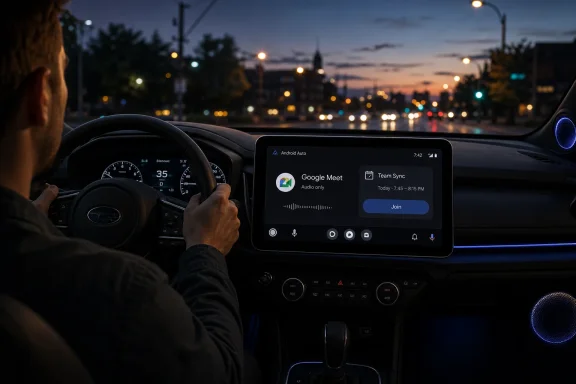 Google Moves the Meeting Room Into the Commute, Then Turns Off the Camera
The most important design choice in Google Meet for Android Auto is what it refuses to do. It does not put faces on the dashboard, does not show shared screens, and does not invite drivers to treat traffic as a conference-room extension. Google’s support documentation frames the feature as a way to join meetings and make calls safely while driving, and the implementation follows that language closely: audio, calendar context, simplified controls, and spoken alerts for meeting states such as recording or transcription.That makes the rollout both obvious and uneasy. Millions of people already take calls in cars, often through Bluetooth, earbuds, or the awkward halfway house of a phone mounted near the wheel. Android Auto now gives Google Meet a first-class surface for behavior that was already happening, which is usually how mobile platforms absorb risk: they do not create the habit so much as formalize it.
NPowerUser’s framing of the update as a productivity expansion is fair, but the word productivity does a lot of sanitizing here. A commuter joining a stand-up call from the freeway is not necessarily more productive in any meaningful human sense. They are more reachable, more schedulable, and less able to use physical location as an excuse for being absent.
That is the quiet platform play. Google is not saying the car should become an office. It is making the office harder to leave behind.
The Rollout Fixes a Strange Gap in Google’s Own Car Story
The timing is notable because Google Meet reached Apple CarPlay before Android Auto, a reversal that Android Authority, Tom’s Guide, and other outlets picked up on earlier this year. For a company whose car platform is supposed to be the natural extension of Android, watching CarPlay users get Google’s meeting client first was a little embarrassing. Android Auto users were not locked out forever, but the order of operations reinforced a long-running sense that Google’s in-car software roadmap is more cautious than its phone roadmap.Google’s Workspace Updates blog later put firmer dates around the enterprise rollout. Meet for Android Auto was listed as on by default for end users with the Meet app installed, with scheduled-release domains expected to complete rollout by June 26, 2026. That matters because this is not merely a consumer convenience feature trickling through the Play Store. It is a Workspace-adjacent capability that administrators and organizations will now have to reckon with, even if the interface itself looks minimal.
The feature also lands after months of scattered reports, support-page sightings, and early availability. Android Central described the app as rolling out with a catch: the catch being the absence of video and the reliance on an audio-only meeting model. Technobezz noted earlier that availability appeared server-side controlled, which is consistent with how Google often stages Android Auto integrations.
By the time NPowerUser reported that Meet is now available to everyone, the story had already moved past novelty. The more interesting question is not whether the app appears in the launcher. It is whether Google can make the car a sanctioned communications endpoint without encouraging users to treat driving as dead time waiting to be monetized by another meeting.
Audio-Only Is a Safety Feature and a Legal Argument
The lack of video is not a missing feature. It is the feature that allows everything else to exist.Google is walking a familiar regulatory and reputational line. Car dashboards are increasingly capable, but capability is not permission. Android Auto has always been built around a bargain: the screen may mirror the phone, but only in ways that reduce temptation rather than reproduce the full phone experience. Navigation, music, calls, messaging, and assistant actions are permitted because they can be simplified into glanceable or voice-led interactions.
Meet stretches that bargain. A meeting is not just a call; it is a social and organizational event with its own pressures. Someone may ask for input on a document the driver cannot see. A manager may assume attendance equals availability. A team may forget that one participant is operating a vehicle at 65 miles per hour.
Google’s answer is to degrade the meeting until it resembles a phone call. The driver can hear and speak, but not watch. Upcoming meetings can be surfaced from the calendar, and joining is made simple enough to avoid phone handling. The interface is not built for collaboration so much as presence.
That may be the only defensible version of the product. It is also a revealing one. The modern meeting has become so audio-tolerant, so ambient, and so routine that a version with no video, no shared content, and limited interaction still counts as useful enough to ship.
The Car Dashboard Is Becoming the New Lock Screen
The broader trend is that Android Auto is absorbing more of the phone’s communications layer. Messaging apps, call controls, calendar prompts, assistant commands, and now Meet all sit on the same basic premise: the phone is still the computer, but the car is an approved input and output device. That turns the dashboard into something like a lock screen for motion, where only the safest subset of interactions is allowed through.This is why the Meet rollout is more strategically important than its feature list suggests. Google does not need drivers to conduct fully interactive meetings from the car. It needs Android Auto to remain the trusted mediation layer between a distracted human and a demanding phone. Every app that joins that layer reinforces the idea that Android Auto is not just a projection standard but a policy boundary.
The distinction matters as cars become more software-defined. Android Auto is still phone projection, while Android Automotive OS is an embedded vehicle operating system used by some automakers under the “Google built-in” branding. But users rarely care about that architectural distinction. They care that the screen in the car can do more things, with fewer cables, fewer weird Bluetooth hacks, and fewer reasons to touch the phone.
Meet on Android Auto fits that user expectation neatly. It is not revolutionary. It is normalization.
Enterprise IT Gets a New Endpoint It Did Not Ask For
For IT administrators, the rollout creates a familiar problem in a new place. A feature that is safe enough for a consumer commute may be complicated inside a regulated organization. Meetings can include confidential audio, customer information, personnel discussions, and recordings. Moving those conversations into a car cabin changes the threat model even if the software itself is secure.Google’s documentation says users may hear spoken notifications when a meeting is recorded, transcribed, or using Gemini. That is useful, but it does not solve the practical questions. Is the driver alone? Are passengers present? Is the vehicle a rental, a rideshare, or a shared company car? Is the meeting being joined over a personal account or a managed Workspace account?
The phrase “on by default” should get administrators’ attention. It does not automatically mean danger, and it certainly does not mean organizations should panic. But it does mean the feature arrives as part of the ambient Google experience unless policy says otherwise. Enterprises that already treat mobile devices as meeting endpoints will need to decide whether the car display is simply another hands-free accessory or a distinct context requiring guidance.
The likely answer is policy rather than prohibition. Telling users never to join a meeting from the car is unrealistic in many organizations. Telling them which meetings are appropriate, when to stay muted, and when to decline because the meeting requires visual attention is more plausible.
Google’s Real Competitor Is Not Zoom or Teams, but Friction
It is tempting to see Meet on Android Auto as part of the endless collaboration-app competition. Microsoft Teams has had its own in-car and automotive-adjacent experiences, and Zoom has spent years adapting to rooms, phones, kiosks, and embedded devices. Google naturally wants Meet to be present wherever calendar-driven work happens.But in the car, the competitive question is not which conferencing app has the richest feature set. Richness is the wrong goal. The winner is the app that removes the most dangerous friction while preserving just enough function to be worth using.
Before this integration, a Meet call in the car could involve opening the phone, finding a calendar event, tapping a meeting link, switching audio routes, and hoping the microphone behaved. Some users did it anyway because work culture often rewards being present more than being sensible. Android Auto reduces that sequence to something closer to a sanctioned call flow.
That is good. It is also a reminder that platform convenience often arrives after users have already invented worse versions of the same workflow. Google is cleaning up a behavior it could not prevent.
The Productivity Pitch Needs a Human Speed Limit
The weakest version of this story is the one that treats the rollout as a straightforward quality-of-life upgrade for busy professionals. Yes, it will help people who spend hours commuting. Yes, it may prevent drivers from fumbling with phones. Yes, it gives Android Auto parity with a feature Google had already begun offering through CarPlay.But there is a darker reading, and it is not anti-technology to say so. Every successful mobile productivity feature eventually becomes an expectation. Email on phones became an expectation. Slack and Teams notifications became expectations. Calendar availability became a proxy for personal availability. The car was one of the last semi-defensible spaces where being “in transit” could still mean being unreachable.
Meet on Android Auto chips away at that boundary. Google has done the technically responsible thing by making the experience audio-only. Employers and users now have to do the socially responsible thing by remembering that a join button is not an obligation.
The healthier framing is not “now you can take more meetings while driving.” It is “if you must take a meeting while driving, the platform gives you a less reckless way to do it.” That distinction should be visible in how companies communicate the feature internally.
The Dashboard Version of Meet Shows Where Android Auto Is Headed
Android Auto’s future is not simply more apps. It is more curated app behavior. The dashboard is becoming a place where services are not ported wholesale but translated into driving-safe modes. That is why Meet without video makes sense, just as messaging without typing makes sense and navigation without full browser freedom makes sense.This model will matter more as AI assistants become deeply embedded in the car experience. Google is already pushing Gemini across Android and automotive contexts, although recent reports from outlets such as TechRadar show that assistant transitions can produce rough edges, including call-related bugs that frustrate users. The lesson is simple: in-car software has a smaller margin for error than phone software. A failed command in a living room is annoying; a failed audio route in traffic is a hazard.
Meet’s restrained launch is therefore encouraging. It suggests Google understands that the car is not another tablet. The challenge is maintaining that discipline as productivity vendors, automakers, and users all ask for more.
The next pressure point will be meeting intelligence. If Gemini can summarize a meeting, identify action items, or tell a driver when their name was mentioned, the temptation to make meetings more interactive from the car will grow. Google will need to decide whether the safest interface is one that does more for the driver or one that politely refuses more often.
The Commute Has a New Join Button, but the Rules Are Still Human
The practical reality of Google Meet on Android Auto is narrower than the platform implications, which is exactly why it will probably be widely used. For most drivers, the app will simply appear in the Android Auto launcher once the necessary updates and rollout flags are in place. A scheduled meeting becomes easier to join, audio moves through the car speakers, and the phone can stay put.That simplicity should not be mistaken for triviality. Small defaults change behavior. If joining a meeting from the car becomes as easy as starting a playlist, more people will do it, and more organizations will quietly assume they can.
The concrete takeaways are straightforward:
- Google Meet for Android Auto is now broadly available after a staged rollout that Google’s Workspace Updates blog expected to complete for scheduled-release domains by June 26, 2026.
- The Android Auto experience is audio-only, with no incoming video feed, no camera participation, and no dashboard presentation viewing while driving.
- Users need the Google Meet app on an Android phone, an updated Android Auto setup, and a compatible vehicle or head unit for the integration to appear.
- The feature is designed to reduce phone handling for meetings that drivers were already likely to join through less safe Bluetooth or handset workflows.
- Organizations should treat in-car meeting access as a policy issue, especially for confidential calls, regulated discussions, and meetings that require visual attention.
- The rollout shows Google expanding Android Auto from navigation and media into controlled productivity, but only by stripping meetings down to their least distracting form.
References
- Primary source: nokiapoweruser.com
Published: 2026-07-05T05:01:00.168523
Loading…
nokiapoweruser.com - Official source: support.google.com
Loading…
support.google.com - Related coverage: androidcentral.com
Loading…
www.androidcentral.com - Related coverage: androidheadlines.com
Loading…
www.androidheadlines.com - Related coverage: workspaceupdates.googleblog.com
Loading…
workspaceupdates.googleblog.com - Related coverage: phonearena.com
Loading…
www.phonearena.com
- Related coverage: technobezz.com
Loading…
www.technobezz.com - Related coverage: androidauthority.com
Google is putting Meet in your Android Auto dashboard just days after CarPlay
Google Meet has finally arrived on Android Auto, allowing you to check your schedule and join calls from your car's display.www.androidauthority.com - Related coverage: cincodias.elpais.com
Loading…
cincodias.elpais.com - Related coverage: techradar.com
- Related coverage: t3.com
Loading…
www.t3.com - Related coverage: tomsguide.com
Loading…
www.tomsguide.com - Related coverage: owners.honda.com
Loading…
owners.honda.com - Related coverage: hearst.cps.edu
Loading…
hearst.cps.edu