

Something is shifting in the PC market, and the new fault line runs straight through Windows 10’s end of life. Google is now pushing ChromeOS Flex as a free “upgrade” path for older Windows and Mac hardware, and that pitch lands at a very awkward moment for Microsoft, which is still managing the aftershocks of Windows 10 support ending on October 14, 2025. The offer is real, but so are the limits: ChromeOS Flex is free, the USB kit is only a few dollars, and the move is less a magical conversion than a strategic re-use of aging hardware. What makes this story notable is not just the product offer itself, but the broader message behind it: if Microsoft won’t make every unsupported PC viable on Windows 11, Google is happy to invite those users elsewhere.
Windows 10’s retirement has become one of the defining PC industry events of 2025 and 2026. Microsoft confirmed that support ended on October 14, 2025, and its own guidance says consumers can extend security coverage for up to a year through the Extended Security Updates program, while organizations can buy additional time under enterprise ESU arrangements. That creates a familiar but uncomfortable transition: millions of devices are still functional, but many do not meet Windows 11’s hardware requirements, especially on the trusted platform module and supported CPU front.
That hardware gate is the real story behind the current wave of “free upgrade” rhetoric. For users whose PCs cannot officially move to Windows 11, the path forward has looked expensive, inconvenient, or both. Microsoft’s own support messaging acknowledges the choice: upgrade to a newer device, enroll in ESU for temporary relief, or continue running an increasingly risky OS. Google is trying to exploit that tension by positioning ChromeOS Flex as a lower-friction escape hatch.
ChromeOS Flex is not new, but its timing is. Google’s official ChromeOS Flex materials describe it as a free operating system for compatible PCs and Macs, with built-in security, centralized management, and a lighter environmental footprint than replacing hardware outright. In practical terms, it is designed to make old machines feel useful again, especially in households, schools, nonprofits, and small businesses that are more sensitive to cost than to platform ideology.
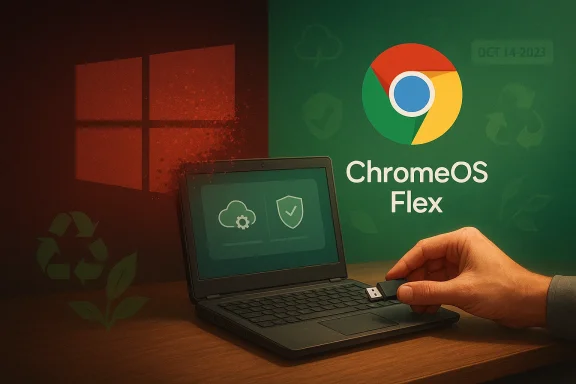
The new twist is the distribution model. Google announced a ChromeOS Flex USB Kit partnership with Back Market, and the company says the kit helps users install ChromeOS Flex on existing hardware more easily. The kit is reusable, costs around $3 or €3, and is paired with Closing the Loop’s waste-compensation work to reduce e-waste. That makes the pitch sound less like a gadget sale and more like a sustainability campaign with a software switch attached.
Microsoft, meanwhile, is trying to keep Windows 11 attractive by making it feel less brittle and less intrusive. Its recent Insider work, plus broader Windows messaging in 2025 and 2026, emphasizes quality, reliability, and consent. That matters because this migration debate is no longer just about system requirements; it is about trust, convenience, and whether users believe the next version of Windows is worth the hassle.
That distinction matters because the term upgrade does a lot of rhetorical work here. To a frustrated Windows 10 user, it sounds like a way to get modern performance without buying a new laptop. In reality, it is more like a controlled downgrade of system complexity: fewer local dependencies, fewer traditional Windows desktop workflows, and a stronger dependence on Google’s cloud-centric environment. It is free, but not neutral.
The official product pages also stress manageability. ChromeOS Flex devices can be administered alongside Chromebooks through Google Admin console, which is a strong selling point for IT teams that want a consistent fleet strategy. For schools, nonprofits, and lightweight enterprise environments, that can be more attractive than squeezing a few more months out of a Windows install that is approaching end-of-support anxiety.
The kit also ties into a broader circular-economy story. Google says the USB sticks in the pilot are “waste-compensated,” meaning an equivalent amount of e-waste by weight is collected and responsibly recycled. That does not solve the full landfill problem created by millions of aging PCs, but it does give Google a cleaner narrative than the one often surrounding forced device replacement.
The problem is that Windows 11 adoption has not been smooth enough to absorb everybody. Microsoft spent years trying to frame the Windows 11 transition as a standard refresh cycle, but the reality has been more exclusionary for users with older machines. Forbes’ own framing, echoed in the Google announcement, is blunt: many people now face the choice between spending hundreds on a new device or staying on an unsupported OS.
Microsoft is trying to soften that landing with ESU and with Windows 11 upgrade messaging, but the transition is still messy. The company has also continued to emphasize security updates for Microsoft 365 on Windows 10 through October 2028, which helps enterprise customers but does not remove the underlying OS risk. The result is a prolonged limbo, and limbo is exactly where alternative platforms become attractive.
That means Google’s offer is not really a direct replacement for Windows in the broadest sense. It is a pressure valve. It gives people a way to extract value from otherwise stranded hardware, while also nudging some fraction of the market into Google’s ecosystem. That is a shrewd move, because it turns Microsoft’s support cutoff into Google’s distribution opportunity.
The strategic appeal is obvious. If a Windows 10 machine cannot move to Windows 11 cleanly, ChromeOS Flex becomes the most legible alternative for users who are not interested in Linux tinkering or paid hardware refreshes. That is especially true for education, call centers, kiosks, hospitality, and family hand-me-down devices, where the PC’s job is limited and web apps do most of the work.
There is also an ecosystem defense element. The more Google can normalize ChromeOS Flex as the obvious safe landing zone for older devices, the more it can prevent those users from drifting to Windows 11 or even to Linux-based alternatives. In a market where inertia is powerful, being the first alternative offered often matters more than being the most technically elegant one.
That tension is not new, but it is sharper now because Windows 10 end-of-life has narrowed the choice set. When a platform reaches support expiration, users are more receptive to the idea that maybe the next move is not another expensive Windows machine at all. Google does not need a majority conversion to make a dent; it only needs enough visible defections to create the impression that Windows is no longer the default answer for every aging PC.
The irony is that Google’s campaign can point to precisely that trust gap. If Microsoft has to keep telling users that Windows is improving, secure, and bug-free, Google can simply offer a different path and let the contrast do the talking. The competitive advantage lies not only in ChromeOS Flex’s features, but in the implied critique of Windows itself.
For Microsoft, the challenge is to make “Windows is reliable” feel boring again. For Google, the opportunity is to make “ChromeOS Flex is simple” feel inevitable. Those are very different marketing jobs, and right now Google has the easier one. Simple always sounds better than fixed.
Google’s sustainability claim rests on a simple premise: reusing an existing machine usually has a lower footprint than manufacturing a new one. That is directionally true, and Google’s materials explicitly say ChromeOS Flex helps extend the life of already manufactured devices while avoiding the emissions associated with replacement hardware. In this context, the environmental message is also a practical one: reusing hardware can be cheaper, faster, and psychologically easier than replacing it.
That is why the green narrative should be read as an amplifier rather than the core reason to adopt. It reduces guilt, and it helps institutions justify the switch, but it does not erase workflow friction. The decision still lives or dies on compatibility, simplicity, and user acceptance. Environmentally responsible is a persuasive label; it is not a universal guarantee.
The practical implication is that ChromeOS Flex could become a favored “second life” system for organizations that are already committed to web apps and Google Admin. If that happens at scale, the main rival is not necessarily Windows 11; it is the disposal pile. Google is trying to win the right to define what happens next after a machine ages out of Windows.
But the second-order beneficiaries may be Google’s strongest audience: schools, nonprofits, shared-device operators, and families. Those are the environments where a browser-first machine makes sense, where admin simplicity matters, and where the OS itself is often just a delivery layer for web services. For those users, ChromeOS Flex may feel less like a compromise and more like a sensible reset.
That split is important because it reveals the true market segmentation behind the announcement. Google is not trying to replace every Windows box; it is trying to capture the long tail of “good enough” PCs that still have life left in them. That is a much more achievable target, and potentially a very lucrative one in aggregate.
The more interesting test may come from institutions rather than individuals. Schools, nonprofits, and small businesses often move faster once a low-cost, low-maintenance option exists, and those are precisely the environments where ChromeOS Flex can build real momentum. If Google can prove that the model reduces cost, extends device life, and keeps fleets manageable, it may not need to win the consumer war to make a real dent in the PC market.
Source: Forbes https://www.forbes.com/sites/zakdof...ree-pc-upgrade-for-500-million-windows-users/
 Background
Windows 10’s retirement has become one of the defining PC industry events of 2025 and 2026. Microsoft confirmed that support ended on October 14, 2025, and its own guidance says consumers can extend security coverage for up to a year through the Extended Security Updates program, while organizations can buy additional time under enterprise ESU arrangements. That creates a familiar but uncomfortable transition: millions of devices are still functional, but many do not meet Windows 11’s hardware requirements, especially on the trusted platform module and supported CPU front.That hardware gate is the real story behind the current wave of “free upgrade” rhetoric. For users whose PCs cannot officially move to Windows 11, the path forward has looked expensive, inconvenient, or both. Microsoft’s own support messaging acknowledges the choice: upgrade to a newer device, enroll in ESU for temporary relief, or continue running an increasingly risky OS. Google is trying to exploit that tension by positioning ChromeOS Flex as a lower-friction escape hatch.
ChromeOS Flex is not new, but its timing is. Google’s official ChromeOS Flex materials describe it as a free operating system for compatible PCs and Macs, with built-in security, centralized management, and a lighter environmental footprint than replacing hardware outright. In practical terms, it is designed to make old machines feel useful again, especially in households, schools, nonprofits, and small businesses that are more sensitive to cost than to platform ideology.
The new twist is the distribution model. Google announced a ChromeOS Flex USB Kit partnership with Back Market, and the company says the kit helps users install ChromeOS Flex on existing hardware more easily. The kit is reusable, costs around $3 or €3, and is paired with Closing the Loop’s waste-compensation work to reduce e-waste. That makes the pitch sound less like a gadget sale and more like a sustainability campaign with a software switch attached.
Microsoft, meanwhile, is trying to keep Windows 11 attractive by making it feel less brittle and less intrusive. Its recent Insider work, plus broader Windows messaging in 2025 and 2026, emphasizes quality, reliability, and consent. That matters because this migration debate is no longer just about system requirements; it is about trust, convenience, and whether users believe the next version of Windows is worth the hassle.
What Google Is Actually Offering
Google’s headline sounds almost too generous: “upgrade” your PC to ChromeOS Flex for free. But the offer is really a software conversion program, not a free hardware replacement. The operating system costs nothing, and the USB kit is inexpensive, but users still need to install it, verify compatibility, and accept that the machine will no longer be a conventional Windows PC in the old sense.That distinction matters because the term upgrade does a lot of rhetorical work here. To a frustrated Windows 10 user, it sounds like a way to get modern performance without buying a new laptop. In reality, it is more like a controlled downgrade of system complexity: fewer local dependencies, fewer traditional Windows desktop workflows, and a stronger dependence on Google’s cloud-centric environment. It is free, but not neutral.
The ChromeOS Flex pitch
Google is framing ChromeOS Flex around three benefits: security, simplicity, and sustainability. The company says the platform is built for older devices, offers built-in protections, and helps keep hardware out of landfills by extending useful life. That messaging is carefully chosen, because it speaks to cost-conscious consumers and ESG-minded institutions at the same time.The official product pages also stress manageability. ChromeOS Flex devices can be administered alongside Chromebooks through Google Admin console, which is a strong selling point for IT teams that want a consistent fleet strategy. For schools, nonprofits, and lightweight enterprise environments, that can be more attractive than squeezing a few more months out of a Windows install that is approaching end-of-support anxiety.
The USB kit and Back Market deal
The Back Market partnership gives the campaign a physical distribution layer. Instead of forcing users to build installation media themselves, Google is leaning on a ready-made USB kit that it says costs around $3 and is reusable. That sounds trivial, but the psychological effect is significant: it lowers the perceived barrier to trying ChromeOS Flex, especially for casual users who would never otherwise venture into OS installation territory.The kit also ties into a broader circular-economy story. Google says the USB sticks in the pilot are “waste-compensated,” meaning an equivalent amount of e-waste by weight is collected and responsibly recycled. That does not solve the full landfill problem created by millions of aging PCs, but it does give Google a cleaner narrative than the one often surrounding forced device replacement.
Why Windows 10’s End Matters So Much
Windows 10’s end of support is not just a date on a lifecycle chart. For many households and organizations, it is a budget event, a security event, and a hardware policy event all at once. Microsoft’s guidance says free security updates stopped on October 14, 2025, with ESU available as a bridge for people who need more time. That means the clock is already ticking on the Windows 10 installed base, even if some devices remain technically usable.The problem is that Windows 11 adoption has not been smooth enough to absorb everybody. Microsoft spent years trying to frame the Windows 11 transition as a standard refresh cycle, but the reality has been more exclusionary for users with older machines. Forbes’ own framing, echoed in the Google announcement, is blunt: many people now face the choice between spending hundreds on a new device or staying on an unsupported OS.
Support, security, and inertia
The security angle is obvious, but inertia is just as important. A large share of PC users do not think of themselves as operating-system shoppers. They buy a machine, use the software that came with it, and only reconsider when something breaks or support expires. That makes Windows 10 end-of-life especially potent: it forces a platform decision onto people who would rather not make one.Microsoft is trying to soften that landing with ESU and with Windows 11 upgrade messaging, but the transition is still messy. The company has also continued to emphasize security updates for Microsoft 365 on Windows 10 through October 2028, which helps enterprise customers but does not remove the underlying OS risk. The result is a prolonged limbo, and limbo is exactly where alternative platforms become attractive.
Consumer versus enterprise impact
For consumers, ChromeOS Flex is easiest to understand as a rescue option for a laptop that still turns on but no longer deserves a full Windows life. For enterprises, the calculus is more complicated because app compatibility, identity systems, device management, and user training all matter. A browser-first platform can be efficient, but only if the organization’s workflows already live comfortably in the web.That means Google’s offer is not really a direct replacement for Windows in the broadest sense. It is a pressure valve. It gives people a way to extract value from otherwise stranded hardware, while also nudging some fraction of the market into Google’s ecosystem. That is a shrewd move, because it turns Microsoft’s support cutoff into Google’s distribution opportunity.
ChromeOS Flex as a Strategic Attack on Windows
This is not just a sustainability story. It is a platform battle wrapped in green messaging. Google has spent years positioning ChromeOS and ChromeOS Flex as secure, low-maintenance alternatives to heavier desktop operating systems, and Windows 10’s retirement gives that strategy a large, visible trigger event.The strategic appeal is obvious. If a Windows 10 machine cannot move to Windows 11 cleanly, ChromeOS Flex becomes the most legible alternative for users who are not interested in Linux tinkering or paid hardware refreshes. That is especially true for education, call centers, kiosks, hospitality, and family hand-me-down devices, where the PC’s job is limited and web apps do most of the work.
Why Google cares
Google benefits when more users spend more time inside browser-centric workflows. ChromeOS Flex reinforces the idea that the browser is the operating system boundary that matters most, which in turn strengthens the role of Google services, Chrome, and cloud app delivery. Even if the user never buys a Chromebook, the message still supports Google’s broader desktop strategy.There is also an ecosystem defense element. The more Google can normalize ChromeOS Flex as the obvious safe landing zone for older devices, the more it can prevent those users from drifting to Windows 11 or even to Linux-based alternatives. In a market where inertia is powerful, being the first alternative offered often matters more than being the most technically elegant one.
Where this could work best
ChromeOS Flex is likely to work best where users mostly need a browser, a video call app, cloud documents, and managed sign-in. It is much less compelling for people who depend on specialized Windows software, local creative tools, or deep peripheral compatibility. That makes it a strong fit for some demographics and a poor fit for others, which is exactly why Google is careful to pitch it as a “free PC upgrade” instead of a universal replacement.- Best fit: browser-first household laptops
- Best fit: school and training fleets
- Best fit: shared devices and kiosks
- Best fit: basic productivity environments
- Weak fit: advanced gaming and pro apps
- Weak fit: niche Windows-only business software
Microsoft’s Competitive Dilemma
Google’s timing is painful for Microsoft because the Windows story is already under stress. Microsoft has been working hard to make Windows 11 feel more stable, more intentional, and less cluttered, but those efforts have not erased the memory of years of user complaints. The more Google can present itself as the calm, simple alternative, the more every Windows annoyance becomes a marketing asset for ChromeOS Flex.That tension is not new, but it is sharper now because Windows 10 end-of-life has narrowed the choice set. When a platform reaches support expiration, users are more receptive to the idea that maybe the next move is not another expensive Windows machine at all. Google does not need a majority conversion to make a dent; it only needs enough visible defections to create the impression that Windows is no longer the default answer for every aging PC.
The Windows 11 trust problem
Microsoft’s own recent documentation and Insider chatter show that the company knows Windows 11 needs to be less disruptive. The platform has been getting quality improvements, more controlled update behavior, and more careful Copilot placement, all of which suggest that Microsoft is trying to repair user trust rather than merely ship new features. That effort matters because trust, once damaged, is hard to rebuild through messaging alone.The irony is that Google’s campaign can point to precisely that trust gap. If Microsoft has to keep telling users that Windows is improving, secure, and bug-free, Google can simply offer a different path and let the contrast do the talking. The competitive advantage lies not only in ChromeOS Flex’s features, but in the implied critique of Windows itself.
The bug-free moment, and why it matters
Microsoft has recently claimed that Windows 11 now has no known issues in its tracked documentation, a milestone that sounds positive but also underscores how much of the Windows narrative has been shaped by instability, broken updates, and recurring friction. Even if that state is temporary, it is remarkable that a major OS vendor can turn “no known issues” into a headline worth celebrating. That alone tells you something about the trust environment around Windows 11.For Microsoft, the challenge is to make “Windows is reliable” feel boring again. For Google, the opportunity is to make “ChromeOS Flex is simple” feel inevitable. Those are very different marketing jobs, and right now Google has the easier one. Simple always sounds better than fixed.
Sustainability Is a Feature, But Also a Sales Pitch
The environmental framing in Google’s announcement is not incidental. The company is clearly trying to turn a hardware-support problem into an e-waste story, and that’s smart because it broadens the appeal beyond tech enthusiasts. Many people are uneasy about throwing away a perfectly working laptop just because an OS vendor drew a new line under support.Google’s sustainability claim rests on a simple premise: reusing an existing machine usually has a lower footprint than manufacturing a new one. That is directionally true, and Google’s materials explicitly say ChromeOS Flex helps extend the life of already manufactured devices while avoiding the emissions associated with replacement hardware. In this context, the environmental message is also a practical one: reusing hardware can be cheaper, faster, and psychologically easier than replacing it.
The limits of the green argument
Still, sustainability alone will not make a bad fit into a good one. If the user needs Windows applications, local creative software, or specific hardware drivers, a greener machine is not necessarily a more usable machine. The ChromeOS Flex pitch is strongest when the workload is light and the device is already old enough that performance expectations have dropped.That is why the green narrative should be read as an amplifier rather than the core reason to adopt. It reduces guilt, and it helps institutions justify the switch, but it does not erase workflow friction. The decision still lives or dies on compatibility, simplicity, and user acceptance. Environmentally responsible is a persuasive label; it is not a universal guarantee.
IT and fleet management implications
For IT departments, ChromeOS Flex’s manageability is probably more important than the carbon angle. Google is selling a centrally controllable, cloud-managed endpoint that can breathe new life into old devices without turning them into maintenance projects. That is attractive for fleets where buying new hardware would be wasteful, but retiring the devices entirely would be equally unattractive.The practical implication is that ChromeOS Flex could become a favored “second life” system for organizations that are already committed to web apps and Google Admin. If that happens at scale, the main rival is not necessarily Windows 11; it is the disposal pile. Google is trying to win the right to define what happens next after a machine ages out of Windows.
Who Actually Benefits Here?
The obvious beneficiaries are people with older, unsupported hardware who do not want to buy a new machine. They now have a cleaner story: either pay Microsoft for temporary breathing room, buy new hardware, or repurpose the existing PC with a free ChromeOS Flex install. That is better than being cornered into immediate replacement, even if the trade-offs remain real.But the second-order beneficiaries may be Google’s strongest audience: schools, nonprofits, shared-device operators, and families. Those are the environments where a browser-first machine makes sense, where admin simplicity matters, and where the OS itself is often just a delivery layer for web services. For those users, ChromeOS Flex may feel less like a compromise and more like a sensible reset.
Consumer reality versus marketing
For the average Windows user, the choice is more complicated than Google’s glossy language suggests. If the machine is mainly used for email, browsing, video, and documents, ChromeOS Flex is probably enough. If the machine is used for games, legacy software, offline work, or specialist peripherals, the “free upgrade” may prove to be a detour rather than a destination.That split is important because it reveals the true market segmentation behind the announcement. Google is not trying to replace every Windows box; it is trying to capture the long tail of “good enough” PCs that still have life left in them. That is a much more achievable target, and potentially a very lucrative one in aggregate.
Strengths and Opportunities
Google’s move has several obvious strengths, and the opportunity is larger than the headline suggests. It turns a hard Windows migration deadline into a practical alternative, gives ChromeOS Flex a fresh burst of attention, and lets Google position itself as both user-friendly and environmentally responsible. The offer also arrives with a low-friction installation story, which matters a great deal when the target audience is made up of people who were never planning to become operating-system hobbyists.- It gives unsupported PC owners a concrete option now.
- It lowers the cost of keeping older hardware useful.
- It reinforces Google’s browser-first ecosystem strategy.
- It creates a sustainability message that resonates beyond tech circles.
- It helps IT teams extend device lifecycles in managed environments.
- It can reduce e-waste pressure in schools and homes.
- It may draw some users away from Windows-only replacement cycles.
Risks and Concerns
The risks are equally real, and they mostly come down to mismatch. ChromeOS Flex is not a universal replacement for Windows, and Google’s marketing language could create expectations that the platform cannot meet for power users, gamers, or anyone dependent on Windows-native software. There is also a broader strategic risk: if the pitch is perceived as opportunistic rather than helpful, it could reinforce the idea that Google is using Microsoft’s pain to upsell a different kind of lock-in.- Compatibility will remain a hard ceiling for many users.
- Some workflows will break when moving off Windows.
- The USB kit still requires manual effort and confidence.
- Browser-first computing is not ideal for every household.
- Enterprise adoption will depend on app and identity readiness.
- The “free upgrade” framing may overpromise in practice.
- Microsoft could respond with stronger Windows 11 migration incentives.
Looking Ahead
The next few months will show whether this is a meaningful migration path or just a well-timed marketing campaign. If Google can make the ChromeOS Flex install process feel almost foolproof, and if Microsoft continues to wrestle with Windows 11 trust issues, the appeal of repurposing old PCs will become much stronger. If not, the story will fade into the long list of alternative OS experiments that look compelling in the abstract and niche in practice.The more interesting test may come from institutions rather than individuals. Schools, nonprofits, and small businesses often move faster once a low-cost, low-maintenance option exists, and those are precisely the environments where ChromeOS Flex can build real momentum. If Google can prove that the model reduces cost, extends device life, and keeps fleets manageable, it may not need to win the consumer war to make a real dent in the PC market.
- Watch for broader Back Market availability.
- Watch for certified-device list expansions.
- Watch for Microsoft ESU enrollment trends through 2026.
- Watch for ChromeOS Flex adoption in schools and nonprofits.
- Watch for Windows 11 quality changes that could blunt migration.
- Watch for any new Google messaging around family or SMB use cases.
Source: Forbes https://www.forbes.com/sites/zakdof...ree-pc-upgrade-for-500-million-windows-users/
