
Google’s new Android fake-call detection began rolling out in June 2026 for Pixel phones and other Android 12-or-newer devices using Phone by Google, aiming to warn users when scammers spoof a saved contact’s number and pretend to be family, friends, or trusted callers. The feature arrives just as Australia’s SMS Sender ID Register takes effect on July 1, 2026, making branded business texts easier to verify but leaving voice calls as the next obvious fraud frontier. The larger story is not that Android has solved impersonation scams. It is that identity on the phone network is being rebuilt, one awkward layer at a time, because the old assumption — that the name on the screen means anything — has collapsed.
For decades, the phone number was treated as a kind of civic identity. It was not a password, exactly, but it behaved like one in everyday life: a bank called from its published line, a parent called from the number in your contacts, and a one-time passcode arrived by SMS because the carrier network was assumed to be close enough to trusted infrastructure.
That model has been dying for years, but AI has made the obituary harder to ignore. Spoofed caller ID was already a mature criminal tactic before deepfake audio became cheap and accessible. Now the attacker does not merely need to make the call look like it came from “Mum”; they can make the first few seconds sound emotionally plausible enough to stop a victim from thinking clearly.
The “Hi Mum” or “Hey Mum” scam was devastating because it exploited a design failure as much as a human one. Messaging apps and SMS inboxes give too much authority to labels, names, and conversational continuity. A scammer does not need to break into a family group chat if they can create a convincing new thread and push the target into urgency.
Google’s fake-call detection is an admission that the same trick works over voice. If the victim sees a familiar contact card and hears something close to a familiar voice, the phone has already done half the attacker’s social engineering. The warning needs to arrive before the conversation becomes emotional.
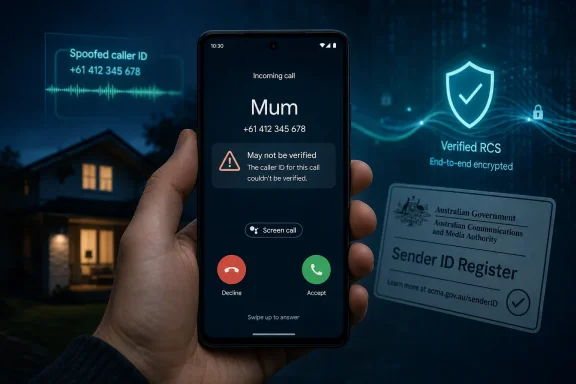
When a saved contact calls, Phone by Google can perform a silent verification using encrypted RCS plumbing. If the caller’s device can prove itself through that channel, the call is treated as legitimate. If a scammer merely spoofs the number, the verification fails, and Android can warn the recipient that the call may not be coming from the person shown on screen.
That distinction matters. Audio analysis is reactive; it listens for patterns after the user is already engaged. Network-level call authentication can help, but it often speaks in the language of carriers and routing rather than personal relationships. Google’s move is more intimate: it tries to bind the contact in your address book to a real device, not just to a string of digits.
This is also why RCS, long marketed as the belated modernization of SMS, is becoming something more than a richer texting protocol. It is turning into a trust layer for mobile identity. That does not make RCS magic, and it certainly does not make Google a neutral public utility. But it does show where consumer security is heading: away from trusting phone numbers and toward verifying devices, accounts, and cryptographic signals.
That makes the feature both promising and incomplete. A Pixel owner whose mother uses a recent Android phone with Phone by Google is in much better shape than a Pixel owner whose mother uses an iPhone, a Samsung dialer without the right integration, or an older handset. The scammer’s favorite target is not the family with perfectly updated devices and harmonized defaults. It is the family where every person has a different phone, app, carrier, and tolerance for update prompts.
This is the recurring weakness of platform security in the consumer world. The security model is often elegant inside the garden and leaky at the fence. Apple has the same problem in reverse with iMessage, FaceTime, and device-based trust signals that work best when everyone involved is using Apple hardware.
For WindowsForum readers, this should sound familiar. Microsoft has spent years trying to make identity less dependent on passwords through Windows Hello, passkeys, TPM-backed credentials, and Entra ID conditional access. The hard part is not inventing a better trust mechanism. The hard part is getting ordinary people, old devices, third-party software, and legacy networks to participate consistently.
But the Android story exposes the boundary of that kind of regulation. The register helps with branded SMS. It does not make voice calls trustworthy. It does not make WhatsApp messages trustworthy. It does not stop a criminal from moving the emotional hook from text to voicemail, from voicemail to live call, or from live call to a video clip.
This is not an argument against the register. Quite the opposite: sender ID registration is overdue because branded SMS created a dangerous illusion of legitimacy. The problem is that each anti-scam fix changes the attacker’s economics rather than ending the attack.
Once a scammer knows that an unregistered “BANKNAME” message will look suspicious, the incentive shifts toward methods that still carry social authority. A call from a saved contact is one of the most powerful of those methods. A warning on that call is not a luxury feature; it is the next defensive line.
Generative AI changes the cost curve. Public social media clips, voicemail greetings, podcast appearances, school videos, and workplace recordings can become raw material for voice cloning. The resulting audio does not need to survive forensic analysis. It only needs to survive a frightened parent’s first reaction.
That is why Google’s device-verification approach is more interesting than another AI-versus-AI filter. If the platform tries to detect synthetic speech, it enters a race in which attackers constantly improve their models and victims remain exposed while the system decides. If the platform verifies the originating device, the scammer has to defeat a different layer of trust.
Of course, this does not eliminate account compromise. If a criminal controls the real phone, the real Google account, or the real messaging session, device verification may confirm exactly the wrong thing. Security teams know this pattern well: stronger authentication narrows the attack surface, but it also increases the value of compromising whatever remains trusted.
A call from “Mum” used to be trusted because the number matched. Under the new model, the phone asks whether the call comes from the expected device, through the expected app stack, with a supporting encrypted signal. That is not full zero trust, but it is recognizably the same impulse: never trust a label when you can verify a signal.
This creates a cultural shift as much as a technical one. Users have been trained to treat warnings as annoyances: certificate prompts, SmartScreen alerts, spam banners, unknown sender labels, and app permission nags all compete for attention. Fake-call detection will only work if the warning is rare, clear, and dramatic enough to interrupt the emotional momentum of a scam.
The danger is habituation. If the feature warns too often because contacts use incompatible devices, users will learn to ignore it. If it stays quiet too often because the ecosystem is fragmented, users may overestimate what it protects. The design challenge is not simply detection accuracy; it is expectation management.
This is where the politics of RCS become more than a messaging war. Apple’s move toward RCS support improved media sharing and group messaging between iPhone and Android, but security parity is still complicated by implementation details, encryption models, and platform control. A fraud-prevention feature that works only inside one vendor’s dialer is useful. A fraud-prevention standard that works across the mobile network would be far more consequential.
There is precedent for this kind of messy evolution. Passkeys are slowly replacing passwords not because one company won a marketing fight, but because platform vendors, browser makers, and standards bodies aligned around a more secure sign-in model. Call identity may need a similar standards-driven path.
Until then, Android’s fake-call detection has the shape of an early platform advantage. Pixel users get another reason to see Google’s phone app as a security product, not just a dialer. But scammers do not care about product differentiation; they care about the weakest reachable victim in the contact graph.
Carriers remain central because they control routing, numbering, and much of the policy enforcement layer. Governments can mandate sender registries, carriers can label suspicious traffic, and device makers can warn at the endpoint. None of these layers is sufficient alone.
The best anti-scam systems will combine all three. A branded message should be checked against a registry. A business call should carry trustworthy attestation. A personal call from a saved contact should be verified against the real device where possible. A suspicious conversation should still trigger on-device scam detection if the earlier layers fail.
That layered approach is familiar to anyone who has defended a Windows fleet. You do not choose between identity protection, endpoint detection, email filtering, user training, and backup. You assume one control will fail and design the next one to catch what slips through.
The rise of passkeys is relevant here. A passkey succeeds because it removes the shared secret that can be phished and anchors sign-in to a device-controlled credential. Google’s fake-call detection is not a passkey for voice, but the philosophical rhyme is hard to miss: stop asking the user to distinguish a convincing fake from a real interaction, and make the device prove what it can prove.
That is the right direction, but it has a usability burden. Security that depends on users understanding RCS handshakes will fail. Security that quietly turns a spoofed “Mum” call into a visible warning has a chance.
The trick is to make trust boring. The user should not need to know the cryptographic choreography. They need to know that if the phone says the call may be fake, they should hang up and call back using a known method.
The emotional script will also change. If users learn that a verified call is safer, scammers may shift toward messages that create confusion before the call ever happens. They may send a fake “new number” message, wait for the victim to save it, then use that saved contact identity later. They may exploit the gap between what the phone warns about and what the user thinks it warns about.
That means public education still matters, even when the technology improves. The advice remains dull but effective: verify urgent money requests out of band, call back on a known number, use family passphrases, and distrust pressure. The novelty is that the phone can now help enforce that pause at the most dangerous moment.
Enterprises should watch this consumer feature closely because the same pattern will reach workplace communications. Executive impersonation, help desk fraud, vendor payment scams, and voice-based social engineering are all downstream of the same identity problem. If attackers can spoof a CFO’s number and clone a voice, the corporate version of “Hey Mum” is “approve this transfer.”
 The Phone Number Has Finally Lost Its Authority
For decades, the phone number was treated as a kind of civic identity. It was not a password, exactly, but it behaved like one in everyday life: a bank called from its published line, a parent called from the number in your contacts, and a one-time passcode arrived by SMS because the carrier network was assumed to be close enough to trusted infrastructure.That model has been dying for years, but AI has made the obituary harder to ignore. Spoofed caller ID was already a mature criminal tactic before deepfake audio became cheap and accessible. Now the attacker does not merely need to make the call look like it came from “Mum”; they can make the first few seconds sound emotionally plausible enough to stop a victim from thinking clearly.
The “Hi Mum” or “Hey Mum” scam was devastating because it exploited a design failure as much as a human one. Messaging apps and SMS inboxes give too much authority to labels, names, and conversational continuity. A scammer does not need to break into a family group chat if they can create a convincing new thread and push the target into urgency.
Google’s fake-call detection is an admission that the same trick works over voice. If the victim sees a familiar contact card and hears something close to a familiar voice, the phone has already done half the attacker’s social engineering. The warning needs to arrive before the conversation becomes emotional.
Google Reaches for RCS Because Caller ID Was Never Enough
The clever part of Google’s approach is that it does not try to decide whether a voice sounds fake. Instead, it asks a simpler question: is the call actually coming from the device associated with this contact?When a saved contact calls, Phone by Google can perform a silent verification using encrypted RCS plumbing. If the caller’s device can prove itself through that channel, the call is treated as legitimate. If a scammer merely spoofs the number, the verification fails, and Android can warn the recipient that the call may not be coming from the person shown on screen.
That distinction matters. Audio analysis is reactive; it listens for patterns after the user is already engaged. Network-level call authentication can help, but it often speaks in the language of carriers and routing rather than personal relationships. Google’s move is more intimate: it tries to bind the contact in your address book to a real device, not just to a string of digits.
This is also why RCS, long marketed as the belated modernization of SMS, is becoming something more than a richer texting protocol. It is turning into a trust layer for mobile identity. That does not make RCS magic, and it certainly does not make Google a neutral public utility. But it does show where consumer security is heading: away from trusting phone numbers and toward verifying devices, accounts, and cryptographic signals.
The First Version Protects the Android Faithful Best
The limitation is obvious and important: this works best when both sides live inside Google’s preferred Android stack. The recipient needs Phone by Google, and the feature depends on the surrounding Google communications ecosystem. Pixel owners see the benefit first, while other Android 12-and-newer devices are expected to follow depending on app availability, manufacturer choices, region, and rollout timing.That makes the feature both promising and incomplete. A Pixel owner whose mother uses a recent Android phone with Phone by Google is in much better shape than a Pixel owner whose mother uses an iPhone, a Samsung dialer without the right integration, or an older handset. The scammer’s favorite target is not the family with perfectly updated devices and harmonized defaults. It is the family where every person has a different phone, app, carrier, and tolerance for update prompts.
This is the recurring weakness of platform security in the consumer world. The security model is often elegant inside the garden and leaky at the fence. Apple has the same problem in reverse with iMessage, FaceTime, and device-based trust signals that work best when everyone involved is using Apple hardware.
For WindowsForum readers, this should sound familiar. Microsoft has spent years trying to make identity less dependent on passwords through Windows Hello, passkeys, TPM-backed credentials, and Entra ID conditional access. The hard part is not inventing a better trust mechanism. The hard part is getting ordinary people, old devices, third-party software, and legacy networks to participate consistently.
Australia’s SMS Register Closes One Door While Scammers Walk to Another
Australia’s SMS Sender ID Register is a useful piece of public infrastructure. From July 1, 2026, businesses and organizations using branded sender IDs must register them, so texts appearing to come from a recognizable business name can be checked against an official system. Unregistered branded messages may be labeled as unverified, making impersonation harder and reducing the credibility of fake bank, delivery, toll-road, and government messages.But the Android story exposes the boundary of that kind of regulation. The register helps with branded SMS. It does not make voice calls trustworthy. It does not make WhatsApp messages trustworthy. It does not stop a criminal from moving the emotional hook from text to voicemail, from voicemail to live call, or from live call to a video clip.
This is not an argument against the register. Quite the opposite: sender ID registration is overdue because branded SMS created a dangerous illusion of legitimacy. The problem is that each anti-scam fix changes the attacker’s economics rather than ending the attack.
Once a scammer knows that an unregistered “BANKNAME” message will look suspicious, the incentive shifts toward methods that still carry social authority. A call from a saved contact is one of the most powerful of those methods. A warning on that call is not a luxury feature; it is the next defensive line.
AI Turns Family Impersonation Into an Infrastructure Problem
The most unsettling part of family impersonation fraud is how little technical sophistication it can require. A convincing text may need only a scraped name, a plausible emergency, and a payment rail. A convincing voice scam once required either a skilled impersonator or enough luck to keep the call short.Generative AI changes the cost curve. Public social media clips, voicemail greetings, podcast appearances, school videos, and workplace recordings can become raw material for voice cloning. The resulting audio does not need to survive forensic analysis. It only needs to survive a frightened parent’s first reaction.
That is why Google’s device-verification approach is more interesting than another AI-versus-AI filter. If the platform tries to detect synthetic speech, it enters a race in which attackers constantly improve their models and victims remain exposed while the system decides. If the platform verifies the originating device, the scammer has to defeat a different layer of trust.
Of course, this does not eliminate account compromise. If a criminal controls the real phone, the real Google account, or the real messaging session, device verification may confirm exactly the wrong thing. Security teams know this pattern well: stronger authentication narrows the attack surface, but it also increases the value of compromising whatever remains trusted.
The Consumer Phone Is Becoming a Miniature Zero-Trust Endpoint
Enterprise IT has spent the past decade repeating that trust should be explicit, contextual, and continuously evaluated. Consumer mobile platforms are now stumbling toward the same doctrine, only with friendlier language and fewer dashboards.A call from “Mum” used to be trusted because the number matched. Under the new model, the phone asks whether the call comes from the expected device, through the expected app stack, with a supporting encrypted signal. That is not full zero trust, but it is recognizably the same impulse: never trust a label when you can verify a signal.
This creates a cultural shift as much as a technical one. Users have been trained to treat warnings as annoyances: certificate prompts, SmartScreen alerts, spam banners, unknown sender labels, and app permission nags all compete for attention. Fake-call detection will only work if the warning is rare, clear, and dramatic enough to interrupt the emotional momentum of a scam.
The danger is habituation. If the feature warns too often because contacts use incompatible devices, users will learn to ignore it. If it stays quiet too often because the ecosystem is fragmented, users may overestimate what it protects. The design challenge is not simply detection accuracy; it is expectation management.
Apple Is the Missing Character in Google’s Story
The obvious unresolved question is cross-platform trust. In many markets, the most important family boundary is not Android-to-Android; it is Android-to-iPhone. If Google’s fake-call detection cannot verify an iPhone caller through equivalent mechanisms, a large share of real-world family calls will remain outside the strongest protection.This is where the politics of RCS become more than a messaging war. Apple’s move toward RCS support improved media sharing and group messaging between iPhone and Android, but security parity is still complicated by implementation details, encryption models, and platform control. A fraud-prevention feature that works only inside one vendor’s dialer is useful. A fraud-prevention standard that works across the mobile network would be far more consequential.
There is precedent for this kind of messy evolution. Passkeys are slowly replacing passwords not because one company won a marketing fight, but because platform vendors, browser makers, and standards bodies aligned around a more secure sign-in model. Call identity may need a similar standards-driven path.
Until then, Android’s fake-call detection has the shape of an early platform advantage. Pixel users get another reason to see Google’s phone app as a security product, not just a dialer. But scammers do not care about product differentiation; they care about the weakest reachable victim in the contact graph.
Carriers Still Own Part of the Mess
It is tempting to frame this as Google cleaning up after the telcos, and there is truth in that. Caller ID spoofing has persisted because the phone network was not designed for the threat model of cheap global fraud. Retrofitted authentication schemes help, but they do not fully restore user confidence in the name and number displayed on a handset.Carriers remain central because they control routing, numbering, and much of the policy enforcement layer. Governments can mandate sender registries, carriers can label suspicious traffic, and device makers can warn at the endpoint. None of these layers is sufficient alone.
The best anti-scam systems will combine all three. A branded message should be checked against a registry. A business call should carry trustworthy attestation. A personal call from a saved contact should be verified against the real device where possible. A suspicious conversation should still trigger on-device scam detection if the earlier layers fail.
That layered approach is familiar to anyone who has defended a Windows fleet. You do not choose between identity protection, endpoint detection, email filtering, user training, and backup. You assume one control will fail and design the next one to catch what slips through.
Microsoft’s Lesson Is That Trust Has to Be Boring
Microsoft is not the main actor in this Android story, but the Windows world has a stake in the same identity collapse. Phone Link, Microsoft Authenticator, Teams, Outlook, Entra ID, and Windows Hello all sit in the broader trust chain between a person and a device. If users cannot trust the call, text, or prompt that starts an interaction, every downstream authentication ceremony becomes more fragile.The rise of passkeys is relevant here. A passkey succeeds because it removes the shared secret that can be phished and anchors sign-in to a device-controlled credential. Google’s fake-call detection is not a passkey for voice, but the philosophical rhyme is hard to miss: stop asking the user to distinguish a convincing fake from a real interaction, and make the device prove what it can prove.
That is the right direction, but it has a usability burden. Security that depends on users understanding RCS handshakes will fail. Security that quietly turns a spoofed “Mum” call into a visible warning has a chance.
The trick is to make trust boring. The user should not need to know the cryptographic choreography. They need to know that if the phone says the call may be fake, they should hang up and call back using a known method.
The Scam Playbook Will Adapt Faster Than the Platforms
No serious observer should expect fake-call detection to end family impersonation scams. Criminals will adapt around the edges. They will ask victims to move to apps where verification does not apply. They will claim their phone is broken. They will use compromised accounts. They will target people whose families straddle iOS, Android, WhatsApp, Facebook Messenger, and aging devices.The emotional script will also change. If users learn that a verified call is safer, scammers may shift toward messages that create confusion before the call ever happens. They may send a fake “new number” message, wait for the victim to save it, then use that saved contact identity later. They may exploit the gap between what the phone warns about and what the user thinks it warns about.
That means public education still matters, even when the technology improves. The advice remains dull but effective: verify urgent money requests out of band, call back on a known number, use family passphrases, and distrust pressure. The novelty is that the phone can now help enforce that pause at the most dangerous moment.
Enterprises should watch this consumer feature closely because the same pattern will reach workplace communications. Executive impersonation, help desk fraud, vendor payment scams, and voice-based social engineering are all downstream of the same identity problem. If attackers can spoof a CFO’s number and clone a voice, the corporate version of “Hey Mum” is “approve this transfer.”
The Real Test Is Whether Families Change Their Habits
The immediate lesson from Android’s rollout is not that one platform has beaten voice fraud. It is that mobile identity is being dragged from assumption into verification, and users will need to adjust their instincts accordingly.- A call displaying a saved contact name should no longer be treated as proof that the person is really calling.
- Google’s fake-call detection is strongest when both parties use compatible Android devices, Phone by Google, and the surrounding RCS-capable Google communications stack.
- Australia’s SMS Sender ID Register improves trust for branded text messages from July 1, 2026, but it does not solve impersonation across calls, messaging apps, or social platforms.
- AI voice cloning makes short, emotional calls more dangerous because the attacker only needs to sound plausible long enough to trigger urgency.
- The safest response to any urgent request for money, credentials, codes, or secrecy is still to stop the interaction and verify through a separate known channel.
- Platform vendors, carriers, and regulators will need shared standards because scam victims do not live inside one company’s ecosystem.
References
- Primary source: pickr.com.au
Published: Thu, 25 Jun 2026 05:04:58 GMT
Loading…
www.pickr.com.au - Related coverage: techtimes.com
Loading…
www.techtimes.com - Related coverage: phonearena.com
Loading…
www.phonearena.com - Related coverage: techspot.com
Loading…
www.techspot.com - Related coverage: sofx.com
Loading…
www.sofx.com - Related coverage: technobaboy.com
Loading…
www.technobaboy.com
- Related coverage: androidauthority.com
Loading…
www.androidauthority.com - Related coverage: techradar.com
7 new Android features coming to your phone in June — including fake call detection and Google Photos wardrobe | TechRadar
They're either out now or coming soonwww.techradar.com - Related coverage: androidcentral.com
Loading…
www.androidcentral.com - Related coverage: tomsguide.com
Loading…
www.tomsguide.com - Related coverage: t3.com
Loading…
www.t3.com
