

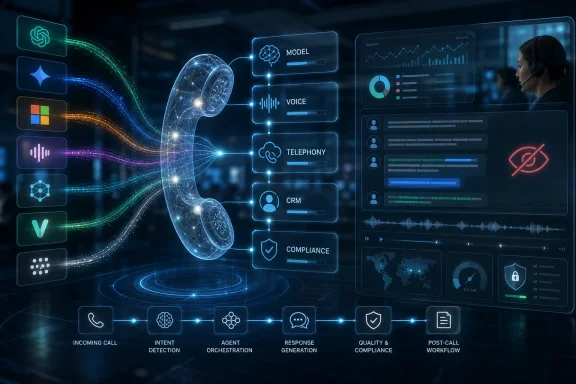
In June 2026, the market for AI phone-call agents is no longer a novelty race but a platform contest among OpenAI, Google, Microsoft, ElevenLabs, PolyAI, CloudTalk, Retell, Vapi, Bland.ai, and Lindy, each attacking a different layer of the voice automation stack. The submitted ranking gets the broad direction right: voice AI has moved from “talking chatbot” demos into production telephony, CRM workflows, customer service queues, and developer infrastructure. But the more interesting story is not which vendor gets the crown. It is that the phone call, the most stubbornly analog-feeling part of business software, is becoming another programmable surface.
The temptation in ranking AI phone agents is to listen for the most natural voice and stop there. That made sense in the first wave, when latency, robotic prosody, and awkward turn-taking were the obvious failures. If the bot paused too long, talked over the customer, or pronounced a name like a malfunctioning GPS, the verdict was immediate.
That is no longer enough. In 2026, the winners are not merely the systems that sound human. They are the systems that can hear messy intent, decide when to call a tool, respect compliance boundaries, hand off cleanly to a person, and leave behind a usable record in the business system of record.
That distinction explains why the top of the market is split between foundation-model companies, enterprise software giants, voice-specialist vendors, and API-first infrastructure startups. OpenAI and Google are trying to make voice an interface for general AI. Microsoft is trying to fold it into the enterprise workflow. PolyAI and CloudTalk are selling contact-center outcomes. Retell, Vapi, and Bland.ai are selling the rails on which other people build agents.
The submitted top 10 therefore reads less like a beauty contest and more like a map of an industry being divided into layers. One layer owns the model. Another owns the voice. Another owns the phone number, the call recording, the CRM sync, the dashboard, and the compliance story. Buyers who treat these as interchangeable “AI receptionist” products are likely to learn, expensively, that they are not.
The submitted article’s framing of OpenAI as a benchmark for natural interruption, memory across a call, multilingual interaction, and tool use is directionally sound. The company’s most important contribution is not just a nicer voice. It is the normalization of tool-calling voice agents that can listen, reason, invoke a booking system, check a refund policy, update a CRM field, and keep the conversation moving while doing it.
But there is a caveat that buyers should not ignore. OpenAI is not, by itself, a contact center. A production deployment still needs telephony, authentication, fallback routing, consent recording, analytics, redaction, fraud controls, and escalation paths. Many companies using OpenAI-powered voice systems will experience OpenAI indirectly through another vendor’s product, not as a raw API project.
That makes OpenAI the engine rather than the whole car. It deserves a top position because so many downstream products are shaped by its capabilities. But CIOs should resist the idea that choosing the strongest foundation model automatically produces the strongest phone operation.
That footprint matters because voice assistants become more useful when they are already sitting inside the user’s dialer, calendar, contacts, email, and documents. Google can screen a call, summarize it, identify likely spam, and connect the result to everyday user workflows in a way that a standalone business voice-agent vendor cannot easily replicate. For consumers and small businesses, that kind of zero-friction deployment is a strategic moat.
The weakness is the flip side of the same strength. Google’s consumer-scale assistant features are not the same thing as a bespoke enterprise phone agent with carefully modeled refund rules, regulated disclosures, and supervisor dashboards. A hotel chain, bank, or insurer does not merely need an assistant that can make a call. It needs one that can operate inside a policy regime and prove what happened afterward.
Recent hiccups around Gemini-driven calling also show that distribution does not eliminate reliability risk. When AI assistants are wired into basic phone functions, a small failure feels bigger than a chatbot outage. Google’s long-term position is formidable, but the enterprise case still depends on whether it can make Gemini feel less like a dazzling assistant and more like dependable business infrastructure.
Copilot Voice, Dynamics 365 Contact Center, Azure Communication Services, and Copilot Studio point toward a coherent strategy: make voice another channel in Microsoft’s enterprise workflow fabric. A customer calls, the system identifies intent, routes the interaction, surfaces CRM context, uses an AI agent where appropriate, and logs the result under familiar governance rules. That is less glamorous than a viral demo, but it is exactly what large organizations need.
The submitted article is right to emphasize regulated industries. In healthcare, finance, insurance, and public-sector work, the question is not only whether an AI agent can resolve a call. It is whether the organization can explain permissioning, data residency, retention, human escalation, and auditing when something goes wrong. Microsoft has spent decades selling into those constraints.
The risk for Microsoft is product complexity. Its ecosystem can be powerful, but it can also be a maze of licenses, admin centers, connectors, and release waves. For companies already standardized on Microsoft infrastructure, that complexity may be acceptable. For everyone else, a focused voice-agent platform may still move faster.
The company’s reputation was built on text-to-speech and voice cloning, and that legacy gives it a privileged place in the stack. Many businesses will not think of ElevenLabs as their full phone-agent vendor. They will encounter it as the voice layer inside another platform, powering the audible personality while another system handles the workflow.
That is both a strength and a limitation. Infrastructure companies can become indispensable without owning the customer relationship, but they also risk being abstracted away. If a contact-center platform lets the buyer choose among multiple voice providers, ElevenLabs must keep proving that its realism is worth the cost and governance overhead.
There is also a social risk around human-sounding agents. As synthetic voices become harder to distinguish from people, disclosure, consent, watermarking, and voice-cloning protections stop being nice-to-have features. They become table stakes. ElevenLabs’ safety work is therefore not a side project; it is central to whether realistic AI speech remains commercially acceptable.
That production history matters. A voice agent in a boardroom demo can follow a clean script. A voice agent on a real support line must survive background noise, emotional customers, half-remembered account details, and edge cases buried in business process. PolyAI’s appeal is that it has been tuned for exactly that unglamorous reality.
The submitted ranking’s emphasis on call deflection, hospitality, banking, logistics, multilingual support, authentication, and payment flows points to PolyAI’s real niche. It is not trying to be a general-purpose assistant living in every app. It is trying to be the voice front door for enterprises with high call volume and measurable service outcomes.
That makes PolyAI one of the more “boring” names on the list in the best possible sense. In enterprise technology, boring often means the thing has survived contact with operations teams. The open question is whether specialist vendors can maintain their advantage as foundation models become more capable and hyperscalers move further up the application stack.
That is where CloudTalk’s established cloud telephony base gives it an advantage. If a company already uses a cloud phone platform, adding an AI voice agent inside the same operational environment is far less intimidating than adopting a new AI infrastructure stack. The buyer does not want a research project. It wants fewer missed leads, shorter queues, and better follow-up.
The submitted article’s focus on transparent SaaS pricing and integrations with systems such as HubSpot, Salesforce, and Pipedrive reflects a real market need. SMBs are sensitive not only to price, but to implementation burden. A technically superior platform that requires engineering time may lose to a simpler product that a revenue-operations manager can deploy.
CloudTalk is unlikely to beat PolyAI in a global bank or OpenAI in raw model capability. But that is not the point. The middle market often rewards packaging over theoretical power, and CloudTalk’s pitch is that AI voice should be a feature of the phone system rather than a separate transformation program.
Retell’s appeal is transparency and observability. In production, a failed AI call is not merely a bad interaction; it is a debugging problem. Teams need transcripts, call replays, intent analytics, webhooks, test environments, cost breakdowns, and a way to understand why the agent made a decision. That is especially true in industries where the call record may later become evidence.
Vapi’s appeal is flexibility. It is model-agnostic, API-first, and attractive to teams that do not want to be trapped inside a monolithic contact-center product. Developers can plug in different LLMs, speech providers, numbers, and workflows, then optimize for cost or performance. That modularity is valuable in a market where the best model in March may not be the best model in September.
The trade-off is that flexibility shifts responsibility back to the builder. A developer platform can make it easy to create an agent, but it does not automatically solve policy design, call escalation, quality assurance, or compliance review. Retell and Vapi are strong choices for technical teams precisely because they expose more of the machinery. Non-technical buyers may prefer a vendor that hides it.
But outbound voice AI lives in the most reputationally dangerous part of the market. Consumers already distrust robocalls, spam, spoofed numbers, and scripted sales outreach. A more natural-sounding automated caller may improve conversion rates, but it can also deepen public hostility if disclosure, consent, and targeting are sloppy.
That is why Bland.ai’s developer-first setup and campaign scalability should be viewed with both appreciation and caution. The technology can be useful when the workflow is legitimate: appointment confirmations, inbound lead response, service reminders, and structured follow-up. It becomes much more fraught when it is used to industrialize cold outreach with synthetic charm.
The submitted ranking places Bland.ai below broader enterprise and infrastructure platforms, which feels right. Its strength is real, but narrower. In 2026, the market will increasingly distinguish between voice automation that reduces friction and voice automation that simply increases the volume of unwanted calls.
For lean teams, Lindy’s appeal is obvious. A no-code assistant that can answer calls, schedule meetings, follow procedures, read from a knowledge base, and connect to calendars or CRMs can replace a surprising amount of administrative glue work. The buyer is not trying to redesign a call center. The buyer is trying to stop routine work from falling through the cracks.
That makes Lindy well suited to founders, consultants, agencies, clinics, service businesses, and small teams that want automation without hiring an engineer. Its broader assistant framing may actually be an advantage in these environments because phone calls are only one part of the work. The same workflow may begin in email, continue in a call, and end in a calendar event or ticket.
The limitation is specialization. At higher call volumes, with strict service-level agreements and complex routing, a broader assistant platform may not offer the depth of a dedicated voice-agent or contact-center product. Lindy’s rank near the bottom of this top 10 is less a criticism than a category distinction: it is an automation assistant that can use the phone, not a phone-native enterprise platform first.
That mixture is not a flaw. It is the reality of the market. The problem comes when buyers compare them as if they were all solving the same problem. A bank modernizing customer service, a startup building a voice product, a dentist trying to reduce missed appointments, and a sales team running outbound qualification campaigns do not need the same vendor.
This is where many rankings become misleading. “Best” only means something after the buyer defines the job. Best voice realism may point to ElevenLabs. Best enterprise governance may point to Microsoft. Best developer control may point to Vapi or Retell. Best production customer-service specialization may point to PolyAI. Best general model capability may point to OpenAI.
The second hidden ranking is cost clarity. Per-minute pricing looks simple until the buyer discovers separate charges for telephony, speech-to-text, text-to-speech, LLM usage, concurrency, storage, compliance add-ons, and support. The meaningful metric is not the cheapest minute. It is the cost per resolved call, booked appointment, qualified lead, or successfully deflected support request.
That is why compliance features should not be treated as enterprise-only extras. Even small businesses need to think about consent to record, caller disclosure, data retention, access control, and what happens when an AI agent misunderstands a request. A small clinic or financial adviser may have fewer calls than a global contact center, but the risk attached to each call can be high.
The stronger vendors are beginning to compete on auditability as much as conversation quality. Transcripts, replay tools, redaction, role-based access, data residency, human handoff, and policy-based guardrails are not administrative garnish. They are the difference between a demo agent and a deployable system.
This is also where WindowsForum readers should be especially skeptical of sweeping marketing claims. “Human-like” is not the same as safe. “Autonomous” is not the same as accountable. The best AI phone agent is the one that can be constrained, observed, corrected, and shut down when necessary.
The next phase will be less forgiving than the demo era. Voice agents will be judged by whether they reduce repeat calls, prevent fraud, improve accessibility, respect privacy, and make human workers more effective when escalation is needed. By 2027, the winners may not be the ones with the most human-sounding voices, but the ones that make the phone network feel less like a queue and more like a reliable interface to getting things done.
 The Best Voice Agent Is No Longer Just the Best Voice
The temptation in ranking AI phone agents is to listen for the most natural voice and stop there. That made sense in the first wave, when latency, robotic prosody, and awkward turn-taking were the obvious failures. If the bot paused too long, talked over the customer, or pronounced a name like a malfunctioning GPS, the verdict was immediate.That is no longer enough. In 2026, the winners are not merely the systems that sound human. They are the systems that can hear messy intent, decide when to call a tool, respect compliance boundaries, hand off cleanly to a person, and leave behind a usable record in the business system of record.
That distinction explains why the top of the market is split between foundation-model companies, enterprise software giants, voice-specialist vendors, and API-first infrastructure startups. OpenAI and Google are trying to make voice an interface for general AI. Microsoft is trying to fold it into the enterprise workflow. PolyAI and CloudTalk are selling contact-center outcomes. Retell, Vapi, and Bland.ai are selling the rails on which other people build agents.
The submitted top 10 therefore reads less like a beauty contest and more like a map of an industry being divided into layers. One layer owns the model. Another owns the voice. Another owns the phone number, the call recording, the CRM sync, the dashboard, and the compliance story. Buyers who treat these as interchangeable “AI receptionist” products are likely to learn, expensively, that they are not.
OpenAI Sets the Pace, but the Stack Is Still Bigger Than the Model
Putting OpenAI at number one is defensible, not because every business should buy directly from OpenAI, but because the company has become the gravitational center for realtime voice-agent development. Its Realtime API and newer speech-to-speech models have pushed the market away from stitched-together pipelines where speech-to-text, an LLM, and text-to-speech each introduce their own delay. That architectural shift matters because phone calls punish latency more brutally than chat does.The submitted article’s framing of OpenAI as a benchmark for natural interruption, memory across a call, multilingual interaction, and tool use is directionally sound. The company’s most important contribution is not just a nicer voice. It is the normalization of tool-calling voice agents that can listen, reason, invoke a booking system, check a refund policy, update a CRM field, and keep the conversation moving while doing it.
But there is a caveat that buyers should not ignore. OpenAI is not, by itself, a contact center. A production deployment still needs telephony, authentication, fallback routing, consent recording, analytics, redaction, fraud controls, and escalation paths. Many companies using OpenAI-powered voice systems will experience OpenAI indirectly through another vendor’s product, not as a raw API project.
That makes OpenAI the engine rather than the whole car. It deserves a top position because so many downstream products are shaped by its capabilities. But CIOs should resist the idea that choosing the strongest foundation model automatically produces the strongest phone operation.
Google’s Advantage Is Distribution, Not Customization
Google’s place near the top comes from a different kind of power. It owns Android, the Phone app experience on Pixel devices, Gemini, Workspace, call screening, spam detection, and a long institutional history with Duplex-style calling. No specialist SaaS vendor can match that distribution.That footprint matters because voice assistants become more useful when they are already sitting inside the user’s dialer, calendar, contacts, email, and documents. Google can screen a call, summarize it, identify likely spam, and connect the result to everyday user workflows in a way that a standalone business voice-agent vendor cannot easily replicate. For consumers and small businesses, that kind of zero-friction deployment is a strategic moat.
The weakness is the flip side of the same strength. Google’s consumer-scale assistant features are not the same thing as a bespoke enterprise phone agent with carefully modeled refund rules, regulated disclosures, and supervisor dashboards. A hotel chain, bank, or insurer does not merely need an assistant that can make a call. It needs one that can operate inside a policy regime and prove what happened afterward.
Recent hiccups around Gemini-driven calling also show that distribution does not eliminate reliability risk. When AI assistants are wired into basic phone functions, a small failure feels bigger than a chatbot outage. Google’s long-term position is formidable, but the enterprise case still depends on whether it can make Gemini feel less like a dazzling assistant and more like dependable business infrastructure.
Microsoft Turns Voice Into an Identity and Compliance Problem
Microsoft’s entry belongs in the upper tier because enterprise voice automation is rarely purchased in isolation. It is purchased by organizations that already have Microsoft 365, Teams, Entra ID, Dynamics 365, Azure, compliance teams, audit requirements, and procurement rules. In that world, the best agent is often the one that fits the existing control plane.Copilot Voice, Dynamics 365 Contact Center, Azure Communication Services, and Copilot Studio point toward a coherent strategy: make voice another channel in Microsoft’s enterprise workflow fabric. A customer calls, the system identifies intent, routes the interaction, surfaces CRM context, uses an AI agent where appropriate, and logs the result under familiar governance rules. That is less glamorous than a viral demo, but it is exactly what large organizations need.
The submitted article is right to emphasize regulated industries. In healthcare, finance, insurance, and public-sector work, the question is not only whether an AI agent can resolve a call. It is whether the organization can explain permissioning, data residency, retention, human escalation, and auditing when something goes wrong. Microsoft has spent decades selling into those constraints.
The risk for Microsoft is product complexity. Its ecosystem can be powerful, but it can also be a maze of licenses, admin centers, connectors, and release waves. For companies already standardized on Microsoft infrastructure, that complexity may be acceptable. For everyone else, a focused voice-agent platform may still move faster.
ElevenLabs Wins the Ear Before Someone Else Wins the Workflow
ElevenLabs earns its position because voice quality still matters, especially in use cases where tone changes outcomes. Sales calls, hospitality bookings, collections, reminders, education, and entertainment all benefit from speech that feels natural, emotionally varied, and brand-appropriate. A voice agent that technically completes the task but sounds uncanny can still damage the customer experience.The company’s reputation was built on text-to-speech and voice cloning, and that legacy gives it a privileged place in the stack. Many businesses will not think of ElevenLabs as their full phone-agent vendor. They will encounter it as the voice layer inside another platform, powering the audible personality while another system handles the workflow.
That is both a strength and a limitation. Infrastructure companies can become indispensable without owning the customer relationship, but they also risk being abstracted away. If a contact-center platform lets the buyer choose among multiple voice providers, ElevenLabs must keep proving that its realism is worth the cost and governance overhead.
There is also a social risk around human-sounding agents. As synthetic voices become harder to distinguish from people, disclosure, consent, watermarking, and voice-cloning protections stop being nice-to-have features. They become table stakes. ElevenLabs’ safety work is therefore not a side project; it is central to whether realistic AI speech remains commercially acceptable.
PolyAI Shows Why Production History Still Counts
PolyAI’s case is less about hype and more about deployments. The company has spent years building enterprise voice assistants for customer service, particularly in sectors where callers do not behave like demo participants. They interrupt, ramble, change their minds, speak with accents, provide partial information, and become annoyed when the machine pretends to understand.That production history matters. A voice agent in a boardroom demo can follow a clean script. A voice agent on a real support line must survive background noise, emotional customers, half-remembered account details, and edge cases buried in business process. PolyAI’s appeal is that it has been tuned for exactly that unglamorous reality.
The submitted ranking’s emphasis on call deflection, hospitality, banking, logistics, multilingual support, authentication, and payment flows points to PolyAI’s real niche. It is not trying to be a general-purpose assistant living in every app. It is trying to be the voice front door for enterprises with high call volume and measurable service outcomes.
That makes PolyAI one of the more “boring” names on the list in the best possible sense. In enterprise technology, boring often means the thing has survived contact with operations teams. The open question is whether specialist vendors can maintain their advantage as foundation models become more capable and hyperscalers move further up the application stack.
CloudTalk Makes the Case for the Middle Market
CloudTalk’s inclusion is important because not every business wants to assemble a voice agent from APIs or negotiate a large enterprise contact-center transformation. Small and midsize businesses often need something simpler: phone system, CRM sync, call recording, analytics, and enough automation to reduce missed calls or repetitive routing.That is where CloudTalk’s established cloud telephony base gives it an advantage. If a company already uses a cloud phone platform, adding an AI voice agent inside the same operational environment is far less intimidating than adopting a new AI infrastructure stack. The buyer does not want a research project. It wants fewer missed leads, shorter queues, and better follow-up.
The submitted article’s focus on transparent SaaS pricing and integrations with systems such as HubSpot, Salesforce, and Pipedrive reflects a real market need. SMBs are sensitive not only to price, but to implementation burden. A technically superior platform that requires engineering time may lose to a simpler product that a revenue-operations manager can deploy.
CloudTalk is unlikely to beat PolyAI in a global bank or OpenAI in raw model capability. But that is not the point. The middle market often rewards packaging over theoretical power, and CloudTalk’s pitch is that AI voice should be a feature of the phone system rather than a separate transformation program.
Retell and Vapi Prove Developers Still Want Control
Retell and Vapi belong together because they represent the developer-first branch of the voice-agent market. Their customers are not just buying an “AI receptionist.” They are building voice products, vertical workflows, internal tools, and custom call automations where control over models, prompts, telephony, latency, and logging matters.Retell’s appeal is transparency and observability. In production, a failed AI call is not merely a bad interaction; it is a debugging problem. Teams need transcripts, call replays, intent analytics, webhooks, test environments, cost breakdowns, and a way to understand why the agent made a decision. That is especially true in industries where the call record may later become evidence.
Vapi’s appeal is flexibility. It is model-agnostic, API-first, and attractive to teams that do not want to be trapped inside a monolithic contact-center product. Developers can plug in different LLMs, speech providers, numbers, and workflows, then optimize for cost or performance. That modularity is valuable in a market where the best model in March may not be the best model in September.
The trade-off is that flexibility shifts responsibility back to the builder. A developer platform can make it easy to create an agent, but it does not automatically solve policy design, call escalation, quality assurance, or compliance review. Retell and Vapi are strong choices for technical teams precisely because they expose more of the machinery. Non-technical buyers may prefer a vendor that hides it.
Bland.ai Is Built for Scale, but Scale Is Not the Same as Trust
Bland.ai’s place on the list reflects the rise of high-volume outbound and inbound automation. Sales teams, lead-qualification shops, appointment setters, collections workflows, and reminder campaigns all have obvious incentives to automate calls. If a business can launch thousands of calls quickly and integrate outcomes back into a CRM, the productivity argument is immediate.But outbound voice AI lives in the most reputationally dangerous part of the market. Consumers already distrust robocalls, spam, spoofed numbers, and scripted sales outreach. A more natural-sounding automated caller may improve conversion rates, but it can also deepen public hostility if disclosure, consent, and targeting are sloppy.
That is why Bland.ai’s developer-first setup and campaign scalability should be viewed with both appreciation and caution. The technology can be useful when the workflow is legitimate: appointment confirmations, inbound lead response, service reminders, and structured follow-up. It becomes much more fraught when it is used to industrialize cold outreach with synthetic charm.
The submitted ranking places Bland.ai below broader enterprise and infrastructure platforms, which feels right. Its strength is real, but narrower. In 2026, the market will increasingly distinguish between voice automation that reduces friction and voice automation that simply increases the volume of unwanted calls.
Lindy Is the Assistant Model Applied to the Phone
Lindy sits at the edge of the category because it is not primarily a contact-center company. It is an AI assistant platform that includes voice agents as part of a broader workflow system. That distinction matters.For lean teams, Lindy’s appeal is obvious. A no-code assistant that can answer calls, schedule meetings, follow procedures, read from a knowledge base, and connect to calendars or CRMs can replace a surprising amount of administrative glue work. The buyer is not trying to redesign a call center. The buyer is trying to stop routine work from falling through the cracks.
That makes Lindy well suited to founders, consultants, agencies, clinics, service businesses, and small teams that want automation without hiring an engineer. Its broader assistant framing may actually be an advantage in these environments because phone calls are only one part of the work. The same workflow may begin in email, continue in a call, and end in a calendar event or ticket.
The limitation is specialization. At higher call volumes, with strict service-level agreements and complex routing, a broader assistant platform may not offer the depth of a dedicated voice-agent or contact-center product. Lindy’s rank near the bottom of this top 10 is less a criticism than a category distinction: it is an automation assistant that can use the phone, not a phone-native enterprise platform first.
The Hidden Ranking Is Between Product, Platform, and Plumbing
The submitted list is useful, but it mixes three different kinds of companies. OpenAI, Google, and Microsoft are platform powers. ElevenLabs is a voice infrastructure specialist. PolyAI and CloudTalk are productized business solutions. Retell, Vapi, and Bland.ai are developer and telephony automation platforms. Lindy is a general assistant with voice capabilities.That mixture is not a flaw. It is the reality of the market. The problem comes when buyers compare them as if they were all solving the same problem. A bank modernizing customer service, a startup building a voice product, a dentist trying to reduce missed appointments, and a sales team running outbound qualification campaigns do not need the same vendor.
This is where many rankings become misleading. “Best” only means something after the buyer defines the job. Best voice realism may point to ElevenLabs. Best enterprise governance may point to Microsoft. Best developer control may point to Vapi or Retell. Best production customer-service specialization may point to PolyAI. Best general model capability may point to OpenAI.
The second hidden ranking is cost clarity. Per-minute pricing looks simple until the buyer discovers separate charges for telephony, speech-to-text, text-to-speech, LLM usage, concurrency, storage, compliance add-ons, and support. The meaningful metric is not the cheapest minute. It is the cost per resolved call, booked appointment, qualified lead, or successfully deflected support request.
Compliance Is Becoming the Feature That Separates Toys From Infrastructure
Voice agents touch sensitive territory by default. They collect names, phone numbers, addresses, payment information, health details, financial facts, emotional complaints, and sometimes biometric clues. They also create recordings and transcripts that may be discoverable, regulated, or subject to retention rules.That is why compliance features should not be treated as enterprise-only extras. Even small businesses need to think about consent to record, caller disclosure, data retention, access control, and what happens when an AI agent misunderstands a request. A small clinic or financial adviser may have fewer calls than a global contact center, but the risk attached to each call can be high.
The stronger vendors are beginning to compete on auditability as much as conversation quality. Transcripts, replay tools, redaction, role-based access, data residency, human handoff, and policy-based guardrails are not administrative garnish. They are the difference between a demo agent and a deployable system.
This is also where WindowsForum readers should be especially skeptical of sweeping marketing claims. “Human-like” is not the same as safe. “Autonomous” is not the same as accountable. The best AI phone agent is the one that can be constrained, observed, corrected, and shut down when necessary.
The 2026 Buyer Should Read This Ranking Sideways
The practical lesson from this top 10 is that voice AI buying should start with architecture, not brand enthusiasm.- Businesses that want the strongest general-purpose realtime AI capability should evaluate OpenAI-powered stacks, but they should still budget for telephony, monitoring, and workflow integration.
- Organizations already deep in Microsoft 365, Teams, Dynamics, and Azure should treat Microsoft’s voice strategy as a serious default option because governance and identity may matter more than novelty.
- Companies with high-volume customer service should compare specialist contact-center vendors such as PolyAI against broader platforms, using resolved-call quality rather than demo fluency as the benchmark.
- Developer teams building custom phone agents should look closely at Retell and Vapi, especially if they need observability, model choice, and control over the end-to-end call flow.
- Small and midsize businesses should prioritize deployment simplicity, CRM integration, transparent pricing, and human fallback over chasing the most advanced model on paper.
- Any organization using outbound AI calling should treat disclosure, consent, targeting, and reputation risk as product requirements, not legal cleanup after launch.
The next phase will be less forgiving than the demo era. Voice agents will be judged by whether they reduce repeat calls, prevent fraud, improve accessibility, respect privacy, and make human workers more effective when escalation is needed. By 2027, the winners may not be the ones with the most human-sounding voices, but the ones that make the phone network feel less like a queue and more like a reliable interface to getting things done.
References
- Primary source: Nubia Magazine!
Published: 2026-06-19T07:50:09.971079
Top 10 Best AI Phone Call Agents & Voice Assistants In The World 2026 | Nubia Magazine
Voice-based artificial intelligence has moved past the era of robotic, frustrating interactions.nubiapage.com - Official source: learn.microsoft.com
FAQ about the voice channel | Microsoft Learn
Use this article to know answers to your frequently asked questions (FAQ) about the voice channel.learn.microsoft.com - Related coverage: openai.github.io

Voice Agents | OpenAI Agents SDK
Build realtime voice assistants using RealtimeAgent and RealtimeSession
openai.github.io
- Related coverage: techradar.com
7 new Android features coming to your phone in June — including fake call detection and Google Photos wardrobe | TechRadar
They're either out now or coming soonwww.techradar.com - Related coverage: jeffturner.info
- Related coverage: 2026-voice-ai-report.s3.us-east-2.amazonaws.com
Coval-Voice-AI-2026-Report — FINAL.pptx
PDF document2026-voice-ai-report.s3.us-east-2.amazonaws.com
