

Microsoft has begun using Open Verifiable Calling, a GSMA Foundry-backed framework demonstrated at MWC 2026, to verify outbound calls from its Azure Communications Services-based contact center across markets where legitimate customer-support and sales calls are too often blocked, mislabeled as spam, or ignored. The move is not merely a telecom plumbing fix. It is Microsoft admitting that the phone network’s social contract has collapsed, and that enterprises now need cryptographic credentials to sound like themselves. If the project works, the humble caller ID may become less of a suggestion and more of a proof.
The modern phone call has become a hostile user interface. A ringing device once implied urgency; now it implies risk, interruption, or some synthetic voice trying to launder fraud through familiarity. Consumers have adapted rationally: if the number is not in the contacts list, the safest answer is often no answer at all.
That defensive posture creates a strange problem for companies that still need to talk to customers. A support engineer may be calling about an open ticket. A sales representative may be following up on a business request. A fraud analyst may be trying to stop an account takeover. Yet from the customer’s perspective, the call looks exactly like the thing they have spent years being trained to distrust.
Microsoft’s Inside Track account of the project is revealing because it starts not with a grand standards pitch, but with an operational embarrassment. Customers were missing legitimate calls from Microsoft’s own contact center, then complaining that Microsoft had not called them back. The company was being filtered by the same defensive machinery that enterprises, carriers, regulators, and handset vendors have encouraged users to depend on.
That is the real significance of Open Verifiable Calling. It reframes the problem from “how do we suppress bad calls?” to “how do we prove good calls?” For years, the industry’s anti-spam posture has largely been reactive, probabilistic, and reputation-driven. Microsoft’s deployment points toward a more assertive model: every legitimate enterprise call should carry evidence of who is calling, what number it has the right to use, and what brand it is permitted to present.
Cloud telephony broke some of the old assumptions in productive and destructive ways at the same time. Services like Azure Communications Services make it easier for a global company to operate a modern contact center without stitching together a mess of on-premises telephony gear. But cloud-originated calls can also cross borders, traverse carriers, and collide with national telecom rules in ways that make a legitimate domestic-looking call appear suspicious.
Microsoft’s own explanation makes this concrete. The company moved more of its contact center in-house using Azure Communications Services, then found that calls were being marked as spam or blocked in some markets because of country-specific rules and the realities of cloud-based calling. In some jurisdictions, international-origin calls are treated harshly by default. In others, the path a cloud call takes can make a local number appear foreign to downstream systems.
The result is that the customer sees “spam,” the agent sees a failed interaction, and the business sees a metric that looks like poor responsiveness. Nobody in that chain is necessarily behaving irrationally. The carrier is trying to protect users, the user is trying to avoid fraud, and Microsoft is trying to reach the person who asked for help. The weakness is the absence of a portable, trustworthy identity layer for voice.
But this is the kind of solution that looks fine in a pilot and miserable in a global operating model. Microsoft says it operates across more than 100 countries and regions, and its earlier approach required roughly 40 different pipelines. That is not a strategy so much as a spreadsheet with a pager attached.
The deeper issue is not just cost or engineering inconvenience. Country-by-country call verification bakes fragmentation into the system. Every new market becomes a telecom integration project. Every carrier relationship becomes a possible point of failure. Every regional rule creates a special case that must be understood, implemented, monitored, and revisited when policy or routing changes.
For a company the size of Microsoft, that may still be survivable. For smaller enterprises, it is prohibitive. A standard framework matters because fraud is global, cloud communications are global, and customer expectations are increasingly global. A legitimate call should not become suspect simply because the company behind it operates across borders.
That distinction matters. Traditional call analytics often resemble a credit score for a telephone number: call volume, complaint history, answer rates, routing patterns, and other signals are used to guess whether a call is wanted or dangerous. Those systems are useful, but they are not the same as identity. They can punish legitimate high-volume callers, and they can be gamed by attackers who rotate numbers, spoof local exchanges, or exploit weak spots between networks.
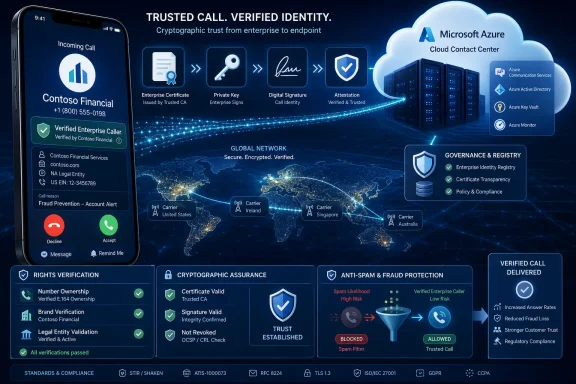
OVC’s more ambitious promise is that the call can include verifiable evidence. Microsoft says each call now passes credentials proving three claims: Microsoft has the right to the displayed number, Microsoft Corporation is the legal entity responsible for the call, and Microsoft has the right to use the displayed brand. That is a more rigorous model than hoping a downstream spam engine likes the look of the number.
Provenant, Microsoft’s Verifiable Voice Protocol partner on the project, performs the signing and verification workflow described in the company’s account. In simplified terms, the credentials say that the number and brand claims check out, and that information is passed into the call path for the terminating carrier to use. The technical details will matter enormously to carriers and standards bodies, but the user-facing ambition is simple: the phone should be able to say, with confidence, that Microsoft is actually calling.
But branding without verification would be dangerous. A logo is powerful precisely because users are trained to respond to it. If attackers can spoof that experience, branded calling becomes a better phishing lure. The industry does not need a more colorful version of caller ID’s original weakness.
That is why Microsoft’s emphasis on rights is important. The project is not just about showing a friendly name on a handset. It is about binding number rights, legal identity, and brand rights into a credentialed call flow. If that model is enforced properly, a scammer should not be able to simply claim the Microsoft logo because the brand presentation depends on verified authorization.
There is still a long distance between a proof of concept, an enterprise deployment, and a global consumer expectation. Handsets, carriers, regulators, CPaaS providers, enterprise systems, and vetting authorities all have to align. But the direction is healthier than the status quo. The goal is not to make users answer every call. It is to make trustworthy calls distinguishable from the noise.
That makes missed calls more than an inconvenience. If a customer ignores a legitimate support call, a ticket may stall. If a customer does answer a fraudulent impersonator, the damage may be immediate. Enterprises are caught between two bad outcomes: being ignored when they are real, and being believed when an attacker pretends to be them.
This is especially acute for technology companies. Microsoft is one of the most impersonated brands in the world because its name sits on operating systems, productivity suites, cloud accounts, developer tools, gaming services, and enterprise identity platforms. A scammer pretending to be Microsoft support is not an edge case; it is one of the recurring shapes of modern fraud.
That context gives OVC a defensive significance beyond call completion rates. If Microsoft can make legitimate calls easier to verify, it also gives customers and carriers a stronger basis for rejecting imitations. The company’s deployment is therefore both operational and reputational. It wants more customers to pick up, but it also wants fewer criminals borrowing its name.
That is also where the project faces its steepest climb. Telecom is not one network in the way users experience the internet as one network. It is a negotiated mesh of operators, national rules, legacy equipment, commercial incentives, and regulatory obligations. Any plan that asks this ecosystem to process identity credentials consistently must solve technical interoperability and institutional trust at the same time.
OVC’s governance model is meant to address that. Microsoft describes vetting agents that validate enterprises in specific regions and for specific communications channels, overseen by a governance authority that sets credential standards and can revoke credentials when participants fail to meet them. That revocation piece is not administrative trivia. A trust system that cannot punish abuse becomes an abuse system.
Still, global acceptance will not happen because Microsoft, GSMA, or Provenant declares the model sensible. Carriers must see value. Regulators must be comfortable with the governance. Enterprises must tolerate vetting. Handset and platform experiences must present verified calls in a way users understand without overpromising safety. The standard’s success will depend less on cryptography in isolation than on whether every participant believes the incentives line up.
One reason is that “the number is not spoofed” is not the same as “the caller is trustworthy.” A legitimate call can still be unwanted. A bad actor can still use a number it controls. A call can pass technical attestation and remain socially useless or malicious. The consumer does not care whether the signaling was honest if the voice on the other end is running a scam.
Another reason is that the phone network is international. National frameworks help, but fraud does not politely stop at the border. Enterprises with global contact centers need identity models that can survive complex routing and regulatory diversity. Microsoft’s experience with region-by-region carrier arrangements is a practical case study in why local fixes struggle to scale.
OVC appears to be aimed at the next layer of the problem: not just whether a number was spoofed, but whether the enterprise identity and brand claim behind the call can be verified. That does not make previous anti-spoofing work obsolete. It suggests the anti-fraud stack is becoming layered, with network attestation, enterprise vetting, brand authorization, analytics, and user interface all playing different roles.
That creates a grim asymmetry. Fraudsters benefit when people answer, but legitimate institutions also need people to answer. The more dangerous the phone becomes, the less useful it becomes for everyone. Trust erosion is not just a consumer annoyance; it is infrastructure decay.
The figures Microsoft cites are stark: three-quarters of consumers ignore calls from unknown numbers, and an even larger share assume unidentified calls are fraudulent. Meanwhile, global scam-loss estimates have crossed into trillion-dollar territory depending on methodology and scope. Even if any single figure should be read carefully, the direction of travel is obvious. The phone channel has become too important to abandon and too compromised to trust casually.
That is why verified calling has a chance to matter. It does not ask users to become more trusting. It tries to give them better evidence. In security terms, that is the right instinct. User education has its place, but systems that depend on every consumer making perfect judgment calls under pressure will fail at scale.
But self-interest is not disqualifying here. In fact, it may be necessary. Anti-fraud infrastructure tends to improve when the parties with money, scale, and reputational exposure feel enough pain to fund solutions. Microsoft’s contact center problem gives it a concrete reason to participate in a standard that could also help banks, hospitals, insurers, airlines, government agencies, and other organizations whose calls users may need to answer.
The key is whether the framework remains open enough and governed well enough to avoid becoming another proprietary trust badge. If verified calling turns into a patchwork of private branded-call clubs, the industry will recreate the fragmentation Microsoft is trying to escape. If it becomes a broadly implemented credential model, the benefits can extend beyond the largest platforms.
There is also a competition angle worth watching. Microsoft is both an enterprise adopting verified calling and a cloud communications provider through Azure Communications Services. If OVC becomes important to contact center credibility, CPaaS platforms will want to support it cleanly. Enterprises will ask whether their provider can carry verified identity across markets. The feature could move from nice-to-have to procurement requirement.
The industry must resist the urge to make the badge too magical. A verified Microsoft call should mean that the call is associated with Microsoft’s authenticated number, legal identity, and brand rights. It should not imply that every sentence spoken on the call is safe, that the user should disclose credentials, or that normal skepticism should be suspended.
This matters because attackers adapt to trust marks. If users are trained that a logo means “do whatever the caller says,” attackers will shift to compromising legitimate channels, manipulating call transfers, or using social engineering around verified interactions. Trust signals reduce certain risks; they do not abolish adversaries.
The best user interface will likely be modest but clear. It should distinguish verified enterprise identity from generic caller ID, show brand information only when authorization is strong, and preserve warnings when behavior is suspicious. A verified identity layer should make good calls easier to recognize and bad claims harder to launder. It should not turn the lock icon problem into a phone icon problem.
That question will matter first in sectors where missed calls are expensive or impersonation is common. Financial services, healthcare, public sector, technology support, logistics, and travel all have legitimate reasons to reach customers quickly. They also have brands worth spoofing. If verified calling matures, these sectors will be early candidates for adoption.
It may also matter for internal IT workflows. Help desks still call employees. Security teams still contact users during incidents. HR, facilities, and executive support groups still rely on voice in high-friction moments. In a world of deepfake audio and increasingly polished impersonation, organizations need stronger ways to signal that a call is actually coming from inside the house.
The Microsoft deployment should therefore be watched as an enterprise infrastructure trial, not just a consumer convenience story. The interesting questions are operational. How difficult is number vetting? How often do credentials fail? What happens when numbers change? How quickly can bad credentials be revoked? How consistently do carriers and devices display the result? Those answers will determine whether verified calling becomes routine or remains a conference demo with a better press release.
This is where governance and policy have to do more than validate identity. They need to support accountability. If verified callers use the system to blast unwanted sales calls, misrepresent intent, or dodge consumer preferences, users will learn to distrust the badge. Trust systems are fragile because they can be polluted by participants who are real but irresponsible.
Microsoft’s use case is sympathetic because it involves customer support and business follow-up. But the same infrastructure could be attractive to high-volume outbound operations whose definition of “customer need” is generous. The industry will need rules for call intent, consent, revocation, complaint handling, and auditability if branded verified calls become widespread.
This is not an argument against OVC. It is an argument that identity is the beginning of trust, not the end. Knowing who is calling lets users, carriers, and regulators make better decisions. It does not eliminate the need to decide whether the call should have been placed in the first place.
Voice may be approaching a similar moment. The PSTN and mobile voice ecosystem were not designed around modern identity threats. Retrofitting proof into that world will be harder than deploying web certificates, because voice networks are older, more regulated, and more fragmented. But the conceptual shift is similar: identity claims need to be verifiable by infrastructure, not merely asserted by the party making the claim.
There is a warning inside the analogy. Browser lock icons did not stop phishing. Certificates proved control of a domain, not the moral character of the website operator. Users misunderstood the signal, attackers adapted, and the industry had to keep refining the model. Verified calling will face the same problem if it lets branding outrun user comprehension.
Still, certificate infrastructure made the web safer than it would otherwise have been. OVC could do something comparable for voice if it becomes boring, standardized, and widely enforced. The best security infrastructure often disappears into expectation. Nobody should be impressed that a bank can prove its call is really from the bank; eventually, users should be alarmed when it cannot.
These are high-context calls. The recipient may have opened a ticket, booked a service, triggered an alert, or requested contact. If verified branding helps that person distinguish the expected call from background scam noise, the value is immediate. The enterprise gets completion; the customer gets confidence; the carrier gets fewer false positives.
Microsoft’s own contact center is a good test bed because the stakes are visible. A customer waiting on a Microsoft support case may not know which number will call. The agent may be in one region, the customer in another, and the call may traverse infrastructure that makes reputation-based systems nervous. Verified identity can smooth that path without requiring the customer to memorize Microsoft’s outbound numbering plan.
The danger is that marketers will seize the same mechanism and drain it of trust. If every verified logo becomes another way to chase attention, users will revert to silence. The standard’s long-term value depends on preserving a meaningful difference between “this caller is authenticated” and “this call deserves your time.”
 Microsoft Is Trying to Rebuild the Phone Call as a Trust Surface
The modern phone call has become a hostile user interface. A ringing device once implied urgency; now it implies risk, interruption, or some synthetic voice trying to launder fraud through familiarity. Consumers have adapted rationally: if the number is not in the contacts list, the safest answer is often no answer at all.That defensive posture creates a strange problem for companies that still need to talk to customers. A support engineer may be calling about an open ticket. A sales representative may be following up on a business request. A fraud analyst may be trying to stop an account takeover. Yet from the customer’s perspective, the call looks exactly like the thing they have spent years being trained to distrust.
Microsoft’s Inside Track account of the project is revealing because it starts not with a grand standards pitch, but with an operational embarrassment. Customers were missing legitimate calls from Microsoft’s own contact center, then complaining that Microsoft had not called them back. The company was being filtered by the same defensive machinery that enterprises, carriers, regulators, and handset vendors have encouraged users to depend on.
That is the real significance of Open Verifiable Calling. It reframes the problem from “how do we suppress bad calls?” to “how do we prove good calls?” For years, the industry’s anti-spam posture has largely been reactive, probabilistic, and reputation-driven. Microsoft’s deployment points toward a more assertive model: every legitimate enterprise call should carry evidence of who is calling, what number it has the right to use, and what brand it is permitted to present.
Caller ID Was Never Built for the Job We Gave It
Caller ID became a trust signal because users needed one, not because the network gave them a robust identity system. The telephone number is a routing artifact that society promoted into a badge of authenticity. That promotion worked tolerably well when fraud was smaller, calls were more local, and the cost of spoofing identity was higher.Cloud telephony broke some of the old assumptions in productive and destructive ways at the same time. Services like Azure Communications Services make it easier for a global company to operate a modern contact center without stitching together a mess of on-premises telephony gear. But cloud-originated calls can also cross borders, traverse carriers, and collide with national telecom rules in ways that make a legitimate domestic-looking call appear suspicious.
Microsoft’s own explanation makes this concrete. The company moved more of its contact center in-house using Azure Communications Services, then found that calls were being marked as spam or blocked in some markets because of country-specific rules and the realities of cloud-based calling. In some jurisdictions, international-origin calls are treated harshly by default. In others, the path a cloud call takes can make a local number appear foreign to downstream systems.
The result is that the customer sees “spam,” the agent sees a failed interaction, and the business sees a metric that looks like poor responsiveness. Nobody in that chain is necessarily behaving irrationally. The carrier is trying to protect users, the user is trying to avoid fraud, and Microsoft is trying to reach the person who asked for help. The weakness is the absence of a portable, trustworthy identity layer for voice.
The Old Fix Was Too Local for a Global Company
Before Open Verifiable Calling, Microsoft took the obvious enterprise route: work with carriers region by region to get numbers recognized. That approach can work. If a carrier knows that certain numbers are legitimately associated with Microsoft, it can avoid labeling those calls as spam or blocking them before they reach the customer.But this is the kind of solution that looks fine in a pilot and miserable in a global operating model. Microsoft says it operates across more than 100 countries and regions, and its earlier approach required roughly 40 different pipelines. That is not a strategy so much as a spreadsheet with a pager attached.
The deeper issue is not just cost or engineering inconvenience. Country-by-country call verification bakes fragmentation into the system. Every new market becomes a telecom integration project. Every carrier relationship becomes a possible point of failure. Every regional rule creates a special case that must be understood, implemented, monitored, and revisited when policy or routing changes.
For a company the size of Microsoft, that may still be survivable. For smaller enterprises, it is prohibitive. A standard framework matters because fraud is global, cloud communications are global, and customer expectations are increasingly global. A legitimate call should not become suspect simply because the company behind it operates across borders.
Open Verifiable Calling Shifts the Burden From Reputation to Evidence
Open Verifiable Calling is the GSMA Foundry project trying to solve that fragmentation problem with a common model for verified caller identity. The framework is designed to carry proof that the caller has the right to use the displayed number, that the legal entity behind the call is who it says it is, and that the brand shown to the recipient is authorized. In Microsoft’s implementation, those claims are attached to outbound calls from its contact center.That distinction matters. Traditional call analytics often resemble a credit score for a telephone number: call volume, complaint history, answer rates, routing patterns, and other signals are used to guess whether a call is wanted or dangerous. Those systems are useful, but they are not the same as identity. They can punish legitimate high-volume callers, and they can be gamed by attackers who rotate numbers, spoof local exchanges, or exploit weak spots between networks.
OVC’s more ambitious promise is that the call can include verifiable evidence. Microsoft says each call now passes credentials proving three claims: Microsoft has the right to the displayed number, Microsoft Corporation is the legal entity responsible for the call, and Microsoft has the right to use the displayed brand. That is a more rigorous model than hoping a downstream spam engine likes the look of the number.
Provenant, Microsoft’s Verifiable Voice Protocol partner on the project, performs the signing and verification workflow described in the company’s account. In simplified terms, the credentials say that the number and brand claims check out, and that information is passed into the call path for the terminating carrier to use. The technical details will matter enormously to carriers and standards bodies, but the user-facing ambition is simple: the phone should be able to say, with confidence, that Microsoft is actually calling.
Branded Calling Is Useful, but Verified Calling Is the Real Prize
It is tempting to focus on the branding layer because that is what users will notice. A call that displays the Microsoft name and logo is easier to understand than a random number from a city the recipient may not recognize. For legitimate enterprises, branded calling could raise answer rates and reduce the infuriating dance of missed calls, voicemails, and support-ticket churn.But branding without verification would be dangerous. A logo is powerful precisely because users are trained to respond to it. If attackers can spoof that experience, branded calling becomes a better phishing lure. The industry does not need a more colorful version of caller ID’s original weakness.
That is why Microsoft’s emphasis on rights is important. The project is not just about showing a friendly name on a handset. It is about binding number rights, legal identity, and brand rights into a credentialed call flow. If that model is enforced properly, a scammer should not be able to simply claim the Microsoft logo because the brand presentation depends on verified authorization.
There is still a long distance between a proof of concept, an enterprise deployment, and a global consumer expectation. Handsets, carriers, regulators, CPaaS providers, enterprise systems, and vetting authorities all have to align. But the direction is healthier than the status quo. The goal is not to make users answer every call. It is to make trustworthy calls distinguishable from the noise.
The Contact Center Has Become a Security Boundary
Microsoft’s story also illustrates how customer support has become part of the security perimeter. Contact centers are no longer just cost centers full of queues and scripts. They are identity-sensitive systems that sit between account recovery, sales, billing, fraud response, and customer trust.That makes missed calls more than an inconvenience. If a customer ignores a legitimate support call, a ticket may stall. If a customer does answer a fraudulent impersonator, the damage may be immediate. Enterprises are caught between two bad outcomes: being ignored when they are real, and being believed when an attacker pretends to be them.
This is especially acute for technology companies. Microsoft is one of the most impersonated brands in the world because its name sits on operating systems, productivity suites, cloud accounts, developer tools, gaming services, and enterprise identity platforms. A scammer pretending to be Microsoft support is not an edge case; it is one of the recurring shapes of modern fraud.
That context gives OVC a defensive significance beyond call completion rates. If Microsoft can make legitimate calls easier to verify, it also gives customers and carriers a stronger basis for rejecting imitations. The company’s deployment is therefore both operational and reputational. It wants more customers to pick up, but it also wants fewer criminals borrowing its name.
The Carrier-Agnostic Pitch Is the Hard Part
The phrase carrier-agnostic does a lot of work here. It is the part of the promise that turns OVC from a Microsoft contact-center improvement into a possible telecom standard. If a number only works after one enterprise negotiates with one carrier in one country, the industry has improved a lane. If the same credential can be understood across carriers, borders, and communications platforms, the industry has improved the road.That is also where the project faces its steepest climb. Telecom is not one network in the way users experience the internet as one network. It is a negotiated mesh of operators, national rules, legacy equipment, commercial incentives, and regulatory obligations. Any plan that asks this ecosystem to process identity credentials consistently must solve technical interoperability and institutional trust at the same time.
OVC’s governance model is meant to address that. Microsoft describes vetting agents that validate enterprises in specific regions and for specific communications channels, overseen by a governance authority that sets credential standards and can revoke credentials when participants fail to meet them. That revocation piece is not administrative trivia. A trust system that cannot punish abuse becomes an abuse system.
Still, global acceptance will not happen because Microsoft, GSMA, or Provenant declares the model sensible. Carriers must see value. Regulators must be comfortable with the governance. Enterprises must tolerate vetting. Handset and platform experiences must present verified calls in a way users understand without overpromising safety. The standard’s success will depend less on cryptography in isolation than on whether every participant believes the incentives line up.
STIR/SHAKEN Was Necessary, but It Was Not Sufficient
In the United States, many readers will naturally think of STIR/SHAKEN, the caller ID authentication framework intended to reduce spoofed robocalls. It was an important step because it gave carriers a way to attest that a call’s caller ID had not been unlawfully spoofed within participating IP networks. But user experience has shown that caller ID authentication alone does not restore trust in the ringing phone.One reason is that “the number is not spoofed” is not the same as “the caller is trustworthy.” A legitimate call can still be unwanted. A bad actor can still use a number it controls. A call can pass technical attestation and remain socially useless or malicious. The consumer does not care whether the signaling was honest if the voice on the other end is running a scam.
Another reason is that the phone network is international. National frameworks help, but fraud does not politely stop at the border. Enterprises with global contact centers need identity models that can survive complex routing and regulatory diversity. Microsoft’s experience with region-by-region carrier arrangements is a practical case study in why local fixes struggle to scale.
OVC appears to be aimed at the next layer of the problem: not just whether a number was spoofed, but whether the enterprise identity and brand claim behind the call can be verified. That does not make previous anti-spoofing work obsolete. It suggests the anti-fraud stack is becoming layered, with network attestation, enterprise vetting, brand authorization, analytics, and user interface all playing different roles.
Fraud Has Trained Users to Treat Silence as Safety
The consumer behavior Microsoft is trying to reverse did not emerge from paranoia. It emerged from experience. Years of robocalls, impersonation scams, fake support calls, spoofed local numbers, and AI-assisted social engineering have turned non-response into a mainstream security habit.That creates a grim asymmetry. Fraudsters benefit when people answer, but legitimate institutions also need people to answer. The more dangerous the phone becomes, the less useful it becomes for everyone. Trust erosion is not just a consumer annoyance; it is infrastructure decay.
The figures Microsoft cites are stark: three-quarters of consumers ignore calls from unknown numbers, and an even larger share assume unidentified calls are fraudulent. Meanwhile, global scam-loss estimates have crossed into trillion-dollar territory depending on methodology and scope. Even if any single figure should be read carefully, the direction of travel is obvious. The phone channel has become too important to abandon and too compromised to trust casually.
That is why verified calling has a chance to matter. It does not ask users to become more trusting. It tries to give them better evidence. In security terms, that is the right instinct. User education has its place, but systems that depend on every consumer making perfect judgment calls under pressure will fail at scale.
Microsoft Also Has a Self-Interest Problem, and That Is Fine
There is a predictable cynical reading of Microsoft’s announcement: the company wants customers to answer its sales and support calls. That is true. Enterprises do not invest in global telecom identity frameworks out of pure civic virtue.But self-interest is not disqualifying here. In fact, it may be necessary. Anti-fraud infrastructure tends to improve when the parties with money, scale, and reputational exposure feel enough pain to fund solutions. Microsoft’s contact center problem gives it a concrete reason to participate in a standard that could also help banks, hospitals, insurers, airlines, government agencies, and other organizations whose calls users may need to answer.
The key is whether the framework remains open enough and governed well enough to avoid becoming another proprietary trust badge. If verified calling turns into a patchwork of private branded-call clubs, the industry will recreate the fragmentation Microsoft is trying to escape. If it becomes a broadly implemented credential model, the benefits can extend beyond the largest platforms.
There is also a competition angle worth watching. Microsoft is both an enterprise adopting verified calling and a cloud communications provider through Azure Communications Services. If OVC becomes important to contact center credibility, CPaaS platforms will want to support it cleanly. Enterprises will ask whether their provider can carry verified identity across markets. The feature could move from nice-to-have to procurement requirement.
The User Interface May Decide Whether Any of This Works
A verified call is only useful if the recipient understands what is being verified. That is not a trivial design problem. Users already see a confusing mix of labels: spam likely, verified, unknown caller, business names, carrier warnings, and app-specific overlays. Adding another trust signal could help, or it could become more visual noise.The industry must resist the urge to make the badge too magical. A verified Microsoft call should mean that the call is associated with Microsoft’s authenticated number, legal identity, and brand rights. It should not imply that every sentence spoken on the call is safe, that the user should disclose credentials, or that normal skepticism should be suspended.
This matters because attackers adapt to trust marks. If users are trained that a logo means “do whatever the caller says,” attackers will shift to compromising legitimate channels, manipulating call transfers, or using social engineering around verified interactions. Trust signals reduce certain risks; they do not abolish adversaries.
The best user interface will likely be modest but clear. It should distinguish verified enterprise identity from generic caller ID, show brand information only when authorization is strong, and preserve warnings when behavior is suspicious. A verified identity layer should make good calls easier to recognize and bad claims harder to launder. It should not turn the lock icon problem into a phone icon problem.
Administrators Should Read This as a Coming Procurement Question
For WindowsForum’s IT audience, the practical implication is not that every organization should suddenly redesign outbound calling. It is that voice identity is becoming part of enterprise trust architecture. The same way admins now ask about domain authentication, phishing-resistant MFA, certificate lifecycle management, and email sender policy, they may soon need to ask how their communications provider proves outbound voice identity.That question will matter first in sectors where missed calls are expensive or impersonation is common. Financial services, healthcare, public sector, technology support, logistics, and travel all have legitimate reasons to reach customers quickly. They also have brands worth spoofing. If verified calling matures, these sectors will be early candidates for adoption.
It may also matter for internal IT workflows. Help desks still call employees. Security teams still contact users during incidents. HR, facilities, and executive support groups still rely on voice in high-friction moments. In a world of deepfake audio and increasingly polished impersonation, organizations need stronger ways to signal that a call is actually coming from inside the house.
The Microsoft deployment should therefore be watched as an enterprise infrastructure trial, not just a consumer convenience story. The interesting questions are operational. How difficult is number vetting? How often do credentials fail? What happens when numbers change? How quickly can bad credentials be revoked? How consistently do carriers and devices display the result? Those answers will determine whether verified calling becomes routine or remains a conference demo with a better press release.
The Security Model Must Survive Abuse From Legitimate Callers Too
Any trust framework that helps enterprises reach users must also confront the possibility that legitimate enterprises can be annoying, careless, or abusive. A verified call from a real company is not automatically a wanted call. Users should not lose control over their attention simply because a brand has passed vetting.This is where governance and policy have to do more than validate identity. They need to support accountability. If verified callers use the system to blast unwanted sales calls, misrepresent intent, or dodge consumer preferences, users will learn to distrust the badge. Trust systems are fragile because they can be polluted by participants who are real but irresponsible.
Microsoft’s use case is sympathetic because it involves customer support and business follow-up. But the same infrastructure could be attractive to high-volume outbound operations whose definition of “customer need” is generous. The industry will need rules for call intent, consent, revocation, complaint handling, and auditability if branded verified calls become widespread.
This is not an argument against OVC. It is an argument that identity is the beginning of trust, not the end. Knowing who is calling lets users, carriers, and regulators make better decisions. It does not eliminate the need to decide whether the call should have been placed in the first place.
The Phone Network Gets a Certificate Authority Moment
The most useful analogy for OVC may be the web’s long migration from informal identity cues to certificate-backed encryption and browser-mediated trust indicators. That migration was imperfect, messy, and sometimes oversold. But it changed expectations. Today, a site that cannot establish basic cryptographic trust looks broken before the user reads a word.Voice may be approaching a similar moment. The PSTN and mobile voice ecosystem were not designed around modern identity threats. Retrofitting proof into that world will be harder than deploying web certificates, because voice networks are older, more regulated, and more fragmented. But the conceptual shift is similar: identity claims need to be verifiable by infrastructure, not merely asserted by the party making the claim.
There is a warning inside the analogy. Browser lock icons did not stop phishing. Certificates proved control of a domain, not the moral character of the website operator. Users misunderstood the signal, attackers adapted, and the industry had to keep refining the model. Verified calling will face the same problem if it lets branding outrun user comprehension.
Still, certificate infrastructure made the web safer than it would otherwise have been. OVC could do something comparable for voice if it becomes boring, standardized, and widely enforced. The best security infrastructure often disappears into expectation. Nobody should be impressed that a bank can prove its call is really from the bank; eventually, users should be alarmed when it cannot.
The First Winners Will Be the Calls People Already Wanted
The early measure of success should not be whether verified calling rescues cold outbound sales. It should be whether it improves calls that customers already have a reason to accept. Support callbacks, fraud alerts, appointment confirmations, incident response, delivery coordination, and account recovery are the natural proving grounds.These are high-context calls. The recipient may have opened a ticket, booked a service, triggered an alert, or requested contact. If verified branding helps that person distinguish the expected call from background scam noise, the value is immediate. The enterprise gets completion; the customer gets confidence; the carrier gets fewer false positives.
Microsoft’s own contact center is a good test bed because the stakes are visible. A customer waiting on a Microsoft support case may not know which number will call. The agent may be in one region, the customer in another, and the call may traverse infrastructure that makes reputation-based systems nervous. Verified identity can smooth that path without requiring the customer to memorize Microsoft’s outbound numbering plan.
The danger is that marketers will seize the same mechanism and drain it of trust. If every verified logo becomes another way to chase attention, users will revert to silence. The standard’s long-term value depends on preserving a meaningful difference between “this caller is authenticated” and “this call deserves your time.”
What Microsoft’s Verified-Calling Trial Tells IT Buyers Now
Microsoft’s deployment is still an early signal, not a universal answer. But it is concrete enough that enterprise IT and security teams should start treating outbound voice as part of their identity roadmap rather than an aging side channel handled entirely by telecom vendors.- Microsoft is using Open Verifiable Calling to attach authenticated number, legal-entity, and brand-rights claims to outbound contact-center calls.
- The project is designed to replace carrier-by-carrier verification work with a more portable model that can operate across regions, carriers, and CPaaS platforms.
- Verified branding may improve answer rates, but its security value depends on cryptographic proof and governance rather than logos alone.
- Enterprises should expect voice identity to become a procurement issue for contact center, CPaaS, fraud prevention, and customer-experience platforms.
- The model will only retain user trust if verified callers remain accountable for consent, call purpose, and abuse.
- The most credible early use cases are support callbacks, fraud alerts, service notifications, and other calls the recipient has a contextual reason to expect.
References
- Primary source: Microsoft
Published: 2026-06-18T15:12:07.302927
Advancing trusted calls with Open Verifiable Calling at Microsoft - Inside Track Blog
Open Verifiable Calling enables us to verify every outbound call here at Microsoft, so calls to customers aren’t marked as spam or blocked by local carriers.www.microsoft.com - Related coverage: gsma.com
GSMA Foundry launches Open Verifiable Calling project, building on proven live deployments to restore trust in Global Voice Communications - GSMA Foundry
Fraud, spoofing, and AI-driven impersonation are on the rise, exploiting the fact that the public telephone network has no native way to verify who is calling. This erodes consumer trust, reduces answer rates, and increases costs for businesses. Open Verifiable Calling addresses this by... www.gsma.com
- Related coverage: mwcbarcelona.com
Mplify, Colt, Orange, Google Cloud, and GSMA Open… | MWC Barcelona
Where innovators, creators & leaders gather to shape the future. Join us next year in Barcelona, 1 - 4 March 2027 www.mwcbarcelona.com
