

Google’s most consequential Search redesign in a quarter-century is not really about making the search box larger. It is about turning the internet’s most valuable entry point into an AI workspace that can interpret long questions, inspect images and videos, analyze files, draw context from Chrome tabs, and eventually act on a user’s behalf. As OpenAI pushes ChatGPT beyond the chatbot and Microsoft embeds generative AI throughout Windows, Edge, and Bing, Google is betting that it can win the consumer AI race by making artificial intelligence feel like an invisible upgrade to a habit billions of people already have.
Google Search has repeatedly changed its machinery without asking users to change the basic ritual. People type a few words, press Enter, and receive a ranked collection of information, services, advertisements, maps, products, and media.
That familiar interaction helped Google become the dominant gateway to the web. It also created an extraordinarily profitable advertising business built around understanding commercial intent at the moment a user expresses it.
Google’s AI Overviews, broadly introduced in 2024 after the company’s Search Generative Experience experiments, accelerated that transition. Instead of merely selecting a page likely to contain an answer, Google could synthesize an answer from multiple sources and display it above much of the conventional results page.
AI Mode went further. Introduced experimentally in 2025 and expanded thereafter, it allowed complex, multi-part questions, conversational follow-ups, and deeper AI-generated responses within Search itself.
The redesign began rolling out in countries and languages where AI Mode was available. Google also said AI Mode had passed one billion monthly users, while usage had more than doubled each quarter since launch.
The visible interface change may appear modest, but the strategic objective is much larger. Google wants the Search box to become the place where people describe goals rather than merely enter keywords.
ChatGPT demonstrated that many people prefer asking a complete question and receiving a synthesized response. The conversational model feels especially natural for research, troubleshooting, comparison shopping, document analysis, coding, and tasks requiring several constraints.
A conversational request can express the full requirement at once: find a lightweight Windows laptop with strong battery life, at least 32GB of memory, a matte display, and adequate performance for virtual machines within a specified budget.
The intelligent Search box is designed to encourage that richer form of expression. Its expanding interface signals that users do not need to compress their needs into a handful of optimized keywords.
If someone begins product research, travel planning, technical troubleshooting, or workplace analysis in ChatGPT, Google may lose the query, the behavioral data surrounding it, and the opportunity to monetize the resulting decision. Even if conventional searches remain plentiful, losing the highest-intent sessions would weaken Google’s position.
Google’s response is therefore defensive and offensive at the same time. It must prevent migration while expanding Search into tasks that previously required multiple applications.
This matters because modern AI systems usually perform better when users provide context. A larger input area encourages people to explain what they are trying to achieve, not simply name the topic.
AI-powered suggestions can also help formulate a query before it is submitted. That capability represents a notable departure from conventional autocomplete, which historically predicted popular keyword sequences rather than helping articulate a complex intent.
For Windows users, practical possibilities include:
That feature illustrates why Google’s ecosystem matters so much. Search can draw context from Chrome, connect results to Maps and Shopping, use YouTube as a video knowledge source, and potentially carry tasks into Gmail, Calendar, or other services.
It also raises significant privacy and transparency questions. Users will need to understand which tabs, documents, account data, and browsing signals an AI response can access.
From that perspective, the expanding box is another step in a process underway for several years. Users still visit Google, enter a request, and receive results.
The company is deliberately preserving continuity. It does not want people to feel that they must learn a new product or decide whether a question belongs in Search, Gemini, Lens, or another interface.
Traditional search engines competed over which pages to rank. AI search systems compete over which answer to construct, which evidence to select, which actions to propose, and how much of the user’s objective they can complete.
The distinction is profound. A search engine points toward resources, while an agentic system may use those resources to finish a task.
Google’s gradual interface strategy can therefore conceal a radical architectural transition. The product remains recognizable even as its role changes from web directory to decision-making layer.
Together, these products create a reinforcement loop:
Moving AI capabilities into that box removes the need to explain why a separate chatbot is useful. A user can discover AI features while performing an ordinary search and gradually adopt more advanced behavior.
This is the essence of Google’s strategy: AI becomes the default behavior of Search rather than a destination competing with Search.
ChatGPT retains strong brand recognition as an AI assistant, and OpenAI can iterate without protecting a conventional search-results business. Younger users and knowledge workers may also be more willing to switch among services based on model quality.
Google must therefore convert distribution into genuine satisfaction. If AI Mode feels slower, more cluttered, less reliable, or overly commercialized, availability alone will not secure long-term preference.
For WindowsForum readers, the competitive dynamics matter because the result will shape how search, browsers, operating systems, and productivity software interact.
That clear identity gives OpenAI freedom to design around conversation from the beginning. It does not have to preserve a results page containing organic links, knowledge modules, shopping units, and decades of advertising conventions.
OpenAI’s challenge is to broaden distribution while maintaining the simplicity that made ChatGPT attractive. As it adds search, agents, commerce, browsing, and productivity tools, it risks developing the same interface complexity it initially avoided.
Yet Windows integration must overcome several years of shifting Copilot branding, placement, and functionality. Users need to understand whether Copilot is an operating-system assistant, web chatbot, Microsoft 365 feature, enterprise agent, or gateway to third-party models.
Google’s proposition may be easier to communicate: use the same Search box, but ask more detailed questions and attach more material.
Microsoft must decide how aggressively to distinguish Bing from Copilot. Too much separation fragments the experience; too much consolidation risks making Bing’s conventional search capabilities less visible.
Zero-click behavior did not begin with generative AI. Definitions, weather reports, calculations, sports scores, maps, and featured snippets had already satisfied a large share of queries directly on the results page.
A field experiment published in 2026 found that, when AI Overviews appeared, outbound organic clicks fell substantially and zero-click behavior increased. The effect did not mean that every search stopped generating traffic, but it confirmed publishers’ concern that generated answers alter user behavior.
AI Mode could deepen the effect because follow-up questions remain inside the conversation. A user who once opened five sites may instead ask Google five additional questions.
The relationship is nonetheless becoming asymmetric. Google can use publishers’ reporting, reviews, tutorials, and analysis to generate an answer while sending fewer readers to the pages that financed the underlying work.
Being cited by an AI system may create brand exposure, but exposure does not automatically pay hosting bills or journalists’ salaries. A citation without a visit is commercially different from a high-ranking conventional result.
That could create a damaging feedback loop:
That context could make advertising more relevant. It could also make the boundary between recommendation and promotion harder to recognize.
If an AI assistant produces a shortlist of products, users need to know whether a brand appears because it is objectively suitable, pays for placement, participates in a shopping program, or benefits from Google’s ranking systems. Clear labeling will be essential.
This creates an opportunity for Google to move closer to the transaction while retaining the user throughout the process. It also threatens comparison sites, affiliate publishers, and smaller retailers that depend on referral traffic.
Organizations may need to track:
Windows users will encounter the effects across browsers, productivity tools, support workflows, and purchasing decisions.
However, troubleshooting advice carries risk. An incorrect recommendation involving Registry edits, drivers, firmware, encryption, account permissions, or command-line operations can cause data loss or weaken security.
Users should treat generated repair instructions as a starting point rather than unquestionable authority. The safest workflow is to:
The risk is that generated comparisons may contain stale prices, confuse regional configurations, or blend specifications from products sharing similar names. Sponsored recommendations could further complicate the picture.
Windows users should verify processor variants, memory configuration, storage type, display technology, port selection, warranty coverage, and upgrade limitations on the seller or manufacturer’s documentation before purchasing.
That makes privacy controls, account separation, history management, and data-retention settings more important than they were when browsers primarily displayed pages. The browser is becoming an active reasoning layer rather than a passive window onto the web.
An employee uploading a document to an intelligent search box may expose information in ways that conventional keyword searches did not.
Organizations should define which materials employees may submit to public AI services. Restrictions may be appropriate for:
IT leaders should evaluate whether AI Search provides stable citations, preserves the context of source material, identifies uncertainty, and supports audit requirements. The answer may differ by query type and service tier.
Organizations should assess portability before AI agents become embedded in daily workflows. Prompts, agent instructions, evaluation data, and automation logic may become as strategically important as documents and email.
The more effectively Google eliminates the need to click, the more responsibility it assumes for the answer users receive.
Google can reduce errors through retrieval, source comparison, specialist models, confidence thresholds, and restrictions on sensitive topics. None of those methods guarantees correctness.
Fresh information poses an additional challenge. Product prices, software versions, legal rules, vulnerabilities, and public events can change faster than model knowledge or indexed pages.
If an agent reads untrusted content and can also access tabs, accounts, files, or transaction tools, prompt injection may attempt to manipulate its behavior. The potential consequences increase as Search moves from answering questions to taking actions.
Google and other vendors will need strong separation among user instructions, retrieved content, and system policies. Enterprises should assume that untrusted web content can be adversarial input.
Users need controls that explain when personalization influenced an answer. They should also be able to request a neutral comparison, clear conversation context, or temporarily disable personalization for sensitive research.
Original reporting, firsthand testing, unique datasets, interactive tools, expert analysis, and clearly documented procedures are harder to replace than generic explanatory articles. Businesses that become trusted sources for AI systems may influence decisions even when traditional traffic declines.
The challenge is converting that influence into measurable value. Brand recognition, subscriptions, direct communities, software tools, and services may become more important than dependence on search referrals alone.
The safest adoption model keeps humans in control of significant decisions. AI can gather and organize information, but users should verify critical facts and approve consequential actions.
The decisive moment will come if Google routes most sufficiently complex requests into AI Mode automatically. At that point, the redesign will no longer be an optional enhancement; it will represent a new default architecture for Search.
Watch for changes in click-through behavior, publisher referral traffic, citation visibility, and Google’s relationships with media companies. Licensing arrangements may become more common if political and commercial pressure grows.
Users may tolerate clearly separated sponsored options. They are likely to resist recommendations whose commercial origins are ambiguous.
The key question is whether ChatGPT remains a destination or becomes a layer available across the user’s digital environment.
A clearer relationship among Windows Search, Copilot, Edge, and Bing could create a compelling alternative, particularly for organizations already standardized on Microsoft’s ecosystem.
The platform that develops the strongest trust model may gain an advantage more durable than a temporary lead in model benchmarks.
Privacy authorities will also consider how multimodal prompts, browsing context, account data, and personalization are processed. Regulatory outcomes could shape product design as much as technical competition does.
For Google, that hybrid approach reduces the risk of forcing users into an unfamiliar model. For OpenAI, it raises the difficulty of separating AI assistance from the search habit Google already owns. For Microsoft, it creates urgency to turn Windows and Copilot into a more unified answer to both rivals.
The intelligent Search box may deserve only a modest score if judged as a visual redesign. Judged as the front door to a system capable of interpreting files, understanding media, reasoning across browser context, and completing tasks, it carries far greater significance.
Google is trying to ensure that people do not think about choosing between search and AI. It wants them to open Google, express what they need in whatever form is convenient, and let its infrastructure decide how the request should be answered. If that strategy succeeds, the company may preserve its dominant role not by defending the old search engine, but by gradually transforming it until the search box becomes indistinguishable from a universal AI assistant.
 Background
Google Search has repeatedly changed its machinery without asking users to change the basic ritual. People type a few words, press Enter, and receive a ranked collection of information, services, advertisements, maps, products, and media.That familiar interaction helped Google become the dominant gateway to the web. It also created an extraordinarily profitable advertising business built around understanding commercial intent at the moment a user expresses it.
From ten blue links to generated answers
The traditional description of Google as a page of “ten blue links” had become outdated long before generative AI arrived. Featured snippets, knowledge panels, direct calculations, weather cards, shopping results, maps, image carousels, and other specialized modules had already transformed Search into an answer engine.Google’s AI Overviews, broadly introduced in 2024 after the company’s Search Generative Experience experiments, accelerated that transition. Instead of merely selecting a page likely to contain an answer, Google could synthesize an answer from multiple sources and display it above much of the conventional results page.
AI Mode went further. Introduced experimentally in 2025 and expanded thereafter, it allowed complex, multi-part questions, conversational follow-ups, and deeper AI-generated responses within Search itself.
The importance of the May 2026 redesign
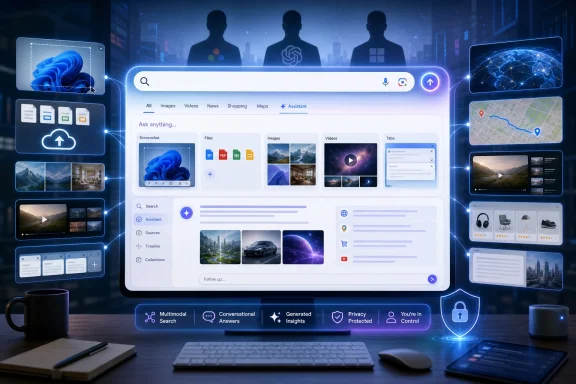
At Google I/O on May 19, 2026, the company unveiled what it described as the biggest upgrade to the Search box since its debut more than 25 years earlier. The new intelligent Search box dynamically expands for longer prompts and accepts combinations of text, images, files, videos, and active Chrome tabs.The redesign began rolling out in countries and languages where AI Mode was available. Google also said AI Mode had passed one billion monthly users, while usage had more than doubled each quarter since launch.
The visible interface change may appear modest, but the strategic objective is much larger. Google wants the Search box to become the place where people describe goals rather than merely enter keywords.
Why Google Is Changing Search Now
Google is not redesigning Search from a position of immediate collapse. It is responding to a change in user expectations before that change can undermine its long-term relevance.ChatGPT demonstrated that many people prefer asking a complete question and receiving a synthesized response. The conversational model feels especially natural for research, troubleshooting, comparison shopping, document analysis, coding, and tasks requiring several constraints.
Search behavior is becoming conversational
Keyword search requires users to translate an objective into terms a retrieval engine can understand. A person looking for a laptop might enter a sequence such as “best Windows laptop battery life,” open several pages, revise the query, and compare specifications manually.A conversational request can express the full requirement at once: find a lightweight Windows laptop with strong battery life, at least 32GB of memory, a matte display, and adequate performance for virtual machines within a specified budget.
The intelligent Search box is designed to encourage that richer form of expression. Its expanding interface signals that users do not need to compress their needs into a handful of optimized keywords.
Google cannot surrender the AI starting point
The central competitive risk is not that ChatGPT will instantly replace every Google query. It is that users may gradually form a new default habit for valuable, complex, or commercially significant tasks.If someone begins product research, travel planning, technical troubleshooting, or workplace analysis in ChatGPT, Google may lose the query, the behavioral data surrounding it, and the opportunity to monetize the resulting decision. Even if conventional searches remain plentiful, losing the highest-intent sessions would weaken Google’s position.
Google’s response is therefore defensive and offensive at the same time. It must prevent migration while expanding Search into tasks that previously required multiple applications.
The Intelligent Search Box Explained
The new interface changes Search from a narrow text field into a multimodal input surface. Google is effectively collapsing the distinction between searching the web, prompting an AI assistant, and providing documents for analysis.Longer prompts without interface friction
A box that expands as users type may sound cosmetic, but interface design strongly influences behavior. The old field suggested brevity, while the new design invites descriptions, conditions, exceptions, and follow-up instructions.This matters because modern AI systems usually perform better when users provide context. A larger input area encourages people to explain what they are trying to achieve, not simply name the topic.
AI-powered suggestions can also help formulate a query before it is submitted. That capability represents a notable departure from conventional autocomplete, which historically predicted popular keyword sequences rather than helping articulate a complex intent.
Images, videos, and files become search inputs
Multimodal Search enables scenarios that ordinary keywords handle poorly. A user can potentially provide a photograph of an unfamiliar connector, a video showing a computer problem, a PDF containing technical specifications, or an image of an error message.For Windows users, practical possibilities include:
- A user can upload a screenshot of a confusing Windows dialog and ask what it means.
- An administrator can provide a log file and request an explanation of likely failure points.
- A buyer can compare specification sheets from several PCs without manually building a spreadsheet.
- A support technician can submit a short video showing an intermittent display or boot problem.
- A developer can ask questions about documentation opened in multiple Chrome tabs.
Chrome tabs become contextual material
The ability to use open Chrome tabs as input ties Search more closely to the browser. Instead of copying information from several pages into a chatbot, users can ask Google to reason across material already open in their session.That feature illustrates why Google’s ecosystem matters so much. Search can draw context from Chrome, connect results to Maps and Shopping, use YouTube as a video knowledge source, and potentially carry tasks into Gmail, Calendar, or other services.
It also raises significant privacy and transparency questions. Users will need to understand which tabs, documents, account data, and browsing signals an AI response can access.
Evolutionary Interface, Revolutionary Infrastructure
Analysts reasonably disagree about whether the redesign is an incremental update or a fundamental transformation. Both interpretations can be correct, depending on whether the focus is the visible interface or the system underneath it.Why the change can look incremental
Google has introduced direct answers and AI-generated results in stages. AI Overviews already answer questions above traditional links, while AI Mode already supports conversational exploration.From that perspective, the expanding box is another step in a process underway for several years. Users still visit Google, enter a request, and receive results.
The company is deliberately preserving continuity. It does not want people to feel that they must learn a new product or decide whether a question belongs in Search, Gemini, Lens, or another interface.
Why the underlying shift is substantial
The infrastructure is moving from document retrieval toward intent interpretation, synthesis, planning, and action. That changes the unit of competition.Traditional search engines competed over which pages to rank. AI search systems compete over which answer to construct, which evidence to select, which actions to propose, and how much of the user’s objective they can complete.
The distinction is profound. A search engine points toward resources, while an agentic system may use those resources to finish a task.
Google’s gradual interface strategy can therefore conceal a radical architectural transition. The product remains recognizable even as its role changes from web directory to decision-making layer.
Google’s Distribution Advantage
OpenAI created the modern consumer chatbot category, but Google possesses one of the technology industry’s most extensive distribution networks. Its AI does not need to persuade every user to install a new application because Google can introduce it through products already used throughout the day.Search, Chrome, and Android form a powerful funnel
Google Search supplies intent. Chrome provides browsing context. Android places Google services on a vast number of mobile devices.Together, these products create a reinforcement loop:
- A user begins with a question in Search.
- AI Mode develops the question into a structured research session.
- Chrome provides context from open pages or files.
- Google services supply maps, video, shopping, email, and scheduling data.
- The resulting interaction improves Google’s understanding of what users expect from AI.
Familiarity reduces adoption costs
Google’s most important advantage may be psychological rather than technical. Users already understand the Search box and trust it for an enormous range of everyday questions.Moving AI capabilities into that box removes the need to explain why a separate chatbot is useful. A user can discover AI features while performing an ordinary search and gradually adopt more advanced behavior.
This is the essence of Google’s strategy: AI becomes the default behavior of Search rather than a destination competing with Search.
Distribution does not guarantee loyalty
Google’s reach does not make victory inevitable. Dominant products have lost users when a new interface offered a clearly superior experience.ChatGPT retains strong brand recognition as an AI assistant, and OpenAI can iterate without protecting a conventional search-results business. Younger users and knowledge workers may also be more willing to switch among services based on model quality.
Google must therefore convert distribution into genuine satisfaction. If AI Mode feels slower, more cluttered, less reliable, or overly commercialized, availability alone will not secure long-term preference.
OpenAI and Microsoft Face a Different Battle
The contest is frequently framed as Google against OpenAI, but Microsoft remains a central participant. It supplies infrastructure and distribution for AI services while also operating Windows, Microsoft 365, Edge, Bing, and Copilot.For WindowsForum readers, the competitive dynamics matter because the result will shape how search, browsers, operating systems, and productivity software interact.
OpenAI’s advantage is product identity
ChatGPT is not perceived merely as another search feature. It has become a recognizable destination for writing, coding, research, brainstorming, document work, and analysis.That clear identity gives OpenAI freedom to design around conversation from the beginning. It does not have to preserve a results page containing organic links, knowledge modules, shopping units, and decades of advertising conventions.
OpenAI’s challenge is to broaden distribution while maintaining the simplicity that made ChatGPT attractive. As it adds search, agents, commerce, browsing, and productivity tools, it risks developing the same interface complexity it initially avoided.
Microsoft can use Windows as leverage
Microsoft’s most important consumer advantage is Windows. Copilot can theoretically connect search and AI assistance to files, applications, settings, Microsoft 365 documents, and enterprise identity.Yet Windows integration must overcome several years of shifting Copilot branding, placement, and functionality. Users need to understand whether Copilot is an operating-system assistant, web chatbot, Microsoft 365 feature, enterprise agent, or gateway to third-party models.
Google’s proposition may be easier to communicate: use the same Search box, but ask more detailed questions and attach more material.
Bing’s position becomes more complicated
Bing helped introduce generative AI to mainstream search in early 2023, but Google’s rapid deployment has reduced the novelty of AI-generated answers as a differentiator. Once both platforms provide conversational results, competition returns to distribution, data quality, speed, trust, and integration.Microsoft must decide how aggressively to distinguish Bing from Copilot. Too much separation fragments the experience; too much consolidation risks making Bing’s conventional search capabilities less visible.
The Zero-Click Search Dilemma
The intelligent Search box will likely accelerate the shift toward searches that end on Google. When an AI response summarizes the relevant information, many users have little reason to open the cited pages.Zero-click behavior did not begin with generative AI. Definitions, weather reports, calculations, sports scores, maps, and featured snippets had already satisfied a large share of queries directly on the results page.
AI expands the range of answerable queries
The difference is scope. Earlier direct-answer systems worked best for concise facts, while generative systems can summarize complicated topics, reconcile several sources, and maintain a conversation.A field experiment published in 2026 found that, when AI Overviews appeared, outbound organic clicks fell substantially and zero-click behavior increased. The effect did not mean that every search stopped generating traffic, but it confirmed publishers’ concern that generated answers alter user behavior.
AI Mode could deepen the effect because follow-up questions remain inside the conversation. A user who once opened five sites may instead ask Google five additional questions.
Links still matter, but their role is changing
Google continues to display links and has experimented with their number, prominence, and placement in AI answers. External sources remain necessary for verification, deeper reading, transactions, specialist tools, and information that cannot be summarized adequately.The relationship is nonetheless becoming asymmetric. Google can use publishers’ reporting, reviews, tutorials, and analysis to generate an answer while sending fewer readers to the pages that financed the underlying work.
Being cited by an AI system may create brand exposure, but exposure does not automatically pay hosting bills or journalists’ salaries. A citation without a visit is commercially different from a high-ranking conventional result.
The open web faces an incentive problem
The danger is not that all websites disappear overnight. It is that producing high-quality information becomes less economically attractive if platforms capture most of the audience’s attention.That could create a damaging feedback loop:
- AI summaries reduce referral traffic.
- Publishers cut investment in original content.
- Fewer authoritative sources remain available for indexing.
- AI systems rely more heavily on duplicated, promotional, or low-quality material.
- Search answers become less trustworthy even as users depend on them more heavily.
Advertising and the Business Model of AI Search
Google’s Search business was built around matching ads to explicit intent. Generative AI does not eliminate that opportunity, but it changes where and how commercial influence can appear.Keywords become goals and conversations
Traditional search advertising targets query terms and sends users to landing pages. An AI conversation can reveal a richer set of preferences, such as budget, location, required features, prior purchases, deadlines, and acceptable trade-offs.That context could make advertising more relevant. It could also make the boundary between recommendation and promotion harder to recognize.
If an AI assistant produces a shortlist of products, users need to know whether a brand appears because it is objectively suitable, pays for placement, participates in a shopping program, or benefits from Google’s ranking systems. Clear labeling will be essential.
Commercial queries are likely to become agentic
The next stage is not merely recommending a product but helping complete the purchase. Search agents could compare options, check availability, apply constraints, build a cart, schedule an appointment, or initiate a transaction.This creates an opportunity for Google to move closer to the transaction while retaining the user throughout the process. It also threatens comparison sites, affiliate publishers, and smaller retailers that depend on referral traffic.
Measurement will need to change
Businesses have traditionally evaluated search visibility through rankings, impressions, click-through rates, sessions, and conversions. AI answers weaken the connection between visibility and website visits.Organizations may need to track:
- How frequently an AI system mentions the brand.
- Whether descriptions of products and policies are accurate.
- Which sources the system uses to support recommendations.
- Whether AI exposure produces later branded searches or direct visits.
- How often users complete transactions without visiting the company’s conventional website.
- Whether paid placement changes the substance of an AI-generated recommendation.
Impact on Windows Users
For consumers, AI Search promises convenience. It can reduce the time spent opening tabs, comparing inconsistent instructions, and extracting answers from pages designed around advertising rather than clarity.Windows users will encounter the effects across browsers, productivity tools, support workflows, and purchasing decisions.
Troubleshooting becomes faster but less transparent
A multimodal search can potentially inspect a screenshot, configuration file, event log, or short video and suggest a repair. That could be valuable for problems that are difficult to describe in words.However, troubleshooting advice carries risk. An incorrect recommendation involving Registry edits, drivers, firmware, encryption, account permissions, or command-line operations can cause data loss or weaken security.
Users should treat generated repair instructions as a starting point rather than unquestionable authority. The safest workflow is to:
- Confirm that the diagnosis matches the displayed error and hardware configuration.
- Check whether instructions apply to the installed Windows version and build.
- Create a backup or restore point when the proposed change is significant.
- Prefer reversible steps before destructive operations.
- Verify commands and download sources independently.
- Consult official documentation for security-sensitive or enterprise-managed systems.
PC shopping could become more efficient
AI Search is particularly well suited to product comparison. Buyers can specify applications, display preferences, upgradeability, battery expectations, accessibility needs, and budget in one request.The risk is that generated comparisons may contain stale prices, confuse regional configurations, or blend specifications from products sharing similar names. Sponsored recommendations could further complicate the picture.
Windows users should verify processor variants, memory configuration, storage type, display technology, port selection, warranty coverage, and upgrade limitations on the seller or manufacturer’s documentation before purchasing.
Browser choice becomes strategically important
Chrome’s ability to contribute tab context gives Google an advantage, while Edge can connect Copilot to Microsoft services and Windows. Browser selection increasingly determines which AI ecosystem can observe and assist with a user’s workflow.That makes privacy controls, account separation, history management, and data-retention settings more important than they were when browsers primarily displayed pages. The browser is becoming an active reasoning layer rather than a passive window onto the web.
Enterprise and IT Implications
Enterprises must evaluate AI Search differently from consumers. Convenience is valuable, but organizational data, regulatory obligations, intellectual property, and auditability impose stricter requirements.An employee uploading a document to an intelligent search box may expose information in ways that conventional keyword searches did not.
Data governance must cover search prompts
Security policies often focus on email, cloud storage, removable media, and approved generative AI tools. Multimodal Search blurs those categories because the ordinary search field can now accept files and contextual browser data.Organizations should define which materials employees may submit to public AI services. Restrictions may be appropriate for:
- Customer records and personally identifiable information.
- Source code and unpublished product designs.
- Financial projections and acquisition documents.
- Legal correspondence and privileged material.
- Security logs containing network details or credentials.
- Internal policies that reveal defensive controls.
- Licensed documents whose terms prohibit external processing.
Search results require provenance
Generated answers can summarize information efficiently, but regulated organizations need to know where claims originated. A plausible response without traceable evidence may be unsuitable for legal, medical, financial, engineering, or compliance decisions.IT leaders should evaluate whether AI Search provides stable citations, preserves the context of source material, identifies uncertainty, and supports audit requirements. The answer may differ by query type and service tier.
Vendor concentration creates operational risk
A company that standardizes on Chrome, Google Workspace, Search, and Gemini gains integration but also deepens dependence on one vendor. The equivalent concern applies to Windows, Edge, Microsoft 365, Azure, and Copilot.Organizations should assess portability before AI agents become embedded in daily workflows. Prompts, agent instructions, evaluation data, and automation logic may become as strategically important as documents and email.
Search Quality, Safety, and Trust
An AI answer can be clear, confident, and wrong. Search engines have always ranked misleading pages, but generated responses concentrate the platform’s interpretation into a single authoritative-sounding presentation.The more effectively Google eliminates the need to click, the more responsibility it assumes for the answer users receive.
Hallucinations become product failures
When a chatbot invents a fact, users may blame the model. When Google places an incorrect generated answer above web results, users are more likely to interpret it as a failure of Search itself.Google can reduce errors through retrieval, source comparison, specialist models, confidence thresholds, and restrictions on sensitive topics. None of those methods guarantees correctness.
Fresh information poses an additional challenge. Product prices, software versions, legal rules, vulnerabilities, and public events can change faster than model knowledge or indexed pages.
Prompt injection reaches the search layer
Multimodal and agentic search introduces security threats that go beyond factual errors. A malicious webpage or document can contain instructions intended for an AI system rather than the human reader.If an agent reads untrusted content and can also access tabs, accounts, files, or transaction tools, prompt injection may attempt to manipulate its behavior. The potential consequences increase as Search moves from answering questions to taking actions.
Google and other vendors will need strong separation among user instructions, retrieved content, and system policies. Enterprises should assume that untrusted web content can be adversarial input.
Personalization can narrow perspective
A search system that knows a user’s history, location, purchases, email context, and preferences can provide highly relevant answers. It can also reinforce assumptions and reduce exposure to alternatives.Users need controls that explain when personalization influenced an answer. They should also be able to request a neutral comparison, clear conversation context, or temporarily disable personalization for sensitive research.
Strengths and Opportunities
Google’s intelligent Search box combines an accessible interface with unusually broad infrastructure. If implemented responsibly, it can make complex information tasks faster for consumers, developers, students, businesses, and IT professionals.Where Google’s strategy is strongest
- The interface is immediately familiar. Users can adopt conversational and multimodal behavior without learning an entirely new product.
- Google can connect many information types. Search, YouTube, Maps, Shopping, Chrome, and other services provide data that standalone assistants may struggle to match.
- Multimodal input solves real problems. Screenshots, files, images, video, and tab context can communicate needs that are cumbersome to describe through keywords.
- The redesign supports gradual adoption. Google can expose advanced AI features while preserving classic results for users who still want links.
- Search intent creates commercial opportunities. Google can develop AI shopping, travel, local services, and transaction tools around requests that already reveal a user’s objective.
- The competition may improve Windows experiences. Pressure from Google gives Microsoft a reason to make Copilot, Edge, Bing, and Windows integration more coherent and useful.
- Complex technical research can become more accessible. AI can translate specialist documentation, compare approaches, and help users ask better questions.
Opportunities for publishers and businesses
The transition does not eliminate the value of authoritative content. It changes the forms most likely to remain useful.Original reporting, firsthand testing, unique datasets, interactive tools, expert analysis, and clearly documented procedures are harder to replace than generic explanatory articles. Businesses that become trusted sources for AI systems may influence decisions even when traditional traffic declines.
The challenge is converting that influence into measurable value. Brand recognition, subscriptions, direct communities, software tools, and services may become more important than dependence on search referrals alone.
Risks and Concerns
The same integration that makes Google’s approach powerful concentrates information discovery, interpretation, advertising, and action within one platform.The central risks
- Publisher traffic may decline further. Generated answers can satisfy increasingly complex questions without sending users to the original sources.
- Commercial influence may become difficult to detect. Ads embedded near recommendations could blur the distinction between assistance and promotion.
- Errors may carry greater authority. A concise generated answer can discourage users from consulting contradictory evidence.
- Sensitive files may be submitted accidentally. An ordinary Search box now presents capabilities that organizations previously associated with dedicated AI tools.
- Chrome integration increases privacy stakes. Tab context and account data can improve results while expanding the information available to Google’s systems.
- Agentic capabilities create security exposure. Prompt injection and malicious documents become more dangerous when AI can perform actions.
- Small websites may lose bargaining power. Google can use their information to improve answers while controlling whether users ever visit them.
- Search optimization may become less transparent. Businesses may struggle to understand why an AI system selected, summarized, or omitted their content.
The risk of premature dependence
Consumers and enterprises may rely on AI Search before it is consistently dependable. Convenience can encourage users to skip verification even in cases involving health, finance, security, or consequential purchases.The safest adoption model keeps humans in control of significant decisions. AI can gather and organize information, but users should verify critical facts and approve consequential actions.
What to Watch Next
The Search redesign is the beginning of a broader transition rather than a completed product. Several developments will determine whether Google converts its distribution advantage into durable AI leadership.1. Whether AI Mode becomes the default experience
Google currently has reasons to preserve conventional Search alongside AI responses. Traditional results remain fast, familiar, inexpensive to produce, and commercially proven.The decisive moment will come if Google routes most sufficiently complex requests into AI Mode automatically. At that point, the redesign will no longer be an optional enhancement; it will represent a new default architecture for Search.
2. How Google presents sources
Link placement will reveal how seriously Google takes the health of the open web. Small source icons and hidden citation panels are not economically equivalent to prominent links.Watch for changes in click-through behavior, publisher referral traffic, citation visibility, and Google’s relationships with media companies. Licensing arrangements may become more common if political and commercial pressure grows.
3. How advertising enters conversations
Google must monetize expensive AI interactions without making answers feel compromised. The format, labeling, and targeting of AI advertisements will be critical.Users may tolerate clearly separated sponsored options. They are likely to resist recommendations whose commercial origins are ambiguous.
4. How OpenAI broadens distribution
OpenAI’s response will probably extend beyond improving model quality. Search, browsers, devices, operating-system partnerships, commerce, and workplace integrations can all reduce Google’s distribution advantage.The key question is whether ChatGPT remains a destination or becomes a layer available across the user’s digital environment.
5. How Microsoft unifies its AI products
Microsoft has the assets to challenge Google: Windows, Edge, Bing, Azure, Microsoft 365, GitHub, enterprise identity, and Copilot. Its problem is product coherence.A clearer relationship among Windows Search, Copilot, Edge, and Bing could create a compelling alternative, particularly for organizations already standardized on Microsoft’s ecosystem.
6. Whether AI agents earn transactional trust
Answering a question is one thing; purchasing an item, changing a booking, editing a document, or modifying a PC is another. Users will expect preview screens, permissions, undo mechanisms, receipts, and reliable accountability.The platform that develops the strongest trust model may gain an advantage more durable than a temporary lead in model benchmarks.
7. Whether regulators intervene
Google’s integration of AI with Search, Chrome, Android, advertising, and commerce will attract competition scrutiny. Regulators may examine whether the company is using its control of established gateways to disadvantage rival assistants or appropriate content without adequate compensation.Privacy authorities will also consider how multimodal prompts, browsing context, account data, and personalization are processed. Regulatory outcomes could shape product design as much as technical competition does.
Looking Ahead
Google’s redesign suggests that the future of Search will not be a clean replacement of links by chatbots. It will be a hybrid interface in which retrieval, generation, browsing, comparison, and action coexist, with the balance changing according to the request.For Google, that hybrid approach reduces the risk of forcing users into an unfamiliar model. For OpenAI, it raises the difficulty of separating AI assistance from the search habit Google already owns. For Microsoft, it creates urgency to turn Windows and Copilot into a more unified answer to both rivals.
The intelligent Search box may deserve only a modest score if judged as a visual redesign. Judged as the front door to a system capable of interpreting files, understanding media, reasoning across browser context, and completing tasks, it carries far greater significance.
Google is trying to ensure that people do not think about choosing between search and AI. It wants them to open Google, express what they need in whatever form is convenient, and let its infrastructure decide how the request should be answered. If that strategy succeeds, the company may preserve its dominant role not by defending the old search engine, but by gradually transforming it until the search box becomes indistinguishable from a universal AI assistant.
References
- Primary source: eMarketer
Published: 2026-07-20T04:00:00+00:00
Google seeks to reinvent search as AI competition intensifies with OpenAI
In May, Google unveiled its most significant search redesign in 25 years: an intelligent search box that expands for longer queries and accepts multimodal inputs including videos, pictures, and files. The redesign is Google's bid to hold its dominant position as AI-powered search...www.emarketer.com - Related coverage: blog.google
Google Search’s I/O 2026 updates: AI agents and more
We shared the next step in our journey to bring together the best of a search engine with the best of AI.blog.google - Related coverage: techcrunch.com
Google Search as you know it is over | TechCrunch
Google is transforming Search from a list of links into an AI-powered experience filled with conversational answers, autonomous agents, and interactive interfaces — a shift that could further reduce traffic to publishers across the web.techcrunch.com - Related coverage: semrush.com
Google unveils Gemini 3.5 Flash and a redesigned ‘intelligent Search box’
Google‘s Gemini 3.5 Flash and intelligent Search box are live. Here‘s what it means for search visibility.www.semrush.com - Related coverage: quattr.com
8 Ways Google's AI Search Box Just Changed Search Forever
Google's AI search box has forever changed how we find information. Discover 8 key shifts reshaping search results and what they mean for you. www.quattr.com
- Related coverage: androidcentral.com
Google is giving Search its biggest overhaul in 25 years | Android Central
Google just ripped out its old search box and replaced it with AI agents that work 24/7.www.androidcentral.com