

The arrival of AI agents inside enterprise environments has created a paradox for modern security teams: simultaneous promise and peril. Microsoft’s recent Cyber Pulse messaging and related security briefings argue that agentic AI—autonomous, tool-enabled assistants that can read, act, and orchestrate—is already reshaping internal operations, but it also widens attack surfaces, compounds insider risk, and challenges the visibility and governance models most organizations still use. That duality—extraordinary innovation paired with unprecedented risk—is not theoretical. Microsoft frames it as a CISO-level problem: unsupervised or ungoverned agents can amplify threats and introduce new failure modes that land on the desks of security leaders and the C-suite.
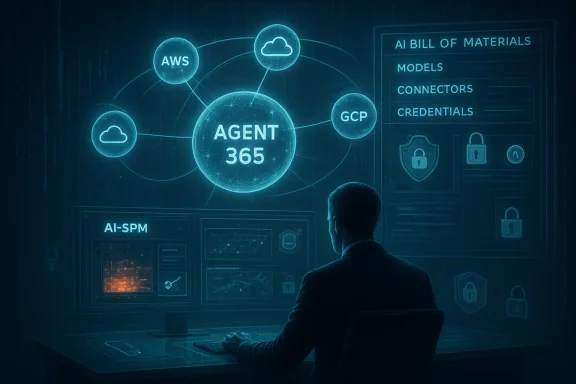
AI agents are not merely smarter automation; they are composite runtimes that bind models, connectors, identities, and orchestration logic into semi-autonomous actors capable of multi-step workflows. This makes an agent’s risk profile cross‑cutting: weaknesses can arise from the model itself, its grounding data, connected tooling and APIs, its identity and credentials, or the orchestration layer that links agents together. Microsoft’s security narrative shifts the problem from “model security” alone to posture management—discover every AI asset (an “AI Bill of Materials”), map data groundings and permissions, and apply mitigations that reduce attack path blast radius.
Key recent signals that drive this agenda include:
Boards should demand:
Microsoft’s control‑plane approach—Agent 365, Defender AI‑SPM, Security Copilot integration—offers a pragmatic path by extending familiar identity and governance primitives to agent fleets. Those platform moves matter, but they are effective only when organizations invest in people, processes, and the discipline to harden defaults, rotate credentials, and enforce human oversight where it counts. Independent researcher disclosures and industry readiness surveys make the imperative clear: the window to act is narrow, and the consequences of delay are operational, financial, and reputational.
For CISOs and business leaders, the question is straightforward: will you treat agents as a governed enterprise asset with lifecycle controls—or wait until an ungoverned agent turns into an incident that defines your next board conversation? The right time to act is now.
Source: Microsoft Cyber Pulse: An AI Security Report | Security Insider
 Background / Overview
AI agents are not merely smarter automation; they are composite runtimes that bind models, connectors, identities, and orchestration logic into semi-autonomous actors capable of multi-step workflows. This makes an agent’s risk profile cross‑cutting: weaknesses can arise from the model itself, its grounding data, connected tooling and APIs, its identity and credentials, or the orchestration layer that links agents together. Microsoft’s security narrative shifts the problem from “model security” alone to posture management—discover every AI asset (an “AI Bill of Materials”), map data groundings and permissions, and apply mitigations that reduce attack path blast radius.Key recent signals that drive this agenda include:
- Product-level investments by major vendors to treat agents as first‑class identities with lifecycle controls and observability. Microsoft’s Agent 365 control plane, for example, is explicitly designed to register, monitor, quarantine, and enforce policies for agent fleets.
- New defensive capabilities layered into cloud security posture tools—capabilities Microsoft calls AI Security Posture Management (AI‑SPM)—intended to detect and remediate risky agent configurations across multi‑cloud environments.
- Real-world researcher disclosures and product misconfigurations showing how agent connectivity and default openness can be abused to escalate privileges, impersonate users, or exfiltrate sensitive data. Recent independent writeups (ServiceNow “BodySnatcher” and findings around Copilot Studio’s Connected Agents) illustrate how agent-to-agent interactions raise high‑blast‑radius threats.
Why agents change the security equation
The anatomy of agent risk
AI agents expand the attack surface in ways traditional security tools weren’t designed to map. Consider the following layers, each creating distinct threats and defensive requirements:- Model & inference environment: jailbreaks, prompt injection, and model misuse can change what an agent is willing to disclose or do.
- Grounding and knowledge sources: if an agent is grounded on sensitive customer records or financial data, compromise equals a functional data breach. Attackers need not break into the database; they only need to redirect or trick the agent.
- Tooling and connectors: browser automation, file-system connectors, and third‑party APIs offer privileged escalation paths when misconfigured or granted excessive privileges.
- Identity and lifecycle: agents with long-lived credentials, poorly managed keys, or no revocation mechanisms can become persistent footholds.
- Orchestration: coordinator agents that invoke sub-agents or external systems multiply the blast radius if compromised.
From convenience to systemic risk
Agents are adopted quickly because they save time and reduce friction. But default openness and convenience habits—shared credentials, permissive connectors, and unchecked agent-to-agent flows—are precisely what researchers have exploited in public disclosures. The ServiceNow “BodySnatcher” chain, for example, combined non-rotating secrets and permissive account-linking to let unauthenticated actors impersonate privileged workflows; Microsoft Copilot Studio’s Connected Agents were critiqued for defaults that enabled silent lateral movement. These are not hypothetical exploitation paths; they were demonstrated in reproducible researcher reports.What Microsoft recommends — and what vendors are building
Agent lifecycle as an auditable identity
Microsoft’s announced posture—visible in its Agent 365 and Defender for Cloud extensions—treats agents as identity-bearing entities with registry, policy, and observability. Core platform promises include:- Central registry to discover and inventory agents across tenants.
- Policy enforcement tied to identity (via Microsoft Entra) to implement least-privilege and conditional access for agents.
- Attack‑path analysis that maps how an exposed API or misconfigured storage account can be used to exploit an agent grounded to sensitive data.
AI Security Posture Management (AI‑SPM)
Defender for Cloud’s AI‑SPM features aim to find generative AI applications and agents across Azure AI Foundry, Azure OpenAI, AWS Bedrock, and GCP Vertex AI, and to surface context-aware recommendations. The goal is to move from raw inventory to meaningful prioritization: which agents are grounded to sensitive data, which have internet-exposed connectors, and which have weak credential hygiene.Security Copilot and agentic defenses
Microsoft has also extended Security Copilot with detection agents and triage workflows to reduce mean time to remediate for AI workloads. The company’s telemetry advantage—its large signal volume—supports detection models that can spot anomalous agent behavior at scale. That telemetry is a strategic asset if used to prioritize interventions; it is not a substitute for policy and least-privilege design.Independent corroboration and the limits of vendor claims
A responsible analysis verifies vendor claims against independent reporting and technical disclosures. Two independent classes of evidence are salient:- Researcher disclosures: Public writeups by AppOmni and Zenity Labs showed concrete exploit chains involving ServiceNow and Copilot Studio—demonstrations that default connectivity plus permissive account-linking can produce privilege escalation and lateral movement. These incidents forced rapid vendor responses (patches, configuration guidance) and underscore the operational urgency of governance.
- Industry readiness signals: Analyst and vendor surveys repeatedly show a perception gap: high confidence in investment vs. lower operational maturity in practice. Independent analysis flags a common pattern—organizations adopt vendor features without the people and process work necessary to make them secure in production. Shortfalls include underinvestment in model-level protections, weak key rotation practices, and widespread “shadow AI” where employees use unsanctioned public tools.
The real-world consequences: case studies and attack patterns
Case: Agent grounded to sensitive data
When an agent is allowed to access customer PII, financial ledgers, or legal files, a compromise of that agent is functionally identical to a data breach. Defender-style attack‑path visualizations—linking an exposed API to the agent and its groundings—help prioritize mitigations by showing which agents create the most risk. The practical controls are straightforward to state but often hard to implement: minimize groundings, apply least‑privilege, and instrument agent access with conditional authentication and logging.Case: Default openness and lateral escalation
The AppOmni BodySnatcher disclosure showed how static client secrets and permissive account-linking enabled unauthenticated escalation through ServiceNow automation features. Similarly, criticisms of Copilot Studio’s default Connected Agents show how convenience-oriented defaults can convert into stealthy backdoors. These cases illustrate two lessons:- Defaults matter: secure-by-default configuration is essential, because many teams lack the time or expertise to harden every integration.
- Observability matters: if you cannot see agent-to-agent traffic or agent invocations, you cannot triage or contain an incident quickly.
What organizations must do now: a practical roadmap
Security leaders should treat agent governance as a discrete program—one that requires technical controls, operational processes, and executive sponsorship. Below is a prioritized, practical roadmap any CISO can start with today.- Establish an AI accountability board with cross‑functional ownership (CISO, CTO, legal, compliance, business owners). Define KPIs and budget authority.
- Discover and inventory every agent (the “AI Bill of Materials”). Use both platform telemetry and network/application discovery to find sanctioned and shadow agents. Treat discovery as continuous, not one‑off.
- Map agent groundings to data sensitivity. Rank agents that touch PII, financial records, IP, or regulated data. Prioritize mitigations by risk.
- Apply least‑privilege access and short-lived credentials for agents. Rotate keys automatically and enforce strong identity bindings via your IAM system. Avoid static client secrets or account-linking that bypasses MFA.
- Enforce secure defaults and posture checks in CI/CD. Shift‑left security by surfacing Defender/Entra/Purview policies in developer toolchains (Microsoft Foundry-style). Build policy gates for publishing agents to production.
- Implement agent-level logging and correlation. Ensure agent actions are auditable, and integrate agent telemetry into your SIEM/SOAR for anomaly detection and automated playbooks.
- Require human-in-the-loop for high‑risk decisions. For workflows that touch regulated data or make critical changes, mandate human verification before completion.
- Simulate agent compromise in tabletop and red-team exercises. Validate your ability to detect, revoke, and remediate rogue agents before a real incident. Use attack‑path analysis to prioritize resilience investments.
- Train users and architects on “safe prompting” and shadow AI risks. Awareness reduces accidental data exposure and encourages use of sanctioned, privacyminded alternatives.
- Measure and report to the board. Convert technical posture into business‑facing metrics: number of agents touching regulated data, percent of agents with short‑lived credentials, mean time to revoke a compromised agent, and financial exposure models.
Strengths of the Microsoft approach — and persistent gaps
Notable strengths
- Holistic control-plane thinking: treating agents as identity-bearing, auditable entities aligns agent governance with existing identity and data controls, which is sensible and scalable.
- Integrated posture tooling: AI‑SPM concepts in Defender for Cloud that map agents to cloud resources and surface remediation reduce cognitive load for SOC teams.
- Operational leverage from telemetry: Microsoft’s telemetry footprint allows detection models to see behavioral anomalies that smaller vendors might miss. When operationalized, that can shorten detection and containment times.
Persistent risks and limitations
- Perception vs. operational maturity: surveys and independent analyses show many organizations believe they have invested enough but lack the deep operational processes—key rotation, secure development lifecycle for agents, model provenance controls—required to actually be protected. Confidence is not the same as capability.
- Vendor coupling and lock-in risk: using a single vendor’s control plane for discovery and policy enforcement may accelerate security adoption, but it also concentrates control and creates procurement and resilience tradeoffs that boards should evaluate.
- Default configuration danger: disclosed incidents show that defaults matter. Even the best control planes cannot fix insecure default behaviors shipped from third‑party apps or misconfigured connectors; vendors and enterprises must converge on secure defaults.
- Model‑level blind spots: controlling access and connectors is necessary but insufficient—models themselves can be attacked (prompt injection, data poisoning). Organizations should budget for model integrity, provenance, and tamper detection in addition to classic access controls.
Governance, regulation, and the boardroom conversation
AI agents are a systemic business risk; they do not belong solely to dev teams or individual business units. CISOs must translate agent risks into business terms the board understands: financial exposure from data exfiltration, regulatory liability from misused PII, and operational loss from interrupted workflows.Boards should demand:
- An enterprise agent inventory and risk heat map.
- Evidence of least‑privilege enforcement and credential lifecycle management.
- Tabletop results showing ability to revoke and contain compromised agents.
- Clear KPIs and a funded roadmap to close identified gaps.
Closing analysis: the choice before CISOs
AI agents will proliferate because they deliver measurable productivity gains. But the security trade‑offs are not transitory—they represent a structural change to how automation, identity, and data interact. The right response is not to block adoption; it is to govern it deliberately. That requires three linked capabilities: discovery at scale, least‑privilege identity and key hygiene, and operationalized observability that ties agent actions back to data and business processes.Microsoft’s control‑plane approach—Agent 365, Defender AI‑SPM, Security Copilot integration—offers a pragmatic path by extending familiar identity and governance primitives to agent fleets. Those platform moves matter, but they are effective only when organizations invest in people, processes, and the discipline to harden defaults, rotate credentials, and enforce human oversight where it counts. Independent researcher disclosures and industry readiness surveys make the imperative clear: the window to act is narrow, and the consequences of delay are operational, financial, and reputational.
For CISOs and business leaders, the question is straightforward: will you treat agents as a governed enterprise asset with lifecycle controls—or wait until an ungoverned agent turns into an incident that defines your next board conversation? The right time to act is now.
Source: Microsoft Cyber Pulse: An AI Security Report | Security Insider
