

Microsoft has put OpenAI’s GPT-5.5 into Microsoft Foundry, signaling another major step in the company’s effort to turn frontier models into enterprise systems that can actually be deployed, governed, and scaled. The announcement, published on April 23, 2026, frames GPT-5.5 as a model built for professional and high-stakes workflows, with Microsoft emphasizing long-context reasoning, improved agentic execution, better computer-use accuracy, and stronger token efficiency. Just as important, the launch is being positioned not as a standalone model drop but as a platform story: Microsoft Foundry is the layer that makes the model operational in real business environments.
The headline here is bigger than a single model name. Microsoft is effectively saying that the next phase of enterprise AI is not just about smarter prompts or more tokens, but about agentic systems that can work across codebases, documents, spreadsheets, interfaces, and business workflows. In Microsoft’s telling, GPT-5.5 is the newest frontier model in a progression that began with GPT-5 and advanced through GPT-5.4, each version adding more reasoning depth and more production-oriented behavior.
That matters because the AI market has moved rapidly from chatbot demos to operational deployment. Enterprises are no longer asking whether a model can answer questions; they are asking whether it can be trusted to carry context, recover from errors, interact with tools, and complete work reliably over long sessions. Microsoft’s pitch for GPT-5.5 is that it is tuned for exactly those conditions, and that Foundry supplies the controls needed to run such systems at scale.
The launch also arrives in a broader Microsoft cadence that has been steadily expanding Foundry’s model catalog. In recent months, Microsoft has pushed GPT-image-1.5, GPT-5-Codex, and other OpenAI models into the platform, while also broadening the ecosystem to include competing frontier model families. That puts Foundry in a very different strategic position from a simple model hosting service: it is becoming a multimodel operating environment for enterprise AI builders.
For WindowsForum readers, the practical question is not just what GPT-5.5 can do, but what Microsoft wants the market to believe about the future of AI adoption. The answer appears to be that the winning platform will be the one that can combine cutting-edge intelligence with security, governance, and deployment plumbing rather than leaving those as afterthoughts. That is the strategic bet behind Foundry, and GPT-5.5 is now one of its clearest proof points.
This latest step also reflects a change in how Microsoft talks about AI maturity. Earlier launches focused on general capability: better reasoning, faster inference, broader modal support. The GPT-5.5 announcement is different because Microsoft leads with operational terms like production work, agentic execution, enterprise-grade infrastructure, and platform-level governance. That phrasing is deliberate. It suggests Microsoft believes the real bottleneck in AI adoption is no longer model quality alone, but the cost and complexity of getting systems to behave predictably in live business settings.
That is a meaningful shift for customers. Many organizations have already tested generative AI in isolated pilots, but those pilots often stall when the model has to connect to internal systems, respect identity boundaries, or run continuously without human babysitting. Microsoft Foundry is designed to solve those problems through a unified environment that combines model choice, agent frameworks, integration hooks, and enterprise controls. GPT-5.5 becomes more valuable in that context because the model is only one component of a broader execution stack.
The competitive backdrop is equally important. Cloud providers are racing to become the default control plane for AI workloads, and that competition is no longer just about the best model score. It is about who can make AI boring in the best possible way—predictable, governed, auditable, and easy to operationalize. Microsoft is trying to win that argument by making Foundry feel like the place where frontier models become repeatable systems rather than fragile experiments.
The company also positions GPT-5.5 Pro as a premium variant for the most demanding enterprise workloads. That split is important because it acknowledges that “best model” is not a single universal category anymore. Some workloads will value cost and throughput; others will pay for deeper reasoning and more resilient task completion. Microsoft is trying to segment the market in a way that makes those tradeoffs explicit rather than hidden.
There are two especially notable claims in the announcement. First, Microsoft says GPT-5.5 improves agentic coding and computer use, including the ability to diagnose ambiguous failures and reason about downstream effects before acting. Second, it says the model can support broader research and document workflows, moving from question-answering into drafting, revising, and synthesis across multiple artifact types. Those are exactly the kinds of tasks that enterprise buyers have been trying to automate without sacrificing quality.
Foundry’s value proposition is that it combines broad model choice, open and flexible agent frameworks, native integration with enterprise systems and productivity tools, and enterprise-grade security, compliance, and governance. That makes it less like a single product and more like an AI operating system for organizations that need control over how models behave. Microsoft is trying to remove the friction that traditionally sits between experimentation and production.
The company also stresses that Foundry can host declarative agents defined in YAML or built with frameworks such as Microsoft Agent Framework, GitHub Copilot SDK, LangGraph, Claude Agent SDK, and OpenAI Agents SDK. That interoperability is a subtle but powerful message. Microsoft is not asking customers to bet on one narrow orchestration style; it is trying to be the place where different agent stacks can coexist.
The launch could also accelerate the shift from copilots to autonomous workflows. Many organizations started with AI as a drafting assistant or search layer, but the next buying cycle is likely to focus on systems that can execute multi-step tasks with minimal supervision. GPT-5.5’s positioning around reasoning, research, and operational continuity aligns neatly with that demand.
There is also a procurement angle. Microsoft’s pricing for GPT-5.5 and GPT-5.5 Pro gives enterprises a clear cost segmentation: standard usage is priced lower than the premium reasoning tier, and cached input pricing is meaningfully cheaper. That kind of transparency helps IT and finance teams build more realistic deployment models, especially when they are evaluating whether a workflow should use the base model or the Pro variant.
For developers, the biggest appeal is consistency. Microsoft is trying to make Foundry a place where model selection, deployment, security, and agent orchestration are managed through a coherent platform layer. That reduces the amount of bespoke glue code teams need to write, especially when they want to move an agent from a prototype in a notebook to a controlled production system.
It is also notable that Microsoft is explicitly supporting multiple frameworks. That gives developers room to bring their existing preferences into Foundry rather than forcing a single opinionated stack. In a market where portability is becoming a strategic concern, that kind of flexibility is likely to resonate with teams that want to avoid deep lock-in.
The addition of GPT-5.5 reinforces Microsoft’s claim that it can move faster than many enterprise customers can internally modernize. If a new frontier model is available in Foundry quickly, and if the platform already handles identity, governance, and integration, then Microsoft can argue that it lowers the time to production in a way competitors may struggle to match. That is a compelling message for CIOs under pressure to deliver AI value.
At the same time, Microsoft has been broadening model choice inside Foundry, including support for non-OpenAI frontier models. That is strategically smart because it reduces the risk of the platform becoming a one-model dependency story. It also creates a stronger market message: Microsoft wants to be the best place to run many models, not just its preferred one.
That pricing structure tells us something about Microsoft’s market strategy. The base model is meant to be accessible enough for broader production use, while the Pro tier is clearly reserved for premium workflows where the value of deeper reasoning outweighs cost concerns. This is a familiar cloud pattern, but it is especially important in AI because token costs can multiply quickly as agents become more autonomous.
Organizations will also focus on the downstream economics of retries, context length, and latency. Microsoft’s emphasis on token efficiency is not just a technical boast; it is a signal that the total cost of ownership can be reduced when the model does better work on the first pass. That can matter more than nominal per-token rates in workflows that run continuously.
Also important is how Microsoft continues to position Foundry against other frontier-model hosting environments. The company is clearly trying to make Foundry the place where companies build and govern AI systems across multiple model families, not just one vendor’s stack. That means the competitive battle will increasingly be about platform trust, operational simplicity, and breadth of integration rather than raw model hype.
Source: asatunews.co.id Microsoft Launches OpenAI GPT-5.5 on Foundry Platform
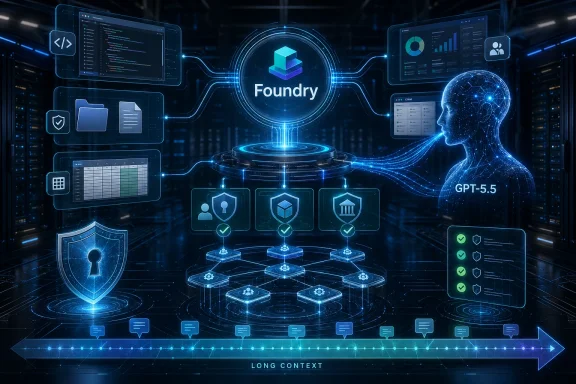 Overview
The headline here is bigger than a single model name. Microsoft is effectively saying that the next phase of enterprise AI is not just about smarter prompts or more tokens, but about agentic systems that can work across codebases, documents, spreadsheets, interfaces, and business workflows. In Microsoft’s telling, GPT-5.5 is the newest frontier model in a progression that began with GPT-5 and advanced through GPT-5.4, each version adding more reasoning depth and more production-oriented behavior.That matters because the AI market has moved rapidly from chatbot demos to operational deployment. Enterprises are no longer asking whether a model can answer questions; they are asking whether it can be trusted to carry context, recover from errors, interact with tools, and complete work reliably over long sessions. Microsoft’s pitch for GPT-5.5 is that it is tuned for exactly those conditions, and that Foundry supplies the controls needed to run such systems at scale.
The launch also arrives in a broader Microsoft cadence that has been steadily expanding Foundry’s model catalog. In recent months, Microsoft has pushed GPT-image-1.5, GPT-5-Codex, and other OpenAI models into the platform, while also broadening the ecosystem to include competing frontier model families. That puts Foundry in a very different strategic position from a simple model hosting service: it is becoming a multimodel operating environment for enterprise AI builders.
For WindowsForum readers, the practical question is not just what GPT-5.5 can do, but what Microsoft wants the market to believe about the future of AI adoption. The answer appears to be that the winning platform will be the one that can combine cutting-edge intelligence with security, governance, and deployment plumbing rather than leaving those as afterthoughts. That is the strategic bet behind Foundry, and GPT-5.5 is now one of its clearest proof points.
Background
Microsoft’s AI platform strategy has evolved through several distinct phases. First came the era of raw model access, when the main competitive question was which cloud could host the most advanced systems. Then came the era of integration, when Microsoft began folding OpenAI models into Azure services, Microsoft 365, GitHub, and developer tooling. Now the conversation has shifted to workflow ownership: not just where a model runs, but how it is governed, monitored, and embedded into enterprise operations.This latest step also reflects a change in how Microsoft talks about AI maturity. Earlier launches focused on general capability: better reasoning, faster inference, broader modal support. The GPT-5.5 announcement is different because Microsoft leads with operational terms like production work, agentic execution, enterprise-grade infrastructure, and platform-level governance. That phrasing is deliberate. It suggests Microsoft believes the real bottleneck in AI adoption is no longer model quality alone, but the cost and complexity of getting systems to behave predictably in live business settings.
That is a meaningful shift for customers. Many organizations have already tested generative AI in isolated pilots, but those pilots often stall when the model has to connect to internal systems, respect identity boundaries, or run continuously without human babysitting. Microsoft Foundry is designed to solve those problems through a unified environment that combines model choice, agent frameworks, integration hooks, and enterprise controls. GPT-5.5 becomes more valuable in that context because the model is only one component of a broader execution stack.
The competitive backdrop is equally important. Cloud providers are racing to become the default control plane for AI workloads, and that competition is no longer just about the best model score. It is about who can make AI boring in the best possible way—predictable, governed, auditable, and easy to operationalize. Microsoft is trying to win that argument by making Foundry feel like the place where frontier models become repeatable systems rather than fragile experiments.
Why the timing matters
The timing of GPT-5.5’s Foundry availability suggests Microsoft wants to keep its enterprise narrative moving fast. In the same general period, the company has been refreshing Foundry’s model catalog, improving reliability for OpenAI Response API models, and adding more production-oriented capabilities. That creates a cadence in which each new model launch reinforces the same message: Microsoft is building a stack where the model is important, but the platform is what turns capability into value.The broader shift from apps to agents
A major theme in the announcement is the rise of agentic AI. Microsoft argues that the hard part is no longer building an agent prototype; it is running thousands of agents with identity, isolation, and governance. That is why Foundry Agent Service gets such prominent attention in the launch. It is the missing middle between a powerful model and a production system that can survive contact with real users, real data, and real business rules.What Microsoft Says GPT-5.5 Adds
Microsoft describes GPT-5.5 as a model optimized for professional scenarios where precision, reliability, and persistence matter. The company highlights stronger long-context reasoning, more reliable agentic execution, improved computer-use accuracy, and greater token efficiency. In plain English, Microsoft is saying the model should be better at staying on task, handling longer jobs, and reducing the waste that comes from retries and broken chains of reasoning.The company also positions GPT-5.5 Pro as a premium variant for the most demanding enterprise workloads. That split is important because it acknowledges that “best model” is not a single universal category anymore. Some workloads will value cost and throughput; others will pay for deeper reasoning and more resilient task completion. Microsoft is trying to segment the market in a way that makes those tradeoffs explicit rather than hidden.
There are two especially notable claims in the announcement. First, Microsoft says GPT-5.5 improves agentic coding and computer use, including the ability to diagnose ambiguous failures and reason about downstream effects before acting. Second, it says the model can support broader research and document workflows, moving from question-answering into drafting, revising, and synthesis across multiple artifact types. Those are exactly the kinds of tasks that enterprise buyers have been trying to automate without sacrificing quality.
The practical meaning of “computer-use accuracy”
Computer-use capability is one of the most consequential areas in modern AI because it turns language models into interface operators. If a model can navigate software more accurately, it can potentially file tickets, update records, assemble reports, or interact with business apps with less human supervision. Microsoft is signaling that GPT-5.5 has been tuned for that kind of work, which makes it more interesting than a generic chat model.Token efficiency as a business feature
Token efficiency may sound like a narrow technical detail, but it is really a business feature. Fewer tokens and fewer retries can mean lower cost, lower latency, and less frustration when agents are running at scale. That matters especially in workflows where a model must reason repeatedly across many steps rather than answer one prompt and stop. Microsoft is clearly trying to make efficiency part of the value proposition, not just a backend optimization.Microsoft Foundry as the Control Plane
The most important part of the announcement may be the platform story around it. Microsoft says Foundry is the layer that turns frontier models into usable, governable systems, and that customers can evaluate, productionize, and scale new models without friction. This is classic platform language, but it reflects a real industry problem: many AI projects fail not because the model is bad, but because the surrounding infrastructure is incomplete.Foundry’s value proposition is that it combines broad model choice, open and flexible agent frameworks, native integration with enterprise systems and productivity tools, and enterprise-grade security, compliance, and governance. That makes it less like a single product and more like an AI operating system for organizations that need control over how models behave. Microsoft is trying to remove the friction that traditionally sits between experimentation and production.
The company also stresses that Foundry can host declarative agents defined in YAML or built with frameworks such as Microsoft Agent Framework, GitHub Copilot SDK, LangGraph, Claude Agent SDK, and OpenAI Agents SDK. That interoperability is a subtle but powerful message. Microsoft is not asking customers to bet on one narrow orchestration style; it is trying to be the place where different agent stacks can coexist.
Why isolation and identity matter
Microsoft’s mention of isolated sandboxes, persistent filesystems, and distinct Microsoft Entra identities is not marketing fluff. Those are the controls enterprise IT teams need when agents begin touching real data and real systems. Without them, “autonomous AI” is just a liability waiting to happen. With them, Microsoft can argue that agentic workloads finally have a credible deployment model.The enterprise platform thesis
The bigger thesis is that AI platforms are converging with cloud platforms. In that world, the question is not whether a model is available; it is whether the provider can make it safe, observable, and manageable enough for procurement, compliance, and operations teams. Microsoft Foundry is being shaped to answer that question affirmatively, and GPT-5.5 is the latest high-profile addition to the stack.Enterprise Implications
For enterprise buyers, GPT-5.5 is attractive because Microsoft is framing it as a model for high-stakes professional work. The company specifically points to software engineering, DevOps, legal, health sciences, and professional services—domains where mistakes are expensive and context matters. That suggests Microsoft is not merely chasing novelty; it is targeting use cases where accuracy and persistence can directly affect business outcomes.The launch could also accelerate the shift from copilots to autonomous workflows. Many organizations started with AI as a drafting assistant or search layer, but the next buying cycle is likely to focus on systems that can execute multi-step tasks with minimal supervision. GPT-5.5’s positioning around reasoning, research, and operational continuity aligns neatly with that demand.
There is also a procurement angle. Microsoft’s pricing for GPT-5.5 and GPT-5.5 Pro gives enterprises a clear cost segmentation: standard usage is priced lower than the premium reasoning tier, and cached input pricing is meaningfully cheaper. That kind of transparency helps IT and finance teams build more realistic deployment models, especially when they are evaluating whether a workflow should use the base model or the Pro variant.
What enterprises will test first
The first real tests will likely be narrow but unforgiving. Companies will want to know whether GPT-5.5 can keep context across long incident-handling sessions, summarize complex legal or research materials without drifting, and support code changes without introducing subtle breakage. Those are not flashy demos, but they are the kinds of scenarios that determine whether a model becomes infrastructure or remains a pilot.The governance question
Enterprise AI is increasingly a governance problem, not just a modeling problem. Microsoft’s emphasis on platform-level policy, identity, and isolation suggests it understands that reality. The question now is whether customers will trust that governance story enough to move more sensitive workloads from experimentation into full production.Consumer and Developer Impact
Although the announcement is enterprise-first, developers should not ignore it. In practice, these launches often influence the broader AI tooling ecosystem, because enterprise availability tends to shape SDKs, frameworks, and integration patterns that eventually trickle down into consumer-facing products. If GPT-5.5 becomes a preferred enterprise model, it may also influence how developers design assistants, agents, and workflows elsewhere.For developers, the biggest appeal is consistency. Microsoft is trying to make Foundry a place where model selection, deployment, security, and agent orchestration are managed through a coherent platform layer. That reduces the amount of bespoke glue code teams need to write, especially when they want to move an agent from a prototype in a notebook to a controlled production system.
It is also notable that Microsoft is explicitly supporting multiple frameworks. That gives developers room to bring their existing preferences into Foundry rather than forcing a single opinionated stack. In a market where portability is becoming a strategic concern, that kind of flexibility is likely to resonate with teams that want to avoid deep lock-in.
Developer productivity versus platform complexity
There is a tradeoff, of course. More platform capability can also mean more conceptual overhead. Developers may appreciate the control, but they will still need to learn how Microsoft wants agents defined, governed, and observed in production. The promise is productivity; the risk is that too many options become their own kind of friction.Consumer spillover
Consumer users may not touch GPT-5.5 directly in Foundry, but they could still feel the effects through Microsoft’s product ecosystem over time. When enterprise models improve, those gains often show up later in workplace tools, support systems, and productivity features. In that sense, enterprise model launches are often the leading edge of wider software change.Competitive Positioning
Microsoft’s Foundry strategy places it in competition not just with other cloud AI platforms, but with the broader idea of which company should own the “AI control plane.” That includes hyperscalers, model providers, and developer platforms that all want to be the default place where agentic workflows are built and deployed. Microsoft’s advantage is the combination of Azure infrastructure, OpenAI model access, and deep enterprise relationships.The addition of GPT-5.5 reinforces Microsoft’s claim that it can move faster than many enterprise customers can internally modernize. If a new frontier model is available in Foundry quickly, and if the platform already handles identity, governance, and integration, then Microsoft can argue that it lowers the time to production in a way competitors may struggle to match. That is a compelling message for CIOs under pressure to deliver AI value.
At the same time, Microsoft has been broadening model choice inside Foundry, including support for non-OpenAI frontier models. That is strategically smart because it reduces the risk of the platform becoming a one-model dependency story. It also creates a stronger market message: Microsoft wants to be the best place to run many models, not just its preferred one.
The rivalry with other clouds
Other clouds are pushing similar enterprise AI platforms, but Microsoft’s messaging is especially aggressive around production readiness and integrated governance. That could help it win customers who care less about benchmark theater and more about compliance, isolation, and reliable deployment. In a market maturing beyond hype, those may be the decisive differentiators.Why model cadence matters
Model cadence is now part of platform competitiveness. The faster a cloud can surface new frontier capabilities, the more likely customers are to treat it as the place where their AI roadmap lives. Microsoft’s repeated Foundry announcements suggest it understands that frequency itself can become a moat.Pricing and Economics
Microsoft lists GPT-5.5 at $5.00 per million input tokens, $0.50 per million cached input tokens, and $30.00 per million output tokens. GPT-5.5 Pro is substantially more expensive at $30.00 per million input tokens and $180.00 per million output tokens, with cached input at $3.00 per million tokens. Those numbers make the economic split between standard and premium reasoning very clear.That pricing structure tells us something about Microsoft’s market strategy. The base model is meant to be accessible enough for broader production use, while the Pro tier is clearly reserved for premium workflows where the value of deeper reasoning outweighs cost concerns. This is a familiar cloud pattern, but it is especially important in AI because token costs can multiply quickly as agents become more autonomous.
Organizations will also focus on the downstream economics of retries, context length, and latency. Microsoft’s emphasis on token efficiency is not just a technical boast; it is a signal that the total cost of ownership can be reduced when the model does better work on the first pass. That can matter more than nominal per-token rates in workflows that run continuously.
What the price signals imply
The pricing model suggests Microsoft expects buyers to segment workloads aggressively. Routine summarization, triage, and support tasks may land on the standard model, while sensitive or highly complex workflows may justify GPT-5.5 Pro. In practical terms, that gives AI teams a more nuanced playbook for matching model quality to business value.Cost is now a product feature
AI pricing used to be an afterthought in many launches. It is no longer. Microsoft is now making cost part of the product narrative because enterprises will not adopt frontier AI at scale unless economics are predictable. That makes pricing not just a commercial detail, but a competitive weapon.Strengths and Opportunities
Microsoft’s GPT-5.5 launch is strategically strong because it ties a frontier model to a deployment environment that enterprise customers already understand. The real opportunity is not simply better model outputs, but the ability to operationalize those outputs inside a governed, interoperable stack. If Microsoft executes well, this could become another anchor point for Azure AI adoption.- Stronger production story than a model-only announcement.
- Clear enterprise use cases in coding, DevOps, legal, and research.
- Better economics through token efficiency and tiered pricing.
- Framework flexibility for different agent-development preferences.
- Identity and isolation controls that support regulated deployments.
- Platform lock-in via value, not just via inertia.
- Cross-product spillover into Microsoft’s broader software ecosystem.
Why this could matter most for enterprises
The best opportunity is for organizations that have already built pilot AI systems and are ready to scale them. GPT-5.5 gives those teams a stronger reason to revisit workloads that were previously too brittle, too slow, or too expensive to automate. In that sense, the launch is a catalyst for moving AI from experimental to structural.Risks and Concerns
Even with a strong launch narrative, Microsoft still has to prove that GPT-5.5 behaves as reliably in the real world as it sounds on paper. Models that look excellent in controlled settings can still struggle when exposed to messy enterprise data, legacy interfaces, or ambiguous instructions. That gap between promise and production remains the biggest risk.- Overpromising on autonomy before customer validation catches up.
- Cost creep if agent workflows use more tokens than expected.
- Complexity overhead from platform and framework choices.
- Security and compliance exposure if governance is misconfigured.
- Vendor concentration risk for companies leaning too heavily on one ecosystem.
- False confidence in computer-use accuracy and long-context reasoning.
- Integration debt if existing systems are not ready for agentic workflows.
The adoption trap
There is also a classic adoption trap here. Enterprises may assume that because a model is “enterprise ready,” it can be dropped into sensitive workflows with minimal supervision. In reality, successful deployment will still require careful prompt design, workflow testing, fallback logic, and human oversight. That work is often underestimated.Looking Ahead
The next thing to watch is whether Microsoft’s Foundry launch translates into visible customer adoption rather than just strong messaging. If enterprises start standardizing on GPT-5.5 for long-running agent workflows, the launch will look like a meaningful turning point. If not, it may be remembered as another strong model announcement that arrived slightly ahead of the market’s readiness.Also important is how Microsoft continues to position Foundry against other frontier-model hosting environments. The company is clearly trying to make Foundry the place where companies build and govern AI systems across multiple model families, not just one vendor’s stack. That means the competitive battle will increasingly be about platform trust, operational simplicity, and breadth of integration rather than raw model hype.
Key things to watch
- Enterprise case studies built on GPT-5.5 in Microsoft Foundry.
- Whether GPT-5.5 Pro gains traction for premium reasoning workloads.
- New agent tooling in Foundry Agent Service and Microsoft Agent Framework.
- Pricing pressure if competitors undercut or outperform on specific workloads.
- How quickly Microsoft exposes GPT-5.5 capabilities across adjacent products.
- Real-world reliability in long-context, multi-step production tasks.
Source: asatunews.co.id Microsoft Launches OpenAI GPT-5.5 on Foundry Platform
