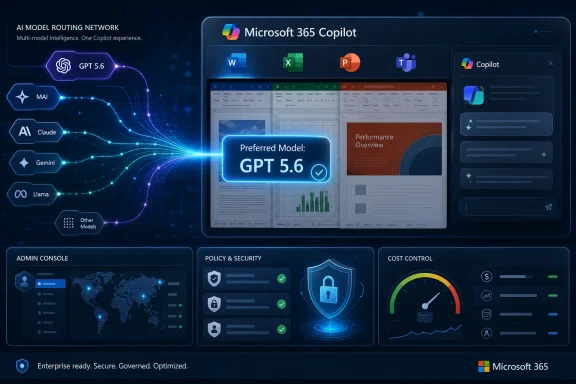
Microsoft adopted OpenAI’s GPT-5.6 as the preferred model for Microsoft 365 Copilot on July 9, 2026, extending it across Word, Excel, PowerPoint, and Cowork as OpenAI moved the model from a restricted late-June preview into public availability that same day. The practical question is not whether Copilot can generate more polished material, but whether it can reduce the prompting, review, correction, and cleanup required to produce dependable business work.
What changed: GPT-5.6 became the preferred Microsoft 365 Copilot model, with the named applications being Word, Excel, PowerPoint, and Cowork.
What is confirmed: The supplied report associates GPT-5.6 with more polished output, fewer prompts, faster drafting and editing, more efficient spreadsheet analysis, improved presentation production, and streamlined collaboration and task completion in Cowork. It also says GPT-5.6 entered a restricted preview in late June, identifies GPT-5.6 Sol as the variant intended for complex workloads, and says public availability followed satisfaction of a stated U.S. government cybersecurity compliance condition.
What is not confirmed: The supplied report does not establish universal availability for every tenant, user, region, application feature, or Copilot interaction. “Preferred model” should not be interpreted as proof that every Microsoft 365 Copilot request immediately uses GPT-5.6 in every environment.
What admins should do: Identify licensed Copilot users, select fixed test tasks in Word, Excel, PowerPoint, and Cowork, retain the original prompts and source files, define acceptance criteria before testing, record time and corrections, and compare results before and after GPT-5.6 becomes available in the organization’s actual environment.
Microsoft’s deployment of GPT-5.6 matters for a more practical reason. The model is being introduced into applications where generated output can become part of the permanent business record.
A response in a standalone chatbot can be copied, discarded, or treated as an exploratory draft. A Copilot response in Excel may influence a financial interpretation. In Word, it can become the first version of a customer-facing document. In PowerPoint, it can shape an executive presentation. Cowork, according to the supplied report, gains streamlined collaboration and task completion.
That raises the quality threshold. Fluency alone is not enough when an AI system is expected to preserve a document’s meaning, interpret a workbook, organize source material into slides, or assist with a business task without losing important constraints.
According to Alvin Lang’s report for Blockchain.News, Microsoft made GPT-5.6 the preferred model for Microsoft 365 Copilot rather than merely presenting it as an isolated experiment. That establishes the model’s importance to Microsoft’s Copilot strategy, but it does not prove that GPT-5.6 is the sole model behind every request or that all users receive identical behavior.
The most defensible interpretation is narrower: Microsoft is placing GPT-5.6 in a preferred position across the named Microsoft 365 Copilot experiences. The exact behavior visible to a particular organization must still be confirmed through direct observation and any tenant-specific notices Microsoft provides.
Users learned that a model could produce polished prose while making factual mistakes. It could follow most of a complicated instruction while overlooking one important constraint. Long prompts often became a form of defensive engineering, with users repeatedly specifying the audience, format, exceptions, tone, and required level of detail.
Those limitations are manageable during casual experimentation. They become expensive when every generated artifact must be checked for missing data, unsupported conclusions, formatting changes, inconsistent terminology, or invented details.
Microsoft is positioning GPT-5.6 against that operational problem. The supplied report characterizes the model as delivering higher-quality output per token, with stronger performance at a lower cost. That claim does not establish a specific savings figure for Microsoft 365 customers, but it creates a testable proposition: useful results may require fewer generated tokens, fewer corrective prompts, or less user effort.
This is why Microsoft’s statement that users should need fewer prompts is more consequential than it first appears. Prompt reduction is not merely a convenience for employees who dislike interacting with chat interfaces. If the claim holds in practice, it could reduce failed attempts, shorten completion time, and make common Copilot tasks more predictable.
Nitin Agrawal, President of Copilot & Agents Core at Microsoft, summarized the pitch in the supplied report: “With GPT-5.6 powering Copilot, customers can create polished outputs across Microsoft 365 tools with less effort.”
The operative phrase is less effort. Microsoft is not only arguing that Copilot can create content. It is saying the newer model can reduce the work between a user’s instruction and a deliverable that is ready for review.
For enterprise customers, that work includes more than typing prompts. It includes locating and selecting source material, checking formulas, preserving terminology, applying formatting, comparing revisions, incorporating feedback, and confirming that the finished file does not contain a consequential mistake.
The relevant measurement is therefore not model quality in isolation. It is the total cost of reaching an acceptable result.
One useful test is instruction retention during revision. A user might specify a target audience, required sections, prohibited terminology, source boundaries, and tone. The organization can then evaluate whether those constraints remain intact as the document is shortened, reorganized, or edited.
The supplied report supports a claim of faster drafting and editing with fewer prompts. It does not guarantee that GPT-5.6 will preserve every constraint in every document, so that behavior should be measured rather than assumed.
Reviewers must still examine whether the analysis reflects the relevant ranges, date periods, filters, missing values, formulas, totals, and definitions. They must also distinguish patterns present in the data from causal explanations that the data cannot establish.
A meaningful Excel improvement would reduce the time required to produce an analysis without increasing the probability that a user accepts an attractive but unsound conclusion. Testing should therefore include workbooks containing known ambiguities, incomplete records, or easily misread totals—not only clean demonstration data.
The reported benefit is production of more visually refined presentations with minimal manual input. Organizations should test that claim with fixed source documents and a defined audience. Reviewers can then record whether the output preserves the central argument, uses the correct figures, attributes claims appropriately, and avoids adding unsupported statistics or conclusions.
Visual polish must be evaluated alongside substance. A presentation is not improved if it looks professional but misstates the underlying report.
Claims that Cowork can independently create or edit particular files, handle communications, manage schedules, search organizational information, or carry out long assignments with approval are not established by the supplied report and should not be inferred from this announcement alone.
Administrators can still evaluate Cowork concretely. They can choose a fixed collaborative task, define the expected result, preserve the starting materials, and record how many interventions are required. The test should focus on what users can actually access in their environment rather than on capabilities assumed from the general concept of an AI coworker.
A response that is inexpensive to generate can still produce an expensive workflow. If an employee spends ten minutes correcting a low-cost AI analysis, the human review cost may outweigh the computing cost of producing it.
The reverse can also be true. A more capable model may be economically preferable if it produces a properly structured result on the first attempt and reduces the amount of correction required.
The supplied reporting does not provide figures for Microsoft’s service costs, Copilot adoption, productivity gains, customer savings, request volume, or revenue associated with the GPT-5.6 deployment. It therefore does not support a conclusion about Microsoft’s margins or a guaranteed reduction in customer technology spending.
“Lower cost” may refer to model-serving efficiency rather than a lower Copilot subscription price. A customer could receive better performance without any direct change to its licensing bill.
The more useful local measure is the cost of obtaining an acceptable output. That includes the number of prompts, elapsed time, active user time, corrections, factual errors, formatting repairs, and review effort required to finish a task.
If those figures improve after GPT-5.6 becomes available, the organization has evidence of practical value. If they remain unchanged, a more capable underlying model may not have improved that particular workflow.
In practical terms, a Copilot result can depend on more than the model. The open file, the user’s instructions, the structure and quality of the supplied material, the application interface, and the availability of relevant context can all affect the output.
A model upgrade therefore cannot independently fix every weakness. If the source document is incomplete, the workbook is poorly structured, or the prompt is ambiguous, a stronger model may still produce an unsatisfactory answer. The model may also generate a plausible interpretation when the available evidence supports several possibilities.
This is an important boundary for administrators evaluating GPT-5.6. The announcement concerns a preferred model, not a complete replacement of every component surrounding Copilot. Improvements—or failures—observed by users may reflect the model, the application, the source material, the prompt, or a combination of those factors.
The supplied report does not provide enough information to assign GPT-5.6 a particular licensing tier, data-processing classification, hosting arrangement, tenant requirement, regional eligibility rule, or feature-specific availability schedule. Those questions must be answered through applicable contractual materials and tenant-specific communications rather than inferred from the model announcement.
Those facts support a limited conclusion: public availability followed a period of restricted access and a cybersecurity-related compliance step.
They do not, without additional sourcing, establish that the preview announcement emphasized specific cybersecurity advances, that OpenAI coordinated testing with trusted partners or the U.S. government, that Sol performed better at defensive vulnerability research than autonomous attacks, or that OpenAI issued a particular warning about benchmark limitations.
It would also be premature to declare that this sequence creates a new release regime for frontier AI. It may indicate that cybersecurity review affected the timing of this release, but one example does not establish a universal process for future models.
For Microsoft 365 customers, the compliance condition should not be treated as a substitute for local risk assessment. Nor does it prove that ordinary Office applications have acquired any particular offensive-security capability. The announcement connects a general-purpose model family to Microsoft 365 Copilot; it does not document every capability or safety mechanism present in each application.
Late June 2026 — OpenAI begins a restricted preview of the GPT-5.6 family, with GPT-5.6 Sol identified for complex workloads.
July 9, 2026 — Microsoft adopts GPT-5.6 as the preferred model for Microsoft 365 Copilot across Word, Excel, PowerPoint, and Cowork. OpenAI also moves the model into public availability after the cybersecurity compliance condition described in the supplied report is satisfied.
It also does not document model-selection controls, automatic routing behavior, licensing distinctions, Cowork eligibility rules, administrative settings, or a detailed rollout schedule.
Admins should consequently avoid promising that every user will receive GPT-5.6 in every named application simply because the preferred-model announcement occurred on that date. The announcement establishes Microsoft’s product direction. Actual availability must be confirmed in each organization’s environment.
This distinction matters for support. Two employees may report different results because they are using different source files, prompts, application contexts, accounts, or features. Without documented tenant-level evidence, the difference should not automatically be attributed to model routing or a staged rollout.
Controlled observation is more useful than speculation. IT teams should record which users can access the relevant Copilot experiences, when availability is first observed, which application and task were involved, and whether the interface explicitly identifies GPT-5.6.
They should not invent a settings path or assume the existence of a rollout control that the supplied report does not document.
Microsoft’s promise of polished output should therefore be treated as a productivity claim, not a guarantee of factual correctness. Polish describes presentation quality. It does not prove that the assumptions, calculations, sources, or conclusions are valid.
The appropriate review level depends on the consequence of an error:
The practical goal is not to remove humans from verification. It is to shorten the path to a result that a qualified person can review and approve.
Compare:
Report where the upgrade reduced work, where it made no meaningful difference, and where it created new review problems.
The evaluation must account for user skill. Employees who have spent months learning how to structure prompts may obtain better results because of experience rather than because the preferred model changed. Keeping prompts and source files consistent helps reduce that uncertainty.
Reviewers should also examine error severity, not only completion speed. An analysis completed in half the time is not an improvement if it introduces a material error that nearly survives review. A polished deck is not a success if its central statistic is unsupported. A shorter Word revision is not useful if it removes a required qualification.
The results will not establish a universal benchmark for GPT-5.6, but they can answer the question that matters locally: does the preferred model make this organization’s real work faster, easier to review, or more reliable?
The exercise may also reveal that some tasks do not benefit significantly from the change. That is still valuable information. GPT-5.6 does not need to improve every workflow to be useful, and organizations do not need to force Copilot into tasks where its output creates more review work than it saves.
Microsoft’s announcement provides a clear direction: GPT-5.6 is now the preferred Microsoft 365 Copilot model for Word, Excel, PowerPoint, and Cowork. What it does not provide is a guarantee of universal availability or uniform business value. The next step belongs to administrators and users: confirm where the model is available, test it against fixed work, preserve the evidence, and decide whether “less effort” survives contact with the organization’s actual documents, data, presentations, and collaborative tasks.
The new point is not that GPT-5.6 replaces every Microsoft model strategy. Rather, OpenAI is presenting GPT-5.6 as the preferred model powering Microsoft 365 Copilot while Microsoft continues exploring its own model stack. Межа notes that the announcement does not contradict earlier reporting about Microsoft’s use of third-party or internal models, and does not indicate that OpenAI’s technology is being removed from Microsoft products.
For admins, the practical takeaway is narrower than “Microsoft has chosen one model everywhere.” GPT-5.6 remains the stated preferred model for Microsoft 365 Copilot, but Microsoft may still route some experiences through other models for cost, performance, or product reasons. That reinforces the original caution: organizations should verify behavior in their own tenant and avoid assuming that every Copilot action in Word, Excel, PowerPoint, or Copilot is necessarily handled by the same model.
 What Changed, What Is Confirmed, and What Admins Should Do
What changed: GPT-5.6 became the preferred Microsoft 365 Copilot model, with the named applications being Word, Excel, PowerPoint, and Cowork.What is confirmed: The supplied report associates GPT-5.6 with more polished output, fewer prompts, faster drafting and editing, more efficient spreadsheet analysis, improved presentation production, and streamlined collaboration and task completion in Cowork. It also says GPT-5.6 entered a restricted preview in late June, identifies GPT-5.6 Sol as the variant intended for complex workloads, and says public availability followed satisfaction of a stated U.S. government cybersecurity compliance condition.
What is not confirmed: The supplied report does not establish universal availability for every tenant, user, region, application feature, or Copilot interaction. “Preferred model” should not be interpreted as proof that every Microsoft 365 Copilot request immediately uses GPT-5.6 in every environment.
What admins should do: Identify licensed Copilot users, select fixed test tasks in Word, Excel, PowerPoint, and Cowork, retain the original prompts and source files, define acceptance criteria before testing, record time and corrections, and compare results before and after GPT-5.6 becomes available in the organization’s actual environment.
Microsoft Is Upgrading the Work, Not Just the Chatbot
Model announcements tend to invite an unhelpful kind of scorekeeping: the new system reasons better, writes better, or outperforms its predecessor on benchmarks that may bear little resemblance to preparing a quarterly forecast or revising a customer proposal.Microsoft’s deployment of GPT-5.6 matters for a more practical reason. The model is being introduced into applications where generated output can become part of the permanent business record.
A response in a standalone chatbot can be copied, discarded, or treated as an exploratory draft. A Copilot response in Excel may influence a financial interpretation. In Word, it can become the first version of a customer-facing document. In PowerPoint, it can shape an executive presentation. Cowork, according to the supplied report, gains streamlined collaboration and task completion.
That raises the quality threshold. Fluency alone is not enough when an AI system is expected to preserve a document’s meaning, interpret a workbook, organize source material into slides, or assist with a business task without losing important constraints.
According to Alvin Lang’s report for Blockchain.News, Microsoft made GPT-5.6 the preferred model for Microsoft 365 Copilot rather than merely presenting it as an isolated experiment. That establishes the model’s importance to Microsoft’s Copilot strategy, but it does not prove that GPT-5.6 is the sole model behind every request or that all users receive identical behavior.
The most defensible interpretation is narrower: Microsoft is placing GPT-5.6 in a preferred position across the named Microsoft 365 Copilot experiences. The exact behavior visible to a particular organization must still be confirmed through direct observation and any tenant-specific notices Microsoft provides.
The Enterprise Test Is the Cost of Reaching an Acceptable Result
GPT-4, which debuted in March 2023, helped establish modern expectations for broadly capable generative AI. Its widespread use also demonstrated why persuasive output cannot automatically be treated as finished work.Users learned that a model could produce polished prose while making factual mistakes. It could follow most of a complicated instruction while overlooking one important constraint. Long prompts often became a form of defensive engineering, with users repeatedly specifying the audience, format, exceptions, tone, and required level of detail.
Those limitations are manageable during casual experimentation. They become expensive when every generated artifact must be checked for missing data, unsupported conclusions, formatting changes, inconsistent terminology, or invented details.
Microsoft is positioning GPT-5.6 against that operational problem. The supplied report characterizes the model as delivering higher-quality output per token, with stronger performance at a lower cost. That claim does not establish a specific savings figure for Microsoft 365 customers, but it creates a testable proposition: useful results may require fewer generated tokens, fewer corrective prompts, or less user effort.
This is why Microsoft’s statement that users should need fewer prompts is more consequential than it first appears. Prompt reduction is not merely a convenience for employees who dislike interacting with chat interfaces. If the claim holds in practice, it could reduce failed attempts, shorten completion time, and make common Copilot tasks more predictable.
Nitin Agrawal, President of Copilot & Agents Core at Microsoft, summarized the pitch in the supplied report: “With GPT-5.6 powering Copilot, customers can create polished outputs across Microsoft 365 tools with less effort.”
The operative phrase is less effort. Microsoft is not only arguing that Copilot can create content. It is saying the newer model can reduce the work between a user’s instruction and a deliverable that is ready for review.
For enterprise customers, that work includes more than typing prompts. It includes locating and selecting source material, checking formulas, preserving terminology, applying formatting, comparing revisions, incorporating feedback, and confirming that the finished file does not contain a consequential mistake.
The relevant measurement is therefore not model quality in isolation. It is the total cost of reaching an acceptable result.
Four Applications, Four Different Tests
The upgrade reaches Word, Excel, PowerPoint, and Cowork, but those products do not place identical demands on an AI model. Generating a paragraph, interpreting a workbook, building a presentation, and supporting collaborative task completion are different problems with different failure modes.| Microsoft 365 tool | Benefit stated in the supplied report | Practical enterprise test |
|---|---|---|
| Word | Faster drafting and editing with fewer prompts | Preserving facts, tone, structure, and source meaning through revisions |
| Excel | More efficient data analysis and quicker insights | Distinguishing supported findings from misleading or incomplete interpretations |
| PowerPoint | More visually refined presentations with minimal manual input | Converting source material into a coherent narrative without inventing support |
| Cowork | Streamlined collaboration and task completion | Completing a defined task accurately while preserving instructions and review boundaries |
Word
In Word, improvement should be measured by how often the first draft is genuinely usable. Faster generation means little if a document still requires extensive rewriting because the model ignored the audience, flattened the author’s voice, repeated ideas, or added claims that the source material does not support.One useful test is instruction retention during revision. A user might specify a target audience, required sections, prohibited terminology, source boundaries, and tone. The organization can then evaluate whether those constraints remain intact as the document is shortened, reorganized, or edited.
The supplied report supports a claim of faster drafting and editing with fewer prompts. It does not guarantee that GPT-5.6 will preserve every constraint in every document, so that behavior should be measured rather than assumed.
Excel
Excel presents a harder verification problem because an articulate explanation can conceal an invalid analytical step. GPT-5.6 may help users reach insights faster, but a confident summary of a workbook is not evidence that the workbook was interpreted correctly.Reviewers must still examine whether the analysis reflects the relevant ranges, date periods, filters, missing values, formulas, totals, and definitions. They must also distinguish patterns present in the data from causal explanations that the data cannot establish.
A meaningful Excel improvement would reduce the time required to produce an analysis without increasing the probability that a user accepts an attractive but unsound conclusion. Testing should therefore include workbooks containing known ambiguities, incomplete records, or easily misread totals—not only clean demonstration data.
PowerPoint
PowerPoint tests synthesis and restraint. A model can create a plausible slide outline easily; producing a presentation that accurately reflects the supplied material, avoids repetitive structure, maintains visual hierarchy, and communicates a clear argument is more demanding.The reported benefit is production of more visually refined presentations with minimal manual input. Organizations should test that claim with fixed source documents and a defined audience. Reviewers can then record whether the output preserves the central argument, uses the correct figures, attributes claims appropriately, and avoids adding unsupported statistics or conclusions.
Visual polish must be evaluated alongside substance. A presentation is not improved if it looks professional but misstates the underlying report.
Cowork
The supplied facts support a narrower description of Cowork than some product commentary may imply: GPT-5.6 is associated with streamlined collaboration and task completion.Claims that Cowork can independently create or edit particular files, handle communications, manage schedules, search organizational information, or carry out long assignments with approval are not established by the supplied report and should not be inferred from this announcement alone.
Administrators can still evaluate Cowork concretely. They can choose a fixed collaborative task, define the expected result, preserve the starting materials, and record how many interventions are required. The test should focus on what users can actually access in their environment rather than on capabilities assumed from the general concept of an AI coworker.
Output per Token Is Not the Same as Customer Savings
OpenAI’s higher-quality-per-token claim addresses a genuine concern in enterprise AI, but it must be interpreted carefully. Organizations do not consume model output in isolation. They bear the cost of user time, governance, support, review, integration, failed attempts, and correction.A response that is inexpensive to generate can still produce an expensive workflow. If an employee spends ten minutes correcting a low-cost AI analysis, the human review cost may outweigh the computing cost of producing it.
The reverse can also be true. A more capable model may be economically preferable if it produces a properly structured result on the first attempt and reduces the amount of correction required.
The supplied reporting does not provide figures for Microsoft’s service costs, Copilot adoption, productivity gains, customer savings, request volume, or revenue associated with the GPT-5.6 deployment. It therefore does not support a conclusion about Microsoft’s margins or a guaranteed reduction in customer technology spending.
“Lower cost” may refer to model-serving efficiency rather than a lower Copilot subscription price. A customer could receive better performance without any direct change to its licensing bill.
The more useful local measure is the cost of obtaining an acceptable output. That includes the number of prompts, elapsed time, active user time, corrections, factual errors, formatting repairs, and review effort required to finish a task.
If those figures improve after GPT-5.6 becomes available, the organization has evidence of practical value. If they remain unchanged, a more capable underlying model may not have improved that particular workflow.
The Model Is One Part of the Copilot Experience
The Blockchain.News report says the integration relies on OpenAI’s API. That identifies a connection between Microsoft and OpenAI, but it does not by itself describe every component involved in a Microsoft 365 Copilot request.In practical terms, a Copilot result can depend on more than the model. The open file, the user’s instructions, the structure and quality of the supplied material, the application interface, and the availability of relevant context can all affect the output.
A model upgrade therefore cannot independently fix every weakness. If the source document is incomplete, the workbook is poorly structured, or the prompt is ambiguous, a stronger model may still produce an unsatisfactory answer. The model may also generate a plausible interpretation when the available evidence supports several possibilities.
This is an important boundary for administrators evaluating GPT-5.6. The announcement concerns a preferred model, not a complete replacement of every component surrounding Copilot. Improvements—or failures—observed by users may reflect the model, the application, the source material, the prompt, or a combination of those factors.
The supplied report does not provide enough information to assign GPT-5.6 a particular licensing tier, data-processing classification, hosting arrangement, tenant requirement, regional eligibility rule, or feature-specific availability schedule. Those questions must be answered through applicable contractual materials and tenant-specific communications rather than inferred from the model announcement.
The Restricted Preview Establishes a Narrow Cybersecurity Fact Pattern
GPT-5.6 entered a restricted preview in late June 2026, with GPT-5.6 Sol positioned for complex workloads. According to the supplied report, the broader public release occurred on July 9 after satisfaction of a stated U.S. government cybersecurity compliance condition.Those facts support a limited conclusion: public availability followed a period of restricted access and a cybersecurity-related compliance step.
They do not, without additional sourcing, establish that the preview announcement emphasized specific cybersecurity advances, that OpenAI coordinated testing with trusted partners or the U.S. government, that Sol performed better at defensive vulnerability research than autonomous attacks, or that OpenAI issued a particular warning about benchmark limitations.
It would also be premature to declare that this sequence creates a new release regime for frontier AI. It may indicate that cybersecurity review affected the timing of this release, but one example does not establish a universal process for future models.
For Microsoft 365 customers, the compliance condition should not be treated as a substitute for local risk assessment. Nor does it prove that ordinary Office applications have acquired any particular offensive-security capability. The announcement connects a general-purpose model family to Microsoft 365 Copilot; it does not document every capability or safety mechanism present in each application.
Timeline
March 2023 — GPT-4 debuts and becomes a major reference point for the generation of models preceding GPT-5.6.Late June 2026 — OpenAI begins a restricted preview of the GPT-5.6 family, with GPT-5.6 Sol identified for complex workloads.
July 9, 2026 — Microsoft adopts GPT-5.6 as the preferred model for Microsoft 365 Copilot across Word, Excel, PowerPoint, and Cowork. OpenAI also moves the model into public availability after the cybersecurity compliance condition described in the supplied report is satisfied.
A Preferred Model Is Not Proof of Universal Availability
Microsoft’s use of the phrase “preferred model” leaves operational questions unanswered. The supplied report does not establish that every tenant, region, user, license, application feature, or Copilot interaction received GPT-5.6 simultaneously on July 9, 2026.It also does not document model-selection controls, automatic routing behavior, licensing distinctions, Cowork eligibility rules, administrative settings, or a detailed rollout schedule.
Admins should consequently avoid promising that every user will receive GPT-5.6 in every named application simply because the preferred-model announcement occurred on that date. The announcement establishes Microsoft’s product direction. Actual availability must be confirmed in each organization’s environment.
This distinction matters for support. Two employees may report different results because they are using different source files, prompts, application contexts, accounts, or features. Without documented tenant-level evidence, the difference should not automatically be attributed to model routing or a staged rollout.
Controlled observation is more useful than speculation. IT teams should record which users can access the relevant Copilot experiences, when availability is first observed, which application and task were involved, and whether the interface explicitly identifies GPT-5.6.
They should not invent a settings path or assume the existence of a rollout control that the supplied report does not document.
One Strong Verification Rule: Review According to Impact
Higher average output quality does not eliminate low-frequency, high-impact failures. Stronger writing may even make an error harder to notice because the surrounding explanation is coherent and authoritative.Microsoft’s promise of polished output should therefore be treated as a productivity claim, not a guarantee of factual correctness. Polish describes presentation quality. It does not prove that the assumptions, calculations, sources, or conclusions are valid.
The appropriate review level depends on the consequence of an error:
- A low-stakes internal summary may need a quick factual check.
- A customer-facing Word document should be checked against approved source material.
- An Excel analysis should be validated against the workbook, formulas, filters, and relevant definitions.
- A PowerPoint presentation should be checked for invented facts, unsupported figures, misleading visual emphasis, and missing qualifications.
- A Cowork task should be assessed against its defined objective, starting materials, and expected result.
The practical goal is not to remove humans from verification. It is to shorten the path to a result that a qualified person can review and approve.
A Bounded Admin Checklist for Measuring GPT-5.6
The model change gives organizations an opportunity to evaluate Copilot with repeatable evidence rather than broad satisfaction surveys. The test does not need to be large, but it should be controlled.1. Identify the test users
- Create a list of users who already have the relevant Copilot licenses.
- Record which users can access Copilot in Word, Excel, PowerPoint, and Cowork.
- Note the date on which GPT-5.6 availability is first observed or communicated for each test group.
- Do not assume that one user’s access proves universal tenant availability.
2. Choose fixed application tasks
Select at least one stable, recurring task for each available application:- Word: Draft or revise a document from an approved source packet.
- Excel: Analyze a fixed workbook containing known totals, trends, and edge cases.
- PowerPoint: Build a presentation from a fixed report for a defined audience.
- Cowork: Complete a clearly bounded collaboration or task-completion exercise supported by the organization’s available Cowork experience.
3. Retain the source files and prompts
- Preserve the original documents, spreadsheets, presentations, instructions, and other source materials.
- Save the exact initial prompt used for each test.
- Save all follow-up prompts and corrective instructions.
- Keep a copy of the resulting artifact or response.
- Remove or protect sensitive data according to existing organizational policy.
4. Define review criteria before testing
Create an acceptance checklist appropriate to each task. Criteria can include:- Factual accuracy
- Completeness
- Compliance with the requested format
- Preservation of source meaning
- Correct use of figures and terminology
- Quality of organization
- Amount of manual formatting required
- Presence of unsupported claims
- Severity of any errors
- Readiness for circulation after review
5. Record the work required
For every attempt, record:- Initial prompt
- Follow-up prompts
- Total elapsed time
- Estimated active user time
- Number of corrections
- Nature of each correction
- Factual or analytical errors
- Formatting problems
- Missing required content
- Unsupported additions
- Final acceptance or rejection
6. Compare before and after availability
Run the same tasks with the same source files, prompts, review criteria, and expected outputs before and after GPT-5.6 availability when a valid before-and-after comparison is possible.Compare:
- Prompts required
- Completion time
- Correction time
- Error count
- Error severity
- Manual formatting effort
- Reviewer confidence
- Final acceptance rate
7. Report results by application and task
Do not combine every Copilot experience into one productivity figure. GPT-5.6 may improve drafting while producing little measurable benefit for a particular spreadsheet or presentation workflow.Report where the upgrade reduced work, where it made no meaningful difference, and where it created new review problems.
The Upgrade Gives IT a Chance to Measure Copilot Honestly
Copilot deployments are often evaluated through anecdotes about time saved or broad statements about employee satisfaction. GPT-5.6 creates an opportunity for a more disciplined assessment because the claimed improvements—fewer prompts, more polished output, faster analysis, and less manual effort—can be measured through fixed tasks.The evaluation must account for user skill. Employees who have spent months learning how to structure prompts may obtain better results because of experience rather than because the preferred model changed. Keeping prompts and source files consistent helps reduce that uncertainty.
Reviewers should also examine error severity, not only completion speed. An analysis completed in half the time is not an improvement if it introduces a material error that nearly survives review. A polished deck is not a success if its central statistic is unsupported. A shorter Word revision is not useful if it removes a required qualification.
The results will not establish a universal benchmark for GPT-5.6, but they can answer the question that matters locally: does the preferred model make this organization’s real work faster, easier to review, or more reliable?
The exercise may also reveal that some tasks do not benefit significantly from the change. That is still valuable information. GPT-5.6 does not need to improve every workflow to be useful, and organizations do not need to force Copilot into tasks where its output creates more review work than it saves.
Microsoft’s announcement provides a clear direction: GPT-5.6 is now the preferred Microsoft 365 Copilot model for Word, Excel, PowerPoint, and Cowork. What it does not provide is a guarantee of universal availability or uniform business value. The next step belongs to administrators and users: confirm where the model is available, test it against fixed work, preserve the evidence, and decide whether “less effort” survives contact with the organization’s actual documents, data, presentations, and collaborative tasks.
Update: OpenAI frames GPT-5.6 Copilot role as partnership continuity (July 10, 2026)
A new report from Межа, citing Bloomberg and TechCrunch context, adds that OpenAI’s GPT-5.6 announcement is being read against reports that Microsoft is also testing or using internal MAI models in parts of Microsoft 365 to reduce costs, including Word and Excel.The new point is not that GPT-5.6 replaces every Microsoft model strategy. Rather, OpenAI is presenting GPT-5.6 as the preferred model powering Microsoft 365 Copilot while Microsoft continues exploring its own model stack. Межа notes that the announcement does not contradict earlier reporting about Microsoft’s use of third-party or internal models, and does not indicate that OpenAI’s technology is being removed from Microsoft products.
For admins, the practical takeaway is narrower than “Microsoft has chosen one model everywhere.” GPT-5.6 remains the stated preferred model for Microsoft 365 Copilot, but Microsoft may still route some experiences through other models for cost, performance, or product reasons. That reinforces the original caution: organizations should verify behavior in their own tenant and avoid assuming that every Copilot action in Word, Excel, PowerPoint, or Copilot is necessarily handled by the same model.
References
- Primary source: blockchain.news
Published: 2026-07-09T21:12:07.951183
Microsoft 365 Copilot Upgrades to GPT-5.6 for Smarter AI Tools
Microsoft 365 Copilot now runs on OpenAI's GPT-5.6, boosting AI capabilities in Word, Excel, and PowerPoint. Learn why this matters for productivity.blockchain.news - Official source: learn.microsoft.com
Choose a model for Copilot Cowork | Microsoft Learn
Pick the right model for your task in Microsoft 365 Copilot Cowork.learn.microsoft.com - Official source: support.microsoft.com
What Copilot license do I have | Microsoft Support
What Copilot license do I havesupport.microsoft.com - Official source: download.microsoft.com
- Official source: cdn-dynmedia-1.microsoft.com
- Official source: techcommunity.microsoft.com
- Related coverage: spscc.edu
- Related coverage: its.fsu.edu
- Related coverage: davyntt.com
- Related coverage: techriver.com
- Official source: marketingassets.microsoft.com
- Related coverage: windowscentral.com
Microsoft 365 is paywalling most of Copilot in its Office apps | Windows Central
Commercial customers will soon need a Microsoft 365 Copilot license to use Copilot Chat in Word, Excel, PowerPoint, and OneNote.www.windowscentral.com - Related coverage: techradar.com
Microsoft makes Copilot Cowork open to everyone, and wants to help you tackle even the trickiest work tasks | TechRadar
Copilot Cowork gets an upgrade as it opens to all userswww.techradar.com - Related coverage: tomsguide.com
Get ready to 'vibe work' in Microsoft Office with new AI agents — here's how | Tom's Guide
Microsoft is adding new AI agents to Word and Excel that let you tell a chatbot what documents to generate or what edits to make, and it should just do it. Here's how it's meant to work.www.tomsguide.com - Related coverage: pcgamer.com
Microsoft announces it will automatically install the Copilot AI app alongside desktop versions of 365 products like Word, Excel and PowerPoint this October—and it seems like there's no way for personal users to opt out | PC Gamer
Don't want it? Time to switch office suite providers, then.www.pcgamer.com
Last edited: