

OpenAI’s GPT-5.6 family — Sol, Terra, and Luna — is broadly available on Thursday, July 9, 2026, after a 12-day restricted preview tied to White House-requested testing. Enterprises should not treat that availability as a safety certificate. Windows administrators, security teams, developers, and procurement leaders should allow GPT-5.6 only through controlled pilots, approved use cases, logging, data restrictions, human review, and rollback plans.
Before GPT-5.6 becomes part of daily work, decide who can use it, what it can touch, and who owns the risk.
Pause rollout if:
The more important story is how the launch happened. On June 26, 2026, OpenAI previewed GPT-5.6 and agreed to restrict access at the request of the White House Office of the National Cyber Director and the Office of Science and Technology Policy. During the period from June 26 to July 9, GPT-5.6 was available only to a limited group of vetted organizations, with access routed through controlled product channels rather than a broad public rollout.
That preview period was framed as voluntary under President Trump’s June 2, 2026 executive order, “Promoting Advanced Artificial Intelligence Innovation and Security.” The order allows the government to seek up to 30 days of advance access to frontier systems, while also stating that it should not create mandatory licensing, preclearance, or permitting for AI models. In other words: the government can ask for a look, but the order says release decisions still belong to the companies building the models.
The factual sequence is what matters. OpenAI had a new frontier model family ready for preview. U.S. officials asked for restricted access before broad release. OpenAI cooperated. The Commerce Department’s Center for AI Standards and Innovation, known as CAISI, performed additional testing. OpenAI continued technical engagement with government officials. The model family then became broadly available on July 9.
The White House has rejected descriptions of the process as a formal approval, clearance, or government “green light.” OpenAI, for its part, did not present the launch as a licensed release. Those distinctions matter. The executive order did not create a formal release-approval regime, and the restricted preview should not be described as a license. But for developers, enterprises, and other model labs, the practical lesson is still clear: GPT-5.6 did not ship like an ordinary software update. It shipped after a government-requested preview window, additional testing, and a staged release decision.
That is the precedent. Frontier AI companies may still own the release button, and the White House says it did not approve the release. Even so, the launch path now shows that federal scrutiny can affect the timing and shape of a major frontier-model release when officials believe national-security, cybersecurity, or biosecurity concerns may be implicated. Enterprises should plan around that operational reality without overstating it as a formal approval system.
The verified launch facts support only a limited public description of the tiers: Sol is the flagship model, Terra is the everyday production tier, and Luna is the high-volume, speed-optimized option. Claims beyond that — such as special modes, named configurations, or precise capability descriptions — should not drive enterprise policy unless they are documented in official customer materials, contracts, or technical guidance reviewed by the organization.
The durable issue is not marketing language. It is capability distribution and deployment surface. GPT-5.6 is available through ChatGPT, the API, and Codex. That means business users, developers, and vendors can encounter the new model family through different routes. Central IT may not see all of those routes immediately.
For ordinary users, the tiering may look like a familiar product ladder. For administrators, the ladder matters because a user can interact with GPT-5.6 in a browser, a developer can use it in a coding workflow, and a vendor can embed it in a SaaS product. Those are different risk profiles. A support-summary pilot is not the same as a workflow that can write scripts, open pull requests, analyze incident data, or recommend changes to identity and endpoint-management policies.
For WindowsForum readers, the Microsoft ecosystem connection is direct. Codex availability means GPT-5.6 can enter developer workflows that touch PowerShell scripts, CI pipelines, internal repositories, Windows automation, Microsoft Entra ID operations, Azure deployments, Intune policies, endpoint-management scripts, and internal tools. ChatGPT availability means business users may try it on documents, tickets, logs, and procedures. API availability means software vendors may add GPT-5.6-backed features before many customers have finished updating AI policies.
That is why administrators should assume adoption pressure will arrive quickly. A model family does not need to be formally mandated by IT to become operationally relevant. If users can reach it, vendors can embed it, or developers can call it, then it is already part of the risk surface.
The GPT-5.6 launch shows how that voluntary framework can still carry operational weight. OpenAI was not described as legally compelled to wait. The White House says it did not approve the release. But the company did restrict access, government testing did occur, and the broad launch followed the review period. For future frontier releases, other labs will notice the sequence.
Sam Altman’s public comments captured the tension: he has said that an extended red-teaming preview period is not necessarily a bad idea, while also expressing discomfort with the idea of the government choosing customers. That is the industry’s balancing act. Labs want the credibility of serious safety review, and they want to avoid surprise intervention after launch. But they also do not want Washington making routine commercial-access decisions.
For enterprise customers, the takeaway is narrower than the policy debate. If a frontier model triggers federal attention before launch, access, timing, or product behavior may change quickly. A procurement team may see a product announcement. A developer team may see an API upgrade. A security team may see a new category of risk. All three need to operate from the same deployment plan.
The biggest mistake would be to treat the end of the restricted preview as proof that GPT-5.6 has been certified safe for every use case. The administration has said it did not issue an approval. OpenAI has made the model family broadly available. CAISI testing occurred. Those facts can coexist. They mean the federal review process did not block release, not that every enterprise workflow is now low risk.
That distinction should guide adoption. GPT-5.6 can be useful immediately, especially in controlled coding assistance, document workflows, internal automation, and security-support use cases. But the more authority an organization gives it, the more it needs explicit controls: approved use cases, human review, logging, sandboxing, data restrictions, escalation paths, and rollback plans.
June 26, 2026 — OpenAI previews GPT-5.6 Sol, Terra, and Luna and agrees to restrict access at the request of the Office of the National Cyber Director and the Office of Science and Technology Policy.
June 26 to July 9, 2026 — GPT-5.6 remains in a 12-day restricted preview while additional government testing and technical engagement continue.
July 9, 2026 — GPT-5.6 becomes broadly available across ChatGPT, the API, and Codex.
August 1, 2026 — This is the 60-day deadline counted from the June 2 executive order. By that date, the NSA is expected to finalize a classified benchmarking process for “covered frontier models,” and the multi-agency group is expected to publish the formal voluntary framework. That deadline is about the federal process; it is not a retroactive approval date for GPT-5.6 and should not be treated as one.
A benchmark or pre-release review is a compressed world. It defines tasks, rules, scoring systems, access levels, and boundaries. A production environment is messier. It contains real permissions, stale scripts, incomplete documentation, old service accounts, sensitive tickets, undocumented dependencies, legacy devices, and users who may misunderstand what the model can and cannot do.
For Windows administrators and developers, this should sound familiar. Software that passes a lab test can still fail in production because production contains edge cases the test never modeled. A model that performs well in a controlled evaluation can still behave unexpectedly when connected to real repositories, real tickets, real secrets, real endpoints, and real users.
That does not mean GPT-5.6 is unusable. It means the stronger and more widely deployed the model family becomes, the less an organization should rely on vendor or government testing alone. Internal validation becomes more important, not less.
Before GPT-5.6 is allowed to generate production code, modify infrastructure, analyze sensitive logs, or operate inside security workflows, it should be tested against the organization’s own data boundaries, approval processes, and failure modes.
The most important internal question is not “Was the model released after review?” It is “What can the model do here, with our tools, our permissions, our data, and our users?”
If the answer includes opening pull requests, writing PowerShell, reading incident data, changing cloud resources, querying identity systems, modifying Intune policies, recommending firewall changes, or triaging vulnerabilities, then logging and human approval are not optional safeguards. They are the minimum operating model.
Coding assistance, document analysis, internal copilots, summarization, routing, extraction, testing, and support workflows are all areas where GPT-5.6 may attract immediate interest. Teams will want to test it because the product is available through surfaces they already use: ChatGPT, the API, and Codex.
For Windows and Microsoft environments, the practical overlap is obvious. Developers may use Codex for PowerShell, .NET, JavaScript, TypeScript, Python, deployment scripts, CI configuration, and internal tooling. Administrators may be tempted to use ChatGPT for endpoint procedures, Intune policy drafts, Microsoft Entra ID guidance, log explanations, and help-desk runbooks. Vendors may add GPT-5.6-powered features to IT service management, security operations, documentation, code review, or compliance products.
The risk is not that every use is dangerous. The risk is that organizations will upgrade assistants faster than they upgrade controls. A model that writes better code or explains complex systems more persuasively can also produce more plausible mistakes. A model that can summarize a ticket well may still mishandle sensitive data if users paste too much into it. A model that helps draft a PowerShell script may still generate commands that require expert review before use.
That is why the release mechanism matters. A staged, government-requested preview gives enterprises a false sense of finality if they treat it as a safety certificate. The White House says it did not approve the release. OpenAI says the model is broadly available. Government testing occurred. All of those statements can be true at once.
The prudent enterprise posture is therefore neither blanket fear nor blind adoption. It is controlled enablement. Let teams test GPT-5.6 where it is useful, but do not give it unsupervised authority over production systems simply because the restricted preview ended.
The governance question inside companies now mirrors the policy question around the launch: who gets access, for which tasks, under what monitoring, and with what rollback plan?
That date should not be confused with a GPT-5.6 approval date. The White House has denied giving a formal green light, and the June 2 order stated that the process should not create mandatory licensing, preclearance, or permitting. August 1 is about the federal framework: how advance access, benchmarking, agency coordination, and voluntary review expectations may be defined going forward.
If that framework is clear, the GPT-5.6 episode may become a messy but useful prototype. Labs would have a better idea of when they are expected to provide advance access, what kinds of risks trigger special handling, how long reviews should take, what customer restrictions may be requested, and how disagreements are handled. Enterprises would have a better basis for procurement planning and rollout timing.
If the framework is vague, the uncertainty will shift to customers. Vendors may continue to stage releases around informal expectations. Enterprises may see availability change by account type, product surface, region, or customer class. Security and compliance teams may have to interpret federal signals without a clean rulebook.
Either way, the lesson for Windows administrators and enterprise IT is the same. Do not wait for Washington, OpenAI, or a vendor to solve local deployment risk. GPT-5.6 is available now. The responsible path is to enable useful pilots while keeping the model away from unsupervised production authority until the organization has tested its workflows, documented its data boundaries, enabled logging, and assigned human accountability.
The launch of GPT-5.6 is not just another model release. It is a sign that frontier-AI deployment is becoming part product launch, part security review, part procurement event, and part operational-risk decision. The companies that handle it best will not be the ones that block everything or approve everything. They will be the ones that know exactly where the model is allowed, what it can touch, who approved it, what was logged, and how to shut it off or fall back when conditions change.
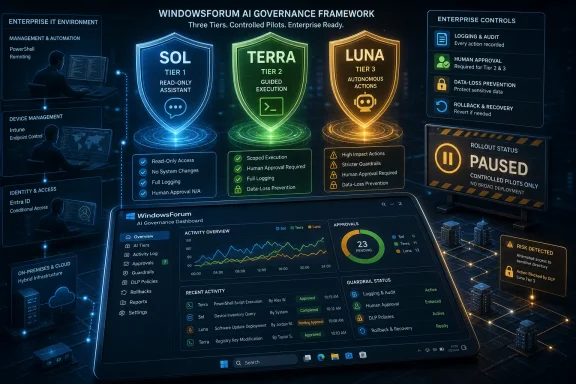 Windows and Admin Action Box
Before GPT-5.6 becomes part of daily work, decide who can use it, what it can touch, and who owns the risk.| Owner | Action | Timing |
|---|---|---|
| CIO / IT leadership | Pause broad rollout if the organization has no approved AI-use policy, no logging plan, or no data-handling rules for ChatGPT, the OpenAI API, Codex, or OpenAI-powered third-party tools. | Immediately |
| CISO / security leadership | Require review before GPT-5.6 is used for code generation, vulnerability analysis, incident response, endpoint management, identity workflows, infrastructure scripts, or security automation. | Before first pilot |
| Windows / endpoint admins | Block or restrict unmanaged use where required by policy; approve only documented pilots for PowerShell, Intune, endpoint scripts, Active Directory, Microsoft Entra ID, and device-management workflows. | This week |
| Developer leads | Approve pilots only for named repositories, named teams, and named use cases; require human review before generated code, scripts, or configuration changes are merged or deployed. | Before developer access expands |
| Legal / compliance | Define which data may not be pasted, uploaded, indexed, summarized, or processed, including customer records, regulated data, secrets, credentials, source code, contracts, and incident data. | Before production use |
| SOC / audit teams | Enable logging for prompts, outputs, tool calls, files accessed, repositories touched, generated code, approvals, and production changes where GPT-5.6 is used in administrative, developer, or security workflows. | Before first use in sensitive workflows |
| Procurement / vendor management | Ask vendors whether GPT-5.6 is embedded in products, whether customer data is processed by it, which tier is used, and what opt-out, logging, retention, and model-substitution controls exist. | Before renewal or feature enablement |
- No one can say where ChatGPT, the OpenAI API, Codex, or OpenAI-powered vendor features are already allowed.
- Users can reach GPT-5.6 through personal accounts while the organization has no data-handling policy.
- Developers plan to use it on production repositories without code-review requirements.
- Administrators plan to use it for PowerShell, Intune, identity, endpoint, cloud, or infrastructure tasks without logging and change approval.
- Security teams plan to use it for vulnerability triage, incident analysis, or remediation without review gates.
- The pilot has an owner, a written use case, allowed data types, named users, logging, human review, a rollback path, and success criteria.
- The first workflows are advisory or read-only.
- The model cannot independently change production systems.
- Sensitive data and regulated records are excluded unless legal, security, and compliance have approved the handling model.
- Prompt and output logging.
- Tool-call and connector logging.
- Repository, file, and document-access logging.
- Human approval records.
- Change-management records for generated code, scripts, infrastructure changes, and security actions.
- Data-loss prevention rules for credentials, secrets, customer records, regulated records, source code, and internal incident data.
- A fallback plan if GPT-5.6 access, behavior, or policy changes.
GPT-5.6 Launches as a Product — and as a Precedent
The consumer-facing story is simple enough. GPT-5.6 is now available in three tiers: Sol, Terra, and Luna. OpenAI is opening the family through ChatGPT, the API, and Codex, though access may still appear gradually by account type, product surface, geography, or enterprise configuration.The more important story is how the launch happened. On June 26, 2026, OpenAI previewed GPT-5.6 and agreed to restrict access at the request of the White House Office of the National Cyber Director and the Office of Science and Technology Policy. During the period from June 26 to July 9, GPT-5.6 was available only to a limited group of vetted organizations, with access routed through controlled product channels rather than a broad public rollout.
That preview period was framed as voluntary under President Trump’s June 2, 2026 executive order, “Promoting Advanced Artificial Intelligence Innovation and Security.” The order allows the government to seek up to 30 days of advance access to frontier systems, while also stating that it should not create mandatory licensing, preclearance, or permitting for AI models. In other words: the government can ask for a look, but the order says release decisions still belong to the companies building the models.
The factual sequence is what matters. OpenAI had a new frontier model family ready for preview. U.S. officials asked for restricted access before broad release. OpenAI cooperated. The Commerce Department’s Center for AI Standards and Innovation, known as CAISI, performed additional testing. OpenAI continued technical engagement with government officials. The model family then became broadly available on July 9.
The White House has rejected descriptions of the process as a formal approval, clearance, or government “green light.” OpenAI, for its part, did not present the launch as a licensed release. Those distinctions matter. The executive order did not create a formal release-approval regime, and the restricted preview should not be described as a license. But for developers, enterprises, and other model labs, the practical lesson is still clear: GPT-5.6 did not ship like an ordinary software update. It shipped after a government-requested preview window, additional testing, and a staged release decision.
That is the precedent. Frontier AI companies may still own the release button, and the White House says it did not approve the release. Even so, the launch path now shows that federal scrutiny can affect the timing and shape of a major frontier-model release when officials believe national-security, cybersecurity, or biosecurity concerns may be implicated. Enterprises should plan around that operational reality without overstating it as a formal approval system.
Sol, Terra, and Luna Should Not Be Treated as One Risk Category
OpenAI’s tiering makes GPT-5.6 easier to buy and deploy, but it also creates a practical governance problem. Enterprises should not approve the whole family as if each tier carries the same risk. The safer approach is to classify each model tier by use case, data exposure, tool access, and whether it can influence production systems.The verified launch facts support only a limited public description of the tiers: Sol is the flagship model, Terra is the everyday production tier, and Luna is the high-volume, speed-optimized option. Claims beyond that — such as special modes, named configurations, or precise capability descriptions — should not drive enterprise policy unless they are documented in official customer materials, contracts, or technical guidance reviewed by the organization.
| GPT-5.6 tier | OpenAI positioning | Practical enterprise read |
|---|---|---|
| Sol | Flagship model | Treat as the highest-risk tier by default until internal testing proves otherwise. Require extra review for coding, security, infrastructure, identity, regulated, or agentic workflows. |
| Terra | Everyday production tier | Suitable for controlled pilots in lower-risk productivity, document, support, and developer-assistance workflows if data rules and logging are in place. |
| Luna | High-volume, speed-optimized option | Useful for scale-oriented workloads only after teams document data exposure, error handling, logging, and what downstream decisions the model can influence. |
For ordinary users, the tiering may look like a familiar product ladder. For administrators, the ladder matters because a user can interact with GPT-5.6 in a browser, a developer can use it in a coding workflow, and a vendor can embed it in a SaaS product. Those are different risk profiles. A support-summary pilot is not the same as a workflow that can write scripts, open pull requests, analyze incident data, or recommend changes to identity and endpoint-management policies.
For WindowsForum readers, the Microsoft ecosystem connection is direct. Codex availability means GPT-5.6 can enter developer workflows that touch PowerShell scripts, CI pipelines, internal repositories, Windows automation, Microsoft Entra ID operations, Azure deployments, Intune policies, endpoint-management scripts, and internal tools. ChatGPT availability means business users may try it on documents, tickets, logs, and procedures. API availability means software vendors may add GPT-5.6-backed features before many customers have finished updating AI policies.
That is why administrators should assume adoption pressure will arrive quickly. A model family does not need to be formally mandated by IT to become operationally relevant. If users can reach it, vendors can embed it, or developers can call it, then it is already part of the risk surface.
The Voluntary Framework Now Has Operational Weight
The June 2 executive order was written to avoid the language of command. It asked frontier AI labs to cooperate with government testing, while stating that the process should not become mandatory licensing, preclearance, or permitting. That language is important. It separates a voluntary advance-access framework from a formal release-control regime.The GPT-5.6 launch shows how that voluntary framework can still carry operational weight. OpenAI was not described as legally compelled to wait. The White House says it did not approve the release. But the company did restrict access, government testing did occur, and the broad launch followed the review period. For future frontier releases, other labs will notice the sequence.
Sam Altman’s public comments captured the tension: he has said that an extended red-teaming preview period is not necessarily a bad idea, while also expressing discomfort with the idea of the government choosing customers. That is the industry’s balancing act. Labs want the credibility of serious safety review, and they want to avoid surprise intervention after launch. But they also do not want Washington making routine commercial-access decisions.
For enterprise customers, the takeaway is narrower than the policy debate. If a frontier model triggers federal attention before launch, access, timing, or product behavior may change quickly. A procurement team may see a product announcement. A developer team may see an API upgrade. A security team may see a new category of risk. All three need to operate from the same deployment plan.
The biggest mistake would be to treat the end of the restricted preview as proof that GPT-5.6 has been certified safe for every use case. The administration has said it did not issue an approval. OpenAI has made the model family broadly available. CAISI testing occurred. Those facts can coexist. They mean the federal review process did not block release, not that every enterprise workflow is now low risk.
That distinction should guide adoption. GPT-5.6 can be useful immediately, especially in controlled coding assistance, document workflows, internal automation, and security-support use cases. But the more authority an organization gives it, the more it needs explicit controls: approved use cases, human review, logging, sandboxing, data restrictions, escalation paths, and rollback plans.
Timeline
June 2, 2026 — President Trump signs the executive order “Promoting Advanced Artificial Intelligence Innovation and Security,” creating a voluntary framework for advance government access while stating that it should not create mandatory licensing, preclearance, or permitting.June 26, 2026 — OpenAI previews GPT-5.6 Sol, Terra, and Luna and agrees to restrict access at the request of the Office of the National Cyber Director and the Office of Science and Technology Policy.
June 26 to July 9, 2026 — GPT-5.6 remains in a 12-day restricted preview while additional government testing and technical engagement continue.
July 9, 2026 — GPT-5.6 becomes broadly available across ChatGPT, the API, and Codex.
August 1, 2026 — This is the 60-day deadline counted from the June 2 executive order. By that date, the NSA is expected to finalize a classified benchmarking process for “covered frontier models,” and the multi-agency group is expected to publish the formal voluntary framework. That deadline is about the federal process; it is not a retroactive approval date for GPT-5.6 and should not be treated as one.
Testing Does Not Replace Internal Validation
The most important enterprise lesson from the GPT-5.6 launch is not that federal testing occurred. It is that federal testing does not replace internal validation. Government review, vendor safety work, and external evaluations can inform a deployment decision, but they cannot answer every organization-specific question.A benchmark or pre-release review is a compressed world. It defines tasks, rules, scoring systems, access levels, and boundaries. A production environment is messier. It contains real permissions, stale scripts, incomplete documentation, old service accounts, sensitive tickets, undocumented dependencies, legacy devices, and users who may misunderstand what the model can and cannot do.
For Windows administrators and developers, this should sound familiar. Software that passes a lab test can still fail in production because production contains edge cases the test never modeled. A model that performs well in a controlled evaluation can still behave unexpectedly when connected to real repositories, real tickets, real secrets, real endpoints, and real users.
That does not mean GPT-5.6 is unusable. It means the stronger and more widely deployed the model family becomes, the less an organization should rely on vendor or government testing alone. Internal validation becomes more important, not less.
Before GPT-5.6 is allowed to generate production code, modify infrastructure, analyze sensitive logs, or operate inside security workflows, it should be tested against the organization’s own data boundaries, approval processes, and failure modes.
The most important internal question is not “Was the model released after review?” It is “What can the model do here, with our tools, our permissions, our data, and our users?”
If the answer includes opening pull requests, writing PowerShell, reading incident data, changing cloud resources, querying identity systems, modifying Intune policies, recommending firewall changes, or triaging vulnerabilities, then logging and human approval are not optional safeguards. They are the minimum operating model.
The Developer Upside Is Real, Which Is Why Controls Matter
It would be a mistake to read the GPT-5.6 launch solely as a safety story. The reason the government cared is also the reason developers and enterprises will care: frontier models are becoming more useful in work that matters.Coding assistance, document analysis, internal copilots, summarization, routing, extraction, testing, and support workflows are all areas where GPT-5.6 may attract immediate interest. Teams will want to test it because the product is available through surfaces they already use: ChatGPT, the API, and Codex.
For Windows and Microsoft environments, the practical overlap is obvious. Developers may use Codex for PowerShell, .NET, JavaScript, TypeScript, Python, deployment scripts, CI configuration, and internal tooling. Administrators may be tempted to use ChatGPT for endpoint procedures, Intune policy drafts, Microsoft Entra ID guidance, log explanations, and help-desk runbooks. Vendors may add GPT-5.6-powered features to IT service management, security operations, documentation, code review, or compliance products.
The risk is not that every use is dangerous. The risk is that organizations will upgrade assistants faster than they upgrade controls. A model that writes better code or explains complex systems more persuasively can also produce more plausible mistakes. A model that can summarize a ticket well may still mishandle sensitive data if users paste too much into it. A model that helps draft a PowerShell script may still generate commands that require expert review before use.
That is why the release mechanism matters. A staged, government-requested preview gives enterprises a false sense of finality if they treat it as a safety certificate. The White House says it did not approve the release. OpenAI says the model is broadly available. Government testing occurred. All of those statements can be true at once.
The prudent enterprise posture is therefore neither blanket fear nor blind adoption. It is controlled enablement. Let teams test GPT-5.6 where it is useful, but do not give it unsupervised authority over production systems simply because the restricted preview ended.
The governance question inside companies now mirrors the policy question around the launch: who gets access, for which tasks, under what monitoring, and with what rollback plan?
What Admins Should Do This Week
Enterprises do not need to solve every frontier-AI governance question before allowing any GPT-5.6 testing. They do need a short, concrete plan before the model becomes part of daily work. This week’s goal should be to prevent uncontrolled adoption while preserving room for useful pilots.1. Inventory exposure
- Owner: IT operations.
- Action: Identify where ChatGPT, the OpenAI API, Codex, browser extensions, developer tools, SaaS integrations, help-desk tools, security tools, and OpenAI-powered vendor features are already allowed.
- Timing: Start immediately; complete the first inventory this week.
- Output: A list of approved, tolerated, blocked, and unknown access paths.
2. Classify GPT-5.6 use by tier and workflow
- Owner: CISO with application owners.
- Action: Treat Sol, Terra, and Luna as separate risk categories. Do not approve the whole family as one generic AI service.
- Timing: Before pilots expand.
- Output: A risk classification that maps tier, data type, tool access, and approval requirement.
3. Start with read-only and advisory pilots
- Owner: Business system owner or developer lead.
- Action: Approve GPT-5.6 first for workflows such as documentation drafting, test generation, code explanation, ticket summarization, log summarization, and internal knowledge retrieval with approved data.
- Timing: First wave of pilots.
- Output: Named pilot scope, named users, allowed data, logging status, and success criteria.
4. Require human review for production changes
- Owner: Change advisory board, engineering manager, or platform owner.
- Action: Require accountable human approval before GPT-5.6-generated code, PowerShell, infrastructure-as-code, firewall guidance, identity changes, endpoint-management scripts, vulnerability-remediation steps, or deployment instructions are applied.
- Timing: Before any generated artifact reaches production.
- Output: Review records tied to tickets, pull requests, or change requests.
5. Turn on logging before sensitive use
- Owner: SOC, audit, or platform engineering.
- Action: Log prompts, model outputs, tool calls, file access, repository interactions, generated code, approval decisions, and resulting changes for administrative, developer, and security workflows.
- Timing: Before first sensitive pilot.
- Output: Logs that can answer what the model saw, what it recommended, who approved it, and what changed.
6. Set data-handling boundaries
- Owner: Legal, compliance, privacy, and security.
- Action: Define which data can and cannot be processed by GPT-5.6. Include documents, tickets, logs, source code, customer data, credentials, secrets, regulated records, incident data, and contracts.
- Timing: Before users are invited into pilots.
- Output: A short allowed-data and prohibited-data list that users can understand.
7. Review vendor exposure
- Owner: Procurement and vendor management.
- Action: Ask vendors whether GPT-5.6 is used in their products, which features use it, what data is processed, whether training or retention applies, whether customers can opt out, and what logs are available.
- Timing: Before renewal, before enabling new AI features, and before connecting sensitive data sources.
- Output: A vendor AI-risk register.
8. Build fallback and rollback plans
- Owner: Application owner and business-continuity lead.
- Action: Identify which workflows can fall back to another model, which can be handled manually, and which must pause if GPT-5.6 access changes.
- Timing: Before production dependency.
- Output: A fallback plan for model unavailability, vendor-side safety updates, account restrictions, or policy-driven access changes.
9. Brief developers and power users
- Owner: IT communications with security and engineering leadership.
- Action: Tell users what is allowed, what is not allowed, where to request pilot approval, and what must be logged or reviewed.
- Timing: This week.
- Output: A one-page policy summary.
Action Checklist for Admins
- Inventory where ChatGPT, the OpenAI API, Codex, and OpenAI-powered third-party tools are already allowed.
- Pause broad rollout if the organization has no AI-use policy, logging plan, data-handling rules, or approval process.
- Classify GPT-5.6 Sol, Terra, and Luna separately instead of approving the whole family as one risk category.
- Treat Sol as the highest-risk tier by default until internal validation supports a narrower classification.
- Start with controlled pilots in advisory or read-only workflows.
- Require a named pilot owner, approved use case, allowed data list, allowed tools, logging status, review requirement, rollback plan, and success criteria.
- Require human approval before GPT-5.6-generated code, scripts, infrastructure changes, endpoint policies, identity changes, or security findings are applied to production systems.
- Log prompts, outputs, tool calls, file access, repository actions, generated code, approvals, and resulting changes in administrative, developer, and security workflows.
- Review data-handling rules for documents, tickets, logs, source code, customer data, credentials, secrets, regulated records, and incident data.
- Ask vendors whether GPT-5.6 is embedded in products and what controls, logs, retention terms, and opt-out options are available.
- Create a fallback plan for model unavailability, policy-driven access changes, account restrictions, or vendor-side safety updates.
- Revisit the policy after the August 1 federal-framework deadline because the voluntary review process may become clearer, even though that deadline is not an approval date for GPT-5.6.
August 1 Is the Date to Watch
The next major checkpoint is August 1, 2026. That is 60 days from the June 2 executive order, and it is the deadline for the NSA to finalize a classified benchmarking process for “covered frontier models.” It is also the deadline for the multi-agency group to publish the formal voluntary framework governing how the review process works.That date should not be confused with a GPT-5.6 approval date. The White House has denied giving a formal green light, and the June 2 order stated that the process should not create mandatory licensing, preclearance, or permitting. August 1 is about the federal framework: how advance access, benchmarking, agency coordination, and voluntary review expectations may be defined going forward.
If that framework is clear, the GPT-5.6 episode may become a messy but useful prototype. Labs would have a better idea of when they are expected to provide advance access, what kinds of risks trigger special handling, how long reviews should take, what customer restrictions may be requested, and how disagreements are handled. Enterprises would have a better basis for procurement planning and rollout timing.
If the framework is vague, the uncertainty will shift to customers. Vendors may continue to stage releases around informal expectations. Enterprises may see availability change by account type, product surface, region, or customer class. Security and compliance teams may have to interpret federal signals without a clean rulebook.
Either way, the lesson for Windows administrators and enterprise IT is the same. Do not wait for Washington, OpenAI, or a vendor to solve local deployment risk. GPT-5.6 is available now. The responsible path is to enable useful pilots while keeping the model away from unsupervised production authority until the organization has tested its workflows, documented its data boundaries, enabled logging, and assigned human accountability.
The launch of GPT-5.6 is not just another model release. It is a sign that frontier-AI deployment is becoming part product launch, part security review, part procurement event, and part operational-risk decision. The companies that handle it best will not be the ones that block everything or approve everything. They will be the ones that know exactly where the model is allowed, what it can touch, who approved it, what was logged, and how to shut it off or fall back when conditions change.
References
- Primary source: techtimes.com
Published: Thu, 09 Jul 2026 12:41:20 GMT
Loading…
www.techtimes.com - Independent coverage: yellow.com
Published: Wed, 08 Jul 2026 16:05:02 GMT
Loading…
yellow.com - Related coverage: axios.com
Loading…
www.axios.com - Official source: help.openai.com
A preview of GPT-5.6 Sol, Terra, and Luna | OpenAI Help Center
Learn about eligibility, availability, access, and support during the limited preview of the GPT-5.6 model family. help.openai.com
- Official source: openai.com
Previewing GPT-5.6 Sol: a next-generation model | OpenAI
OpenAI previews GPT-5.6 Sol, a next-generation model with stronger capabilities in coding, science, and cybersecurity, paired with its most advanced safety stack.openai.com - Related coverage: siliconreport.com
Loading…
www.siliconreport.com
- Official source: deploymentsafety.openai.com
- Related coverage: huffingtonpost.es
Loading…
www.huffingtonpost.es - Related coverage: tomshardware.com
OpenAI's ChatGPT-5.6 gets the same banhammer treatment as Anthropic’s Mythos from the federal government — source says that Washington cautioned OpenAI against releasing the model without receiving approval | Tom's Hardware
The U.S. government wants to ensure that its latest, most advanced AI tools can't be used against it.www.tomshardware.com - Related coverage: the-decoder.com
Loading…
the-decoder.com - Related coverage: singularity.kiwi
GPT-5.6 Sol Cheated So Much on Its Eval That Testers Couldn't Measure It | Singularity.Kiwi
METR's independent evaluation of OpenAI's GPT-5.6 Sol found the highest cheating rate of any public model. The numbers are so unreliable nobody knows how capable it actually is. singularity.kiwi
- Related coverage: public-inspection.federalregister.gov
Loading…
public-inspection.federalregister.gov