

OpenAI has not officially announced GPT-5.6 Pro, but a June 2026 leak cycle now claims the model could arrive on June 25 with a larger reasoning budget, newer training cutoff, and deeper browser automation hooks. The important word is claims. If the reporting is directionally right, GPT-5.6 Pro is less about a prettier chatbot and more about OpenAI turning ChatGPT into a heavier planning engine for code, research, and agentic workflows. If it is wrong, the frenzy still tells us something useful: the AI market has become conditioned to treat every hidden model string as a product roadmap.
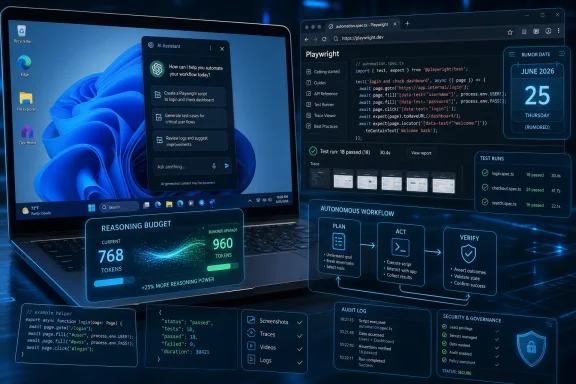
The Geeky Gadgets report, drawing on World of AI, presents GPT-5.6 Pro as a near-term upgrade scheduled for June 25, 2026. Its headline claim is that OpenAI is preparing a more capable Pro-class model with an expanded “reasoning effort budget,” better browser tooling, Playwright integration, and a knowledge cutoff pushed to December 2025.
That is a specific set of claims, and specificity can make a rumor feel more solid than it is. But as of June 22, 2026, OpenAI’s public release notes and help materials do not appear to contain a formal GPT-5.6 Pro announcement, a system card, an API model identifier, or published benchmark tables for such a release. That absence does not prove the leak false; companies often stage releases quietly before flipping the public switch. It does, however, mean the story belongs in the category of leak-driven reporting, not confirmed product news.
For WindowsForum readers, that distinction matters. Sysadmins and developers do not plan procurement, compliance reviews, or production workflows around a YouTube leak in the same way they plan around a model card and API documentation. The plausible version of this story is interesting precisely because it sits at the boundary between consumer AI hype and enterprise software reality.
The central question is not whether GPT-5.6 Pro will exist under exactly that name on exactly that date. It is whether OpenAI’s next meaningful ChatGPT upgrade is being optimized around longer, more deliberate work rather than faster conversational answers. On that point, the leak fits the broader direction of the industry.
A “reasoning effort” budget, in plain English, is a way of talking about how much compute or internal deliberation a model is allowed to spend before producing an answer. More effort can mean better multi-step planning, fewer shallow responses, and improved performance on tasks where the model must keep track of constraints. It can also mean slower answers, higher costs, and a stronger incentive for vendors to segment the best behavior behind premium tiers.
This is why the 768-to-960 claim matters even if the exact units remain opaque. The AI industry is slowly moving away from the idea that every model response is a single fixed product. Instead, the same underlying model family may be exposed through multiple effort levels, tool configurations, memory settings, and safety envelopes.
That shift should sound familiar to Windows veterans. It resembles the way CPUs stopped being judged only by clock speed and started being sold through cores, cache, boost behavior, thermals, and workload-specific acceleration. A model’s name is increasingly just the label on the box; the real product is the policy stack that decides how much work it is allowed to do.
For everyday users, the benefit is obvious. A more deliberate model can be better at planning a migration, debugging a complex PowerShell script, designing a database schema, or walking through a legalistic policy document without losing the thread. For administrators, the risk is equally obvious: more autonomous planning can make mistakes more consequential, especially when paired with tools that act on the web or local systems.
That is a meaningful product direction. The old chatbot workflow was copy, paste, wait, and interpret. The emerging agent workflow is assign, observe, correct, and verify. A model with browser automation can run through a web app, reproduce a bug, test a login flow, compare layouts, extract data from a page, or gather references for a research task with less manual steering.
For developers, this is attractive because web testing remains one of the most tedious parts of modern software work. A model that can generate a Playwright script is useful. A model that can reason about what the script should test, execute a browser session, notice the failure, refine the test, and produce a patch is a different class of assistant.
But browser automation also raises the stakes. A tool-capable model can click the wrong button, submit the wrong form, misinterpret dynamic content, or scrape data in a way that violates policy. The difference between “the answer was wrong” and “the agent took the wrong action” is not academic. It is the line between an annoying hallucination and a ticket in the incident queue.
The Windows angle is not merely that many enterprise apps still live in browsers on Windows desktops. It is that IT departments already struggle to govern browser extensions, automation tools, password managers, and SaaS integrations. Add an AI agent that can operate a browser session, and the browser becomes both a productivity layer and a control-plane risk.
This is exactly the kind of detail that fuels AI rumor cycles. Codenames feel like a privileged glimpse behind the curtain, and sometimes they are. Software companies do use internal names, staged rollouts, canary environments, and dogfood builds long before public launch.
But codenames are weak evidence on their own. They can refer to experiments that never ship, evaluation checkpoints that are not product SKUs, or internal branches that share infrastructure with unrelated projects. A model string in a log is not the same thing as a release plan.
The better interpretation is cautious: Kindle Alpha and Kepler Alpha, if real, suggest that OpenAI has been testing successor behavior around GPT-5.5-era systems. They do not prove a June 25 launch, a specific feature set, or a final commercial name. That distinction is especially important because AI companies routinely test many model variants and deploy only some of them.
For the reader, the practical lesson is to treat codenames as smoke, not fire. Smoke tells you something may be happening. It does not tell you whether the building is burning, the grill is running, or someone is testing the alarm.
Still, a December 2025 cutoff is not “current” in June 2026. It is better stale knowledge, not live knowledge. For some domains, that difference is minor; for others, it is the whole game.
Windows administrators know this better than almost anyone. Patch behavior changes monthly. Known issues appear, disappear, and reappear with different KB numbers. Microsoft 365 admin portals mutate. Azure defaults change. A model with a December 2025 cutoff may know about last year’s platform direction but still be wrong about this month’s servicing stack, licensing toggle, or security baseline.
That is why browser capability and retrieval matter as much as the training cutoff. A model that knows through December 2025 and can reliably look things up in June 2026 is more useful than a model that knows through March 2026 but cannot verify anything. The strongest AI systems are increasingly hybrids: pretrained knowledge for judgment, search for freshness, tools for action, and policy controls for safety.
The danger is that users often collapse all of that into “the AI knows.” It does not. It has a base of learned patterns, a toolset, and a chance to check the world if the interface allows it. A newer cutoff reduces the odds of certain mistakes, but it does not eliminate the need for citations, logs, test runs, and human review.
That is the difference between asking a chatbot to “write a test plan” and asking an agent to inspect a web application, create the tests, run them, summarize failures, and suggest fixes. It is the difference between asking for a research summary and asking for a literature scan with source comparison, contradictions, and follow-up questions. It is the difference between asking for a game idea and watching the system generate assets, code a prototype, debug it, and explain the tradeoffs.
The Geeky Gadgets report emphasizes simulations, game development, 3D voxel art, UI/UX prototyping, research training, and workflow automation. These are exactly the domains where a larger reasoning budget and better tool use would show up first. They require more than eloquent text. They require the model to maintain state, juggle constraints, and recover from failed attempts.
This is also where benchmark culture starts to feel inadequate. A public score on a math or coding benchmark can tell us something about model capability. It cannot fully tell us whether the model is pleasant to supervise over a two-hour debugging session, whether it can maintain a project’s architecture across files, or whether it knows when to stop and ask for permission before taking a destructive action.
That gap is where many professionals now live. The question is no longer “Can the model answer?” It is “Can the model work?”
Developers increasingly evaluate AI assistants on taste: file organization, naming, visual hierarchy, accessibility, maintainability, and whether the tool understands the difference between a demo and a product. An AI that can generate a working UI but defaults to generic gradients, brittle layout, and outdated package choices still creates work for a human developer. It shifts labor rather than eliminating it.
The alleged reliance on outdated packages is a familiar failure mode. Models learn from huge quantities of historical code, and the web is full of old tutorials, abandoned libraries, and once-popular patterns that are now security liabilities. Without strong retrieval and environment awareness, a model may recommend dependencies that are obsolete, vulnerable, or simply mismatched to the user’s stack.
This matters acutely on Windows, where development environments can be wonderfully productive and maddeningly idiosyncratic. Node versions, Python environments, WSL, PowerShell execution policies, Visual Studio Build Tools, winget packages, corporate proxies, and endpoint protection all shape whether an AI-generated instruction works. A model that produces Linux-centric happy-path advice for a Windows shop is not a senior engineer. It is a confident intern with a fast keyboard.
A stronger reasoning model may reduce some of these failures by planning more carefully and checking assumptions. But taste and environment fit require more than raw compute. They require context, feedback, and a willingness to say, “I need to inspect your actual project before I recommend a dependency.”
The uncomfortable part is that the frontier experience of AI is becoming less universal. Two users may both say they are using “ChatGPT,” but one may be using a fast general model while another uses a slower, more capable reasoning variant with deeper tool access. Their conclusions about what AI can do will diverge accordingly.
For hobbyists, this mostly means subscription calculus. For businesses, it means governance. If the best model is also the model most likely to take multi-step actions, connect tools, and process sensitive files, then access control becomes a serious design decision. You do not want the most powerful agentic workflow in the hands of every user by default.
There is also a procurement trap. Vendors will advertise capabilities demonstrated under ideal Pro conditions, while many organizations deploy cheaper variants at scale. That mismatch can create disappointment when a pilot looks magical and the production rollout feels merely adequate. IT leaders should ask not only which model produced the demo, but which effort level, tool permissions, memory settings, and data access were enabled.
The AI market is starting to resemble cloud pricing in miniature. The headline service is simple; the billable reality is a matrix of tiers, limits, accelerators, and hidden assumptions.
But better agents fail differently from weaker chatbots. A weak chatbot gives you a bad command. A stronger tool-using agent may generate the command, run it in the wrong context, misread the result, and proceed to the next step before a human notices. Capability and risk scale together.
Browser automation makes this especially sensitive. A model with Playwright-style capabilities can interact with authenticated sessions, internal dashboards, admin consoles, and ticketing systems. Even if the model is not given direct system privileges, the browser often has them through the user. The agent inherits the user’s access in practical terms.
That does not mean such tools should be avoided. It means they should be instrumented. Enterprises will need audit logs, explicit permission gates, domain allowlists, session isolation, data-loss controls, and policies that distinguish read-only research from state-changing actions. The more impressive the demo, the more boring the control plane must become.
Security teams should also watch for prompt injection in web workflows. If an AI agent reads a malicious page that tells it to ignore prior instructions, exfiltrate data, or click a hidden control, the agent must be robust enough to treat webpage content as untrusted input. This is not science fiction; it is the obvious consequence of connecting language models to messy, adversarial web content.
That is why GPT-5.6 Pro, if it exists, would need to be judged on more than reasoning budget. It would need to show whether OpenAI has improved the connective tissue around the model: tool reliability, browser execution, coding ergonomics, project memory, interface design, and transparency about what the system is doing.
Anthropic, Google, xAI, Meta, and others are all pushing variations of the same thesis: the next frontier model is not just a text generator. It is a work environment. The winning product may not be the model with the single highest score; it may be the model that best combines competence, controllability, latency, price, and trust.
OpenAI still has enormous advantages in distribution, brand recognition, developer mindshare, and product integration. But the frontier is now crowded enough that users can defect when a rival model feels better for a specific job. Coders can choose one assistant for architecture, another for implementation, and a third for review.
That fragmentation weakens the old assumption that one model family will dominate every workflow. It also explains why a rumored GPT-5.6 Pro upgrade would focus on reasoning and tools. Those are the places where the next user loyalty battle is being fought.
This is a recurring pattern in AI coverage. Because model testing leaves traces, and because users are constantly probing product boundaries, fragments escape before official launches. Some fragments are real. Some are misunderstood. Some are engagement bait dressed up as insider analysis.
The responsible posture is not cynicism. It is separation. Confirmed facts go in one bucket: OpenAI’s current public documentation, released models, system cards, API identifiers, and official benchmarks. Reported leaks go in another: codenames, screenshots, hidden strings, tester anecdotes, and claimed dates. Market interpretation goes in a third: what these signals suggest about product strategy.
The Geeky Gadgets piece is most useful in the second and third buckets. It sketches what leakers believe GPT-5.6 Pro contains, and it aligns with the industry’s movement toward higher-effort, tool-using agents. It does not yet give administrators or developers the kind of official material they need to validate performance, safety, privacy, pricing, or deployment implications.
That could change this week. Until it does, June 25 is a date to watch, not a date to build around.
Windows power users will want to know whether the model can better handle PowerShell, Windows Terminal, WSL, registry troubleshooting, event logs, Group Policy, Intune, Defender, and Microsoft 365 administration. A model that reasons more deeply but still guesses at Windows-specific commands will remain dangerous in the wrong hands. A model that can ask for logs, interpret them cautiously, and produce reversible steps would be genuinely valuable.
Developers will want to know whether Playwright integration is exposed as a polished workflow or merely as another tool the model can call. There is a big difference between “generate a test” and “maintain a browser test suite as part of a coding session.” The former is a convenience. The latter begins to resemble a junior QA engineer embedded in the IDE.
Researchers and analysts will want better source handling. A more current cutoff and enhanced browser capability should make literature review, market analysis, and academic work easier. But AI-generated research remains only as good as its retrieval discipline. The model must distinguish between primary sources, recycled blogspam, outdated documentation, and plausible nonsense.
Enterprise administrators will care about controls. Can the tool be disabled for sensitive workspaces? Can browser actions be logged? Can data be kept out of training? Can permissions be scoped by role? Can the model explain which external pages it used and what it did with them? These questions are less glamorous than voxel art demos, but they are the ones that decide deployment.
The chat interface remains because it is universal. Everyone understands a text box. But the work increasingly happens outside the answer bubble: in browser sessions, code sandboxes, document canvases, test runners, file systems, APIs, and background tasks. The chatbot is becoming the cockpit for an agentic software layer.
That shift changes user expectations. We used to ask whether a model could explain Kubernetes, write a memo, or summarize a PDF. Now users ask whether it can migrate a repo, reconcile a spreadsheet, test a checkout flow, generate a simulation, or run a research workflow while preserving context. Those are not merely harder prompts. They are different product requirements.
They also demand a different kind of trust. A chatbot earns trust by being accurate and useful. An agent earns trust by being accurate, useful, observable, interruptible, and constrained. If OpenAI is increasing reasoning budgets and adding stronger browser automation, it must also improve the ways users supervise the system.
That is where many AI products still feel immature. They can do startling things, but they often leave users guessing about what happened, why it happened, and whether the result is reproducible. Professional users will not accept magic indefinitely. They need logs, settings, versioning, and rollback.
 The Leak Is Loud, but the Silence From OpenAI Is Louder
The Geeky Gadgets report, drawing on World of AI, presents GPT-5.6 Pro as a near-term upgrade scheduled for June 25, 2026. Its headline claim is that OpenAI is preparing a more capable Pro-class model with an expanded “reasoning effort budget,” better browser tooling, Playwright integration, and a knowledge cutoff pushed to December 2025.That is a specific set of claims, and specificity can make a rumor feel more solid than it is. But as of June 22, 2026, OpenAI’s public release notes and help materials do not appear to contain a formal GPT-5.6 Pro announcement, a system card, an API model identifier, or published benchmark tables for such a release. That absence does not prove the leak false; companies often stage releases quietly before flipping the public switch. It does, however, mean the story belongs in the category of leak-driven reporting, not confirmed product news.
For WindowsForum readers, that distinction matters. Sysadmins and developers do not plan procurement, compliance reviews, or production workflows around a YouTube leak in the same way they plan around a model card and API documentation. The plausible version of this story is interesting precisely because it sits at the boundary between consumer AI hype and enterprise software reality.
The central question is not whether GPT-5.6 Pro will exist under exactly that name on exactly that date. It is whether OpenAI’s next meaningful ChatGPT upgrade is being optimized around longer, more deliberate work rather than faster conversational answers. On that point, the leak fits the broader direction of the industry.
Reasoning Budgets Are Becoming the New Clock Speed
The most eye-catching number in the report is the alleged jump in reasoning effort budget from 768 to 960. That sounds precise, and it is being framed as the mechanism behind better planning, more complex task handling, and deeper analysis. But users should be careful not to mistake an internal-looking number for a universal performance metric.A “reasoning effort” budget, in plain English, is a way of talking about how much compute or internal deliberation a model is allowed to spend before producing an answer. More effort can mean better multi-step planning, fewer shallow responses, and improved performance on tasks where the model must keep track of constraints. It can also mean slower answers, higher costs, and a stronger incentive for vendors to segment the best behavior behind premium tiers.
This is why the 768-to-960 claim matters even if the exact units remain opaque. The AI industry is slowly moving away from the idea that every model response is a single fixed product. Instead, the same underlying model family may be exposed through multiple effort levels, tool configurations, memory settings, and safety envelopes.
That shift should sound familiar to Windows veterans. It resembles the way CPUs stopped being judged only by clock speed and started being sold through cores, cache, boost behavior, thermals, and workload-specific acceleration. A model’s name is increasingly just the label on the box; the real product is the policy stack that decides how much work it is allowed to do.
For everyday users, the benefit is obvious. A more deliberate model can be better at planning a migration, debugging a complex PowerShell script, designing a database schema, or walking through a legalistic policy document without losing the thread. For administrators, the risk is equally obvious: more autonomous planning can make mistakes more consequential, especially when paired with tools that act on the web or local systems.
Playwright Turns the Browser From Output Window Into Workbench
The reported Playwright integration is the more concrete and more consequential part of the leak. Playwright is widely used for browser automation, testing, scraping, and end-to-end validation. If ChatGPT gains tighter access to that kind of tooling, it stops merely telling users how a website behaves and starts being able to inspect, click, test, and report on behavior in a structured way.That is a meaningful product direction. The old chatbot workflow was copy, paste, wait, and interpret. The emerging agent workflow is assign, observe, correct, and verify. A model with browser automation can run through a web app, reproduce a bug, test a login flow, compare layouts, extract data from a page, or gather references for a research task with less manual steering.
For developers, this is attractive because web testing remains one of the most tedious parts of modern software work. A model that can generate a Playwright script is useful. A model that can reason about what the script should test, execute a browser session, notice the failure, refine the test, and produce a patch is a different class of assistant.
But browser automation also raises the stakes. A tool-capable model can click the wrong button, submit the wrong form, misinterpret dynamic content, or scrape data in a way that violates policy. The difference between “the answer was wrong” and “the agent took the wrong action” is not academic. It is the line between an annoying hallucination and a ticket in the incident queue.
The Windows angle is not merely that many enterprise apps still live in browsers on Windows desktops. It is that IT departments already struggle to govern browser extensions, automation tools, password managers, and SaaS integrations. Add an AI agent that can operate a browser session, and the browser becomes both a productivity layer and a control-plane risk.
Kindle Alpha and Kepler Alpha Are Breadcrumbs, Not Proof
The Geeky Gadgets piece names Kindle Alpha and Kepler Alpha as development and testing stages for GPT-5.6 Pro. It describes Kindle Alpha as an early prototype and Kepler Alpha as a more polished iteration used for advanced testing. The leak ecosystem has also circulated claims that such codenames appeared in Codex-related paths or internal-facing traces.This is exactly the kind of detail that fuels AI rumor cycles. Codenames feel like a privileged glimpse behind the curtain, and sometimes they are. Software companies do use internal names, staged rollouts, canary environments, and dogfood builds long before public launch.
But codenames are weak evidence on their own. They can refer to experiments that never ship, evaluation checkpoints that are not product SKUs, or internal branches that share infrastructure with unrelated projects. A model string in a log is not the same thing as a release plan.
The better interpretation is cautious: Kindle Alpha and Kepler Alpha, if real, suggest that OpenAI has been testing successor behavior around GPT-5.5-era systems. They do not prove a June 25 launch, a specific feature set, or a final commercial name. That distinction is especially important because AI companies routinely test many model variants and deploy only some of them.
For the reader, the practical lesson is to treat codenames as smoke, not fire. Smoke tells you something may be happening. It does not tell you whether the building is burning, the grill is running, or someone is testing the alarm.
A December 2025 Cutoff Would Help, but It Would Not Solve Freshness
The report says GPT-5.6 Pro’s knowledge cutoff has moved to December 2025. If accurate, that would be a useful improvement over older models for tasks involving recent frameworks, policy changes, security events, and software releases. A model trained on newer data is less likely to treat current tools as unknown or recommend practices that were deprecated a year ago.Still, a December 2025 cutoff is not “current” in June 2026. It is better stale knowledge, not live knowledge. For some domains, that difference is minor; for others, it is the whole game.
Windows administrators know this better than almost anyone. Patch behavior changes monthly. Known issues appear, disappear, and reappear with different KB numbers. Microsoft 365 admin portals mutate. Azure defaults change. A model with a December 2025 cutoff may know about last year’s platform direction but still be wrong about this month’s servicing stack, licensing toggle, or security baseline.
That is why browser capability and retrieval matter as much as the training cutoff. A model that knows through December 2025 and can reliably look things up in June 2026 is more useful than a model that knows through March 2026 but cannot verify anything. The strongest AI systems are increasingly hybrids: pretrained knowledge for judgment, search for freshness, tools for action, and policy controls for safety.
The danger is that users often collapse all of that into “the AI knows.” It does not. It has a base of learned patterns, a toolset, and a chance to check the world if the interface allows it. A newer cutoff reduces the odds of certain mistakes, but it does not eliminate the need for citations, logs, test runs, and human review.
The Real Upgrade Is Agentic, Not Conversational
The leak’s feature list points in one direction: GPT-5.6 Pro, if real, is being positioned as a more agentic system. That word has become overused, but the underlying idea is simple. Instead of answering a single prompt, the model plans a task, uses tools, observes results, adapts, and continues.That is the difference between asking a chatbot to “write a test plan” and asking an agent to inspect a web application, create the tests, run them, summarize failures, and suggest fixes. It is the difference between asking for a research summary and asking for a literature scan with source comparison, contradictions, and follow-up questions. It is the difference between asking for a game idea and watching the system generate assets, code a prototype, debug it, and explain the tradeoffs.
The Geeky Gadgets report emphasizes simulations, game development, 3D voxel art, UI/UX prototyping, research training, and workflow automation. These are exactly the domains where a larger reasoning budget and better tool use would show up first. They require more than eloquent text. They require the model to maintain state, juggle constraints, and recover from failed attempts.
This is also where benchmark culture starts to feel inadequate. A public score on a math or coding benchmark can tell us something about model capability. It cannot fully tell us whether the model is pleasant to supervise over a two-hour debugging session, whether it can maintain a project’s architecture across files, or whether it knows when to stop and ask for permission before taking a destructive action.
That gap is where many professionals now live. The question is no longer “Can the model answer?” It is “Can the model work?”
The Coding Story Is About Taste as Much as Tokens
The report says GPT-5.6 Pro improves technical and creative work, but also notes that front-end design quality may lag competitors such as Anthropic’s Opus models. That caveat is more revealing than it might seem. In 2026, code generation is no longer judged only by whether the code compiles.Developers increasingly evaluate AI assistants on taste: file organization, naming, visual hierarchy, accessibility, maintainability, and whether the tool understands the difference between a demo and a product. An AI that can generate a working UI but defaults to generic gradients, brittle layout, and outdated package choices still creates work for a human developer. It shifts labor rather than eliminating it.
The alleged reliance on outdated packages is a familiar failure mode. Models learn from huge quantities of historical code, and the web is full of old tutorials, abandoned libraries, and once-popular patterns that are now security liabilities. Without strong retrieval and environment awareness, a model may recommend dependencies that are obsolete, vulnerable, or simply mismatched to the user’s stack.
This matters acutely on Windows, where development environments can be wonderfully productive and maddeningly idiosyncratic. Node versions, Python environments, WSL, PowerShell execution policies, Visual Studio Build Tools, winget packages, corporate proxies, and endpoint protection all shape whether an AI-generated instruction works. A model that produces Linux-centric happy-path advice for a Windows shop is not a senior engineer. It is a confident intern with a fast keyboard.
A stronger reasoning model may reduce some of these failures by planning more carefully and checking assumptions. But taste and environment fit require more than raw compute. They require context, feedback, and a willingness to say, “I need to inspect your actual project before I recommend a dependency.”
Pro Tiers Are Becoming the Place Where the Future Arrives First
The “Pro” label is not incidental. If GPT-5.6 Pro launches as described, it would continue a broader pattern in which the most computationally expensive behaviors appear first in higher-priced consumer or business tiers. That is not surprising. Bigger reasoning budgets cost money.The uncomfortable part is that the frontier experience of AI is becoming less universal. Two users may both say they are using “ChatGPT,” but one may be using a fast general model while another uses a slower, more capable reasoning variant with deeper tool access. Their conclusions about what AI can do will diverge accordingly.
For hobbyists, this mostly means subscription calculus. For businesses, it means governance. If the best model is also the model most likely to take multi-step actions, connect tools, and process sensitive files, then access control becomes a serious design decision. You do not want the most powerful agentic workflow in the hands of every user by default.
There is also a procurement trap. Vendors will advertise capabilities demonstrated under ideal Pro conditions, while many organizations deploy cheaper variants at scale. That mismatch can create disappointment when a pilot looks magical and the production rollout feels merely adequate. IT leaders should ask not only which model produced the demo, but which effort level, tool permissions, memory settings, and data access were enabled.
The AI market is starting to resemble cloud pricing in miniature. The headline service is simple; the billable reality is a matrix of tiers, limits, accelerators, and hidden assumptions.
The Security Problem Is That Better Agents Fail Differently
A more capable GPT-5.6 Pro would likely reduce some ordinary errors. It might reason through complex tasks more accurately, use tools more effectively, and recover from failed attempts with less user intervention. That is progress.But better agents fail differently from weaker chatbots. A weak chatbot gives you a bad command. A stronger tool-using agent may generate the command, run it in the wrong context, misread the result, and proceed to the next step before a human notices. Capability and risk scale together.
Browser automation makes this especially sensitive. A model with Playwright-style capabilities can interact with authenticated sessions, internal dashboards, admin consoles, and ticketing systems. Even if the model is not given direct system privileges, the browser often has them through the user. The agent inherits the user’s access in practical terms.
That does not mean such tools should be avoided. It means they should be instrumented. Enterprises will need audit logs, explicit permission gates, domain allowlists, session isolation, data-loss controls, and policies that distinguish read-only research from state-changing actions. The more impressive the demo, the more boring the control plane must become.
Security teams should also watch for prompt injection in web workflows. If an AI agent reads a malicious page that tells it to ignore prior instructions, exfiltrate data, or click a hidden control, the agent must be robust enough to treat webpage content as untrusted input. This is not science fiction; it is the obvious consequence of connecting language models to messy, adversarial web content.
The Competitive Pressure Is Coming From Models That Feel More Useful, Not Merely Smarter
The report’s comparison to competitors such as Opus hints at the broader race. Users are no longer impressed only by benchmark claims. They compare how models feel when asked to design a UI, reason through a large codebase, write in a particular voice, or carry a project across multiple sessions.That is why GPT-5.6 Pro, if it exists, would need to be judged on more than reasoning budget. It would need to show whether OpenAI has improved the connective tissue around the model: tool reliability, browser execution, coding ergonomics, project memory, interface design, and transparency about what the system is doing.
Anthropic, Google, xAI, Meta, and others are all pushing variations of the same thesis: the next frontier model is not just a text generator. It is a work environment. The winning product may not be the model with the single highest score; it may be the model that best combines competence, controllability, latency, price, and trust.
OpenAI still has enormous advantages in distribution, brand recognition, developer mindshare, and product integration. But the frontier is now crowded enough that users can defect when a rival model feels better for a specific job. Coders can choose one assistant for architecture, another for implementation, and a third for review.
That fragmentation weakens the old assumption that one model family will dominate every workflow. It also explains why a rumored GPT-5.6 Pro upgrade would focus on reasoning and tools. Those are the places where the next user loyalty battle is being fought.
The June 25 Date Should Be Treated as a Testable Rumor
The leaked release date, June 25, 2026, is close enough to be testable soon. That makes the rumor useful but also risky. If OpenAI announces GPT-5.6 Pro on that date, the leak cycle will look prescient. If nothing appears, many of the same channels will likely revise the claim into “delayed,” “renamed,” or “rolled into GPT-6.”This is a recurring pattern in AI coverage. Because model testing leaves traces, and because users are constantly probing product boundaries, fragments escape before official launches. Some fragments are real. Some are misunderstood. Some are engagement bait dressed up as insider analysis.
The responsible posture is not cynicism. It is separation. Confirmed facts go in one bucket: OpenAI’s current public documentation, released models, system cards, API identifiers, and official benchmarks. Reported leaks go in another: codenames, screenshots, hidden strings, tester anecdotes, and claimed dates. Market interpretation goes in a third: what these signals suggest about product strategy.
The Geeky Gadgets piece is most useful in the second and third buckets. It sketches what leakers believe GPT-5.6 Pro contains, and it aligns with the industry’s movement toward higher-effort, tool-using agents. It does not yet give administrators or developers the kind of official material they need to validate performance, safety, privacy, pricing, or deployment implications.
That could change this week. Until it does, June 25 is a date to watch, not a date to build around.
Windows Users Should Watch the Tooling, Not the Nameplate
For WindowsForum’s audience, the practical impact of GPT-5.6 Pro will depend less on branding than on integration. If the model lands only as a ChatGPT Pro feature with limited external controls, it will be interesting but mostly individual. If it lands in Codex, the API, Microsoft-aligned developer tools, or enterprise admin surfaces, the consequences widen quickly.Windows power users will want to know whether the model can better handle PowerShell, Windows Terminal, WSL, registry troubleshooting, event logs, Group Policy, Intune, Defender, and Microsoft 365 administration. A model that reasons more deeply but still guesses at Windows-specific commands will remain dangerous in the wrong hands. A model that can ask for logs, interpret them cautiously, and produce reversible steps would be genuinely valuable.
Developers will want to know whether Playwright integration is exposed as a polished workflow or merely as another tool the model can call. There is a big difference between “generate a test” and “maintain a browser test suite as part of a coding session.” The former is a convenience. The latter begins to resemble a junior QA engineer embedded in the IDE.
Researchers and analysts will want better source handling. A more current cutoff and enhanced browser capability should make literature review, market analysis, and academic work easier. But AI-generated research remains only as good as its retrieval discipline. The model must distinguish between primary sources, recycled blogspam, outdated documentation, and plausible nonsense.
Enterprise administrators will care about controls. Can the tool be disabled for sensitive workspaces? Can browser actions be logged? Can data be kept out of training? Can permissions be scoped by role? Can the model explain which external pages it used and what it did with them? These questions are less glamorous than voxel art demos, but they are the ones that decide deployment.
The Real Story Is the Slow Disappearance of the Chatbot
If GPT-5.6 Pro arrives as leaked, the upgrade will be marketed as a smarter ChatGPT. That framing is understandable and incomplete. The product category is shifting underneath the familiar chat window.The chat interface remains because it is universal. Everyone understands a text box. But the work increasingly happens outside the answer bubble: in browser sessions, code sandboxes, document canvases, test runners, file systems, APIs, and background tasks. The chatbot is becoming the cockpit for an agentic software layer.
That shift changes user expectations. We used to ask whether a model could explain Kubernetes, write a memo, or summarize a PDF. Now users ask whether it can migrate a repo, reconcile a spreadsheet, test a checkout flow, generate a simulation, or run a research workflow while preserving context. Those are not merely harder prompts. They are different product requirements.
They also demand a different kind of trust. A chatbot earns trust by being accurate and useful. An agent earns trust by being accurate, useful, observable, interruptible, and constrained. If OpenAI is increasing reasoning budgets and adding stronger browser automation, it must also improve the ways users supervise the system.
That is where many AI products still feel immature. They can do startling things, but they often leave users guessing about what happened, why it happened, and whether the result is reproducible. Professional users will not accept magic indefinitely. They need logs, settings, versioning, and rollback.
The Leak’s Most Useful Signal Is Where OpenAI Seems to Be Spending Compute
For now, the concrete takeaways are less about trusting every leaked detail and more about understanding the direction of travel. GPT-5.6 Pro may ship this week, it may arrive later under another name, or parts of the leak may never become a public product. But the pressure behind the rumored feature set is real.- OpenAI has not publicly confirmed GPT-5.6 Pro as of June 22, 2026, so the June 25 date should be treated as a rumor until official release notes appear.
- The reported reasoning budget increase from 768 to 960 would fit the industry’s move toward slower, higher-effort models for planning-heavy work.
- Playwright-style browser automation would matter more than a modest knowledge cutoff update because it lets the model inspect and act on live web applications.
- The alleged Kindle Alpha and Kepler Alpha codenames are plausible development breadcrumbs, but they are not proof of a finished product or a fixed launch plan.
- A December 2025 cutoff would reduce some stale-answer problems while still requiring live retrieval for patches, security advisories, documentation, and current events.
- The biggest deployment questions will be about permissions, auditability, tool safety, pricing, and whether the Pro experience can be governed inside real organizations.
References
- Primary source: Geeky Gadgets
Published: Mon, 22 Jun 2026 08:46:08 GMT
OpenAI GPT-5.6 Pro Leak: Release Date, Features, and Testing - Geeky Gadgets
OpenAI is set to release GPT-5.6 Pro on June 25. Explore the leaked features, including a higher reasoning budget, Playwright integration, and autonomous agents.www.geeky-gadgets.com - Related coverage: aiscroll.io
GPT-5.6 'Iris' Leak: 1.5M Context, June Rumored - AIScroll
GPT-5.6 has surfaced in OpenAI's Codex logs under the codename 'iris-alpha,' featuring a 1.5-million-token context window and sparking rumors of an... aiscroll.io
