

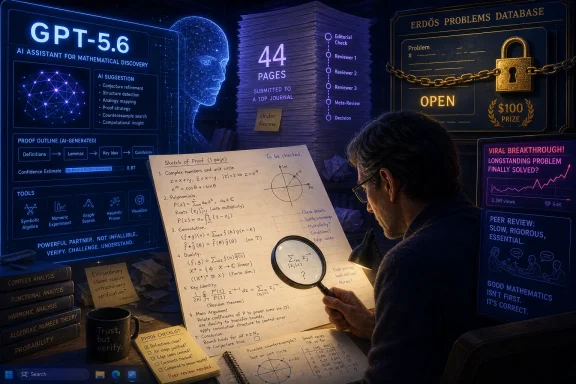
A striking claim raced across technology and mathematics circles on July 20, 2026: OpenAI’s GPT-5.6 Sol had allegedly dispatched a long-standing Erdős problem in a single page, eclipsing a 44-page proof published by József Beck in the Annals of Mathematics in 1991. The underlying development may still prove important, but the viral version compresses several different claims into one misleading headline. As of July 20, the authoritative Erdős Problems database continued to list Problem #119 as open, its $100 prize unclaimed, and its third question unresolved, making this a case where the verification process matters as much as the purported proof.
Paul Erdős was not merely one of the twentieth century’s most prolific mathematicians. He was also a human clearinghouse for mathematical questions, circulating problems among collaborators, returning to them across decades, and attaching cash prizes that reflected his personal estimate of their difficulty.
Those awards ranged from modest sums to thousands of dollars, but their symbolic value far exceeded their face value. Claiming an Erdős prize meant that a result had survived examination by a community accustomed to elegant arguments, hidden counterexamples, and deceptively simple statements.
That final qualification is important. An “open” label does not constitute an absolute guarantee that no solution exists somewhere in the literature, while a newly submitted proof does not automatically change a problem to “solved.” Mathematical status changes only after the relevant argument has been located, read, checked, compared with prior work, and accepted as answering the exact question posed.
However, the public Problem #119 page still described the third question as open on July 20. It also said there were no complete or partial solutions claimed in the associated comments and continued to display the $100 award next to the open status.
This does not prove that no new manuscript exists. Websites can lag behind private discussions or rapidly developing research. It does mean that the public evidence did not yet support declaring the entire Erdős problem solved or the bounty claimed.
[
pn(z)=\prod{i\leq n}(z-z_i).
]
The quantity of interest is
[
Mn=\max{|z|=1}|p_n(z)|,
]
the largest magnitude attained by that polynomial as (z) also moves around the unit circle.
This setup leads to three related but distinct questions. Treating them as one interchangeable conjecture is the first source of confusion in the viral account.
[
\limsup M_n=\infty.
]
In plain English, must the maximum magnitude become arbitrarily large along some subsequence, regardless of how the zeros are arranged?
Gerold Wagner answered a weaker form of the broader growth question in 1980. His result showed that (M_n) exceeds a positive power of (\log n) infinitely often, which is enough to establish unbounded growth.
[
M_n>n^c
]
for infinitely many values of (n).
This is much stronger than proving that (M_n) eventually escapes every fixed bound. A power of (n), even with an extremely small positive exponent, grows faster than every fixed power of (\log n).
Beck answered this second question affirmatively in his 1991 paper. The database states the result in an equivalent maximum-over-an-initial-range form:
[
\max_{n\leq N}M_n>N^c
]
for some positive constant (c).
[
\sum_{k\leq n}M_k>n^{1+c}.
]
This is an averaged growth statement. It is not enough for occasional values of (M_n) to spike above a power-law threshold. The accumulated total must eventually beat linear growth by a fixed power for every sufficiently large endpoint.
This third question is the one that the Erdős Problems database still listed as open and attached to the $100 prize on July 20. Any new proof must therefore establish this stronger cumulative inequality, not merely simplify Beck’s answer to the second question.
Beck was already a major figure in combinatorics and discrepancy theory. His work carried weight not because of page count but because it established a polynomial lower bound where only weaker growth had previously been known.
A new one-page argument would not make those contributions worthless. It would show that the route Beck took was not the shortest route to one particular destination.
This distinction appears throughout mathematical history. Complicated first proofs establish that a phenomenon is real; later proofs reveal why it had to be true.
It might also expose a relationship between harmonic analysis and the polynomial construction that was obscured by the original machinery. Proof compression can constitute a mathematical contribution even when it does not solve a previously open problem.
What it cannot do is retroactively turn the already answered second question into the prize-bearing third question. Those claims require separate verification.
That description is plausible at a high level. Many hard estimates become simpler after smoothing an irregular expression, translating it, and moving the problem into a dual space where an integral pairing is easier to bound.
A time or index shift can then align adjacent terms. Instead of bounding every polynomial maximum independently, an argument may compare an original quantity with a smoothed or displaced version whose cumulative behavior is more tractable.
Such a step can look almost embarrassingly simple after discovery. Before discovery, there is no guarantee that the smoothing preserves precisely the lower bound needed, nor that the shifted expression corresponds to the original polynomial sequence in the right way.
The originality, when there is any, lies in identifying the correct operator, test function, normalization, and place to apply the method. Calling the tools elementary does not mean that finding the configuration was easy.
A proof should be evaluated by what it proves, what it assumes, what prior results it invokes, how robustly it handles edge cases, and what new concepts it introduces. Page count can reflect elegance, but it can also conceal dependencies.
Conversely, a long original paper may prove every component from first principles because the relevant theory did not yet exist in a convenient form. Comparing lengths without tracing dependencies can therefore exaggerate the difference.
The alleged shortcut is described as elementary, which would reduce this concern if accurate. Even then, independent readers must establish that no difficult step has simply been declared “immediate.”
A one-page proof of Beck’s exact theorem would instead replace a long proof with a short one. That would be elegant and useful, but it would not settle the question Beck left open.
A one-page argument that proves only a variant under additional assumptions would be more limited still. The first task for reviewers is thus not to admire the brevity but to identify the theorem.
AI makes that process more urgent because a model can produce polished technical prose faster than experts can audit it. Fluency and confidence are not evidence of correctness.
The page also stated that no complete or partial solution had been claimed in its comments. It had last been edited on January 23, 2026, so a very recent submission could naturally be awaiting incorporation.
That lag leaves several possible interpretations:
The strongest confirmation would be a combination of conventional peer review and formal verification. A proof assistant could check the logical steps once the relevant background theory had been encoded, while human mathematicians would assess novelty, significance, and proper attribution.
The significant event would be the acceptance of a correct proof. Any bounty claim should follow that acceptance, not serve as evidence for it.
The release also expanded “max” reasoning and an “ultra” mode that coordinates multiple subagents. Instead of relying on one linear attempt, the system can distribute work, investigate competing strategies, critique candidate answers, and synthesize the strongest route.
An AI system can cheaply vary the assumptions, reorder the lemmas, test small examples, search for alternate formulations, and revisit discarded routes. It does not experience boredom, embarrassment, or the opportunity cost of staking a career on an unpromising method.
This does not eliminate the need for mathematical judgment. It changes the economics of exploration.
Parallelism still matters. One agent can search literature, another can test finite cases, another can seek counterexamples, and several can attack different proof strategies. A final critic can inspect the synthesis for missing conditions.
The result is closer to an automated research workshop than a conventional chatbot session. The important innovation may be orchestration rather than a mysterious leap in the model’s internal mathematical faculty.
Those improvements indicate that additional computation helps the model orient itself, revise hypotheses, and persist. They do not prove that it can reliably solve arbitrary open problems.
Research-level mathematics remains a sparse, high-variance domain. A system can produce several remarkable successes while still failing repeatedly, hallucinating citations, or overlooking elementary counterexamples.
Conflating these categories creates avoidable controversy.
That remains valuable. Mathematical literature is enormous, fragmented across languages and decades, and difficult for any one researcher to survey comprehensively.
However, finding an overlooked paper cannot be advertised as proving a previously unsolved theorem. The difference concerns priority, novelty, and the basic historical record.
Models often bridge gaps with phrases such as “it follows,” “by a standard argument,” or “without loss of generality.” Those transitions are precisely where hidden assumptions can enter.
A convincing AI-mathematics workflow must therefore separate generation from validation. The model proposing an argument should not be treated as the final judge of that same argument.
Calling a result “AI-only” erases those contributions. Calling it merely human work with autocomplete ignores the scale and persistence supplied by the model.
The most accurate description is often AI-assisted mathematics, with explicit disclosure of who chose the strategy, what the system generated, and who verified the final proof.
The immediate impact is not a new Windows feature. It is a shift from conversational assistants toward persistent, tool-using research agents.
That pattern resembles modern software development, where the local PC orchestrates remote repositories, build systems, containers, and cloud infrastructure. The intelligence may be remote, but the workflow remains grounded in the user’s files, applications, permissions, and review tools.
For Windows-based enterprise deployments, this creates demand for:
A Windows user might eventually ask an assistant to explain a theorem, produce a human-readable proof, formalize it, run the checker, and highlight any assumptions that remain unproved. That would be a far more trustworthy workflow than accepting mathematical prose on appearance alone.
Engineering, drug discovery, cybersecurity, finance, and software optimization offer similarly structured but messier environments.
This could change how organizations allocate expertise. Senior researchers may spend less time on mechanical exploration and more time defining useful questions, designing verification criteria, and interpreting successful results.
The likely near-term model is not autonomous science. It is a high-throughput collaboration in which machines widen the search and humans determine what is meaningful.
In mathematics, that means formal proof checking and expert review. In software, it means tests, static analysis, reproducible builds, and security scanning. In medicine, it means controlled studies and regulatory evidence.
The same principle applies across all of them: AI output is a hypothesis until an independent process establishes otherwise.
Research institutions may require detailed contribution logs comparable to those used in collaborative software projects. Journals and patent offices will face pressure to define when AI involvement must be disclosed and who can claim inventorship or authorship under existing rules.
If the proof concerns only Beck’s second-question result, coverage should say that it dramatically simplifies a known theorem. If it establishes the cumulative lower bound in the third question, it should be presented as a candidate resolution of the remaining open problem.
A short argument may be checked quickly, but apparent simplicity can be deceptive. The decisive question is not how long the PDF is but whether every implication survives hostile reading.
The site’s maintainer has repeatedly emphasized that database labels reflect current knowledge rather than infallible historical truth. That caution should be treated as a strength, not an obstacle to a dramatic announcement.
The ideal workflow would proceed in four stages:
A single successful run tells us that the system can produce the proof under some conditions. Repeated success would tell us whether the capability is robust enough to become a dependable research method.
AI changes the last two immediately. It can search unfashionable directions, repeat slight variations, and revisit assumptions that experts learned long ago not to question.
That efficiency has a cost. Occasionally, the path marked “obviously unpromising” contains a short proof.
A persistent agent can challenge these inherited stop rules. It does not need to replace intuition; it can serve as a counterweight, asking whether the abandoned branch was truly impossible or merely unattractive.
Experts connect the proof to existing theory, identify whether it generalizes, and explain why the shortcut was previously hidden. In many future discoveries, the scarce resource may shift from producing candidate ideas to understanding which candidates deserve attention.
Windows PCs will likely become gateways to these environments, much as they now serve as gateways to cloud development. The winning platforms will not simply generate the most impressive answers. They will make complex reasoning inspectable, reproducible, and safe to challenge.
The alleged one-page Erdős proof may ultimately be validated as a major result, reclassified as an elegant simplification of Beck’s known theorem, or rejected because a subtle step fails. On July 20, 2026, the public record was not yet sufficient to choose among those outcomes, and Problem #119 remained officially open. Yet the episode still marks an important stage in AI-assisted mathematics: models are producing arguments serious enough that experts must inspect them, while the rest of us are learning that a proof headline is not a proof, brevity is not verification, and persistence may be becoming a computational resource in its own right.
 Background
Paul Erdős was not merely one of the twentieth century’s most prolific mathematicians. He was also a human clearinghouse for mathematical questions, circulating problems among collaborators, returning to them across decades, and attaching cash prizes that reflected his personal estimate of their difficulty.Those awards ranged from modest sums to thousands of dollars, but their symbolic value far exceeded their face value. Claiming an Erdős prize meant that a result had survived examination by a community accustomed to elegant arguments, hidden counterexamples, and deceptively simple statements.
The role of the Erdős Problems database
The modern Erdős Problems website, maintained by University of Manchester mathematician Thomas Bloom, catalogues more than a thousand questions associated with Erdős. It records known results, references, prize information, discussion, formalized statements, and the site owner’s current assessment of whether each problem is open.That final qualification is important. An “open” label does not constitute an absolute guarantee that no solution exists somewhere in the literature, while a newly submitted proof does not automatically change a problem to “solved.” Mathematical status changes only after the relevant argument has been located, read, checked, compared with prior work, and accepted as answering the exact question posed.
Why the current story demands caution
The July 20 report attributes the new proof to GPT-5.6 working under the guidance of a mathematician identified as Korsky. It further says Bloom examined the argument, found it correct, and judged it stronger and dramatically shorter than Beck’s work.However, the public Problem #119 page still described the third question as open on July 20. It also said there were no complete or partial solutions claimed in the associated comments and continued to display the $100 award next to the open status.
This does not prove that no new manuscript exists. Websites can lag behind private discussions or rapidly developing research. It does mean that the public evidence did not yet support declaring the entire Erdős problem solved or the bounty claimed.
What Erdős Problem #119 Actually Asks
Problem #119 concerns a sequence of complex numbers (z_1,z_2,\ldots), each lying on the unit circle. For every positive integer (n), those points become the zeros of a polynomial[
pn(z)=\prod{i\leq n}(z-z_i).
]
The quantity of interest is
[
Mn=\max{|z|=1}|p_n(z)|,
]
the largest magnitude attained by that polynomial as (z) also moves around the unit circle.
This setup leads to three related but distinct questions. Treating them as one interchangeable conjecture is the first source of confusion in the viral account.
The first question
The first question asks whether[
\limsup M_n=\infty.
]
In plain English, must the maximum magnitude become arbitrarily large along some subsequence, regardless of how the zeros are arranged?
Gerold Wagner answered a weaker form of the broader growth question in 1980. His result showed that (M_n) exceeds a positive power of (\log n) infinitely often, which is enough to establish unbounded growth.
The second question
The second question asks whether there is a constant (c>0) such that[
M_n>n^c
]
for infinitely many values of (n).
This is much stronger than proving that (M_n) eventually escapes every fixed bound. A power of (n), even with an extremely small positive exponent, grows faster than every fixed power of (\log n).
Beck answered this second question affirmatively in his 1991 paper. The database states the result in an equivalent maximum-over-an-initial-range form:
[
\max_{n\leq N}M_n>N^c
]
for some positive constant (c).
The third question
The third question asks whether there is a (c>0) such that, for all sufficiently large (n),[
\sum_{k\leq n}M_k>n^{1+c}.
]
This is an averaged growth statement. It is not enough for occasional values of (M_n) to spike above a power-law threshold. The accumulated total must eventually beat linear growth by a fixed power for every sufficiently large endpoint.
This third question is the one that the Erdős Problems database still listed as open and attached to the $100 prize on July 20. Any new proof must therefore establish this stronger cumulative inequality, not merely simplify Beck’s answer to the second question.
What Beck Proved in 1991
József Beck’s paper, “The Modulus of Polynomials with Zeros on the Unit Circle: A Problem of Erdős,” appeared on pages 609 through 651 of Volume 134, Issue 3 of the Annals of Mathematics. Depending on whether one counts the opening and closing pages inclusively or refers to typeset leaves, it is commonly described as a 43- or 44-page paper.Beck was already a major figure in combinatorics and discrepancy theory. His work carried weight not because of page count but because it established a polynomial lower bound where only weaker growth had previously been known.
Why the paper was long
Long mathematical papers rarely consist of a single proof padded to an arbitrary length. They develop definitions, intermediate lemmas, reductions, estimates, auxiliary constructions, boundary cases, and ideas that may matter well beyond the theorem highlighted by later commentators.A new one-page argument would not make those contributions worthless. It would show that the route Beck took was not the shortest route to one particular destination.
This distinction appears throughout mathematical history. Complicated first proofs establish that a phenomenon is real; later proofs reveal why it had to be true.
A short proof would still be consequential
If the reported argument supplies an elementary one-page proof of Beck’s polynomial-growth result, that would be genuinely noteworthy. It could make the theorem easier to teach, reuse, formalize, and generalize.It might also expose a relationship between harmonic analysis and the polynomial construction that was obscured by the original machinery. Proof compression can constitute a mathematical contribution even when it does not solve a previously open problem.
What it cannot do is retroactively turn the already answered second question into the prize-bearing third question. Those claims require separate verification.
The Alleged One-Page Shortcut
The report describes a key move involving convolution with a non-negative function, a unit shift, and an estimate of an operator norm through duality and an inner product. These are familiar techniques in harmonic and functional analysis rather than newly invented mathematical machinery.That description is plausible at a high level. Many hard estimates become simpler after smoothing an irregular expression, translating it, and moving the problem into a dual space where an integral pairing is easier to bound.
Smoothing changes the shape of the problem
Convolution replaces a function with a weighted local average. If the kernel is non-negative and normalized appropriately, the operation can preserve useful inequalities while suppressing sharp local behavior that makes direct estimates difficult.A time or index shift can then align adjacent terms. Instead of bounding every polynomial maximum independently, an argument may compare an original quantity with a smoothed or displaced version whose cumulative behavior is more tractable.
Such a step can look almost embarrassingly simple after discovery. Before discovery, there is no guarantee that the smoothing preserves precisely the lower bound needed, nor that the shifted expression corresponds to the original polynomial sequence in the right way.
Duality is common but powerful
Estimating an operator through a dual norm is among the standard moves of modern analysis. Rather than attacking a norm directly, the mathematician pairs the object with carefully chosen test functions and studies the resulting inner product.The originality, when there is any, lies in identifying the correct operator, test function, normalization, and place to apply the method. Calling the tools elementary does not mean that finding the configuration was easy.
The missing mathematical object
The public report does not provide enough of the actual one-page argument to check its quantifiers, constants, hypotheses, or conclusion. In particular, it is unclear whether the proof establishes:- Beck’s already known statement about large individual values.
- A stronger version of Beck’s statement with a cleaner exponent.
- A lower bound for an average over a restricted range.
- The full third question for all sufficiently large (n).
- A nearby result that has been interpreted as Problem #119 itself.
Why One Page Does Not Automatically Outperform 44
The “one page beats 44 pages” framing is ideal for social media because it turns mathematical progress into a simple compression ratio. It is also a poor way to compare research.A proof should be evaluated by what it proves, what it assumes, what prior results it invokes, how robustly it handles edge cases, and what new concepts it introduces. Page count can reflect elegance, but it can also conceal dependencies.
Hidden complexity in citations
A one-page note may call upon a theorem whose proof occupies hundreds of pages. It may omit routine calculations intended for specialists, compress several transformations into one sentence, or rely on definitions and conventions established elsewhere.Conversely, a long original paper may prove every component from first principles because the relevant theory did not yet exist in a convenient form. Comparing lengths without tracing dependencies can therefore exaggerate the difference.
The alleged shortcut is described as elementary, which would reduce this concern if accurate. Even then, independent readers must establish that no difficult step has simply been declared “immediate.”
Different theorems can look deceptively similar
The second and third parts of Problem #119 demonstrate why headlines based on page count are hazardous. A one-page proof of the stronger third claim really would surpass Beck’s theorem in a meaningful technical sense, because the cumulative lower bound implies more persistent growth.A one-page proof of Beck’s exact theorem would instead replace a long proof with a short one. That would be elegant and useful, but it would not settle the question Beck left open.
A one-page argument that proves only a variant under additional assumptions would be more limited still. The first task for reviewers is thus not to admire the brevity but to identify the theorem.
The Verification Gap
Mathematics has no central authority that instantly certifies a proof. Verification emerges through a distributed process in which specialists examine the reasoning, test critical steps, compare it with the literature, and attempt to break it.AI makes that process more urgent because a model can produce polished technical prose faster than experts can audit it. Fluency and confidence are not evidence of correctness.
The current public status
On July 20, the public Erdős Problems entry for #119 remained marked OPEN. Its explanatory text said that Beck had answered the second question and that the third question “seems to remain open.”The page also stated that no complete or partial solution had been claimed in its comments. It had last been edited on January 23, 2026, so a very recent submission could naturally be awaiting incorporation.
That lag leaves several possible interpretations:
- A valid proof was privately circulated but had not yet been added to the database.
- A proof of Beck’s theorem was found and described imprecisely as solving all of Problem #119.
- A candidate proof of the third question existed but was still under review.
- The report merged comments about multiple AI-generated proofs into one narrative.
- The claim was amplified before the underlying manuscript or expert assessment could be independently confirmed.
What would count as confirmation
A credible resolution would normally include a publicly accessible manuscript stating the theorem exactly, a named human author or prompter who accepts responsibility for the submission, and scrutiny from specialists in analysis or polynomial inequalities.The strongest confirmation would be a combination of conventional peer review and formal verification. A proof assistant could check the logical steps once the relevant background theory had been encoded, while human mathematicians would assess novelty, significance, and proper attribution.
The prize is not the main issue
Whether the $100 has literally been transferred is almost beside the point. The prize functions as a label for the unresolved third question, not as an automated payment triggered by a model output.The significant event would be the acceptance of a correct proof. Any bounty claim should follow that acceptance, not serve as evidence for it.
GPT-5.6 Sol and the Rise of Multi-Agent Reasoning
OpenAI broadly released the GPT-5.6 family in July 2026 after a limited preview that began in late June. The family includes Sol as its flagship tier, along with the lower-cost Terra and Luna variants.The release also expanded “max” reasoning and an “ultra” mode that coordinates multiple subagents. Instead of relying on one linear attempt, the system can distribute work, investigate competing strategies, critique candidate answers, and synthesize the strongest route.
Persistence as a capability
Research mathematics contains many points at which a promising idea fails for a small reason. A human expert may abandon the direction because the failure resembles a familiar obstruction or because experience suggests that further investment will not pay off.An AI system can cheaply vary the assumptions, reorder the lemmas, test small examples, search for alternate formulations, and revisit discarded routes. It does not experience boredom, embarrassment, or the opportunity cost of staking a career on an unpromising method.
This does not eliminate the need for mathematical judgment. It changes the economics of exploration.
Parallelism versus originality
Running 64 agents in parallel is not equivalent to having 64 independent mathematicians. The agents share a model, training history, and characteristic blind spots, so their errors may be correlated.Parallelism still matters. One agent can search literature, another can test finite cases, another can seek counterexamples, and several can attack different proof strategies. A final critic can inspect the synthesis for missing conditions.
The result is closer to an automated research workshop than a conventional chatbot session. The important innovation may be orchestration rather than a mysterious leap in the model’s internal mathematical faculty.
Benchmark gains do not settle research ability
GPT-5.6 Sol posted strong results on academic and professional evaluations, including high scores on FrontierMath and better performance at increased inference effort. ARC-AGI-3 results also rose sharply with more reasoning, from approximately 0.3 percent at the low setting to roughly 7.8 percent at the maximum setting.Those improvements indicate that additional computation helps the model orient itself, revise hypotheses, and persist. They do not prove that it can reliably solve arbitrary open problems.
Research-level mathematics remains a sparse, high-variance domain. A system can produce several remarkable successes while still failing repeatedly, hallucinating citations, or overlooking elementary counterexamples.
Lessons From Earlier AI Mathematics Claims
The current excitement arrives after a series of disputes over what it means for AI to “solve” a mathematical problem. The word has been used for literature retrieval, proof completion, conjecture generation, numerical improvement, counterexample discovery, and genuinely new theorem proving.Conflating these categories creates avoidable controversy.
Literature discovery is not theorem discovery
In 2025, OpenAI researchers reported progress involving a set of Erdős problems that appeared open in a database. Subsequent examination found that some supposed solutions already existed in published literature and that the model’s real achievement was locating or reconstructing known results.That remains valuable. Mathematical literature is enormous, fragmented across languages and decades, and difficult for any one researcher to survey comprehensively.
However, finding an overlooked paper cannot be advertised as proving a previously unsolved theorem. The difference concerns priority, novelty, and the basic historical record.
Candidate proofs are not accepted proofs
An AI-generated manuscript can be complete in the sense that it contains a beginning, middle, and conclusion. It is not necessarily complete in the mathematical sense.Models often bridge gaps with phrases such as “it follows,” “by a standard argument,” or “without loss of generality.” Those transitions are precisely where hidden assumptions can enter.
A convincing AI-mathematics workflow must therefore separate generation from validation. The model proposing an argument should not be treated as the final judge of that same argument.
Human guidance deserves attribution
The reported Erdős work involved a mathematician guiding GPT-5.6, while OpenAI’s other recent projects have used elaborate prompts and parallel agents. The human role may include selecting the problem, identifying relevant literature, designing the search space, rejecting flawed drafts, and recognizing the promising idea.Calling a result “AI-only” erases those contributions. Calling it merely human work with autocomplete ignores the scale and persistence supplied by the model.
The most accurate description is often AI-assisted mathematics, with explicit disclosure of who chose the strategy, what the system generated, and who verified the final proof.
Implications for Windows and PC Users
An abstract theorem about polynomials on the unit circle may seem remote from Windows computing, but the workflow behind it points toward changes that will reach technical professionals, developers, researchers, and advanced PC users.The immediate impact is not a new Windows feature. It is a shift from conversational assistants toward persistent, tool-using research agents.
Local PCs become research consoles
The heaviest inference for flagship models still runs in cloud data centers, but a Windows workstation increasingly serves as the control surface. Researchers can manage documents, launch coding agents, inspect generated proofs, run symbolic computations, and coordinate formal verification from familiar desktop environments.That pattern resembles modern software development, where the local PC orchestrates remote repositories, build systems, containers, and cloud infrastructure. The intelligence may be remote, but the workflow remains grounded in the user’s files, applications, permissions, and review tools.
Copilot-style interfaces will need deeper provenance
If scientific reasoning enters mainstream productivity suites, a polished answer will no longer be enough. Users will need inspectable histories showing which documents were consulted, which subagents generated each claim, what computations were executed, and where uncertainty remains.For Windows-based enterprise deployments, this creates demand for:
- Clear separation between model-generated text and verified results.
- Reproducible agent logs that administrators can retain and audit.
- Permission boundaries preventing agents from reading unrelated files.
- Sandboxed execution for code, proof assistants, and symbolic tools.
- Stable document hashes showing which source version informed an answer.
- Identity records identifying the human responsible for approving publication.
Formal proof tools may move closer to the mainstream
Proof assistants such as Lean, Coq, and Isabelle have traditionally served specialist communities. AI could make them accessible by translating natural-language arguments into formal statements and filling routine proof obligations.A Windows user might eventually ask an assistant to explain a theorem, produce a human-readable proof, formalize it, run the checker, and highlight any assumptions that remain unproved. That would be a far more trustworthy workflow than accepting mathematical prose on appearance alone.
Enterprise and Scientific Impact
The broader commercial opportunity lies in applying the same multi-agent persistence to technical domains where answers can be tested. Mathematics is attractive because proofs provide an unusually clear target: every step should follow from stated assumptions.Engineering, drug discovery, cybersecurity, finance, and software optimization offer similarly structured but messier environments.
Research teams gain a tireless search layer
A strong reasoning agent can examine variations that human teams do not have time to pursue. It can compare formulations, generate test cases, search for counterexamples, translate notation, and maintain a record of failed attempts.This could change how organizations allocate expertise. Senior researchers may spend less time on mechanical exploration and more time defining useful questions, designing verification criteria, and interpreting successful results.
The likely near-term model is not autonomous science. It is a high-throughput collaboration in which machines widen the search and humans determine what is meaningful.
Verification becomes a product category
As generation gets cheaper, trustworthy validation becomes more valuable. Enterprises will pay for systems that can certify where an answer came from, replay the computation, test it against adversarial cases, and route uncertain claims to qualified reviewers.In mathematics, that means formal proof checking and expert review. In software, it means tests, static analysis, reproducible builds, and security scanning. In medicine, it means controlled studies and regulatory evidence.
The same principle applies across all of them: AI output is a hypothesis until an independent process establishes otherwise.
Intellectual property grows more complicated
Organizations will also need policies for authorship and ownership. If a human supplies the problem and prompt, an AI system produces the critical lemma, and another employee formalizes the result, assigning credit becomes difficult.Research institutions may require detailed contribution logs comparable to those used in collaborative software projects. Journals and patent offices will face pressure to define when AI involvement must be disclosed and who can claim inventorship or authorship under existing rules.
Strengths and Opportunities
The reported one-page proof, whether it settles only Beck’s theorem or eventually resolves the stronger open question, illustrates several genuine opportunities.- AI can revisit abandoned approaches at low marginal cost. A model does not need to protect its reputation or justify weeks spent testing an unfashionable idea.
- Short proofs can reveal better abstractions. Replacing a complicated construction with smoothing and duality may expose the true structural reason a theorem holds.
- Multi-agent systems can divide research labor. Separate agents can search, calculate, criticize, formalize, and edit rather than forcing one context stream to do everything.
- Old literature can become easier to navigate. Models can connect modern notation with papers written decades earlier and help researchers detect rediscoveries before publication.
- Formalization may become less expensive. AI can translate conventional proofs into proof-assistant syntax, leaving experts to resolve the difficult gaps.
- Negative results become useful data. Failed approaches, if logged systematically, can prevent repeated effort and reveal where a conjecture resists standard methods.
- Consumer access may broaden participation. Students and independent researchers with a Windows PC could use tools that previously required a large institution or specialized research group.
Risks and Concerns
The same speed and confidence that make reasoning agents useful can make them dangerous when verification does not keep pace.- Headlines can outrun the mathematics. A candidate proof may be reported as accepted before specialists have established that it answers the exact problem.
- Different subproblems can be conflated. Problem #119 contains three questions, and solving or simplifying one does not automatically settle the others.
- Fluent omissions can hide fatal gaps. A one-page proof has little room to expose every dependency, boundary case, or quantifier transition.
- Automated consensus can be misleading. Multiple agents based on the same model may repeat the same error and create the appearance of independent confirmation.
- Attribution can disappear. Human prompt design, literature knowledge, and manuscript checking may be minimized in favor of a cleaner “AI solved it” narrative.
- Commercial incentives favor premature announcements. Frontier-model vendors benefit when a research result can be framed as a watershed moment.
- Verification resources may become a bottleneck. Models can generate candidate proofs much faster than qualified mathematicians can review them.
- Security and confidentiality risks will grow. Research agents connected to Windows desktops, cloud drives, email, and code repositories could expose unpublished work or proprietary information.
What to Watch Next
The next phase should replace social-media compression with a clear documentary record. Several concrete developments would establish what actually happened.Publication of the exact theorem and proof
The first requirement is the purported one-page manuscript. Readers need to see its definitions, assumptions, constants, and final inequality.If the proof concerns only Beck’s second-question result, coverage should say that it dramatically simplifies a known theorem. If it establishes the cumulative lower bound in the third question, it should be presented as a candidate resolution of the remaining open problem.
Independent expert review
Specialists should attempt to reconstruct every step without relying on the model’s explanation of its own reasoning. They should test whether the use of convolution, shifting, and duality preserves the required inequalities uniformly for all sufficiently large (n).A short argument may be checked quickly, but apparent simplicity can be deceptive. The decisive question is not how long the PDF is but whether every implication survives hostile reading.
An update to the problem database
A status change on the Erdős Problems site would provide a useful public signal, especially if accompanied by notes distinguishing the known Beck result from the newly claimed theorem.The site’s maintainer has repeatedly emphasized that database labels reflect current knowledge rather than infallible historical truth. That caution should be treated as a strength, not an obstacle to a dramatic announcement.
Formal verification
Because the problem’s statement has already attracted formalization interest, encoding the new proof in a proof assistant would be a natural next step. Formal verification would not automatically establish novelty or importance, but it would eliminate many classes of logical error.The ideal workflow would proceed in four stages:
- Human and AI collaborators would publish the natural-language proof and disclose their respective roles.
- Independent mathematicians would check that the theorem matches the open question.
- Formalizers would encode the argument and identify any unstated lemmas.
- The community would compare the result with existing literature before updating the historical record.
Reproducible agent methodology
If GPT-5.6 genuinely found the key idea, researchers will want to know how. The full prompt, available tools, number of attempts, rejected outputs, human interventions, token budget, and review process all matter.A single successful run tells us that the system can produce the proof under some conditions. Repeated success would tell us whether the capability is robust enough to become a dependable research method.
Looking Ahead
The most important lesson may not be that an AI model can compress decades of mathematics into one page. It may be that mathematical difficulty contains several ingredients that were previously hard to separate: conceptual depth, technical complexity, literature access, social convention, and the finite patience of human researchers.AI changes the last two immediately. It can search unfashionable directions, repeat slight variations, and revisit assumptions that experts learned long ago not to question.
The patience hypothesis
Human intuition is an extraordinary compression mechanism. It allows a mathematician to discard thousands of hopeless paths without explicitly exploring them.That efficiency has a cost. Occasionally, the path marked “obviously unpromising” contains a short proof.
A persistent agent can challenge these inherited stop rules. It does not need to replace intuition; it can serve as a counterweight, asking whether the abandoned branch was truly impossible or merely unattractive.
The difficulty of recognizing significance
Even if a model generates the decisive line, humans must recognize that the line matters. A database entry, a polished PDF, and a benchmark score do not determine mathematical significance by themselves.Experts connect the proof to existing theory, identify whether it generalizes, and explain why the shortcut was previously hidden. In many future discoveries, the scarce resource may shift from producing candidate ideas to understanding which candidates deserve attention.
From isolated demonstrations to infrastructure
The transition to reliable AI-assisted science will require more than stronger models. It will need research environments that combine literature retrieval, symbolic computation, code execution, formal proof checking, version control, citation tracking, and human approval.Windows PCs will likely become gateways to these environments, much as they now serve as gateways to cloud development. The winning platforms will not simply generate the most impressive answers. They will make complex reasoning inspectable, reproducible, and safe to challenge.
The alleged one-page Erdős proof may ultimately be validated as a major result, reclassified as an elegant simplification of Beck’s known theorem, or rejected because a subtle step fails. On July 20, 2026, the public record was not yet sufficient to choose among those outcomes, and Problem #119 remained officially open. Yet the episode still marks an important stage in AI-assisted mathematics: models are producing arguments serious enough that experts must inspect them, while the rest of us are learning that a proof headline is not a proof, brevity is not verification, and persistence may be becoming a computational resource in its own right.
References
- Primary source: KuCoin
Published: 2026-07-20T12:46:01+00:00
Loading…
www.kucoin.com