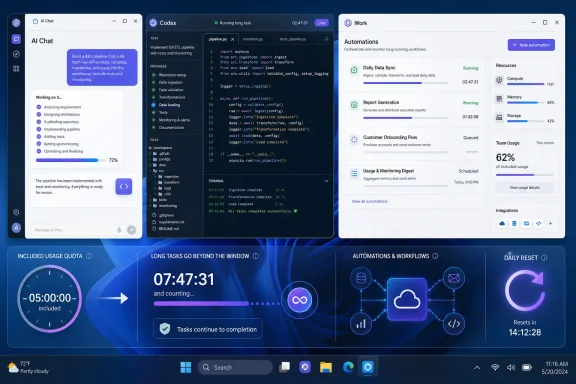
OpenAI has reportedly removed the five-hour usage window for GPT-5.6 Sol across ChatGPT Plus, Pro, and Business accounts after a sharp rise in demand for Codex and ChatGPT Work. The temporary change was disclosed by product manager Tibo, according to AIBase, alongside a one-time reset of users’ available agentic-workflow quota.
The move matters most to developers and IT teams using Codex, ChatGPT Work, ChatGPT for Excel, or Workspace Agents for longer-running tasks. OpenAI’s support documentation says those products draw from the same agentic usage and credit pool when available on a plan. A large repository task, extended session, or cloud-delegated workflow can therefore consume the allowance much faster than a normal chat.
OpenAI has not published a detailed public notice setting out the temporary policy’s duration, a revised numerical allowance, or a promise that the five-hour window will not return. Its current GPT-5.6 help documentation still says usage limits depend on the plan and, for managed workspaces, local workspace settings.
That distinction is important. Removing a visible five-hour reset period does not mean unlimited use. Users may still encounter a total plan allowance, credit requirement, model fallback, or a service-side restriction intended to manage capacity or abuse prevention.
For paid ChatGPT users, GPT-5.6 Sol is the reasoning model behind Medium and High settings, while Extra High is available on Pro, Business, and Enterprise plans. GPT-5.6 Sol Pro remains the top option for Pro subscribers. In Codex, Plus, Pro, Business, and Enterprise users can access Sol, Terra, and Luna; OpenAI says Free and Go access is limited to Terra.
OpenAI’s own GPT-5.6 preview materials do support the broad efficiency theme: the company says Sol produced stronger GeneBench results than GPT-5.5 while using fewer tokens, and achieved comparable performance on one cybersecurity benchmark with roughly one-third of the output tokens. Those are benchmark claims rather than a guarantee for individual coding jobs, where token use will still depend heavily on repository size, tool calls, task duration, and selected reasoning level.
The practical result is more headroom for current Codex and Work jobs, but teams should continue budgeting for limits to return.
OpenAI product lead Tibo Sottiaux said inference optimizations should deliver roughly 10% more usage from existing allowances. OpenAI also temporarily reduced a Codex-related product context setting from 372,000 to 272,000 tokens after discovering the larger setting consumed more quota than intended. The company reportedly plans to restore it after further work and is correcting excessive consumption involving multi-agent tasks at High and Extra High reasoning levels.
OpenAI has also expanded its one-time “banked reset” rollout. After initially reaching about 500,000 users, the company said all affected accounts—now totaling seven million—had received at least one reset, with web and mobile redemption available. The reset can replenish weekly usage when redeemed, but it does not permanently raise an account’s allowance.
The move matters most to developers and IT teams using Codex, ChatGPT Work, ChatGPT for Excel, or Workspace Agents for longer-running tasks. OpenAI’s support documentation says those products draw from the same agentic usage and credit pool when available on a plan. A large repository task, extended session, or cloud-delegated workflow can therefore consume the allowance much faster than a normal chat.
 Limits are loosened, not necessarily gone
OpenAI has not published a detailed public notice setting out the temporary policy’s duration, a revised numerical allowance, or a promise that the five-hour window will not return. Its current GPT-5.6 help documentation still says usage limits depend on the plan and, for managed workspaces, local workspace settings.That distinction is important. Removing a visible five-hour reset period does not mean unlimited use. Users may still encounter a total plan allowance, credit requirement, model fallback, or a service-side restriction intended to manage capacity or abuse prevention.
For paid ChatGPT users, GPT-5.6 Sol is the reasoning model behind Medium and High settings, while Extra High is available on Pro, Business, and Enterprise plans. GPT-5.6 Sol Pro remains the top option for Pro subscribers. In Codex, Plus, Pro, Business, and Enterprise users can access Sol, Terra, and Luna; OpenAI says Free and Go access is limited to Terra.
Efficiency work is the bigger change
Tibo also said OpenAI is improving GPT-5.6’s efficiency so it consumes less usage for comparable work. The company has not described the implementation, so claims about a lighter architecture or reduced reasoning depth remain speculation.OpenAI’s own GPT-5.6 preview materials do support the broad efficiency theme: the company says Sol produced stronger GeneBench results than GPT-5.5 while using fewer tokens, and achieved comparable performance on one cybersecurity benchmark with roughly one-third of the output tokens. Those are benchmark claims rather than a guarantee for individual coding jobs, where token use will still depend heavily on repository size, tool calls, task duration, and selected reasoning level.
What Windows users and admins should do
Windows developers using the ChatGPT desktop app’s Codex mode should verify they are on version 26.707.30751 or later; the Codex CLI minimum for GPT-5.6 is version 0.144.0, per OpenAI’s support guidance. Workspace administrators should also check model availability, role permissions, and credit policies before treating the temporary relaxation as a new baseline.The practical result is more headroom for current Codex and Work jobs, but teams should continue budgeting for limits to return.
Update: Weekly caps remain as OpenAI expands resets and fixes quota accounting (July 14, 2026)
New reporting from WinBuzzer and Yellow.com confirms that weekly GPT-5.6 Sol limits remain in force. Removing the five-hour window only lets Codex and ChatGPT Work users concentrate more of their weekly allowance into longer sessions; it does not increase the recurring weekly allocation.OpenAI product lead Tibo Sottiaux said inference optimizations should deliver roughly 10% more usage from existing allowances. OpenAI also temporarily reduced a Codex-related product context setting from 372,000 to 272,000 tokens after discovering the larger setting consumed more quota than intended. The company reportedly plans to restore it after further work and is correcting excessive consumption involving multi-agent tasks at High and Extra High reasoning levels.
OpenAI has also expanded its one-time “banked reset” rollout. After initially reaching about 500,000 users, the company said all affected accounts—now totaling seven million—had received at least one reset, with web and mobile redemption available. The reset can replenish weekly usage when redeemed, but it does not permanently raise an account’s allowance.
References
- Primary source: AIBase
Published: 2026-07-13T08:50:11.317394
Surge in Demand for Flagship Models: OpenAI Temporarily Lifts GPT-5.6Sol Computing Power Restrictions
Faced with a 48-hour surge in demand for GPT-5.6 Sol, OpenAI announced the temporary removal of the 5-hour usage limit for Plus, Pro, and Business users to freenews.aibase.com
- Official source: developers.openai.com
GPT-5.6 Sol Model | OpenAI API
 developers.openai.com
Last edited: