

Derya Unutmaz, an immunologist at The Jackson Laboratory for Genomic Medicine, used OpenAI’s GPT-5 Pro to analyze a long-stalled T cell dataset in 2025, producing a mechanistic explanation and follow-up experiments for a puzzle his lab had been wrestling with since 2022. The headline version is seductive: frontier AI compresses years of human frustration into minutes of machine reasoning. The more important story is less magical and more disruptive. GPT-5 did not replace immunology; it changed the tempo at which expert immunology can move.
The easy mistake is to read Unutmaz’s result as another “AI solved science” parable. That framing flatters the model and insults the process. The work mattered because a domain expert had the right dataset, knew which question had remained unanswered, understood why earlier analysis had stalled, and could recognize when the model’s answer was biologically plausible rather than merely fluent.
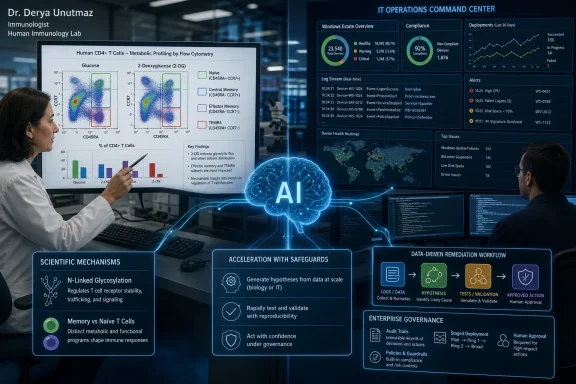
OpenAI’s own account says Unutmaz gave GPT-5 Pro unpublished flow cytometry data involving human CD4+ T cells exposed to varying glucose and 2-deoxyglucose conditions. The mystery concerned why a metabolic perturbation produced a particular shift in T cell behavior. GPT-5 Pro reportedly suggested that disrupted N-linked glycosylation during priming could explain the observations, and that memory rather than naïve T cells were the key population driving the effect.
That is not a trivial autocomplete trick. It requires connecting metabolism, cell-state transitions, immune-cell subsets, experimental artifacts, and validation strategy. But it also is not autonomous discovery in the cinematic sense. The model was operating inside a frame built by human scientists, on data generated by human scientists, and its output had to survive the old-fashioned indignity of experiment.
That distinction matters because it is exactly where AI’s near-term value in science appears to be landing. The most credible role for systems like GPT-5 Pro is not as an oracle but as an accelerant: a tireless hypothesis generator that can traverse adjacent literatures, suggest mechanisms, and propose tests faster than a lab can convene its next meeting.
The phrase that should catch the eye of every sysadmin, developer, and enterprise architect is not “T cell mystery.” It is research workflow. OpenAI is arguing that frontier models can sit inside professional loops where the output is not a final answer but a next action. In immunology, that next action is a wet-lab experiment. In software engineering, it might be a patch, a test harness, or a threat model. In enterprise operations, it might be a remediation plan that still requires human sign-off.
That is why this story belongs on WindowsForum as much as in a biotech newsletter. The same architectural question now cuts across medicine, coding, security, and administration: where can AI reduce the distance between a confusing signal and a useful intervention? A model that can help an immunologist turn an old chart into a testable mechanism is also a model class that can help an IT team turn telemetry into a plausible root cause.
The risk is that vendors will blur the boundary between acceleration and authority. In the Unutmaz case, the AI’s suggestion reportedly led to experiments that confirmed the model’s hypothesis. That makes the story powerful. It also makes it exceptional. In normal operations, plenty of AI-suggested explanations will be incomplete, misattributed, or wrong in ways that only become obvious after someone spends money, time, or credibility testing them.
That is where AI changes the economics. If a senior scientist can ask a model to reason across a knotty dataset and get a useful direction in minutes, the bottleneck shifts. The limiting factor becomes validation capacity, not hypothesis generation. Wet labs cannot run infinite experiments. Security teams cannot test every mitigation instantly. Enterprise admins cannot reboot every production cluster because an AI assistant saw an anomaly.
This is the same story Windows administrators have watched unfold with automation for decades. PowerShell did not eliminate judgment; it raised the cost of bad judgment by making action faster. Configuration management did not remove the need for change control; it made change control more important. AI-assisted science follows the same pattern. Speed is only an advantage if the system around it can absorb speed safely.
The Unutmaz case, then, is less about a machine “cracking” biology than about shrinking the feedback loop between observation and experiment. That is valuable. It is also operationally dangerous if institutions treat the model’s confidence as a substitute for process.
That matters because markets love narrative adjacency. AI plus science plus “decentralized research” is exactly the kind of conceptual soup that can attract speculation long before it produces infrastructure. The Unutmaz story may be good news for AI-assisted biotech, but it does not automatically validate DeSci tokens, AI coins, or any project whose main connection to the research is a shared vocabulary.
The same warning applies outside crypto. Enterprises will be tempted to buy whatever product wraps itself in the glow of frontier-model case studies. A lab breakthrough does not prove that every AI copilot is ready for regulated workflows. A model that can help reason about T cell subsets under expert supervision does not guarantee that it can safely rewrite a production Group Policy, approve a patch rollout, or triage an incident without review.
The useful lesson is not “buy the theme.” It is “inspect the workflow.” Who provides the data? Who frames the question? Who validates the answer? Who is accountable when the model is persuasive and wrong? Those questions separate serious adoption from storytelling.
A model might be wrong three times and still useful if the fourth suggestion opens a path no one had prioritized. It might be correct but useless if the experiment is impossible to run. It might produce a plausible mechanism that requires weeks of validation before anyone can say whether it mattered. That does not fit neatly into the pass-fail logic of multiple-choice benchmarks or leaderboard screenshots.
In biology, this ambiguity is obvious because nature gets the final vote. In IT, the same problem is often hidden. An AI assistant can sound correct while recommending a registry change, a firewall exception, or a cloud permission adjustment. The system may not fail immediately. The damage may arrive later, in the form of drift, exposure, or a maintenance burden nobody remembers approving.
That is why the best analogy for GPT-5 Pro in this story is not a junior researcher or a search engine. It is a very fast, very well-read collaborator with no institutional memory unless you provide it, no real accountability unless you impose it, and no embarrassment about being wrong unless the surrounding process catches the error.
That is exactly how AI should enter serious IT operations. Feed it logs, documentation, configuration histories, and known constraints. Ask it to propose root causes and remediation paths. Then verify against authoritative sources, test in staging, and require accountable humans to approve changes. The model can shorten the path to a candidate explanation, but it cannot own the blast radius.
Microsoft’s ecosystem is already moving in this direction with Copilot-branded tooling across Windows, Microsoft 365, GitHub, Security, and Azure. The promise is not merely that users will type fewer commands. The promise is that professionals will spend less time assembling context and more time making decisions. The Unutmaz story is a glimpse of that future in a domain where the stakes are cells rather than servers.
But Windows veterans know the other side of integration. The more deeply an assistant sits inside workflows, the more important identity, permissions, logging, retention, and auditability become. A model that can reason across sensitive datasets is useful precisely because it can see things. That visibility must be governed, especially in medical, legal, security, and enterprise environments.
This is where the public conversation about AI often goes sideways. People ask whether AI will replace experts, when the more immediate question is whether experts using AI will widen the gap between competent and mediocre institutions. A strong lab may turn a frontier model into a force multiplier. A weak organization may turn the same model into a confidence amplifier for bad assumptions.
There is a hard implication here for employers. If AI tools become genuinely useful in expert workflows, cutting expertise to save money will be self-defeating. The model does not remove the need for people who understand the domain. It increases the value of people who can ask better questions, spot weak reasoning, and design decisive tests.
In IT departments, that means the senior admin, security engineer, and developer do not become less important. Their work changes. They become reviewers of machine-generated hypotheses, curators of operational context, and guardians of the line between suggested action and approved action.
A model that merely comments on a screenshot is one thing. A model that can query a data warehouse, generate analysis code, schedule experiments, or trigger automated workflows is another. Each added capability increases usefulness and risk at the same time. The future of AI in professional environments will be shaped less by raw model intelligence than by the controls around tool use.
Windows and enterprise administrators should recognize this movie. Least privilege, staged deployment, rollback plans, logging, and separation of duties are not bureaucratic obstacles. They are what make powerful automation survivable. AI does not repeal those principles. It makes them more urgent.
The lesson from the Unutmaz case is that the winning systems will combine flexible reasoning with disciplined execution. The model can wander intellectually; the workflow cannot. That tension will define the next phase of AI adoption.
That does not mean every old problem is one prompt away from resolution. It means the cost of reopening old problems may fall. Ideas that were not worth a month of a postdoc’s time, a week of an engineer’s attention, or a full incident review may become worth a 20-minute model-assisted pass. Some of those passes will go nowhere. A few may change the roadmap.
This is where the productivity argument becomes credible. AI does not need to be right all the time to matter. It needs to be useful enough, often enough, under expert supervision, to increase the number of serious hypotheses an organization can afford to test.
The uncomfortable corollary is that organizations with better data hygiene will benefit first. A model cannot reason well over missing context, corrupted records, undocumented systems, or private knowledge trapped in one person’s head. The AI era rewards the boring work: clean datasets, good documentation, reproducible experiments, versioned infrastructure, and institutional memory.
 The Breakthrough Was Not That GPT-5 Knew Biology
The easy mistake is to read Unutmaz’s result as another “AI solved science” parable. That framing flatters the model and insults the process. The work mattered because a domain expert had the right dataset, knew which question had remained unanswered, understood why earlier analysis had stalled, and could recognize when the model’s answer was biologically plausible rather than merely fluent.OpenAI’s own account says Unutmaz gave GPT-5 Pro unpublished flow cytometry data involving human CD4+ T cells exposed to varying glucose and 2-deoxyglucose conditions. The mystery concerned why a metabolic perturbation produced a particular shift in T cell behavior. GPT-5 Pro reportedly suggested that disrupted N-linked glycosylation during priming could explain the observations, and that memory rather than naïve T cells were the key population driving the effect.
That is not a trivial autocomplete trick. It requires connecting metabolism, cell-state transitions, immune-cell subsets, experimental artifacts, and validation strategy. But it also is not autonomous discovery in the cinematic sense. The model was operating inside a frame built by human scientists, on data generated by human scientists, and its output had to survive the old-fashioned indignity of experiment.
That distinction matters because it is exactly where AI’s near-term value in science appears to be landing. The most credible role for systems like GPT-5 Pro is not as an oracle but as an accelerant: a tireless hypothesis generator that can traverse adjacent literatures, suggest mechanisms, and propose tests faster than a lab can convene its next meeting.
OpenAI Is Selling a Workflow, Not Just a Model
OpenAI’s framing around the Unutmaz case is careful in one sense and ambitious in another. The company repeatedly emphasizes expert oversight, validation, and the limits of curated case studies. At the same time, it is clearly positioning GPT-5 as something more consequential than a chatbot with better benchmarks.The phrase that should catch the eye of every sysadmin, developer, and enterprise architect is not “T cell mystery.” It is research workflow. OpenAI is arguing that frontier models can sit inside professional loops where the output is not a final answer but a next action. In immunology, that next action is a wet-lab experiment. In software engineering, it might be a patch, a test harness, or a threat model. In enterprise operations, it might be a remediation plan that still requires human sign-off.
That is why this story belongs on WindowsForum as much as in a biotech newsletter. The same architectural question now cuts across medicine, coding, security, and administration: where can AI reduce the distance between a confusing signal and a useful intervention? A model that can help an immunologist turn an old chart into a testable mechanism is also a model class that can help an IT team turn telemetry into a plausible root cause.
The risk is that vendors will blur the boundary between acceleration and authority. In the Unutmaz case, the AI’s suggestion reportedly led to experiments that confirmed the model’s hypothesis. That makes the story powerful. It also makes it exceptional. In normal operations, plenty of AI-suggested explanations will be incomplete, misattributed, or wrong in ways that only become obvious after someone spends money, time, or credibility testing them.
The Three-Year Mystery Is Really a Latency Story
The most striking detail is not that GPT-5 Pro found a plausible mechanism. It is that the lab had been sitting with the mystery since 2022. In mature fields, delay is often not caused by lack of intelligence. It is caused by scarce attention, overloaded experts, fragmented literature, noisy data, and the brutal prioritization that every lab, software team, and IT department knows too well.That is where AI changes the economics. If a senior scientist can ask a model to reason across a knotty dataset and get a useful direction in minutes, the bottleneck shifts. The limiting factor becomes validation capacity, not hypothesis generation. Wet labs cannot run infinite experiments. Security teams cannot test every mitigation instantly. Enterprise admins cannot reboot every production cluster because an AI assistant saw an anomaly.
This is the same story Windows administrators have watched unfold with automation for decades. PowerShell did not eliminate judgment; it raised the cost of bad judgment by making action faster. Configuration management did not remove the need for change control; it made change control more important. AI-assisted science follows the same pattern. Speed is only an advantage if the system around it can absorb speed safely.
The Unutmaz case, then, is less about a machine “cracking” biology than about shrinking the feedback loop between observation and experiment. That is valuable. It is also operationally dangerous if institutions treat the model’s confidence as a substitute for process.
The Crypto Angle Is a Red Herring With a Useful Warning
Crypto Briefing’s coverage was unusually blunt for a crypto publication: there is no meaningful cryptocurrency angle here. No token appears to be involved. No decentralized science protocol seems to have funded the work. No blockchain mechanism is necessary to explain what happened. A traditional research institution used a centralized AI model to analyze biological data.That matters because markets love narrative adjacency. AI plus science plus “decentralized research” is exactly the kind of conceptual soup that can attract speculation long before it produces infrastructure. The Unutmaz story may be good news for AI-assisted biotech, but it does not automatically validate DeSci tokens, AI coins, or any project whose main connection to the research is a shared vocabulary.
The same warning applies outside crypto. Enterprises will be tempted to buy whatever product wraps itself in the glow of frontier-model case studies. A lab breakthrough does not prove that every AI copilot is ready for regulated workflows. A model that can help reason about T cell subsets under expert supervision does not guarantee that it can safely rewrite a production Group Policy, approve a patch rollout, or triage an incident without review.
The useful lesson is not “buy the theme.” It is “inspect the workflow.” Who provides the data? Who frames the question? Who validates the answer? Who is accountable when the model is persuasive and wrong? Those questions separate serious adoption from storytelling.
Biology Shows Why AI Evaluation Is So Hard
The Unutmaz case also exposes a problem that benchmark culture struggles to capture. In many professional settings, the value of an AI system is not whether it answers a static question correctly. It is whether it changes the trajectory of a human team.A model might be wrong three times and still useful if the fourth suggestion opens a path no one had prioritized. It might be correct but useless if the experiment is impossible to run. It might produce a plausible mechanism that requires weeks of validation before anyone can say whether it mattered. That does not fit neatly into the pass-fail logic of multiple-choice benchmarks or leaderboard screenshots.
In biology, this ambiguity is obvious because nature gets the final vote. In IT, the same problem is often hidden. An AI assistant can sound correct while recommending a registry change, a firewall exception, or a cloud permission adjustment. The system may not fail immediately. The damage may arrive later, in the form of drift, exposure, or a maintenance burden nobody remembers approving.
That is why the best analogy for GPT-5 Pro in this story is not a junior researcher or a search engine. It is a very fast, very well-read collaborator with no institutional memory unless you provide it, no real accountability unless you impose it, and no embarrassment about being wrong unless the surrounding process catches the error.
The Windows World Should Read This as an Enterprise AI Case Study
For Windows users and IT pros, the immunology details are fascinating but secondary. The transferable lesson is about deployment maturity. The successful pattern was not “ask AI a question and trust the answer.” It was a constrained, expert-led loop: provide relevant data, ask for mechanisms, interrogate the reasoning, design follow-up tests, and validate outside the model.That is exactly how AI should enter serious IT operations. Feed it logs, documentation, configuration histories, and known constraints. Ask it to propose root causes and remediation paths. Then verify against authoritative sources, test in staging, and require accountable humans to approve changes. The model can shorten the path to a candidate explanation, but it cannot own the blast radius.
Microsoft’s ecosystem is already moving in this direction with Copilot-branded tooling across Windows, Microsoft 365, GitHub, Security, and Azure. The promise is not merely that users will type fewer commands. The promise is that professionals will spend less time assembling context and more time making decisions. The Unutmaz story is a glimpse of that future in a domain where the stakes are cells rather than servers.
But Windows veterans know the other side of integration. The more deeply an assistant sits inside workflows, the more important identity, permissions, logging, retention, and auditability become. A model that can reason across sensitive datasets is useful precisely because it can see things. That visibility must be governed, especially in medical, legal, security, and enterprise environments.
The Human Expert Is Not a Decorative Safety Net
OpenAI’s repeated emphasis on expert oversight should not be treated as boilerplate. It is the core of the story. Unutmaz reportedly had decades of experience in T cell biology and cancer immunotherapy. That background is what made him able to challenge, interpret, and test the model’s proposal.This is where the public conversation about AI often goes sideways. People ask whether AI will replace experts, when the more immediate question is whether experts using AI will widen the gap between competent and mediocre institutions. A strong lab may turn a frontier model into a force multiplier. A weak organization may turn the same model into a confidence amplifier for bad assumptions.
There is a hard implication here for employers. If AI tools become genuinely useful in expert workflows, cutting expertise to save money will be self-defeating. The model does not remove the need for people who understand the domain. It increases the value of people who can ask better questions, spot weak reasoning, and design decisive tests.
In IT departments, that means the senior admin, security engineer, and developer do not become less important. Their work changes. They become reviewers of machine-generated hypotheses, curators of operational context, and guardians of the line between suggested action and approved action.
The Next Bottleneck Is Trustworthy Integration
If GPT-5 Pro can produce useful scientific hypotheses from a chart, the natural next question is what happens when models connect more directly to instruments, databases, lab notebooks, simulation platforms, and enterprise systems. That is where the opportunity becomes larger and the governance problem becomes harder.A model that merely comments on a screenshot is one thing. A model that can query a data warehouse, generate analysis code, schedule experiments, or trigger automated workflows is another. Each added capability increases usefulness and risk at the same time. The future of AI in professional environments will be shaped less by raw model intelligence than by the controls around tool use.
Windows and enterprise administrators should recognize this movie. Least privilege, staged deployment, rollback plans, logging, and separation of duties are not bureaucratic obstacles. They are what make powerful automation survivable. AI does not repeal those principles. It makes them more urgent.
The lesson from the Unutmaz case is that the winning systems will combine flexible reasoning with disciplined execution. The model can wander intellectually; the workflow cannot. That tension will define the next phase of AI adoption.
The Real Breakthrough Is a Shorter Distance From Puzzle to Proof
There is a reason this story resonates beyond immunology. Every technical field has stale mysteries: the bug nobody can reproduce, the performance regression that appears only under load, the security alert that never quite explains itself, the dataset that seems to contain a signal no one has time to chase. GPT-5 Pro’s contribution was to make one such mystery tractable again.That does not mean every old problem is one prompt away from resolution. It means the cost of reopening old problems may fall. Ideas that were not worth a month of a postdoc’s time, a week of an engineer’s attention, or a full incident review may become worth a 20-minute model-assisted pass. Some of those passes will go nowhere. A few may change the roadmap.
This is where the productivity argument becomes credible. AI does not need to be right all the time to matter. It needs to be useful enough, often enough, under expert supervision, to increase the number of serious hypotheses an organization can afford to test.
The uncomfortable corollary is that organizations with better data hygiene will benefit first. A model cannot reason well over missing context, corrupted records, undocumented systems, or private knowledge trapped in one person’s head. The AI era rewards the boring work: clean datasets, good documentation, reproducible experiments, versioned infrastructure, and institutional memory.
The T Cell Story Leaves IT With a Practical Checklist
The Unutmaz case is not a template that can be copied blindly from immunology into Windows administration or enterprise security. It is a pattern worth studying because it shows where frontier AI is strongest when the stakes are real: not in replacing validation, but in making validation worth attempting sooner.- GPT-5 Pro reportedly helped identify a plausible mechanism for a T cell dataset that had puzzled Unutmaz’s lab since 2022.
- The model’s useful contribution came inside an expert-led workflow, not as an autonomous scientific discovery machine.
- The case supports the argument that AI can compress hypothesis-generation timelines, while leaving experimentation and accountability firmly in human hands.
- The crypto connection is essentially nonexistent, despite the story’s appearance in a crypto publication.
- The enterprise lesson is that AI assistants should be treated as accelerators for investigation, not authorities for unsupervised action.
- The organizations most likely to benefit are the ones with clean data, strong experts, and disciplined validation processes.
References
- Primary source: Crypto Briefing
Published: Tue, 23 Jun 2026 17:34:23 GMT
Derya Unutmaz uses GPT-5 Pro to crack a T cell mystery that stumped his lab since 2022
Immunologist Derya Unutmaz used GPT-5 Pro to solve a three-year-old T cell mystery in minutes. Here's what it means for AI narratives in crypto markets.cryptobriefing.com - Independent coverage: OpenAI
Published: Tue, 23 Jun 2026 17:07:48 GMT
How GPT-5 helped immunologist Derya Unutmaz solve a 3-year-old mystery | OpenAI
GPT-5 Pro helped solve a 3-year-old immunology mystery, offering insights into T cell behavior. The breakthrough could support cancer and autoimmune research.openai.com - Official source: academy.openai.com
A new playbook for drug repurposing - Blog | OpenAI Academy
Immunologist Dr. Oral Alpan is using GPT-5 Pro to surface new uses for existing FDA-approved drugs by starting from real-world clinical vignettes and working backward to mechanism. A patient with severe eczema and Food Protein Induced Enterocolitis Syndrome (FPIES) stopped reacting to wheat... academy.openai.com
- Official source: cdn.openai.com
- Official source: deploymentsafety.openai.com
