

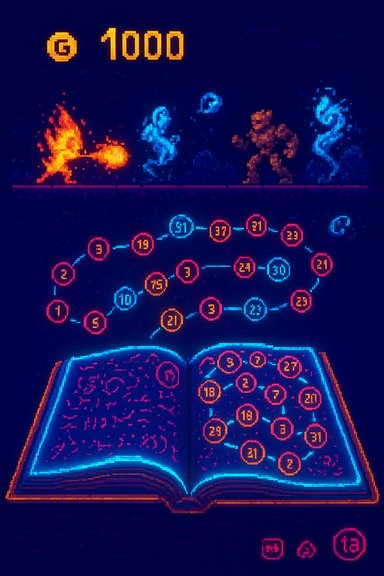
Grimoire of Domance arrived on Windows platforms as a compact, old‑school action‑platformer with a modern twist — and its achievement list has become an instant talking point for completionists who track progress across Xbox, Windows 10, and third‑party sites like Exophase. The game ships with a straightforward, completion‑focused achievements structure (31 achievements, 1,000 Gamerscore total) that mirrors the level‑by‑level design of the title, but the way those achievements are surfaced, tracked, and — when things go wrong — fixed highlights broader issues in the Windows achievement ecosystem that every player and developer should understand.
Grimoire of Domance is published and sold through the Xbox storefront for Windows and consoles; the Microsoft pages list the game as released on January 16, 2026 and advertise Xbox Achievements and cloud save compatibility for Windows editions. The store listing makes clear the title’s focus: elemental combat, level progression, and a compact set of gameplay systems built around switching elements to exploit enemy weaknesses. Achievement‑tracking sites like TrueAchievements have already cataloged the game’s full achievement roster for both Xbox and Windows editions: 31 achievements for the Windows release, collectively worth the full 1,000 Gamerscore. The achievement names and descriptions are straightforward — a series of per‑level completion awards that map directly to the game’s 31 levels — which makes Grimoire of Domance an unusually predictable candidate for completionists who want a clean 1,000 score. Exophase — the multi‑platform achievement aggregator that many players rely on to consolidate progress across consoles, PC storefronts, and mobile services — is part of this conversation, as Exophase is the natural home for players who want a single dashboard for cross‑platform completion tracking. Exophase’s mechanics, community support channels, and data‑sync behavior are familiar touchpoints for achievement hunters; community threads show Exophase actively curating and correcting entries for newly released titles and handling discrepancies between platform telemetry and the site’s database. Still, not every game appears instantly (or in identical form) on Exophase’s index, and cross‑site synchronization can lag after launch windows.
Players who want to secure their 1,000 should treat the launch window like a small technical project: verify account sign‑in, document level completions, and consult community trackers. Developers and publishers should treat achievements as part of the platform deliverable: publish complete metadata, provide reconciliation logs, and coordinate with sites like Exophase ahead of launch. Doing so will keep the focus where it belongs — on gameplay, not on paperwork.
For now, Grimoire of Domance offers a compact, approachable path to a full gamerscore, and the launch serves as a useful reminder: clear achievement design meets modern distribution systems, and both sides need a little TLC to make completion a joy rather than a chore.
Source: Exophase https://www.exophase.com/game/grimoire-of-domance-windows-xbox/achievements/]
 Background
Grimoire of Domance is published and sold through the Xbox storefront for Windows and consoles; the Microsoft pages list the game as released on January 16, 2026 and advertise Xbox Achievements and cloud save compatibility for Windows editions. The store listing makes clear the title’s focus: elemental combat, level progression, and a compact set of gameplay systems built around switching elements to exploit enemy weaknesses. Achievement‑tracking sites like TrueAchievements have already cataloged the game’s full achievement roster for both Xbox and Windows editions: 31 achievements for the Windows release, collectively worth the full 1,000 Gamerscore. The achievement names and descriptions are straightforward — a series of per‑level completion awards that map directly to the game’s 31 levels — which makes Grimoire of Domance an unusually predictable candidate for completionists who want a clean 1,000 score. Exophase — the multi‑platform achievement aggregator that many players rely on to consolidate progress across consoles, PC storefronts, and mobile services — is part of this conversation, as Exophase is the natural home for players who want a single dashboard for cross‑platform completion tracking. Exophase’s mechanics, community support channels, and data‑sync behavior are familiar touchpoints for achievement hunters; community threads show Exophase actively curating and correcting entries for newly released titles and handling discrepancies between platform telemetry and the site’s database. Still, not every game appears instantly (or in identical form) on Exophase’s index, and cross‑site synchronization can lag after launch windows. Overview: What the Grimoire of Domance achievement list looks like
- Total achievements: 31 (Windows edition).
- Total Gamerscore: 1,000 (standard Xbox/Windows scoring).
- Achievement focus: Level completion trophies — each achievement corresponds to finishing a specific level or milestone; there are no massive meta‑grinds or elaborate secret chains documented in the Xbox/TrueAchievements copies at launch.
The public listing and how players will see it
- Xbox store metadata (Windows edition) shows the game as published January 16, 2026 and advertises Xbox Achievements and cloud saves; that is the authoritative storefront record for buyers.
- Community achievement trackers such as TrueAchievements mirror the achievement list with per‑level entry names and the full 1,000 score — these pages are where many hunters first consult for checklists and completion percentages.
- Exophase is generally the place to corral multi-platform progress, but newly released Windows titles can take a short time to propagate through Exophase’s ecosystem depending on scans and user reports. Community logs show Exophase staff actively resolving missing entries and mismatches when they appear.
Deep dive: Strengths of Grimoire of Domance’s achievements
1) Clarity and predictability
The single best feature for achievement hunters is clarity. Every achievement corresponds to a level or obvious milestone. That makes planning efficient: players can map the entire 1,000 score to a linear progression of tasks and measure progress precisely.- Benefits for players:
- Reduced wasted effort trying to guess hidden triggers.
- Easier guide creation and verification for community sites.
- Straightforward sprint or marathon completion strategies.
2) Low friction for new achievers
Because most tasks are simple “complete level X” tasks, the barrier to entry for the game’s Gamerscore is low. Players looking for a tidy 1,000 who value minimal grind time — especially those who enjoy platformers and retro‑style combat — will appreciate this.3) Tight alignment with game design
Achievements that reflect the game’s structure (one per level) feel natural and unobtrusive. They don’t require bizarre exploits or time‑gated content; instead, they reward play that most players will naturally perform while progressing through the game’s narrative and encounter design.Risks and friction points: telemetry, entitlements, and community headaches
A clean achievement list does not guarantee a clean tracking experience. Over the past few years Windows/Xbox/third‑party aggregation has shown a handful of recurring problems that can affect new releases — and Grimoire of Domance is no exception in terms of exposure to the same risks.1) Telemetry and entitlement lag or mismatch
Windows achievements rely on telemetry between the game client, Microsoft’s backend, and third‑party trackers. If cloud saves or telemetry conflict with a local session, achievements may not register immediately — or, in rare cases, they may not register at all until a later server patch or manual reconciliation request. Community troubleshooting threads emphasize the need to document any misregistered achievements (screenshots, timestamps) for support appeals.2) Exophase propagation delays and indexing gaps
Exophase is fast but not instantaneous. New Windows titles can take time to be recognized, scanned, and matched to a clean achievements dataset. Until the site’s scans stabilize, completionists may see incomplete or inconsistent entries on their Exophase profiles. Community moderators and database editors commonly step in to correct missing achievements after launch — but that process depends on user reports and manual verification.3) Regional storefront differences and version mismatches
The Xbox Store sometimes lists multiple SKU identifiers (Windows vs. console bundles) that are similar but not identical. If a player owns a version bundled with other games or a regional SKU, cross‑platform aggregation may misattribute achievements or split progress across a bundle entry and a standalone entry. The Xbox store metadata confirms multiple regional and bundle variants for Grimoire of Domance, which is worth keeping in mind for players who purchase non‑standard editions.4) Possibility of easy achievements fostering low‑value Gamerscore
From a design perspective, tightly mapped per‑level achievements can be a double‑edge sword: they’re friendly to players but also inflate Gamerscore with low-effort trophies. For some community members — especially those on sites that emphasize “meaningful” completions — this can be seen as diluting the prestige of high gamerscore titles.5) Cheating and false completions
Third‑party achievement unlockers and account manipulation remain a real, if minority, problem: completed lists can be falsified, and sites must expend moderation effort to police outliers. Communities like TrueAchievements and Exophase track uncommon completions and investigate suspicious patterns; completion evidence (screenshots, timestamps) helps these investigations.Practical advice for Windows players and achievement hunters
If you’re aiming for a clean 1,000 on Grimoire of Domance, or you simply want to avoid the common post‑launch headaches, use this short checklist.- Before you start:
- Ensure the Xbox/Microsoft account you use to run the Windows version is properly signed into the Xbox services and the Microsoft Store.
- Back up saves when possible, or disable cloud sync briefly if you want to force a fresh local save to populate achievements (some players have used this as a workaround for stubborn telemetry issues). Community troubleshooting threads show this method sometimes resolves stuck unlocks, though it’s not risk‑free.
- During your run:
- Progress linearly through the levels and tick achievements off in order (levels map cleanly to achievements).
- Document each milestone with a screenshot at the level completion screen — a cheap, fast insurance policy if telemetry fails.
- If an achievement fails to register, stop and document the session (date/time, Xbox/Microsoft account, screenshot); retry the level in offline mode if you suspect cloud conflicts.
- After an unregistered achievement:
- Rescan your account on Exophase (if you use it), check TrueAchievements, and open a support ticket with Microsoft/Xbox if telemetry seems broken.
- If you use Exophase, add a note to the game’s discussion page and attach your screenshots; Exophase editors and community members are often vigilant with new releases.
For developers and publishers: lessons from the launch cycle
Grimoire of Domance illustrates a lean development approach — small price point, clear achievement design, and cross‑store availability — but it also underlines best practices and pitfalls to avoid.- Ship a deterministic achievements schema
- Benefits: Easier QA, faster guide creation, and less community confusion.
- Implementation tip: Make achievements correspond to in‑game, reproducible states (level complete flags are an ideal pattern).
- Publish metadata and SKU mapping early
- Expose clear SKU IDs (Windows vs. console bundles) so third‑party sites can map the game correctly.
- The Xbox store’s multiple regional pages for Grimoire illustrate why unique identifiers and consistent metadata matter.
- Instrument robust telemetry and provide manual reconciliation hooks
- Implement server‑side logs that allow support staff to validate achievement events using timestamps and session IDs. This reduces the need for user interventions and speeds post‑launch remediation.
- Coordinate with third‑party trackers
- Provide an early achievements export to aggregator sites (or open an editor contact) so Exophase and similar services can seed their databases before the public launch window. Community feedback shows that early inclusion prevents indexing delays and reduces the number of manual corrections required after release.
Cross‑checked facts and what we verified
- Release date and platform support: The Xbox store lists Grimoire of Domance with a release date of January 16, 2026 and marks the Windows SKU as supporting Xbox achievements and cloud saves. This is the authoritative storefront record players should reference for purchase and entitlement questions.
- Achievement count and structure: Multiple independent trackers list the Windows edition as having 31 achievements totaling the standard 1,000 Gamerscore; the achievement names correspond to level completion markers. This cross‑reference between TrueAchievements and Xbox metadata confirms the straightforward per‑level design.
- Exophase indexing and behavior: Exophase is a widely used aggregator for cross‑platform achievement tracking; it typically indexes new Windows titles quickly but relies on scanning and manual fixes for edge cases. Community posts and Exophase forum threads document the site’s processes and staff corrections for missing or mismatched achievements. If a player does not see Grimoire of Domance on their Exophase profile immediately after launch, this is likely a propagation issue rather than a data discrepancy — but evidence collection (screenshots, timestamps) helps expedite corrections.
The broader picture: why Grimoire of Domance matters to Windows gamers
Grimoire of Domance is a small release, but it’s a pointed example of how straightforward achievement design interacts with a complex cross‑platform ecosystem. For Windows gamers in 2026, the title underscores three ongoing trends:- Achievements remain a strong driver of engagement; even small indie releases use built‑in Gamerscore to attract completionists.
- Cross‑platform aggregation (Exophase, TrueAchievements, and similar services) has become part of the modern achievement economy — both for players tracking progress and for publishers who need to ensure consistent metadata and telemetry.
- Post‑launch support and transparent telemetry are as important as in‑game polish; missing or misregistered achievements create disproportionate friction for players chasing a tidy 100% completion.
Conclusion
Grimoire of Domance’s achievement list is intentionally simple: 31 achievements, 1,000 Gamerscore, and a level‑by‑level checklist that makes the game an attractive target for tidy completionists. That simplicity is both the game’s strength and the reason it reveals fault lines in the achievement ecosystem. The Windows/Xbox/third‑party chain — store metadata, in‑game telemetry, and aggregator indexing — must work in lockstep to deliver the frictionless experience players expect. When it does, finishing the game is a clean, satisfying run; when it doesn’t, even a small title can generate outsized frustration.Players who want to secure their 1,000 should treat the launch window like a small technical project: verify account sign‑in, document level completions, and consult community trackers. Developers and publishers should treat achievements as part of the platform deliverable: publish complete metadata, provide reconciliation logs, and coordinate with sites like Exophase ahead of launch. Doing so will keep the focus where it belongs — on gameplay, not on paperwork.
For now, Grimoire of Domance offers a compact, approachable path to a full gamerscore, and the launch serves as a useful reminder: clear achievement design meets modern distribution systems, and both sides need a little TLC to make completion a joy rather than a chore.
Source: Exophase https://www.exophase.com/game/grimoire-of-domance-windows-xbox/achievements/]
