

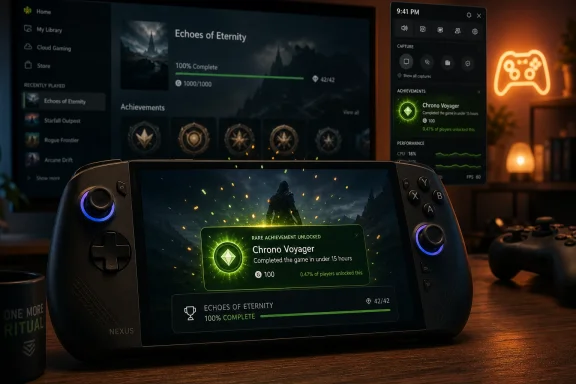
Microsoft is testing a redesigned Xbox achievement experience for the Xbox PC app and Game Bar in the PC Gaming Preview, bringing console-style animations, custom color matching, rare-achievement flair, and 100-percent completion highlights to Windows players as of mid-May 2026. That sounds cosmetic until you understand the platform Microsoft is trying to build. Xbox on PC has long carried the right account system, library hooks, Game Pass integration, and social graph, but too often it has felt like a Microsoft Store utility wearing a gaming hoodie. For handheld players especially, this update fixes a small notification and exposes a much larger truth: Xbox cannot merge console and PC if the emotional texture of Xbox still disappears the moment Windows takes over.
Achievements are not infrastructure in the way DirectStorage, shader compilation, or driver scheduling are infrastructure. They do not improve frame times, reduce input latency, or make Windows less awkward on a seven-inch screen. But platforms are not remembered only by their technical foundations; they are remembered by the moments when the machine acknowledges the player.
On Xbox consoles, that acknowledgement has been unusually durable. The achievement pop is part notification, part reward ceremony, part social contract. It says the system saw what you did, that your profile has changed, and that your progress belongs to a persistent identity larger than the game currently running.
On Windows, that same moment has often felt like office software got involved. A flat blue toast, a delayed alert, or no visible notification at all is not just less fun. It tells the player that the Xbox layer on PC is still secondary to Windows’ own notification model, and that the platform’s personality is negotiable.
That distinction matters more now because Microsoft is no longer treating Xbox-on-Windows as a side door for Game Pass. It is becoming the test bed for the company’s next argument about gaming hardware: that console and PC can collapse into one ecosystem without either audience feeling shortchanged. If the smallest celebratory moments still feel mismatched, the bigger promise starts leaking credibility.
Handheld players are particularly sensitive to interface dissonance because they are already making compromises. They are navigating launchers with thumbsticks, accepting occasional driver weirdness, managing power profiles, and living with Windows dialogs that were never designed for couch or commute gaming. The least the platform can do is make an achievement unlock feel like it came from Xbox rather than from a helpdesk ticketing system.
That is why the visual refresh lands with more force than its patch-note footprint suggests. Dynamic color matching makes the notification feel tied to the user’s Xbox identity. Distinct animations for rare achievements restore some of the theater that console players have taken for granted. Completion highlights give the 100-percent crowd a system-level nod instead of making them dig through static lists.
None of this solves Windows’ deeper handheld problems. It does not make every launcher controller-friendly, does not guarantee sleep-and-resume reliability, and does not make anti-cheat vendors suddenly harmonize around every device configuration. But it attacks one of the most visible places where Microsoft’s ecosystem has been telling players, unintentionally, that PC is still the second-class Xbox experience.
But a launcher alone is not a platform. A full-screen interface can get you to the game, but it cannot make the experience feel coherent if the moment-to-moment system behaviors still fall back to generic Windows habits. Notifications, overlays, profile surfaces, store prompts, screenshots, party chat, cloud saves, and performance controls all have to feel like parts of the same machine.
Achievements are one of the easiest places to see whether Microsoft understands that. They sit at the intersection of identity, UI, social proof, and persistence. They are also one of the few system features that players encounter while emotionally engaged with a game rather than while managing settings.
That makes the achievement refresh a modest but meaningful piece of Xbox Mode’s credibility. If Microsoft can make Windows behave like Xbox when the player unlocks something, it can apply the same thinking elsewhere. If it cannot, Xbox Mode risks becoming a skin over the same old PC sprawl.
That shift gives Microsoft an opportunity Sony and Nintendo are not really trying to match. A box that can run Xbox console titles and PC games, backed by Game Pass, cross-buy where available, cloud saves, and the Windows ecosystem, could be uniquely flexible. It could also become uniquely confusing.
Console buyers do not buy architecture diagrams. They buy trust. They expect games to launch cleanly, profiles to sync, parties to work, notifications to behave, storage to make sense, and the operating system to stay mostly out of the way. The more PC capability Microsoft adds, the more carefully it has to preserve the console contract.
That is why something as small as an achievement toast becomes strategically relevant. A hybrid Xbox cannot ask console players to tolerate a downgrade in ritual just because the underlying stack looks more like Windows. If Microsoft wants to sell a PC-shaped console without inheriting all of PC gaming’s mess, it has to carry the Xbox experience across the boundary at a microscopic level.
Valve’s Steam Deck and SteamOS changed expectations by proving that PC games could be wrapped in a console-like experience without pretending the PC layer did not exist. SteamOS is not perfect, and compatibility gaps remain, especially around anti-cheat and certain multiplayer titles. But it made a persuasive case that the operating system should serve the game session rather than constantly reminding the player of itself.
Microsoft has advantages Valve does not. It controls Windows, owns Xbox, runs Game Pass, maintains a massive identity system, and has relationships across the hardware ecosystem. In theory, it should be better positioned than anyone to build the definitive handheld and living-room PC gaming layer.
In practice, Microsoft has had to relearn that a gaming OS is judged by accumulated sensation. It is not enough for the Xbox app to know your library if the rest of the device feels like a tablet from the IT department. It is not enough for Game Bar to expose useful tools if its notifications lack the charm, hierarchy, and reliability of the console experience. SteamOS won mindshare not only because it was efficient, but because it felt intentionally designed around the player.
The achievement refresh is Microsoft moving in that direction. It is a small case of the company admitting, through design rather than apology, that the old PC experience was too clinical for the world it now wants to enter.
Xbox has historically understood this better than most. Achievements helped unify Xbox Live identity across games at a time when many publishers still treated progression as a private, title-specific artifact. The point was never only the number. The point was that the platform remembered.
On PC, that memory has been fragmented across Steam, Epic, GOG, Battle.net, Ubisoft Connect, EA app, and Microsoft’s own Xbox infrastructure. A player can complete the same game under different launchers and surface different parts of that identity to different friend groups. Xbox’s challenge is not merely to display a prettier toast, but to make its achievement layer feel authoritative on a platform where authority is distributed.
That is why failures to track achievements in games routed through external launchers are more than edge cases. When a Diablo IV session, a Ubisoft title, or a third-party launcher breaks the chain between action and recognition, the Xbox promise weakens. The account system may still exist, but the player learns not to trust it as the canonical record of play.
Microsoft cannot fix all of that with an animation pass. It will need deeper integration agreements, more reliable APIs, better launcher handoff behavior, and clearer rules for how Xbox identity follows PC games that do not live entirely inside Microsoft’s store. But improving the presentation is still necessary. A reliable system that feels lifeless will not inspire loyalty; a charming system that misses unlocks will not earn trust. Xbox needs both.
Microsoft needs to know whether the new banners trigger reliably in borderless fullscreen, exclusive fullscreen, handheld overlays, external monitors, and resume-from-sleep scenarios. It also needs feedback on timing and hierarchy. A rare achievement animation should feel special, not obnoxious. A completion highlight should be obvious, not gaudy. A color-matched banner should feel personal without becoming visual noise.
The Insider route also lets Microsoft test how much console DNA PC players actually want. Some Windows users prefer minimalism and may not want elaborate animations intruding on competitive sessions. Others will welcome the console-style celebration precisely because it makes handheld play feel less like a compromised Windows workaround.
The best answer is not a single behavior imposed on everyone. It is a system that defaults to character but gives users control. Xbox has already been moving in that direction with profile curation and the ability to hide games from achievement history. That matters because a mature platform understands that identity is both public and edited.
Old achievement systems assumed accumulation was the whole point. More games, more points, more visible history. Modern players are more complicated. They may want to hide a title they sampled for five minutes, clean up a profile polluted by old Game Pass experiments, or present completed games as a curated shelf rather than a landfill of partial progress.
That is especially important in the subscription era. Game Pass encourages sampling, which is good for discovery but messy for achievement history. A player might install ten games in a weekend, unlock one accidental achievement in six of them, and then be stuck with a profile that implies a backlog of abandoned projects. Hiding games does not erase the underlying Gamerscore, but it gives users a way to make the public surface less chaotic.
Completion highlights serve the opposite impulse. They let players foreground the games where they did the work. That may sound trivial, but for completionists it gives Xbox a better answer to Steam showcases and PlayStation trophy culture. It also creates a healthier form of platform engagement than the raw Gamerscore chase, because it celebrates finishing rather than merely accumulating.
Microsoft’s challenge will be restraint. The achievement profile should become more expressive, not more social-network exhausting. If every milestone becomes a badge, every badge becomes a prompt, and every prompt becomes a feed event, the charm curdles into engagement sludge.
For desktop players, that complexity is often acceptable because the tradeoff is control. For handheld players, it is more grating because the form factor invites console expectations. A handheld device that needs keyboard workarounds, inconsistent suspend behavior, or launcher babysitting loses the advantage of being portable.
Microsoft appears to understand this in pieces. Xbox Mode aims to reduce desktop exposure. The Xbox app has been gaining more post-session and library features. Game Bar remains a convenient system overlay when it behaves. Achievement notifications now look closer to the console layer. These are all tiles in the same mosaic.
The question is whether Microsoft can move from piecemeal improvements to systemic coherence before Project Helix forces the issue. A next-generation Xbox hybrid will put Windows gaming’s rough edges in front of console buyers who did not sign up to be beta testers. If those buyers feel like they bought an expensive small-form-factor PC with an Xbox logo, the strategy falters.
Xbox on PC has a similar problem. The platform can technically do a great deal. It can install PC Game Pass titles, surface cloud saves, join parties, capture clips, launch some third-party games, expose system widgets, and run on everything from towers to handhelds. But if each feature feels like it came from a different product team, the user perceives fragility even when the stack mostly works.
Achievement notifications are a visible consistency test because they cross boundaries. They require the game, the Xbox identity layer, the overlay, the notification system, and the user interface to coordinate in real time. When they work elegantly, the platform feels integrated. When they arrive late, look generic, or vanish into a phone notification, the whole ecosystem feels less intentional.
That lesson applies to administrators and power users evaluating Windows gaming devices for families, shared spaces, labs, events, or enthusiast setups. The question is not simply whether a device can run a game. It is whether it can deliver a repeatable experience without constant maintenance. Xbox wants the emotional benefits of a console and the breadth of a PC. It cannot get there by treating polish as optional.
The moment after the frame matters too. The clip capture, the invite, the achievement, the friend notification, the resume screen, the cloud sync indicator, the battery warning, the overlay that does or does not steal focus — these shape whether the machine feels like a gaming device or a repurposed work computer.
Microsoft’s new achievement work belongs to that second category of polish. It is not glamorous engineering in the benchmark sense, but it is exactly the type of detail that makes a platform feel inhabited. Console players have long benefited from that kind of choreography. PC players, particularly those inside the Xbox app ecosystem, have too often received the functional minimum.
The company’s current challenge is to scale that choreography across the messy openness of Windows. That means respecting third-party stores without letting them shatter the experience. It means making Xbox Mode feel like the default path for gaming without locking power users out of the desktop. It means turning Game Bar from a useful overlay into a consistently delightful one.
The achievement refresh is a start because it treats the player’s accomplishment as a first-class event. That is the correct instinct. Now Microsoft has to apply it everywhere else.
If Microsoft is serious about a hybrid Xbox future, the company has to keep sanding down these mismatches until the player no longer thinks about whether a moment came from console code, PC code, Game Bar, or the Xbox app. The achievement pop is a small ceremony, but ceremonies are how platforms teach users what to trust. Project Helix will ultimately be judged by performance, price, compatibility, and games; yet its success may depend just as much on whether Microsoft can make every ordinary moment feel like it belongs to the same Xbox.
Source: Windows Central Xbox finally fixes its clinical PC achievements problem — a welcome change for handheld players
 The Achievement Toast Was Always a Brand Test
Achievements are not infrastructure in the way DirectStorage, shader compilation, or driver scheduling are infrastructure. They do not improve frame times, reduce input latency, or make Windows less awkward on a seven-inch screen. But platforms are not remembered only by their technical foundations; they are remembered by the moments when the machine acknowledges the player.On Xbox consoles, that acknowledgement has been unusually durable. The achievement pop is part notification, part reward ceremony, part social contract. It says the system saw what you did, that your profile has changed, and that your progress belongs to a persistent identity larger than the game currently running.
On Windows, that same moment has often felt like office software got involved. A flat blue toast, a delayed alert, or no visible notification at all is not just less fun. It tells the player that the Xbox layer on PC is still secondary to Windows’ own notification model, and that the platform’s personality is negotiable.
That distinction matters more now because Microsoft is no longer treating Xbox-on-Windows as a side door for Game Pass. It is becoming the test bed for the company’s next argument about gaming hardware: that console and PC can collapse into one ecosystem without either audience feeling shortchanged. If the smallest celebratory moments still feel mismatched, the bigger promise starts leaking credibility.
Handheld PCs Turned a Cosmetic Bug Into a Daily Irritation
The rise of Windows handhelds has made Xbox’s PC achievement problem harder to dismiss. On a desktop monitor, a bland notification is annoying but tolerable. On a ROG Ally, Legion Go, MSI Claw, or similar device, the whole machine is trying to impersonate a console, and every standard Windows interruption breaks the spell.Handheld players are particularly sensitive to interface dissonance because they are already making compromises. They are navigating launchers with thumbsticks, accepting occasional driver weirdness, managing power profiles, and living with Windows dialogs that were never designed for couch or commute gaming. The least the platform can do is make an achievement unlock feel like it came from Xbox rather than from a helpdesk ticketing system.
That is why the visual refresh lands with more force than its patch-note footprint suggests. Dynamic color matching makes the notification feel tied to the user’s Xbox identity. Distinct animations for rare achievements restore some of the theater that console players have taken for granted. Completion highlights give the 100-percent crowd a system-level nod instead of making them dig through static lists.
None of this solves Windows’ deeper handheld problems. It does not make every launcher controller-friendly, does not guarantee sleep-and-resume reliability, and does not make anti-cheat vendors suddenly harmonize around every device configuration. But it attacks one of the most visible places where Microsoft’s ecosystem has been telling players, unintentionally, that PC is still the second-class Xbox experience.
Xbox Mode Needs More Than a Pretty Shell
The timing is not accidental. Microsoft has been pushing Xbox Mode, formerly the Xbox full-screen experience, as a way to make Windows PCs behave more like living-room and handheld gaming machines. That effort is sensible: if Windows is going to be the base layer for more Xbox hardware, it needs a front end that can hide the desktop until the user actually wants it.But a launcher alone is not a platform. A full-screen interface can get you to the game, but it cannot make the experience feel coherent if the moment-to-moment system behaviors still fall back to generic Windows habits. Notifications, overlays, profile surfaces, store prompts, screenshots, party chat, cloud saves, and performance controls all have to feel like parts of the same machine.
Achievements are one of the easiest places to see whether Microsoft understands that. They sit at the intersection of identity, UI, social proof, and persistence. They are also one of the few system features that players encounter while emotionally engaged with a game rather than while managing settings.
That makes the achievement refresh a modest but meaningful piece of Xbox Mode’s credibility. If Microsoft can make Windows behave like Xbox when the player unlocks something, it can apply the same thinking elsewhere. If it cannot, Xbox Mode risks becoming a skin over the same old PC sprawl.
Project Helix Raises the Cost of Inconsistency
The larger shadow over this update is Project Helix, Microsoft’s next-generation Xbox effort that the company and reporting around the platform have framed as a deeper PC-console hybrid. The details remain fluid, and Microsoft has been careful about which storefront, compatibility, and hardware promises it states plainly. But the direction is unmistakable: the next Xbox is expected to blur the border between console and Windows gaming more aggressively than any previous generation.That shift gives Microsoft an opportunity Sony and Nintendo are not really trying to match. A box that can run Xbox console titles and PC games, backed by Game Pass, cross-buy where available, cloud saves, and the Windows ecosystem, could be uniquely flexible. It could also become uniquely confusing.
Console buyers do not buy architecture diagrams. They buy trust. They expect games to launch cleanly, profiles to sync, parties to work, notifications to behave, storage to make sense, and the operating system to stay mostly out of the way. The more PC capability Microsoft adds, the more carefully it has to preserve the console contract.
That is why something as small as an achievement toast becomes strategically relevant. A hybrid Xbox cannot ask console players to tolerate a downgrade in ritual just because the underlying stack looks more like Windows. If Microsoft wants to sell a PC-shaped console without inheriting all of PC gaming’s mess, it has to carry the Xbox experience across the boundary at a microscopic level.
The Steam Deck Set the Emotional Benchmark
Microsoft’s problem is not that Windows cannot run games. Windows remains the largest and most flexible PC gaming platform, with the broadest compatibility, the deepest storefront support, and the fewest hard walls around modding, peripherals, and legacy software. Its problem is that flexibility often arrives as friction.Valve’s Steam Deck and SteamOS changed expectations by proving that PC games could be wrapped in a console-like experience without pretending the PC layer did not exist. SteamOS is not perfect, and compatibility gaps remain, especially around anti-cheat and certain multiplayer titles. But it made a persuasive case that the operating system should serve the game session rather than constantly reminding the player of itself.
Microsoft has advantages Valve does not. It controls Windows, owns Xbox, runs Game Pass, maintains a massive identity system, and has relationships across the hardware ecosystem. In theory, it should be better positioned than anyone to build the definitive handheld and living-room PC gaming layer.
In practice, Microsoft has had to relearn that a gaming OS is judged by accumulated sensation. It is not enough for the Xbox app to know your library if the rest of the device feels like a tablet from the IT department. It is not enough for Game Bar to expose useful tools if its notifications lack the charm, hierarchy, and reliability of the console experience. SteamOS won mindshare not only because it was efficient, but because it felt intentionally designed around the player.
The achievement refresh is Microsoft moving in that direction. It is a small case of the company admitting, through design rather than apology, that the old PC experience was too clinical for the world it now wants to enter.
Achievements Are a Social System, Not a Sticker Album
It is easy to mock achievement hunters until you remember that every platform owner has spent decades trying to build habits around identity and status. Gamerscore, trophies, badges, trading cards, seasonal ranks, cosmetics, profile showcases, and completion counters all exist because people like to see effort made legible. The notification is the visible tip of a much larger behavioral system.Xbox has historically understood this better than most. Achievements helped unify Xbox Live identity across games at a time when many publishers still treated progression as a private, title-specific artifact. The point was never only the number. The point was that the platform remembered.
On PC, that memory has been fragmented across Steam, Epic, GOG, Battle.net, Ubisoft Connect, EA app, and Microsoft’s own Xbox infrastructure. A player can complete the same game under different launchers and surface different parts of that identity to different friend groups. Xbox’s challenge is not merely to display a prettier toast, but to make its achievement layer feel authoritative on a platform where authority is distributed.
That is why failures to track achievements in games routed through external launchers are more than edge cases. When a Diablo IV session, a Ubisoft title, or a third-party launcher breaks the chain between action and recognition, the Xbox promise weakens. The account system may still exist, but the player learns not to trust it as the canonical record of play.
Microsoft cannot fix all of that with an animation pass. It will need deeper integration agreements, more reliable APIs, better launcher handoff behavior, and clearer rules for how Xbox identity follows PC games that do not live entirely inside Microsoft’s store. But improving the presentation is still necessary. A reliable system that feels lifeless will not inspire loyalty; a charming system that misses unlocks will not earn trust. Xbox needs both.
The Insider Ring Is the Right Place to Break the Spell First
For now, the refreshed PC achievement experience is in Insider testing rather than broad release. That is where it belongs. Notifications are deceptively risky UI because they arrive on top of games, overlays, HDR modes, variable refresh displays, capture tools, and sometimes other launchers’ own pop-ups.Microsoft needs to know whether the new banners trigger reliably in borderless fullscreen, exclusive fullscreen, handheld overlays, external monitors, and resume-from-sleep scenarios. It also needs feedback on timing and hierarchy. A rare achievement animation should feel special, not obnoxious. A completion highlight should be obvious, not gaudy. A color-matched banner should feel personal without becoming visual noise.
The Insider route also lets Microsoft test how much console DNA PC players actually want. Some Windows users prefer minimalism and may not want elaborate animations intruding on competitive sessions. Others will welcome the console-style celebration precisely because it makes handheld play feel less like a compromised Windows workaround.
The best answer is not a single behavior imposed on everyone. It is a system that defaults to character but gives users control. Xbox has already been moving in that direction with profile curation and the ability to hide games from achievement history. That matters because a mature platform understands that identity is both public and edited.
Profile Curation Is the Quietly Bigger Change
The broader achievement work includes more than unlock banners. Microsoft’s recent Insider-facing achievement improvements also include profile presentation changes, such as hiding games from achievement history and highlighting fully completed titles. Those additions may sound like housekeeping, but they speak to a more sophisticated understanding of how players use their profiles.Old achievement systems assumed accumulation was the whole point. More games, more points, more visible history. Modern players are more complicated. They may want to hide a title they sampled for five minutes, clean up a profile polluted by old Game Pass experiments, or present completed games as a curated shelf rather than a landfill of partial progress.
That is especially important in the subscription era. Game Pass encourages sampling, which is good for discovery but messy for achievement history. A player might install ten games in a weekend, unlock one accidental achievement in six of them, and then be stuck with a profile that implies a backlog of abandoned projects. Hiding games does not erase the underlying Gamerscore, but it gives users a way to make the public surface less chaotic.
Completion highlights serve the opposite impulse. They let players foreground the games where they did the work. That may sound trivial, but for completionists it gives Xbox a better answer to Steam showcases and PlayStation trophy culture. It also creates a healthier form of platform engagement than the raw Gamerscore chase, because it celebrates finishing rather than merely accumulating.
Microsoft’s challenge will be restraint. The achievement profile should become more expressive, not more social-network exhausting. If every milestone becomes a badge, every badge becomes a prompt, and every prompt becomes a feed event, the charm curdles into engagement sludge.
Windows Still Has to Earn Its Place Under the Xbox Skin
The achievement refresh should not distract from the larger engineering burden Microsoft faces. Windows remains a general-purpose OS with decades of compatibility expectations. That is its superpower and its curse. A console-style shell can hide complexity for a while, but the underlying machine still has to handle driver updates, background services, multiple launchers, anti-cheat modules, store entitlements, cloud saves, controller mapping, and power management.For desktop players, that complexity is often acceptable because the tradeoff is control. For handheld players, it is more grating because the form factor invites console expectations. A handheld device that needs keyboard workarounds, inconsistent suspend behavior, or launcher babysitting loses the advantage of being portable.
Microsoft appears to understand this in pieces. Xbox Mode aims to reduce desktop exposure. The Xbox app has been gaining more post-session and library features. Game Bar remains a convenient system overlay when it behaves. Achievement notifications now look closer to the console layer. These are all tiles in the same mosaic.
The question is whether Microsoft can move from piecemeal improvements to systemic coherence before Project Helix forces the issue. A next-generation Xbox hybrid will put Windows gaming’s rough edges in front of console buyers who did not sign up to be beta testers. If those buyers feel like they bought an expensive small-form-factor PC with an Xbox logo, the strategy falters.
The Enterprise Lesson Is That Consistency Beats Capability
WindowsForum readers know this pattern from outside gaming. In IT, a platform does not win merely by supporting every scenario; it wins when common scenarios behave predictably enough that administrators can build policy and users can build habits. Capability without consistency becomes a support burden.Xbox on PC has a similar problem. The platform can technically do a great deal. It can install PC Game Pass titles, surface cloud saves, join parties, capture clips, launch some third-party games, expose system widgets, and run on everything from towers to handhelds. But if each feature feels like it came from a different product team, the user perceives fragility even when the stack mostly works.
Achievement notifications are a visible consistency test because they cross boundaries. They require the game, the Xbox identity layer, the overlay, the notification system, and the user interface to coordinate in real time. When they work elegantly, the platform feels integrated. When they arrive late, look generic, or vanish into a phone notification, the whole ecosystem feels less intentional.
That lesson applies to administrators and power users evaluating Windows gaming devices for families, shared spaces, labs, events, or enthusiast setups. The question is not simply whether a device can run a game. It is whether it can deliver a repeatable experience without constant maintenance. Xbox wants the emotional benefits of a console and the breadth of a PC. It cannot get there by treating polish as optional.
Microsoft Is Finally Designing for the Moment After the Frame
PC gaming discourse tends to obsess over performance, and for good reason. Frame pacing, shader compilation, upscaling, driver quality, and thermal behavior all matter enormously, especially on constrained handheld hardware. But the experience does not end at the rendered frame.The moment after the frame matters too. The clip capture, the invite, the achievement, the friend notification, the resume screen, the cloud sync indicator, the battery warning, the overlay that does or does not steal focus — these shape whether the machine feels like a gaming device or a repurposed work computer.
Microsoft’s new achievement work belongs to that second category of polish. It is not glamorous engineering in the benchmark sense, but it is exactly the type of detail that makes a platform feel inhabited. Console players have long benefited from that kind of choreography. PC players, particularly those inside the Xbox app ecosystem, have too often received the functional minimum.
The company’s current challenge is to scale that choreography across the messy openness of Windows. That means respecting third-party stores without letting them shatter the experience. It means making Xbox Mode feel like the default path for gaming without locking power users out of the desktop. It means turning Game Bar from a useful overlay into a consistently delightful one.
The achievement refresh is a start because it treats the player’s accomplishment as a first-class event. That is the correct instinct. Now Microsoft has to apply it everywhere else.
The New Pop-Up Carries More Weight Than It Should
The concrete lesson from this update is not that animations save platforms. It is that Microsoft has reached the point where even small inconsistencies undermine its largest Xbox story. If console and PC are converging, the seams have to disappear in the places players notice most.- The redesigned Xbox PC achievement experience is currently an Insider-tested change, not yet a universal public rollout for every Windows player.
- The update matters most on handheld PCs, where generic Windows notifications clash with the console-like experience Microsoft is trying to sell.
- Dynamic color matching, rare-achievement animations, and completion highlights bring the PC presentation closer to Xbox console expectations.
- The change supports the broader Xbox Mode and Project Helix strategy by making Windows feel less like an exposed desktop during play.
- Microsoft still needs to solve achievement reliability across external launchers and storefronts, because presentation polish cannot compensate for missing unlocks.
- The larger test is whether Xbox on Windows can become consistent enough for console players without losing the openness that makes PC gaming valuable.
If Microsoft is serious about a hybrid Xbox future, the company has to keep sanding down these mismatches until the player no longer thinks about whether a moment came from console code, PC code, Game Bar, or the Xbox app. The achievement pop is a small ceremony, but ceremonies are how platforms teach users what to trust. Project Helix will ultimately be judged by performance, price, compatibility, and games; yet its success may depend just as much on whether Microsoft can make every ordinary moment feel like it belongs to the same Xbox.
Source: Windows Central Xbox finally fixes its clinical PC achievements problem — a welcome change for handheld players
