

Rainbow Department Store in China is among the first retailers deploying Hanshow’s xPilot AI store-execution assistant in live stores after Hanshow announced the Microsoft-backed platform at NRF 2026 APAC in Singapore on June 4, 2026. The announcement is less about one retailer testing another dashboard than about the retail industry’s next attempted control layer: a digital twin of the physical store that can see, reason, assign, and verify. Microsoft’s role matters because xPilot is being positioned not as a point solution, but as an Azure, Fabric, and Foundry-backed operating model for store work. If it succeeds, the humble shelf could become one more managed endpoint in the enterprise cloud.
Retail technology has spent years digitizing the parts of commerce that were already easiest to measure. E-commerce funnels, loyalty databases, warehouse systems, and payment rails all became rich sources of telemetry. The physical store, meanwhile, remained stubbornly analog at the moment that matters most: a product is either on the shelf, priced correctly, and placed where the plan says it should be, or it is not.
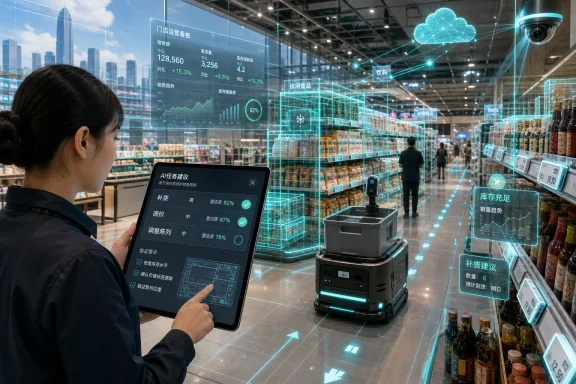
Hanshow’s xPilot is aimed squarely at that gap. The company describes it as a real-time store execution AI assistant powered by store digital twin technology, built on Microsoft Azure and tied into Microsoft Fabric for data unification. Microsoft Foundry then provides the agentic layer, allowing AI agents to interpret store signals and trigger decisions or workflows.
That language can sound like conference-stage fog until it is translated into store-floor reality. A shelf edge label, a smart cart, a camera-equipped robot, a traffic sensor, a labor scheduling system, and a point-of-sale feed all describe different versions of the same store. xPilot’s premise is that those signals should not sit in separate systems waiting for a manager to reconcile them after the fact.
The bet is that a store can be modeled as a living system. When stock is missing, a display is wrong, a price is inconsistent, or labor is being pulled into the wrong zone, the software should not merely report the condition. It should decide what matters, route the work, and confirm whether the fix happened.
That is the leap from analytics to execution. Retailers have not lacked data. They have lacked a dependable loop between knowing and doing.
This division of labor is important. Microsoft does not need to own the shelf label to own the architecture. Azure, Fabric, and Foundry give Microsoft a route into the operational core of retailers without asking those retailers to rip and replace every device already bolted to the store.
For Hanshow, the Microsoft partnership upgrades the pitch. Electronic shelf labels are useful, but they are also increasingly commoditized. A store digital twin tied to AI agents moves the company up the stack, from device vendor to execution platform.
That is where the strategic center of gravity is shifting across enterprise software. The next valuable layer is not just collecting events, storing them, or visualizing them. It is coordinating action across systems that were never designed to agree with one another in real time.
Retail is a particularly tempting arena because the inefficiencies are visible, repetitive, and expensive. Empty shelves, misplaced products, inaccurate prices, non-compliant displays, and poorly timed staffing decisions do not require speculative AI magic to matter. They already hurt sales and margins every day.
The more uncomfortable truth for retailers is that many of these failures are not information failures. Someone, somewhere, often knows the problem exists. The failure is that the knowledge does not become timely, verified action.
A demo environment can always make a digital twin look persuasive. The shelf is wrong, the model notices, the AI agent recommends an action, and the task is resolved. A live store is less polite.
In a real store, sensors miss things. Staff are interrupted. Promotions collide with replenishment cycles. The planogram may be technically correct but commercially wrong for a local customer pattern. The assistant must decide not only what it thinks is happening, but how much confidence to attach to that judgment.
This is where the Microsoft connection could either strengthen the product or expose its limits. Fabric can unify data, and Foundry can support agentic applications, but the quality of the retail outcome will depend on the fidelity of the model, the integration depth, and the governance around automated decisions. A store execution assistant that floods workers with low-value alerts becomes another inbox. A store execution assistant that quietly prioritizes the right intervention at the right time becomes infrastructure.
Rainbow’s deployment should therefore be read less as a victory lap and more as a live stress test. Can xPilot reduce manual inspections without creating new verification work elsewhere? Can it distinguish between a genuine out-of-stock event and a transient shelf condition? Can it help stores move faster without turning every deviation into a compliance drama?
Those questions matter because retail employees already work under pressure from labor constraints, fluctuating demand, and increasingly complex omnichannel obligations. A good AI assistant should reduce cognitive load. A bad one merely turns management anxiety into push notifications.
xPilot depends on collapsing enough of that fragmentation to make AI action credible. An agent cannot reliably recommend a replenishment task if it sees shelf sensors but not inventory status. It cannot prioritize labor if it sees traffic but not staffing. It cannot assess display compliance if it sees a store image but not the current merchandising instruction.
That is why the phrase “unified data foundation” is doing so much work here. It is the difference between an AI assistant with situational awareness and a chatbot bolted onto a dashboard.
For WindowsForum readers, the interesting Microsoft angle is familiar: the company is again using platform gravity to pull an industry workflow into its cloud. Azure supplies the infrastructure, Fabric organizes the data estate, and Foundry becomes the place where AI agents are built and governed. The retail store becomes another domain where Microsoft can say, in effect, “Bring us the signals, and we will make them operational.”
There is a strong enterprise logic to that. Retailers already using Microsoft identity, security, analytics, and productivity tooling may prefer an AI retail architecture that fits into the same governance model. Security teams are more likely to tolerate agentic workflows if they can understand the data boundaries, access controls, logging, and lifecycle management.
But the same logic also deepens dependency. Once store execution workflows depend on Azure data pipelines and Microsoft-hosted agents, the cloud platform is no longer just running reports. It is participating in store operations. That is a different kind of lock-in, because the switching cost includes process redesign, worker retraining, and operational trust.
In retail, that system is chaotic. Shelves are touched by staff, customers, suppliers, cleaners, merchandisers, and delivery processes. Product moves without permission. Labels lag. Promotions change. Aisles are blocked. Local managers improvise.
That means the most important question is not whether xPilot can display a digital version of a store. It is whether the digital representation is reliable enough to support action. A pretty model with stale or partial data is theater. A less flashy model with strong event fidelity can be transformative.
Hanshow has an advantage because its installed base and product portfolio sit close to the physical edge of retail. Electronic shelf labels and related smart-store infrastructure give it a way to collect signals where store execution actually happens. If those signals are frequent, accurate, and integrated with business context, they become the raw material for meaningful automation.
Still, retail digital twins face a tougher burden than warehouse automation or factory modeling. Stores are public environments. Customers are unpredictable. The data is noisier. Operational exceptions are not always errors; sometimes they are local adaptations that make sense.
The best systems will therefore need to treat digital twin output as probabilistic, not divine. They should surface confidence, explain reasoning, and allow local override. Otherwise, stores risk replacing human judgment with a brittle model of what headquarters thinks the store should be.
In the xPilot model, AI agents are not merely summarizing sales or answering manager questions. They are interpreting live operational signals, prioritizing exceptions, and triggering staff tasks or automated actions. That gives the software a degree of authority over store labor and process sequencing.
Retailers will welcome that if it reduces waste and missed sales. Nobody wants a manager walking aisles with a clipboard if the store already has enough sensing infrastructure to identify gaps. Nobody wants a promotion to fail because the display was never corrected. Nobody wants a customer to abandon a purchase because the inventory system said the item existed but the shelf did not.
But authority creates accountability. If an AI assistant prioritizes the wrong task, who owns the miss? If it recommends labor allocation that improves conversion but increases worker stress, how is that judged? If it optimizes energy usage in a way that conflicts with customer comfort or food safety margins, which policy wins?
These are not philosophical edge cases. They are ordinary operational trade-offs. Retail is a low-margin business where small optimizations add up, but small mistakes scale quickly across store networks.
The agentic layer therefore needs guardrails that are operational, not just technical. Retailers will need to define which decisions can be automated, which require approval, which require explanation, and which must remain local. Microsoft’s enterprise AI governance story may help, but each retailer will still need to encode its own tolerance for risk.
Retail technology often fails when it treats labor as a variable to be optimized rather than as the interface through which operations become real. A task can be perfectly prioritized in software and still fail if the worker receiving it lacks time, context, equipment, or trust in the alert.
The best version of xPilot would make store work more legible and less reactive. Instead of asking employees to patrol for problems, it could direct them to the exceptions with the highest commercial impact. Instead of requiring managers to reconcile systems, it could provide a ranked operational picture. Instead of leaving staff to guess whether a shelf fix mattered, it could verify completion.
The worst version would intensify surveillance without improving conditions. If every shelf deviation becomes an alert and every alert becomes a performance metric, the digital twin could become a digital overseer. Retailers will need to be careful not to confuse execution intelligence with indiscriminate monitoring.
There is also a training problem. Natural-language interaction can lower the barrier to using operational data, but workers still need to understand how much to trust the answer. If the system says a display is non-compliant, can a department manager challenge it? If the system recommends moving labor from one zone to another, can local knowledge override the model?
Adoption will depend on whether xPilot behaves like a competent assistant or an inflexible auditor. The former gets used. The latter gets gamed.
That matters because the physical store is still strategically important even in an omnichannel world. Stores serve as showrooms, fulfillment nodes, return centers, local marketing surfaces, and service points. They are also expensive, labor-intensive, and difficult to standardize.
Agentic AI gives Microsoft a way to frame these stores as software-manageable environments. The same broad enterprise story appears in other sectors: connect the data, model the domain, apply agents, govern the workflow, and continuously improve. Retail becomes another vertical expression of that template.
The risk is that the template can flatten industry nuance. A store is not a spreadsheet with shelves. It is a human environment shaped by local habits, customer behavior, supply variability, and brand experience. The more Microsoft and its partners push agentic automation into the store, the more they will need to show that the system improves the lived operation rather than simply making headquarters more aware of imperfections.
Still, the opportunity is real. Retailers have spent heavily on digital transformation while leaving the execution layer full of manual work and delayed feedback. If Microsoft can help close that loop, it becomes more than a cloud vendor. It becomes part of the retail operating system.
That is why Hanshow’s partnership is a useful case study. Microsoft does not need to build every retail sensor or application. It needs an ecosystem in which partners bring domain-specific systems that become more valuable when attached to Microsoft’s data and AI stack.
But “open” is one of the most abused words in enterprise technology. It can mean open APIs, partner-friendly integration, cloud-native deployment, standards alignment, or merely “not completely closed.” Retailers evaluating xPilot should press hard on what openness means in procurement terms.
Can retailers extract historical store-event data in usable formats? Can they swap analytics models? Can third-party task systems participate without losing functionality? Can identity and access policies map cleanly to existing enterprise controls? Can a retailer use xPilot with non-Hanshow devices at scale?
Those details will decide whether xPilot becomes a flexible execution layer or a vertically integrated stack with a friendly label. The distinction matters because large retailers rarely have uniform store estates. They inherit devices, systems, regional vendors, franchise constraints, and years of technology decisions that cannot be unwound quickly.
Open architecture also matters for resilience. If the AI layer fails, stores still need to operate. If connectivity degrades, essential workflows must continue. If a vendor relationship changes, the retailer should not lose the operational memory of its own stores.
The most credible version of xPilot will be one that can integrate widely, degrade gracefully, and let retailers keep meaningful control over their data and workflows. Anything less will make the digital twin feel less like a store model and more like a toll booth.
That does not make the architecture inherently unsafe. In fact, centralized identity, logging, and cloud governance can improve security compared with ad hoc device deployments. But the stakes change when the system can influence pricing accuracy, inventory action, labor deployment, and potentially automated in-store responses.
A compromised dashboard is bad. A compromised execution assistant is worse. If an attacker can manipulate store signals, poison data, or trigger operational workflows, the impact could move from information exposure to business disruption.
Retailers will need to treat store digital twin platforms as critical operational systems. That means device identity, secure provisioning, network segmentation, least-privilege access, audit trails, anomaly detection, and clear incident response procedures. It also means scrutinizing the AI agent layer for prompt injection, tool misuse, over-permissioned actions, and weak human approval boundaries.
The Windows and Microsoft ecosystem angle is again relevant. Many retailers already manage fleets of Windows devices, Azure identities, Microsoft security tools, and endpoint policies. A Microsoft-aligned retail AI platform could simplify governance if it plugs into those controls cleanly.
But convenience is not a substitute for threat modeling. The more physical operations depend on AI-assisted workflows, the more security teams must ask what happens when the model is wrong, the input is malicious, or the automation fires at the wrong time.
The live heatmaps Hanshow describes — covering sales, traffic, conversion, labor, and energy usage — point to a broader optimization agenda. The store becomes a continuously measured environment where managers can see not only what is happening, but where attention should go next.
That could be especially valuable for chains with many stores and uneven execution. Headquarters can design a promotion perfectly and still lose money if local displays are late, inventory is misplaced, or staffing misses peak traffic. A real-time execution assistant promises to compress the gap between policy and reality.
Yet the business case will vary by format. A department store such as Rainbow has complex merchandising zones, customer flow patterns, and display requirements. Grocery, convenience, electronics, pharmacy, and apparel each have different operational pain points. xPilot’s value will depend on whether its models and workflows can adapt to those differences without expensive customization.
Retailers should also be wary of savings that appear in one budget while costs appear in another. Reducing manual inspections is useful, but if the system requires new support teams, integration projects, device maintenance, and exception management, the ROI calculation becomes more complicated.
The strongest case will come from measured outcomes in live deployments: fewer shelf gaps, faster correction times, better promotion compliance, reduced labor waste, improved conversion, and lower energy cost without service degradation. Until those numbers are public, xPilot remains promising but not proven.
That shift will not arrive evenly. Some retailers will move quickly because they already have digital shelf infrastructure and cloud data platforms. Others will lag because their store systems are fragmented, their margins are thin, or their workforce processes are not ready for AI-assisted orchestration.
The important point is that xPilot represents a direction of travel, not just a product launch. Physical retail is being pulled into the same software logic that transformed data centers, offices, warehouses, and factories. Everything becomes observable. Everything becomes modelable. Everything becomes a candidate for automation.
For consumers, the changes may be subtle at first. Shelves may be better stocked, prices more consistent, staff better directed, and promotions more reliable. For workers and managers, the changes will be more direct: tasks will increasingly be generated by systems that see across the store in ways no individual can.
For IT teams, the store will look more like a managed digital environment. Device fleets, data pipelines, AI permissions, cloud dependencies, and operational dashboards will need the same rigor traditionally applied to back-office systems.
The retailer that treats this as a gadget rollout will struggle. The retailer that treats it as an operating model change has a better chance of extracting value.
The announcement also shows how Microsoft wants Foundry and Fabric to be understood. They are not just developer services or analytics platforms; they are becoming the substrate for vertical AI systems. In this case, the vertical is retail, the partner is Hanshow, and the testbed includes Rainbow Department Store.
That should interest WindowsForum’s IT readership because the same pattern will repeat elsewhere. Healthcare, manufacturing, logistics, finance, and public-sector operations will all see AI assistants that combine domain devices, unified data layers, and agentic workflows. The technical vocabulary may vary, but the architecture will rhyme.
The question for each industry will be how much authority the agent receives and how visibly humans remain in control. Retail is a good early proving ground because the tasks are concrete and measurable, but the environment is messy enough to expose shallow automation quickly.
If xPilot works, it will not be because it sounds intelligent. It will be because stores run better with it than without it.
 The Store Finally Gets Its Control Plane
Retail technology has spent years digitizing the parts of commerce that were already easiest to measure. E-commerce funnels, loyalty databases, warehouse systems, and payment rails all became rich sources of telemetry. The physical store, meanwhile, remained stubbornly analog at the moment that matters most: a product is either on the shelf, priced correctly, and placed where the plan says it should be, or it is not.Hanshow’s xPilot is aimed squarely at that gap. The company describes it as a real-time store execution AI assistant powered by store digital twin technology, built on Microsoft Azure and tied into Microsoft Fabric for data unification. Microsoft Foundry then provides the agentic layer, allowing AI agents to interpret store signals and trigger decisions or workflows.
That language can sound like conference-stage fog until it is translated into store-floor reality. A shelf edge label, a smart cart, a camera-equipped robot, a traffic sensor, a labor scheduling system, and a point-of-sale feed all describe different versions of the same store. xPilot’s premise is that those signals should not sit in separate systems waiting for a manager to reconcile them after the fact.
The bet is that a store can be modeled as a living system. When stock is missing, a display is wrong, a price is inconsistent, or labor is being pulled into the wrong zone, the software should not merely report the condition. It should decide what matters, route the work, and confirm whether the fix happened.
That is the leap from analytics to execution. Retailers have not lacked data. They have lacked a dependable loop between knowing and doing.
Hanshow and Microsoft Are Selling a Retail Nervous System
The xPilot announcement follows Hanshow and Microsoft’s earlier 2026 collaboration around Store Digital Twin frameworks. Hanshow brought the in-store hardware and retail operating context: electronic shelf labels, sensors, smart devices, and the accumulated messiness of physical store deployments. Microsoft brought the cloud platform, data fabric, and AI infrastructure that can make the story feel enterprise-grade rather than experimental.This division of labor is important. Microsoft does not need to own the shelf label to own the architecture. Azure, Fabric, and Foundry give Microsoft a route into the operational core of retailers without asking those retailers to rip and replace every device already bolted to the store.
For Hanshow, the Microsoft partnership upgrades the pitch. Electronic shelf labels are useful, but they are also increasingly commoditized. A store digital twin tied to AI agents moves the company up the stack, from device vendor to execution platform.
That is where the strategic center of gravity is shifting across enterprise software. The next valuable layer is not just collecting events, storing them, or visualizing them. It is coordinating action across systems that were never designed to agree with one another in real time.
Retail is a particularly tempting arena because the inefficiencies are visible, repetitive, and expensive. Empty shelves, misplaced products, inaccurate prices, non-compliant displays, and poorly timed staffing decisions do not require speculative AI magic to matter. They already hurt sales and margins every day.
The more uncomfortable truth for retailers is that many of these failures are not information failures. Someone, somewhere, often knows the problem exists. The failure is that the knowledge does not become timely, verified action.
Rainbow’s Pilot Is Really a Test of Trust
Rainbow Department Store’s role as an early live-store adopter gives the announcement its practical anchor. Hanshow says Rainbow is using xPilot to validate whether digital twin technology can translate real-time store intelligence into consistent in-store execution at scale. That phrasing is careful, but it identifies the right test.A demo environment can always make a digital twin look persuasive. The shelf is wrong, the model notices, the AI agent recommends an action, and the task is resolved. A live store is less polite.
In a real store, sensors miss things. Staff are interrupted. Promotions collide with replenishment cycles. The planogram may be technically correct but commercially wrong for a local customer pattern. The assistant must decide not only what it thinks is happening, but how much confidence to attach to that judgment.
This is where the Microsoft connection could either strengthen the product or expose its limits. Fabric can unify data, and Foundry can support agentic applications, but the quality of the retail outcome will depend on the fidelity of the model, the integration depth, and the governance around automated decisions. A store execution assistant that floods workers with low-value alerts becomes another inbox. A store execution assistant that quietly prioritizes the right intervention at the right time becomes infrastructure.
Rainbow’s deployment should therefore be read less as a victory lap and more as a live stress test. Can xPilot reduce manual inspections without creating new verification work elsewhere? Can it distinguish between a genuine out-of-stock event and a transient shelf condition? Can it help stores move faster without turning every deviation into a compliance drama?
Those questions matter because retail employees already work under pressure from labor constraints, fluctuating demand, and increasingly complex omnichannel obligations. A good AI assistant should reduce cognitive load. A bad one merely turns management anxiety into push notifications.
Fabric Gives the Pitch Its Enterprise Spine
The Microsoft Fabric piece of the announcement is not decorative. Fabric is Microsoft’s attempt to provide a unified data platform across analytics, data engineering, real-time intelligence, and business intelligence. In retail terms, that matters because store operations have historically been fragmented across point-of-sale systems, inventory platforms, workforce management tools, merchandising systems, IoT platforms, and vendor-specific dashboards.xPilot depends on collapsing enough of that fragmentation to make AI action credible. An agent cannot reliably recommend a replenishment task if it sees shelf sensors but not inventory status. It cannot prioritize labor if it sees traffic but not staffing. It cannot assess display compliance if it sees a store image but not the current merchandising instruction.
That is why the phrase “unified data foundation” is doing so much work here. It is the difference between an AI assistant with situational awareness and a chatbot bolted onto a dashboard.
For WindowsForum readers, the interesting Microsoft angle is familiar: the company is again using platform gravity to pull an industry workflow into its cloud. Azure supplies the infrastructure, Fabric organizes the data estate, and Foundry becomes the place where AI agents are built and governed. The retail store becomes another domain where Microsoft can say, in effect, “Bring us the signals, and we will make them operational.”
There is a strong enterprise logic to that. Retailers already using Microsoft identity, security, analytics, and productivity tooling may prefer an AI retail architecture that fits into the same governance model. Security teams are more likely to tolerate agentic workflows if they can understand the data boundaries, access controls, logging, and lifecycle management.
But the same logic also deepens dependency. Once store execution workflows depend on Azure data pipelines and Microsoft-hosted agents, the cloud platform is no longer just running reports. It is participating in store operations. That is a different kind of lock-in, because the switching cost includes process redesign, worker retraining, and operational trust.
The Digital Twin Is Only as Good as the Store It Sees
Digital twin language has followed a familiar hype cycle. It began in industrial engineering, migrated into smart buildings and logistics, and now appears in retail with increasing confidence. In the best case, a digital twin is not a 3D gimmick but a continuously updated model of a physical system that can be queried, simulated, and acted upon.In retail, that system is chaotic. Shelves are touched by staff, customers, suppliers, cleaners, merchandisers, and delivery processes. Product moves without permission. Labels lag. Promotions change. Aisles are blocked. Local managers improvise.
That means the most important question is not whether xPilot can display a digital version of a store. It is whether the digital representation is reliable enough to support action. A pretty model with stale or partial data is theater. A less flashy model with strong event fidelity can be transformative.
Hanshow has an advantage because its installed base and product portfolio sit close to the physical edge of retail. Electronic shelf labels and related smart-store infrastructure give it a way to collect signals where store execution actually happens. If those signals are frequent, accurate, and integrated with business context, they become the raw material for meaningful automation.
Still, retail digital twins face a tougher burden than warehouse automation or factory modeling. Stores are public environments. Customers are unpredictable. The data is noisier. Operational exceptions are not always errors; sometimes they are local adaptations that make sense.
The best systems will therefore need to treat digital twin output as probabilistic, not divine. They should surface confidence, explain reasoning, and allow local override. Otherwise, stores risk replacing human judgment with a brittle model of what headquarters thinks the store should be.
AI Agents Move the Battle From Insight to Authority
The term AI agent is now everywhere in enterprise technology, and its overuse can obscure the real change. A chatbot answers. An agent acts, or at least proposes actions inside a workflow. That difference is why xPilot deserves attention beyond the retail trade press.In the xPilot model, AI agents are not merely summarizing sales or answering manager questions. They are interpreting live operational signals, prioritizing exceptions, and triggering staff tasks or automated actions. That gives the software a degree of authority over store labor and process sequencing.
Retailers will welcome that if it reduces waste and missed sales. Nobody wants a manager walking aisles with a clipboard if the store already has enough sensing infrastructure to identify gaps. Nobody wants a promotion to fail because the display was never corrected. Nobody wants a customer to abandon a purchase because the inventory system said the item existed but the shelf did not.
But authority creates accountability. If an AI assistant prioritizes the wrong task, who owns the miss? If it recommends labor allocation that improves conversion but increases worker stress, how is that judged? If it optimizes energy usage in a way that conflicts with customer comfort or food safety margins, which policy wins?
These are not philosophical edge cases. They are ordinary operational trade-offs. Retail is a low-margin business where small optimizations add up, but small mistakes scale quickly across store networks.
The agentic layer therefore needs guardrails that are operational, not just technical. Retailers will need to define which decisions can be automated, which require approval, which require explanation, and which must remain local. Microsoft’s enterprise AI governance story may help, but each retailer will still need to encode its own tolerance for risk.
Store Workers Will Judge the System First
The success of xPilot will not be decided solely in CIO presentations. It will be decided by store workers who either find the system useful or learn to route around it.Retail technology often fails when it treats labor as a variable to be optimized rather than as the interface through which operations become real. A task can be perfectly prioritized in software and still fail if the worker receiving it lacks time, context, equipment, or trust in the alert.
The best version of xPilot would make store work more legible and less reactive. Instead of asking employees to patrol for problems, it could direct them to the exceptions with the highest commercial impact. Instead of requiring managers to reconcile systems, it could provide a ranked operational picture. Instead of leaving staff to guess whether a shelf fix mattered, it could verify completion.
The worst version would intensify surveillance without improving conditions. If every shelf deviation becomes an alert and every alert becomes a performance metric, the digital twin could become a digital overseer. Retailers will need to be careful not to confuse execution intelligence with indiscriminate monitoring.
There is also a training problem. Natural-language interaction can lower the barrier to using operational data, but workers still need to understand how much to trust the answer. If the system says a display is non-compliant, can a department manager challenge it? If the system recommends moving labor from one zone to another, can local knowledge override the model?
Adoption will depend on whether xPilot behaves like a competent assistant or an inflexible auditor. The former gets used. The latter gets gamed.
Microsoft’s Retail Strategy Is Becoming More Physical
Microsoft has spent years pitching cloud and AI into retail, but xPilot points to a more physical turn. The company is not just helping retailers analyze customers or automate back-office tasks. It is supporting systems that reach into the store environment itself.That matters because the physical store is still strategically important even in an omnichannel world. Stores serve as showrooms, fulfillment nodes, return centers, local marketing surfaces, and service points. They are also expensive, labor-intensive, and difficult to standardize.
Agentic AI gives Microsoft a way to frame these stores as software-manageable environments. The same broad enterprise story appears in other sectors: connect the data, model the domain, apply agents, govern the workflow, and continuously improve. Retail becomes another vertical expression of that template.
The risk is that the template can flatten industry nuance. A store is not a spreadsheet with shelves. It is a human environment shaped by local habits, customer behavior, supply variability, and brand experience. The more Microsoft and its partners push agentic automation into the store, the more they will need to show that the system improves the lived operation rather than simply making headquarters more aware of imperfections.
Still, the opportunity is real. Retailers have spent heavily on digital transformation while leaving the execution layer full of manual work and delayed feedback. If Microsoft can help close that loop, it becomes more than a cloud vendor. It becomes part of the retail operating system.
That is why Hanshow’s partnership is a useful case study. Microsoft does not need to build every retail sensor or application. It needs an ecosystem in which partners bring domain-specific systems that become more valuable when attached to Microsoft’s data and AI stack.
The Open Architecture Claim Will Need Proof
Hanshow says xPilot supports open architecture and integration with partner applications across merchandising, supply chain, store operations, and customer engagement. That is the right claim to make, because no serious retailer wants a new execution layer that traps store data in yet another vendor silo.But “open” is one of the most abused words in enterprise technology. It can mean open APIs, partner-friendly integration, cloud-native deployment, standards alignment, or merely “not completely closed.” Retailers evaluating xPilot should press hard on what openness means in procurement terms.
Can retailers extract historical store-event data in usable formats? Can they swap analytics models? Can third-party task systems participate without losing functionality? Can identity and access policies map cleanly to existing enterprise controls? Can a retailer use xPilot with non-Hanshow devices at scale?
Those details will decide whether xPilot becomes a flexible execution layer or a vertically integrated stack with a friendly label. The distinction matters because large retailers rarely have uniform store estates. They inherit devices, systems, regional vendors, franchise constraints, and years of technology decisions that cannot be unwound quickly.
Open architecture also matters for resilience. If the AI layer fails, stores still need to operate. If connectivity degrades, essential workflows must continue. If a vendor relationship changes, the retailer should not lose the operational memory of its own stores.
The most credible version of xPilot will be one that can integrate widely, degrade gracefully, and let retailers keep meaningful control over their data and workflows. Anything less will make the digital twin feel less like a store model and more like a toll booth.
Security Teams Should Read This as an Edge Computing Story
Although the xPilot announcement is framed around retail execution, security-minded readers should see another theme: the attack surface of the store is expanding. Smart shelves, carts, robots, sensors, operational systems, cloud pipelines, AI agents, and task orchestration tools create a dense fabric of connected endpoints and workflows.That does not make the architecture inherently unsafe. In fact, centralized identity, logging, and cloud governance can improve security compared with ad hoc device deployments. But the stakes change when the system can influence pricing accuracy, inventory action, labor deployment, and potentially automated in-store responses.
A compromised dashboard is bad. A compromised execution assistant is worse. If an attacker can manipulate store signals, poison data, or trigger operational workflows, the impact could move from information exposure to business disruption.
Retailers will need to treat store digital twin platforms as critical operational systems. That means device identity, secure provisioning, network segmentation, least-privilege access, audit trails, anomaly detection, and clear incident response procedures. It also means scrutinizing the AI agent layer for prompt injection, tool misuse, over-permissioned actions, and weak human approval boundaries.
The Windows and Microsoft ecosystem angle is again relevant. Many retailers already manage fleets of Windows devices, Azure identities, Microsoft security tools, and endpoint policies. A Microsoft-aligned retail AI platform could simplify governance if it plugs into those controls cleanly.
But convenience is not a substitute for threat modeling. The more physical operations depend on AI-assisted workflows, the more security teams must ask what happens when the model is wrong, the input is malicious, or the automation fires at the wrong time.
The Business Case Is Shrink, Sales, Labor, and Consistency
Retailers will not adopt xPilot because digital twins sound futuristic. They will adopt it if the economics work. The obvious targets are lost sales from out-of-stock shelves, labor wasted on manual checks, inconsistent planogram execution, pricing errors, and operational blind spots across store networks.The live heatmaps Hanshow describes — covering sales, traffic, conversion, labor, and energy usage — point to a broader optimization agenda. The store becomes a continuously measured environment where managers can see not only what is happening, but where attention should go next.
That could be especially valuable for chains with many stores and uneven execution. Headquarters can design a promotion perfectly and still lose money if local displays are late, inventory is misplaced, or staffing misses peak traffic. A real-time execution assistant promises to compress the gap between policy and reality.
Yet the business case will vary by format. A department store such as Rainbow has complex merchandising zones, customer flow patterns, and display requirements. Grocery, convenience, electronics, pharmacy, and apparel each have different operational pain points. xPilot’s value will depend on whether its models and workflows can adapt to those differences without expensive customization.
Retailers should also be wary of savings that appear in one budget while costs appear in another. Reducing manual inspections is useful, but if the system requires new support teams, integration projects, device maintenance, and exception management, the ROI calculation becomes more complicated.
The strongest case will come from measured outcomes in live deployments: fewer shelf gaps, faster correction times, better promotion compliance, reduced labor waste, improved conversion, and lower energy cost without service degradation. Until those numbers are public, xPilot remains promising but not proven.
Rainbow’s Early Move Shows Where the Shelf Is Headed
Rainbow’s deployment gives the industry an early look at a store model that is less periodic and more continuous. The old rhythm of store execution relied on inspections, reports, manager judgment, and delayed analysis. The new rhythm is sensor event, model update, agent recommendation, task assignment, and verification.That shift will not arrive evenly. Some retailers will move quickly because they already have digital shelf infrastructure and cloud data platforms. Others will lag because their store systems are fragmented, their margins are thin, or their workforce processes are not ready for AI-assisted orchestration.
The important point is that xPilot represents a direction of travel, not just a product launch. Physical retail is being pulled into the same software logic that transformed data centers, offices, warehouses, and factories. Everything becomes observable. Everything becomes modelable. Everything becomes a candidate for automation.
For consumers, the changes may be subtle at first. Shelves may be better stocked, prices more consistent, staff better directed, and promotions more reliable. For workers and managers, the changes will be more direct: tasks will increasingly be generated by systems that see across the store in ways no individual can.
For IT teams, the store will look more like a managed digital environment. Device fleets, data pipelines, AI permissions, cloud dependencies, and operational dashboards will need the same rigor traditionally applied to back-office systems.
The retailer that treats this as a gadget rollout will struggle. The retailer that treats it as an operating model change has a better chance of extracting value.
The Real Signal From xPilot Is That Retail AI Has Left the Chat Window
The most concrete lesson from Hanshow’s xPilot launch is that enterprise AI is moving away from generic assistants and toward domain-specific systems tied to live operational data. Retailers do not need another place to type prompts if the answer never reaches the shelf. They need controlled automation that can close the loop between detection and execution.The announcement also shows how Microsoft wants Foundry and Fabric to be understood. They are not just developer services or analytics platforms; they are becoming the substrate for vertical AI systems. In this case, the vertical is retail, the partner is Hanshow, and the testbed includes Rainbow Department Store.
That should interest WindowsForum’s IT readership because the same pattern will repeat elsewhere. Healthcare, manufacturing, logistics, finance, and public-sector operations will all see AI assistants that combine domain devices, unified data layers, and agentic workflows. The technical vocabulary may vary, but the architecture will rhyme.
The question for each industry will be how much authority the agent receives and how visibly humans remain in control. Retail is a good early proving ground because the tasks are concrete and measurable, but the environment is messy enough to expose shallow automation quickly.
If xPilot works, it will not be because it sounds intelligent. It will be because stores run better with it than without it.
The Shelf-Edge Lessons IT Leaders Should Carry Forward
Hanshow’s announcement is early enough that the most useful response is neither hype nor dismissal. The practical posture is to treat xPilot as a sign of where operational AI is going and to evaluate it with the same discipline applied to any system that touches business-critical workflows.- Retail AI is shifting from dashboards and chatbots toward execution systems that assign, prioritize, and verify work in real time.
- Microsoft’s role in xPilot shows how Azure, Fabric, and Foundry are being packaged as a vertical AI foundation rather than a loose collection of cloud services.
- Rainbow Department Store’s live deployment will matter most if it produces measurable evidence around shelf availability, planogram compliance, pricing accuracy, and labor efficiency.
- Store digital twins will succeed only if their data is accurate enough to support action and transparent enough for workers and managers to challenge.
- Security teams should treat AI store-execution platforms as operational technology, not merely analytics software.
- Retailers should demand specific proof of openness, data portability, governance controls, and failure-mode behavior before making an execution assistant central to store operations.
References
- Primary source: Retail Technology Innovation Hub
Published: 2026-06-05T06:30:14.420090
Rainbow Department Store among first retailers to deploy Hanshow xPilot solution in live environment — Retail Technology Innovation Hub
Hanshow has announced the launch of xPilot, a real-time store execution AI assistant powered by the company’s digital twin technology, in collaboration with Microsoft. Built on Microsoft Azure, xPilot uses Microsoft Fabric to unify in-store sensing data with retailer business data, creating a conretailtechinnovationhub.com
- Related coverage: prnewswire.com
Hanshow Launches xPilot in Collaboration with Microsoft, an AI-Powered Real-Time Store Execution Assistant at NRF 2026 APAC
/PRNewswire/ -- Hanshow, a global leader in digital store solutions, announced the launch of xPilot, a real-time store execution AI Assistant powered by... www.prnewswire.com
- Related coverage: marketscreener.com
Hanshow Technology Co., Ltd. And Microsoft Corporation Launch xPilot In Collaboration As An AI-Powered Real-Time Store Execution Assistant At NRF 2026 APAC
Hanshow Technology Co., Ltd. announced the launch of xPilot, a real-time store execution AI Assistant powered by Hanshow digital twin technology, in collaboration with Microsoft Corporation at NRF...www.marketscreener.com
- Related coverage: uk.marketscreener.com
Hanshow Technology Co., Ltd. And Microsoft Corporation Launch xPilot In Collaboration As An AI-Powered Real-Time Store Execution Assistant At NRF 2026 APAC
Hanshow Technology Co., Ltd. announced the launch of xPilot, a real-time store execution AI Assistant powered by Hanshow digital twin technology, in collaboration with Microsoft Corporation at NRF...uk.marketscreener.com
- Related coverage: retailtechinnovationhub.squarespace.com
Rainbow Department Store among first retailers to deploy Hanshow xPilot solution in live environment — Retail Technology Innovation Hub
Hanshow has announced the launch of xPilot, a real-time store execution AI assistant powered by the company’s digital twin technology, in collaboration with Microsoft. Built on Microsoft Azure, xPilot uses Microsoft Fabric to unify in-store sensing data with retailer business data, creating a con - Related coverage: hanshow.com
Hanshow Collaborates with Microsoft to Explore Store Digital Twin for the Future of Retail at NRF 2026 | Hanshow
Get updated with our Hanshow Collaborates with Microsoft to Explore Store Digital Twin for the Future of Retail at NRF 2026. Contact Hanshow for more.www.hanshow.com
- Related coverage: zonebourse.com
Hanshow Technology et Microsoft lancent xPilot, un assistant d'exécution en magasin en temps réel piloté par l'IA, lors du NRF 2026 APAC
Hanshow Technology Co., Ltd. a annoncé le lancement de xPilot, un assistant d'IA pour l'exécution en magasin en temps réel s'appuyant sur la technologie de jumeau numérique de Hanshow, en...www.zonebourse.com
- Official source: news.microsoft.com
- Related coverage: storage.hanshow.com
logo-classicblue-72px-CMYK
Omni channel technology of online retail business. Multichannel marketing on social media network platform offer service of internet payment channel, online retail shopping and omni digital app.storage.hanshow.com

