

Microsoft’s recent push to move BitLocker encryption out of the CPU and into purpose-built silicon is a defining moment for Windows storage security: the company has added OS-level support for hardware-accelerated BitLocker in recent Windows 11 releases, promised large reductions in CPU overhead and measurable storage throughput gains, and signaled initial device support tied to next‑generation SoCs — but the change brings new operational trade-offs, a multi‑vendor rollout dependency, and real-world caveats that every PC owner and IT team must understand before declaring victory.
BitLocker has been Windows’ built‑in full‑disk encryption tool for nearly two decades. Historically, BitLocker carried out encryption and decryption on the host CPU (often aided by AES‑NI), which was fine when disk throughput lagged far behind CPU capability. With modern NVMe SSDs delivering multi‑GB/s transfers and much higher sustained I/O, that CPU‑centric model has become a bottleneck in some workloads: real‑time AES transforms can consume measurable CPU cycles and add latency, particularly for random I/O at low queue depths. Independent testing before Microsoft’s announcement documented those impacts — in a notable case, software‑based BitLocker reduced random write performance by as much as 45% on one high‑end SSD. Microsoft’s answer is an operating‑system level architecture that can route bulk disk crypto to a dedicated crypto engine inside the SoC or CPU subsystem, and optionally keep the disk encryption key sealed inside hardware so plaintext keys never appear in system RAM. That capability is now described in Microsoft’s Windows IT Pro/Tech Community materials and is appearing in recent Windows servicing and feature updates — but Microsoft’s own documentation makes clear that the OS plumbing alone does not activate the feature: firmware, OEM flags, drivers and silicon support must be present for hardware acceleration to actually be used on a device.
Microsoft’s hardware‑accelerated BitLocker is a technically credible and overdue modernization for disk encryption on Windows. It directly addresses the measurable CPU and throughput costs of software BitLocker on modern NVMe hardware and introduces stronger key protection models that align with contemporary hardware‑backed security trends. The wins will be tangible for users on properly matched hardware, but the rollout will be incremental and demands due diligence: pilot testing, firmware update governance, recovery‑key escrow, and procurement questions must be answered before wide deployment.
Practically speaking, this is not an instant fix for users suffering today’s software BitLocker penalties, but it is a durable, structural improvement to Windows’ security architecture that — if implemented transparently and audited thoroughly by silicon and OEM partners — will make always‑on disk encryption less painful for power users and enterprise fleets alike.
Source: Tom's Hardware https://www.tomshardware.com/softwa...-cpus-that-arent-available-on-the-market-yet/
 Background / Overview
BitLocker has been Windows’ built‑in full‑disk encryption tool for nearly two decades. Historically, BitLocker carried out encryption and decryption on the host CPU (often aided by AES‑NI), which was fine when disk throughput lagged far behind CPU capability. With modern NVMe SSDs delivering multi‑GB/s transfers and much higher sustained I/O, that CPU‑centric model has become a bottleneck in some workloads: real‑time AES transforms can consume measurable CPU cycles and add latency, particularly for random I/O at low queue depths. Independent testing before Microsoft’s announcement documented those impacts — in a notable case, software‑based BitLocker reduced random write performance by as much as 45% on one high‑end SSD. Microsoft’s answer is an operating‑system level architecture that can route bulk disk crypto to a dedicated crypto engine inside the SoC or CPU subsystem, and optionally keep the disk encryption key sealed inside hardware so plaintext keys never appear in system RAM. That capability is now described in Microsoft’s Windows IT Pro/Tech Community materials and is appearing in recent Windows servicing and feature updates — but Microsoft’s own documentation makes clear that the OS plumbing alone does not activate the feature: firmware, OEM flags, drivers and silicon support must be present for hardware acceleration to actually be used on a device. What Microsoft announced (the technical pillars)
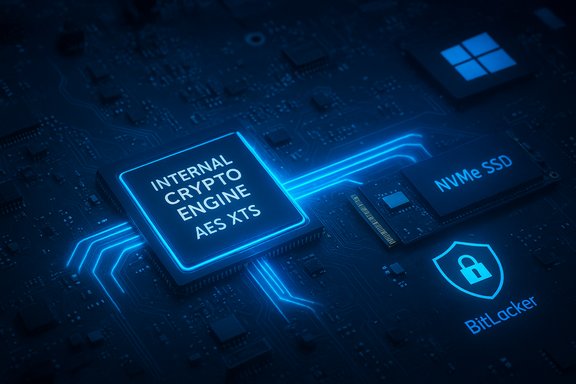
Microsoft framed hardware‑accelerated BitLocker around two complementary technical pillars:- Crypto offload: Bulk AES/XTS encryption and decryption are performed inside a dedicated crypto engine on the SoC, rather than on general‑purpose CPU cores. That engine accepts buffer‑level requests and returns ciphertext/plaintext without exposing the raw Data Encryption Key (DEK) to the CPU. This reduces the per‑I/O CPU cycles required for encryption and can lower visible latency for I/O‑heavy workloads.
- Hardware‑protected keys (hardware‑wrapped DEKs): The DEK can be generated, wrapped and used entirely inside a silicon boundary (secure enclave, secure element or equivalent), so the operating system never holds the unwrapped key in RAM. This reduces the attack surface against memory‑scraping and many kernel‑level extraction techniques but changes how recovery, imaging, and drive mobility work in practice.
Who will get it first — and when
Microsoft’s blog explicitly calls out initial device support on certain Intel vPro platforms using Intel® Core™ Ultra Series 3 (Panther Lake) processors, and says broader vendor support is planned over time. Intel’s public roadmap places Panther Lake as a major client SoC family with device shipments and mainstream availability aligned with the 2025/2026 cadence — Intel specifically signaled Panther Lake SKUs will roll into customer devices starting in late 2025 and see broader retail availability in January 2026. That means real world activation for most users will be tied to new PCs shipping with those chips (or other vendors rolling out equivalent hardware engines), not simply to an OS update. Important operational point: installing the Windows 11 update that contains the OS support (Windows 11 servicing and 25H2 updates) is necessary but not sufficient — firmware, drivers and OEM flags must expose the crypto engine before offload becomes active on a device. Expect a phased, OEM‑by‑OEM rollout.The performance and power claims — what Microsoft says and what’s been tested
Microsoft’s headlining numbers are attention‑grabbing:- The company claims up to about 70% fewer CPU cycles per I/O for BitLocker workloads when hardware offload is used versus software BitLocker, a reduction Microsoft says will translate to improved battery life on mobile devices.
- Demonstrations Microsoft has shared and partner videos show storage throughput in hardware‑accelerated mode approaching — or in some cases exceeding — unencrypted performance for specific workloads. Microsoft’s CrystalDiskMark demo highlighted multi‑GB/s single‑thread sequential numbers when offload is active.
How the hardware model differs from prior acceleration models
It’s vital to separate three concepts that are often conflated:- AES‑NI / CPU instruction acceleration: Modern Intel and AMD cores include AES instructions that speed AES operations executed on the CPU. This is still a software‑centric model — the CPU performs the AES transforms, just faster.
- Self‑Encrypting Drives (SEDs / TCG Opal): Many SSDs have on‑drive controllers that perform encryption internally. Those drives can offer near‑native performance when their hardware encryption is fully supported and trusted by the OS. However, past research has found implementation flaws in some SEDs, prompting Microsoft to prefer software BitLocker in some installs.
- Hardware crypto offload (the new BitLocker mode): The OS dispatches encrypt/decrypt operations to a dedicated crypto engine in the SoC. The crypto engine executes bulk AES/XTS transforms and can hold keys in a hardware boundary. The OS never receives plaintext DEKs. This is the structural change Microsoft announced and is distinct from AES‑NI or SEDs.
Security gains — and new risks
Hardware‑wrapped keys and offload deliver clear security advantages:- Reduced key exposure: If the DEK never exists unwrapped in system RAM, memory scraping and many kernel‑space extraction techniques become far harder. That materially raises the bar for adversaries who rely on runtime memory access.
- Smaller OS crypto footprint: Offloading bulk crypto removes high‑frequency cryptographic code from kernel paths, shrinking the runtime attack surface during sustained I/O.
- Drive mobility and recovery complications: Keys tied to silicon can make moving a drive to another machine impossible without a prior recovery plan. Enterprises and forensic teams must plan for drive replacement, motherboard swaps and device retirement differently than with software BitLocker.
- Firmware fragility and update risk: Tying key release to attestation values means firmware or microcode changes can trigger BitLocker recovery screens. This has happened with BitLocker before; sealing keys in hardware raises the stakes and requires disciplined update testing and recovery‑key escrow.
- Trust shift to silicon and firmware vendors: Security becomes as much about firmware quality and vendor practices as about OS code. Hardware claims are only as strong as their implementation and update processes; independent auditing and certification remain essential.
- Legacy weaknesses in hardware crypto implementations: The history of Opal/SED implementations shows that hardware encryption must be scrutinized: past research demonstrated that some drive firmware bugs allowed practical bypasses. The community should insist on vendor transparency and independent validation for SoC crypto engines as well.
UFS Inline Crypto Engine and storage ecosystem context
Microsoft mentioned UFS Inline Crypto Engine technology as part of the broader storage modernization that makes hardware crypto effective across device classes. Inline crypto engines operate at the block I/O layer and accept per‑I/O instructions or indexed keyslot references so that encryption can be applied with low overhead and testable correctness. Linux kernel documentation for inline encryption explains the model and underlines why OS‑level plumbing is necessary to manage hardware keyslots, recover keys after controller resets, and integrate with layered block devices. For mobile and embedded storage that uses UFS inline engines, the integration story and firmware handling are especially important to reliability and recovery.Practical guidance: for power users, IT admins, and procurement teams
- Check whether your device is already using hardware‑accelerated BitLocker:
- Open an elevated Command Prompt and run: manage‑bde -status
- Inspect the “Encryption Method” line — if it shows Hardware accelerated (or similar), the OS is using the SoC crypto offload. Microsoft plans to improve tooling readouts over time.
- Don’t assume an OS update alone will enable offload:
- Activation requires firmware, drivers and OEM‑exposed flags. Windows updates add the capability, but OEM/SoC participation is mandatory. Plan for a phased rollout and verify hardware/firmware documentation.
- Update recovery and imaging playbooks:
- Ensure recovery keys are escrowed in Entra ID / Azure AD or another audited key‑management system before enabling any hardware binding. Test restore and imaging scenarios, including motherboard replacement and firmware rollbacks.
- Revisit Group Policy / MDM settings:
- If enterprise policies require specific algorithms or key sizes that the SoC does not advertise, Windows will remain in software mode. Administrators should align policies with planned hardware or expect to remain software‑based until hardware support is confirmed.
- Pilot, measure, and iterate:
- Run controlled tests (fio, DiskSpd, CrystalDiskMark) comparing unencrypted, software BitLocker, and hardware‑accelerated modes. Measure CPU usage, throughput, latency and battery life under representative workloads. Use those results to drive rollout or procurement decisions.
- Procurement checklist for hardware‑accelerated BitLocker:
- Ask OEMs and silicon vendors to document:
- The SoC crypto engine’s capabilities (algorithms, keywrap modes, FIPS certifications).
- Firmware and recovery workflows for hardware‑wrapped DEKs.
- Driver and update policies (how firmware updates are validated and how rollback is handled).
- Include hardware‑accelerated BitLocker support as a line item in RFPs only after pilot validation.
What this means for end users and enthusiasts
- If you own an older PC or a system without the necessary SoC crypto engine, you will continue to rely on software BitLocker (with AES‑NI help on many CPUs). The benefits Microsoft touts will arrive primarily with new devices that expose the offload capabilities. Expect to see the first shipping PCs with Panther Lake‑class silicon in late 2025 and broader availability through January 2026, so mainstream penetration will be gradual.
- For users frustrated by BitLocker’s software‑mode performance hit today, the path forward is realistic but not instantaneous: buying a new PC with an SoC that advertises hardware offload or using a trusted OPAL‑compliant SED remain practical ways to avoid the CPU hit in the short term — but both approaches require careful verification of vendor claims and recovery flows.
Verification, independent testing, and the cautionary note
Microsoft’s architecture and demos are technically sound and address a real performance problem. Independent reporting and earlier benchmarks validate the core motivation: software BitLocker can introduce non‑trivial performance penalties in some scenarios. However, the magnitude of Microsoft’s headline figures — “nearly double throughput” or “70% fewer CPU cycles” — will depend entirely on the full stack: SoC crypto engine design, NVMe controller behavior, OEM firmware maturity, and driver/OS integration. Early vendor demos and Microsoft’s own blog provide credible directional evidence, but broad independent verification across hardware families will be necessary before those numbers become authoritative for procurement decisions. Where claims are not yet independently verifiable, flag them with caution: the “recoverability and mobility” constraints, firmware update fragility, and the need for vendor transparency are real, concrete operational risks that require explicit mitigation before enterprise‑wide adoption.Final verdict — a measured scorecard
- Strengths:
- Performance: Hardware crypto offload removes a visible CPU bottleneck on high‑throughput NVMe drives and can restore near‑native performance for encrypted volumes on capable hardware.
- Efficiency: Reduced CPU cycles translates into lower power draw and improved battery life in mobile scenarios.
- Key protection: Hardware‑wrapped DEKs significantly reduce exposure to memory‑based extraction techniques.
- Risks and tradeoffs:
- Operational complexity: Recovery, imaging and device mobility require new runbooks and careful escrow planning.
- Vendor trust and firmware quality: Security depends on opaque firmware implementations and ongoing update discipline.
- Phased availability: OS updates do not flip a global switch; adoption requires coordinated OEM and silicon‑vendor participation (initially Panther Lake devices).
Microsoft’s hardware‑accelerated BitLocker is a technically credible and overdue modernization for disk encryption on Windows. It directly addresses the measurable CPU and throughput costs of software BitLocker on modern NVMe hardware and introduces stronger key protection models that align with contemporary hardware‑backed security trends. The wins will be tangible for users on properly matched hardware, but the rollout will be incremental and demands due diligence: pilot testing, firmware update governance, recovery‑key escrow, and procurement questions must be answered before wide deployment.
Practically speaking, this is not an instant fix for users suffering today’s software BitLocker penalties, but it is a durable, structural improvement to Windows’ security architecture that — if implemented transparently and audited thoroughly by silicon and OEM partners — will make always‑on disk encryption less painful for power users and enterprise fleets alike.
Source: Tom's Hardware https://www.tomshardware.com/softwa...-cpus-that-arent-available-on-the-market-yet/
