

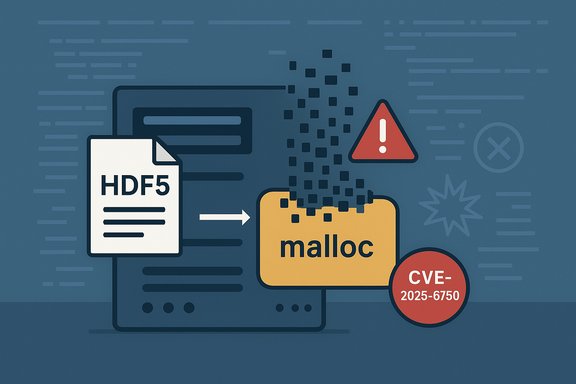
A heap-based buffer overflow has been reported in HDF5 v1.14.6: the function H5O__mtime_new_encode in src/H5Omtime.c can be manipulated to write past an allocated heap buffer (CVE‑2025‑6750), a defect tracked publicly with a working proof‑of‑concept and tracked by distribution vendors and security databases.
HDF5 (Hierarchical Data Format 5) is a widely used binary container and runtime library for scientific datasets, imagery, and structured storage. It exposes C APIs that many higher‑level toolchains, scientific packages and server processes link into directly. HDF5’s broad deployment across desktop, HPC, cloud ingestion and embedded toolchains means memory‑safety flaws inside the library can have outsized operational impact when untrusted or malformed files reach a process that links the library. Several HDF5 vulnerabilities were disclosed around the 1.14.6 release window, creating a cluster of memory‑safety concerns developers and packagers had to triage.
The specific entry for CVE‑2025‑6750 identifies the faulty routine as H5O__mtime_new_encode in src/H5Omtime.c and describes a heap‑based buffer overflow that requires local access (attack vector: local). Public trackers report that a proof‑of‑concept and at least one exploit artifact exist, which increases the urgency for affected deployments. Multiple vendor and distribution advisories list the CVE and provide varying severity assessments (CVSS v3.1 ≈ 3.3; CVSS v4.0 ≈ 4.8 in some feeds).
Source: MSRC Security Update Guide - Microsoft Security Response Center
 Background
HDF5 (Hierarchical Data Format 5) is a widely used binary container and runtime library for scientific datasets, imagery, and structured storage. It exposes C APIs that many higher‑level toolchains, scientific packages and server processes link into directly. HDF5’s broad deployment across desktop, HPC, cloud ingestion and embedded toolchains means memory‑safety flaws inside the library can have outsized operational impact when untrusted or malformed files reach a process that links the library. Several HDF5 vulnerabilities were disclosed around the 1.14.6 release window, creating a cluster of memory‑safety concerns developers and packagers had to triage.The specific entry for CVE‑2025‑6750 identifies the faulty routine as H5O__mtime_new_encode in src/H5Omtime.c and describes a heap‑based buffer overflow that requires local access (attack vector: local). Public trackers report that a proof‑of‑concept and at least one exploit artifact exist, which increases the urgency for affected deployments. Multiple vendor and distribution advisories list the CVE and provide varying severity assessments (CVSS v3.1 ≈ 3.3; CVSS v4.0 ≈ 4.8 in some feeds).
What the bug is — technical summary
The vulnerable code path
The vulnerability resides in the code that encodes modification‑time metadata into an HDF5 object header (the mtime object encoding). The implicated function constructs an encoded representation of an object's modification time and writes that representation into a heap buffer before returning it to higher layers of the library. Under certain manipulations of inputs and internal length computations, the code can proceed to write more bytes than the allocation can hold — a classic heap overflow (CWE‑122). Public vulnerability records name the source file and function precisely and point to reproducer evidence.Trigger and attacker model
- Attack vector: Locally triggered by processes that call into the vulnerable routine (attackers need the ability to cause the vulnerable code path to run on the target process). Several trackers mark the attack vector as local, though practical remote triggering can occur when a service accepts uploaded .h5 files and processes them on the server (upload → server parsing = remote‑triggerable in practice).
- Privileges: Low to medium; the vulnerability does not require kernel privileges, but the attacker must be able to cause a vulnerable process to parse crafted HDF5 content or to perform the specific object‑creation paths that call the mtime encoder.
- Observable effects: crashes (availability loss), heap corruption, and potential information leakage depending on the code path executed after the overflow. Public PoCs demonstrate crashing behavior. Claims of reliable remote code execution are speculative without additional exploit chaining.
Scope: affected versions and packaging status
- Confirmed affected: HDF5 v1.14.6 is listed as the vulnerable release in canonical trackers. Many Linux distribution trackers and security advisories map this CVE to packages that either shipped or re‑packaged 1.14.6.
- Upstream and patch artifacts: The upstream HDF Group issue and PR flow is referenced by distribution trackers (for example, GitHub issue numbers and commits appear in Debian’s tracker and other vendor pages). Where a formal HDF Group consolidated security advisory is absent or sparse, packagers have relied on upstream commits and PRs to prepare backports and releases. Administrators should verify that their vendor package changelogs explicitly include the upstream commit(s) that fix the mtime encoder path.
- Distribution responses vary: Different OS vendors and packagers assigned different priorities and released updates on differing schedules. Some vendors treat the issue as moderate/low (based on the local attack vector and expected impact), while others flagged it as medium due to PoC availability and HDF5’s broad usage.
Why this matters in practice
Ubiquity of HDF5 in data pipelines
HDF5 is commonly embedded in scientific tools, Python extensions, container images and server‑side ingestion services. Where a server or daemon accepts user‑provided .h5 files (uploads, automated conversion, thumbnailing, preview generation, cloud ingestion), a local or semi‑remote vulnerability can quickly become remotely exploitable in practice: the attacker uploads a crafted file which the server then parses using an unpatched HDF5 library. Several prior HDF5 memory‑safety defects demonstrate this pattern repeatedly.PoC existence shortens attacker lead time
Multiple trackers and aggregators list a public proof‑of‑concept or reproduction artifacts for HDF5 memory defects from the same release window. A public PoC materially lowers the barrier for attackers and penetration testers to weaponize the flaw. That means defenders should prioritize mitigation where processes parse untrusted HDF5 content.Exploitability nuance: DoS vs. RCE
- Denial‑of‑Service (DoS): Immediate and reliable. Heap overflow → crash is a typical and easily reproducible outcome in many environments. PoCs often demonstrate crashing behavior.
- Arbitrary code execution (RCE): The leap from a heap overflow to reliable RCE depends on allocator behavior, ASLR, RELRO/PIE, hardened allocators and platform architecture. While skilled attackers can sometimes chain heap corruptions into code execution, public advisories that accompany CVE‑2025‑6750 do not establish a widely‑verified RCE primitive; treat RCE claims as speculative unless independent exploit writeups demonstrate it.
Evidence and confidence in the report
- Multiple independent vulnerability feeds (NVD, Debian, Ubuntu, SUSE mirrors, public CVE aggregators) list CVE‑2025‑6750, cite the same vulnerable function, and place the bug in HDF5 1.14.6. This cross‑corroboration across CI/packaging pages and national vendors gives high confidence that the vulnerability exists and is correctly characterized at a high level.
- Distribution trackers and issue threads reference specific GitHub issues, PRs and commits tied to HDF5 fixes for the 1.14.6 release window — evidence that maintainers and packagers had concrete remediation artifacts to work with. Administrators can therefore verify fixes by checking for the referenced commit IDs in their package changelogs.
- Caveat: while the vulnerability’s basic mechanics and location are corroborated, some scoring and impact characterizations differ between trackers. For example, CVSS v3.1 values reported in the wild range from low (≈3.3) to distributor-assigned higher values depending on local policy; CVSS v4.0 entries sometimes show a medium ranking (≈4.8) in aggregators. Scoring differences reflect different threat models and do not alter the underlying correctness of the technical finding, but they do affect prioritization decisions.
Recommended mitigation and remediation playbook
Apply remediation in order of correctness and operational practicality. The single correct fix is to install an HDF5 build that includes the upstream fix for the mtime encoder. Where vendor packages are not yet available, follow the compensating controls below.- Inventory and exposure mapping (first 24–72 hours)
- Identify all binaries, Python wheels, containers, images, firmware and static artifacts that include HDF5 v1.14.6 or that bundle HDF5 source code.
- Pay special attention to server processes that accept or automatically process uploaded HDF5 files (web endpoints, ingestion pipelines, preview/thumbnailing workers, HPC job pipelines).
- Patch and rebuild (preferred)
- Apply vendor updates that explicitly mention CVE‑2025‑6750, or rebuild HDF5 from upstream source including the commit/PR that fixes the H5Omtime.c overflow. Verify package changelogs reference the fix commit.
- Rebuild any statically linked binaries and container images that embed HDF5. Static linking means the only way to remediate is a rebuild with patched source.
- If immediate patching is impossible: temporary mitigations
- Block or require authentication for uploads of .h5 files until patched builds are deployed.
- Sandbox/process isolate HDF5‑using services: run them in containers, with seccomp, AppArmor/SELinux profiles, reduced capabilities, and minimal privileges.
- Disable automated processing pipelines that open arbitrary HDF5 content where feasible; require manual review or processing in a hardened environment.
- Enforce maximum file size/complexity limits and strict validation for file inputs; reject files that include unusual objects or metadata that would exercise the mtime encode path.
- Monitoring and detection
- Enable crash reporting and telemetry for processes that use HDF5; watch for unexpected core dumps or repeated process restarts.
- Monitor for indicators of PoC use or reproduction attempts in repositories and telemetry feeds; post‑disclosure PoCs often lead to scanning and mass‑trawling attempts.
- Long‑term: secure software supply and CI
- Run fuzzing or targeted unit tests against object header encoding/decoding paths in HDF5 as part of CI. Failure cases in object encoding/decoding historically produce memory‑safety issues; automated fuzzing helps find regressions early.
Operational nuance and risk tradeoffs
- Local vs. remote confusion: Although the canonical attack vector is local, real‑world services that parse uploaded HDF5 files make the vulnerability remotely triggerable via unauthenticated uploads in many architectures. Treat any server‑side HDF5 processing as high risk until patched.
- Static linking complicates remediation: Many scientific stacks and embedded devices include statically linked libraries. Those builds require rebuilds and redeployments to remediate — an operational burden that sometimes delays patch adoption. Inventory static linkages early.
- Scoring inconsistency: Different trackers produce different CVSS numbers. Use vendor guidance and local threat models to prioritize remediation rather than relying solely on a single numeric score. The presence of a PoC should raise urgency regardless of whether CVSS is low or medium.
- RCE remains speculative: Current public records and vendor notes emphasize crash and heap corruption effects first; escalation to reliable arbitrary code execution has not been demonstrated in authoritative advisories at disclosure. Treat RCE as a conditional risk that depends on your process hardening and exploitation mitigations.
Quick checklist for sysadmins and developers
- Confirm whether any production or development host runs HDF5 v1.14.6.
- If yes, identify which processes call HDF5 APIs and whether those processes accept external .h5 files.
- Prioritize patching packages that note CVE‑2025‑6750 in their changelogs. If vendor patches are unavailable, rebuild HDF5 from upstream containing the fix commits referenced in distributor trackers.
- Temporarily block or authenticate HDF5 uploads; run parsers in hardened sandboxes.
- Watch telemetry for crashes; rotate logs and collect core dumps for forensic analysis if crashes begin appearing.
Conclusions and editorial assessment
CVE‑2025‑6750 is a confirmed heap overflow inside HDF5 v1.14.6’s mtime encoding routine. Cross‑referenced vendor and distribution trackers corroborate the issue’s existence and location, and proof‑of‑concept evidence is publicly reported; that combination elevates the vulnerability from speculative to actionable. The highest immediate impact is availability (crashes and denial‑of‑service), with possible integrity or information‑disclosure consequences in specific code paths. While remote, unauthenticated mass exploitation is not the canonical attack vector, real‑world server architectures that parse uploaded .h5 files can transform the local vulnerability into a remotely triggered DoS — and PoC code shortens the window for exploit attempts. Recommendations for operators are straightforward: inventory, patch/rebuild, and isolate untrusted HDF5 processing until a patched build is in place. Verify vendor package changelogs or upstream commit IDs before declaring systems remediated; differences in scoring and packaging timelines mean that an installed package version number alone is not definitive evidence of safety. Finally, treat claims of guaranteed remote code execution as unverified until independent exploit writeups demonstrate reliable escalation. The practical priority for most organizations is to remove the attack surface (block untrusted .h5 ingestion or sandbox it) and deploy patched HDF5 builds as soon as they’re available.Source: MSRC Security Update Guide - Microsoft Security Response Center
