

The short, practical answer is: No — Azure Linux is not proven to be the only Microsoft product that could include the vulnerable library; it is the only Microsoft product Microsoft has publicly attested to include the affected open‑source component so far. That attestation is authoritative for Azure Linux, but it is product‑scoped and not a blanket guarantee that no other Microsoft images, kernels, or artifacts ship the same vulnerable code. Microsoft has publicly committed to update the CVE / VEX records if additional Microsoft products are discovered to include the component.
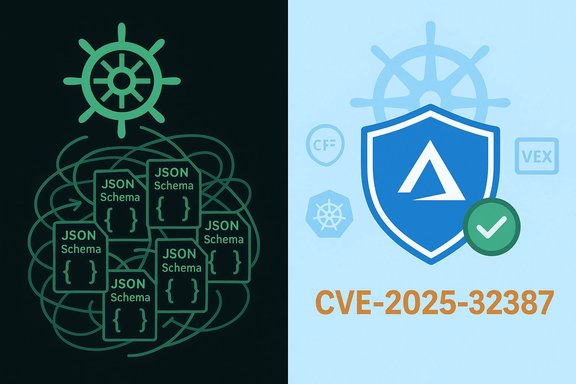
Helm — the de facto package manager for Kubernetes — was assigned CVE‑2025‑32387 after security researchers discovered that a specially crafted JSON Schema inside a Helm chart could cause the Helm process to recurse deeply while resolving $ref references and ultimately trigger a stack overflow in the parser. The issue was fixed in Helm v3.17.3; users of older Helm 3.x releases should consider those versions vulnerable until updated. This technical summary and the fixed version are confirmed by multiple vulnerability trackers and advisories. Why this matters: Helm charts are often published to public or private chart repositories and copied between machines and CI pipelines. A malicious or compromised chart containing a crafted JSON Schema could cause a crash of the Helm client or tooling that loads and validates schemas — producing denial‑of‑service (availability) on developer machines, CI runners, or automation that parses charts. Several vulnerability databases give the issue a mid‑severity score (CVSS ≈ 6.5) and classify the impact primarily as availability/DoS, though some downstream trackers discuss more severe exploitation models in specific contexts.
Two key takeaways from Microsoft’s wording:
Why that nuance matters:
Checklist: inventory, verify, patch
Source: MSRC Security Update Guide - Microsoft Security Response Center
 Background / Overview
Helm — the de facto package manager for Kubernetes — was assigned CVE‑2025‑32387 after security researchers discovered that a specially crafted JSON Schema inside a Helm chart could cause the Helm process to recurse deeply while resolving $ref references and ultimately trigger a stack overflow in the parser. The issue was fixed in Helm v3.17.3; users of older Helm 3.x releases should consider those versions vulnerable until updated. This technical summary and the fixed version are confirmed by multiple vulnerability trackers and advisories. Why this matters: Helm charts are often published to public or private chart repositories and copied between machines and CI pipelines. A malicious or compromised chart containing a crafted JSON Schema could cause a crash of the Helm client or tooling that loads and validates schemas — producing denial‑of‑service (availability) on developer machines, CI runners, or automation that parses charts. Several vulnerability databases give the issue a mid‑severity score (CVSS ≈ 6.5) and classify the impact primarily as availability/DoS, though some downstream trackers discuss more severe exploitation models in specific contexts. What Microsoft actually said — and how to read it
Microsoft’s public MSRC phrasing in its update guide that “Azure Linux includes this open‑source library and is therefore potentially affected by this vulnerability” is a product‑level inventory attestation — not an assertion that no other Microsoft product could contain the same library. That attestation means Microsoft has completed an inventory for the Azure Linux product family and confirmed the component is present in the builds they examined. It does not imply Microsoft scanned every Windows, Azure, or marketplace artifact company‑wide. Microsoft also said it began publishing machine‑readable CSAF/VEX attestations as part of a phased transparency program and will update the CVE if additional Microsoft products are identified.Two key takeaways from Microsoft’s wording:
- Authoritative yes for Azure Linux: Treat the VEX/CSAF attestation as definitive for Azure Linux images that Microsoft maintains and distributes. If you run official Azure Linux images, assume they are in‑scope and follow the vendor remediation guidance.
- Not proof of exclusivity: Absence of an attestation for other Microsoft products is not evidence those products are unaffected — it only means Microsoft has not yet completed or published an artifact‑level inventory for them. Other Microsoft artifacts that ship the same component may also carry the vulnerability until verified.
The technical root: how a JSON Schema can collapse a stack
Helm’s chart validation supports JSON Schema to validate values.yaml and other inputs. The parser implementation follows $ref links when evaluating schema references. A carefully constructed set of schema files can create deeply nested or recursive reference chains (self‑references or cyclical references). Because the parser resolves references recursively, this can cause:- repeated function calls that grow the call stack,
- eventual exhaustion of the process stack space,
- a runtime panic, crash, or stack overflow inside the Helm process.
- Attack vector: a malicious chart published to a repository, or a chart file received by a developer/CI system that runs Helm with schema validation. Many trackers treat the vector as network‑reachable if users download/consume charts.
- User interaction: installation/inspection of the chart typically triggers the parsing (some advisories indicate a UI:R characteristic in the CVSS vector), meaning user or pipeline action is required.
- Impact: primarily denial‑of‑service (Helm crash), though context (such as privileged CI runners, container escape chains, or poorly sandboxed automation) can amplify risk or lead to more severe outcomes in specific environments.
Is Azure Linux the only Microsoft product that includes this open‑source library?
Short answer: No — Azure Linux is the only product Microsoft has explicitly attested to so far, but other Microsoft artifacts may also include the same vulnerable component until verified.Why that nuance matters:
- Microsoft’s public VEX/CSAF rollout began with Azure Linux, as a phased approach to producing machine‑readable attestations for product families. Because of that phased model, Microsoft can say with confidence whether Azure Linux includes the component — but other products (e.g., WSL kernels, linux‑azure kernel packages, Marketplace VM images, AKS node images, and other images Microsoft ships) are separate artifacts that require their own inventory checks. Microsoft has expressly said it will update CVE entries and attestations if it identifies other impacted Microsoft products.
- Kernel and library reuse across multiple artifacts means the presence of a library is a build‑time attribute. Two different Microsoft kernels or images built from the same upstream tree can differ based on CONFIG_* flags, backports, or vendor patches — each shipping artifact must be checked individually.
Verification: How to check whether your Microsoft artifacts are carriers
Operators should treat each artifact independently and perform tangible checks rather than relying on high‑level vendor statements.Checklist: inventory, verify, patch
- Inventory all places where Helm is installed or run:
- Developer machines and laptops
- CI/CD runners (GitHub Actions, Azure DevOps, Jenkins agents)
- Build servers and release pipelines
- Kubernetes operator toolchains and platform automation
- Any Microsoft‑distributed images or appliances that include Helm (Azure Marketplace, curated VM images)
- For each host or runner, determine the Helm version:
- helm version --short
- If Helm < v3.17.3 (or other fixed version indicated by vendor), mark it vulnerable and schedule upgrades.
- For chart repositories and registries:
- Scan charts for JSON Schema files (*.schema.json, Chart schemas included in the chart package) and audit for suspicious $ref patterns.
- Enforce scanning in the developer workflow and CI before chart publication.
- For Microsoft‑supplied images or kernels:
- For images like Azure Linux, apply Microsoft’s VEX/CSAF guidance and use the vendor‑provided updates.
- For WSL, Marketplace images, or linux‑azure builds, verify the shipped Helm binary/version and the kernel/library build artifacts for the vulnerable component. Don’t assume Azure Linux attestation covers these other artifacts — they are separate.
- Apply Least Privilege and sandboxing:
- Run Helm operations in constrained, ephemeral environments (e.g., ephemeral CI runners, containerized helper jobs) where a crash cannot impact host integrity.
- Avoid exposing Helm’s client endpoints or automation to untrusted chart sources.
- Helm version check:
- helm version --short
- Search charts for schema files:
- find . -type f -name "schema.json" -print
- Inspect schema $ref patterns (simple grep):
- grep -R "\"\$ref\"" charts/ | sed -n '1,200p'
Remediation and mitigation guidance
Immediate steps for operators- Upgrade Helm: update any Helm installations to Helm v3.17.3 or later (the release where the parser defensive checks were added). This is the single most effective step to eliminate this attack vector for clients and tooling that use Helm.
- Harden CI and pipeline processes: ensure charts are scanned before acceptance into internal registries. Prevent automatic installation of charts from unknown public sources by default.
- Limit chart ingestion: add policies to reject charts that contain complex or external schema references unless reviewed.
- Monitor for Microsoft updates: subscribe to Microsoft’s VEX/CSAF feeds and MSRC update guide for any expansion of affected‑product attestations (Microsoft has stated it will update CVEs with additional product impact when discovered).
- Add schema recursion depth checks as part of any internal JSON Schema validation libraries used by your platform if you implement your own schema resolvers.
- Treat third‑party content as untrusted: apply content isolation, scanning, and sandboxing for parsing steps that accept remote schemas.
- Automate inventory and SBOM collection for all managed images and infrastructure to make future attestations and triage faster and less error‑prone.
Exploitation likelihood and operational risk model
Multiple scan and vendor trackers assign a moderate CVSS score and a low EPSS in early observations, indicating public exploitation was not widespread at the time of disclosure. The exploit requires delivery of a malicious chart (network‑accessible), plus user or automation action to trigger parsing. That makes it a credible but not trivially wormable threat. However, environments that automatically validate or process charts from third‑party feeds in a high‑privilege context (shared CI runners, cloud build services, or unmanaged developer laptops in corporate networks) are the highest risk and should be remediated first. In short:- High‑risk scenarios: automated pipelines that validate and install charts without adequate isolation; multi‑tenant CI runners; public registries that replicate charts into internal systems.
- Lower‑risk scenarios: manually invoked Helm commands on isolated developer laptops that are patched promptly.
Why Microsoft’s product‑scoped attestation approach matters for operators
Microsoft’s adoption of the CSAF/VEX attestation model is a positive step for transparency: the vendor’s machine‑readable attestations allow automation to triage and prioritize patching for specific product families. But the rollout is phased and product‑scoped (Azure Linux began the program), so the presence of an attestation confirms the vendor inspected a specific product — it does not certify a vendor‑wide absence. Practically, that means:- Use Microsoft’s attestations as authoritative for the specific product they name.
- Do not interpret the lack of an attestation for another Microsoft product as a negative result. Instead, treat it as unknown until confirmed by Microsoft or by your artifact inspection.
Recommended runbook (concise, actionable)
- Inventory all Helm clients and runners in your estate.
- Patch Helm to v3.17.3+ everywhere you control.
- Block or isolate ingestion of charts from untrusted public registries until you have scanning in place.
- Scan all charts in your private registries for JSON Schema files and suspicious $ref usage.
- For any Microsoft-distributed image (Azure Linux, WSL, Marketplace images), consult Microsoft VEX/CSAF feeds and perform artifact checks yourself if the image is critical to your operations. Treat an Azure Linux attestation as a “yes” for that product; treat other Microsoft artifacts as “unknown” until attested.
- Document exceptions and apply compensating controls (e.g., run Helm in sandboxed containers, use ephemeral runners).
Strengths, limitations, and potential risks — a critical appraisal
Strengths- Microsoft’s move to publish machine‑readable CSAF/VEX attestations is an important operational improvement for customers who need deterministic inventory signals and automation hooks for triage. That enables faster, scriptable decision making when a CVE appears.
- The Helm fix is normative and contained: imposing recursion limits and returning a safe parse error eliminates the root crash condition for affected Helm releases, making remediation straightforward for those who can apply the update.
- Vendor attestations are product‑scoped and phased — they do not exhaustively prove the absence of vulnerable components across an entire vendor portfolio. Operators must perform artifact‑level verification until attestations are complete. Misreading an attestation as universal can lead to blind spots.
- The primary remediation (upgrade Helm) will not address vulnerable charts or registries; legacy or unpatched consumers of charts may still crash when processing malicious charts. Chart scanning and repository hygiene remain necessary.
- Environments that automatically consume/unpack charts without isolation remain vulnerable to supply‑chain amplification: a single malicious chart can affect many build agents or developer machines.
- Whether Microsoft has discovered additional affected products — Microsoft stated it will update the CVE/VEX entries if it finds others, but until that happens, we cannot confirm further impact. That is an open, time‑sensitive item; operators must watch vendor feeds.
- Any claims about in‑the‑wild exploitation should be treated cautiously and verified via telemetry and vendor reports — early EPSS/scan values and vendor notes listed low to no active exploitation at disclosure in multiple trackers.
Conclusion — what WindowsForum readers need to do now
- Treat Microsoft’s statement about Azure Linux as an authoritative yes for Azure Linux only; do not assume it means other Microsoft products are safe. Microsoft will update the CVE/VEX entries if and when it finds additional affected products.
- Immediately upgrade any Helm instances to v3.17.3 or later and add chart‑scanning gates in CI and chart registries.
- Inventory all places Helm runs, including developer machines, CI runners, and Microsoft‑provided images; verify versions and apply updates or isolation controls.
- Automate monitoring of MSRC / CSAF / VEX feeds and relevant distro/vendor advisories for changes to product mappings and additional attestations.
- Apply defenses in depth: patching plus sandboxed parsing, chart scanning, and least‑privilege execution minimize the operational blast radius of malicious charts.
Source: MSRC Security Update Guide - Microsoft Security Response Center
