

Hertz’s experiments with Microsoft Power Platform show how a global mobility business can turn frontline pain points into measurable automation and AI wins — a pragmatic, low-code pathway from tactical fixes to strategic modernization that’s already delivering employee productivity gains and faster customer support responses.
Hertz is a global mobility and vehicle rental business operating the Hertz, Dollar, Thrifty, and Firefly brands across roughly 11,000–11,400 rental locations in about 160 countries, with roughly 26,000 employees and a fleet measured in the hundreds of thousands. Those scale numbers matter: any platform choice must support distributed frontline teams, fast operational changes, and strict data controls. Facing those constraints, Hertz launched a technology modernization program that prioritizes rapid, high-impact wins. A central pillar of the effort has been adopting Microsoft Power Platform — notably Power Apps, Power Automate, Dataverse, and Copilot Studio — to build low-code apps and AI agents that integrate with Microsoft Teams and Microsoft Shifts to reduce friction in scheduling, operations, and customer service. The public case study published by Microsoft describes two representative projects: a “Start My Day” / “Plan My Day” Power Apps solution that consolidates shift and location data for hourly workers, and an AI-driven roadside-assistance agent (internally called “Manny”) built in Copilot Studio that helps customer reps locate vehicle-specific instructions quickly.
However, prudent IT leaders must balance enthusiasm with disciplined governance. Key actions before scaling:
Moving from pilots to enterprise change will require disciplined governance, lifecycle controls, and cost oversight. When those elements are present, low-code and agentic AI can become not just a set of productivity tools but a strategic force multiplier for large, distributed businesses.
Source: Microsoft Hertz drives process automation and AI-enabled innovation with Power Platform | Microsoft Customer Stories
 Background / Overview
Hertz is a global mobility and vehicle rental business operating the Hertz, Dollar, Thrifty, and Firefly brands across roughly 11,000–11,400 rental locations in about 160 countries, with roughly 26,000 employees and a fleet measured in the hundreds of thousands. Those scale numbers matter: any platform choice must support distributed frontline teams, fast operational changes, and strict data controls. Facing those constraints, Hertz launched a technology modernization program that prioritizes rapid, high-impact wins. A central pillar of the effort has been adopting Microsoft Power Platform — notably Power Apps, Power Automate, Dataverse, and Copilot Studio — to build low-code apps and AI agents that integrate with Microsoft Teams and Microsoft Shifts to reduce friction in scheduling, operations, and customer service. The public case study published by Microsoft describes two representative projects: a “Start My Day” / “Plan My Day” Power Apps solution that consolidates shift and location data for hourly workers, and an AI-driven roadside-assistance agent (internally called “Manny”) built in Copilot Studio that helps customer reps locate vehicle-specific instructions quickly. What Hertz built: concrete solutions and architecture
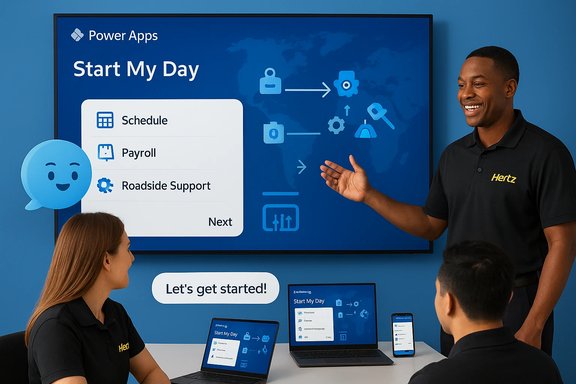
The “Start My Day” (Plan My Day) app — frontline planning in one screen
The “Start My Day” app consolidates multiple data sources — Microsoft Shifts for roster information, Palantir-derived operational data, and daily "huddle sheets" — into a single Power Apps interface backed by Dataverse and synchronized via Power Automate flows. The app:- Pulls scheduled shifts from Microsoft Shifts into Dataverse.
- Displays location-specific demand signals (cars due for pickup/return) so agents know daily load.
- Updates payroll/HR systems (ADP) automatically when roster changes are made in the app.
“Manny” — a Copilot Studio agent for roadside and vehicle help
Hertz used Microsoft Copilot Studio to build a natural-language agent that helps customer service reps answer vehicle-specific questions. Instead of searching multiple manuals and SharePoint pages, reps query Manny with natural language prompts like “How do I activate the lane assist on this model?” The agent:- Aggregates a tightly curated set of knowledge sources (manufacturer sites, government VIN lookup pages, instructional video links).
- Returns step-by-step guidance and quick links that reps can share with customers.
- Can be improved iteratively by refining topic prompts and limiting sources to trusted sites.
Why Power Platform made sense for Hertz
- Tight integration with Microsoft 365 and Teams: The ability to link Power Apps and Copilot Studio to Microsoft Shifts and Teams reduced integration friction and kept the experience inside tools employees already use. This lowers adoption barriers for distributed, hourly workforces.
- Speed of delivery with citizen + pro developer mix: Hertz’s example shows that small teams and even employees with limited agent-building experience can deliver production-usable features quickly on Power Platform. This is the central promise of low-code: accelerate time-to-value and scale use cases that would otherwise wait in backlog.
- Governance with guardrails: Hertz highlights that Copilot Studio allowed them to balance enablement and control — enabling makers to explore AI while enforcing constraints on data sources and prompt behavior. This is essential for regulated or customer-facing scenarios.
- Documented economic upside for similar programs: Independent TEI/ROI research commissioned on Power Platform shows sizable productivity and cost benefits when applied consistently across an enterprise — for example, Forrester’s composite analyses for Power Apps/Power Platform found large time savings and strong ROI over a multi-year horizon. While those studies model a composite organization, they support the claim that low-code platforms can produce measurable returns when governed and scaled.
- Community and product momentum: More broadly, Power Platform’s ecosystem (community templates, governance tooling, Copilot integrations) is accelerating feature adoption and providing templates for operational use cases that look very similar to Hertz’s needs. Industry newsletters and community threads reinforce that Power Platform updates are focused on agentic AI, process mining, and improving ALM/CI-CD for low-code teams.
Measurable benefits and the case for scale
Hertz’s public materials emphasize two practical outcomes from the early pilots:- Faster employee planning and fewer manual payroll adjustments thanks to automated synchronization between scheduling and payroll systems.
- Reduced time-to-resolution for certain customer support questions via the Manny agent (pilot reduction >15%).
Critical analysis — strengths and what Hertz executed well
Speed, practicality, and focus on frontline pain
Hertz chose problems that are operationally critical and easy to observe: shift planning, daily huddle data, and vehicle-specific troubleshooting. These are well-scoped, high-frequency workflows where time savings compound quickly. The decision to build a single-pane app and an agent that uses a limited, trusted knowledge set shows practical risk-management: build the value first, then expand.Using the Microsoft stack reduces friction
Because many enterprises already run Microsoft 365/Teams and ADP for payroll, Power Platform’s integration points deliver a low-friction path to production. Integrating Shifts into a Power Apps UI, then writing back to ADP via Power Automate, is an example of system-of-record consolidation rather than full re-architecture — a pragmatic, lower-risk modernization pattern.Incremental governance and reuse
Hertz’s mention of Copilot Studio guardrails and limiting data sources demonstrates good discipline at pilot stage: restrict the scope of intelligence, control the knowledge base, and iterate. That approach reduces hallucination risk and makes results auditable — vital for customer-facing agents.Critical analysis — risks, limitations, and governance concerns
Despite the clear benefits, the Hertz story also surfaces broader risks that enterprise IT leaders must weigh:- Vendor concentration and lock-in: Building on Power Platform deepens dependence on Microsoft’s ecosystem. That improves integration but consolidates architectural and commercial risk. Strategies to mitigate include negotiated exit clauses, data export plans, and cross-platform abstraction for critical services.
- Model and data consumption costs: Agentic AI and Copilot features can incur variable cloud and model consumption costs. Without consumption governance and environment-level caps, runaway costs are possible. Budgeting for model usage and Dataverse storage is essential before large-scale rollout.
- Data governance and privacy: Agents that access vehicle manuals, customer records, or VIN-linked consumer data must be governed for PII and regional requirements (GDPR, PCI where applicable). Ensuring prompt logs, data lineage, and retention policies is essential for compliance and audit readiness.
- Quality of knowledge sources and hallucination risk: Hertz’s team improved performance by restricting sources to trusted manufacturer pages and a VIN lookup site — a smart defense against inaccurate outputs. However, scaling the agent to more locations, languages, and models increases the surface area for erroneous guidance unless metadata, versioning, and periodic human-in-the-loop review are institutionalized.
- Shadow IT and uncontrolled maker sprawl: Low-code democratization can foster innovation — but it also multiplies endpoints that must be monitored. A center-of-excellence (CoE) approach, environment controls, and ALM patterns are necessary to prevent security and maintainability problems as hundreds of makers start publishing automations. Forrester’s TEI research and community guidance consistently highlight this as a common scaling trap.
- Measuring true business impact: Pilot-level percentage improvements (for example, Hertz’s reported 15% reduction in resolution time) are credible and valuable, but they are early-stage and not yet independently audited. Care should be taken to measure both direct savings and downstream effects (customer satisfaction, rework rates, error reduction) before extrapolating to enterprise ROI. The Microsoft story explicitly frames the Manny result as a pilot improvement. Treat pilot metrics as directional and validate at scale.
A practical rollout playbook for other travel & mobility operators
- Identify a single, high-frequency pain: pick a scenario where time savings compound (shift swaps, daily operational briefings, or common customer troubleshooting).
- Build a minimum-viable app/agent: use Power Apps + Power Automate + Dataverse for the UI and integration; use Copilot Studio for agentic experiments.
- Restrict knowledge sources: for initial agents, limit sources to a small set of trusted sites or internal manuals.
- Enforce environment-level guardrails: use Managed Environments, CoE tooling, and environment quotas for model/API consumption.
- Instrument outcomes and audit logs: collect time-to-resolution, manual steps avoided, and user-satisfaction feedback. Log prompts, sources, and model versions.
- Iterate and expand with human-in-the-loop reviews: use periodic audits to refine prompts, add new sources, and expand agent tasks.
- Plan for lifecycle and exit: ensure exportable data models and documented APIs to avoid vendor lock-in or migration pain later.
Technical considerations and architecture checklist
- Use Dataverse as the canonical store for consolidated shift and operational data.
- Surface roster and operational signals in Power Apps and host within Teams for maximal adoption.
- Use Power Automate for sync flows between Shifts, Dataverse, and downstream systems (ADP, Palantir feeds).
- Build agents in Copilot Studio, restrict knowledge sources, and use model version controls.
- Enforce telemetry: prompt logs, query latency, and accuracy feedback loops are non-negotiable.
- Apply role-based access control (RBAC) and machine identity management for agent and connector credentials.
The broader context: why this matters for IT leaders
Low-code + agentic AI is maturing into a pragmatic enterprise toolset — but success is not automatic. The Hertz story is instructive because it:- Focuses on operational value at scale rather than speculative AI experiments.
- Leverages existing Microsoft investments to shorten the integration runway.
- Embeds guardrails early, rather than retrofitting governance after sprawl.
Final assessment — strengths, caveats, and next steps
Hertz’s Power Platform program demonstrates a strong, repeatable pattern: identify high-frequency manual tasks, replace brittle Excel/manual processes with a Power Apps front end, use Power Automate for integration, and experiment with Copilot Studio agents where natural-language assistance can replace time-consuming searches. The early results — notably the pilot reduction in resolution time and the streamlined shift-to-payroll flows — are exactly the kinds of velocity wins that justify a scaled program.However, prudent IT leaders must balance enthusiasm with disciplined governance. Key actions before scaling:
- Build a CoE to manage environments, templates, and telemetry.
- Budget for model consumption and Dataverse storage as distinct line items.
- Restrict and version agent knowledge bases and log prompts for auditability.
- Tie pilot KPIs to measurable, auditable business outcomes before enterprise extrapolation.
Conclusion
Hertz’s Power Platform journey is a clear demonstration of modern enterprise automation: rapid, low-code innovation delivered inside a familiar productivity stack and governed enough to be useful in customer- and operations-facing scenarios. The company’s pragmatic pilots — a frontline planning app and an agent that reduces resolution time for vehicle questions — show how targeted automation can free employee time, reduce manual rekeying, and improve service speed.Moving from pilots to enterprise change will require disciplined governance, lifecycle controls, and cost oversight. When those elements are present, low-code and agentic AI can become not just a set of productivity tools but a strategic force multiplier for large, distributed businesses.
Source: Microsoft Hertz drives process automation and AI-enabled innovation with Power Platform | Microsoft Customer Stories
