

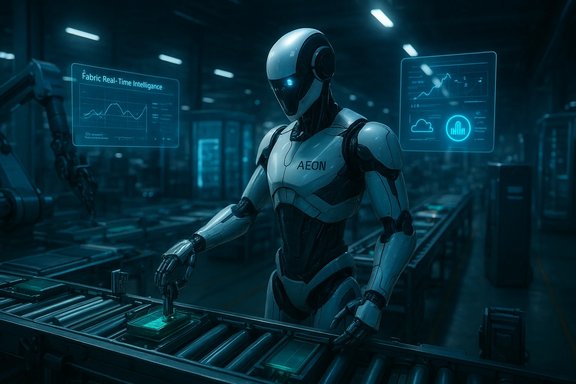
Hexagon Robotics’ new partnership with Microsoft is a clear signal that humanoid robots are moving from research labs toward production-ready industrial deployments, and that major cloud providers are positioning themselves as the connective tissue between robotics hardware and enterprise-scale automation. Announced at CES and detailed in Hexagon’s robotics disclosures, the collaboration pairs Hexagon’s AEON humanoid hardware and sensor-fusion stack with Microsoft’s cloud, data and edge platforms — most prominently Microsoft Fabric Real‑Time Intelligence, Azure IoT Operations, and Azure App Service — to accelerate real‑time telemetry, model training, and the at-scale rollout of physical AI for manipulation and inspection tasks.
Hexagon introduced AEON — a humanoid robot purpose‑built for industrial environments — in mid‑2025, positioning it as a practical solution for manufacturing, aerospace and logistics customers facing chronic labour gaps and complex inspection requirements. AEON bundles locomotion, high‑fidelity sensing and on‑device reasoning, and Hexagon has publicly indicated pilots with industrial partners such as Schaeffler and Pilatus. The company has also named strategic partners across the stack, including NVIDIA for compute and simulation and maxon for actuation. The January 2026 announcement frames the Microsoft alliance as a technology and go‑to‑market partnership: Hexagon brings sensor fusion, spatial intelligence and robot hardware; Microsoft brings cloud scale, data fabrics and real‑time analytics. Together they plan to scale imitation learning, reinforcement learning (RL) and multimodal vision‑language‑action models to produce industrial humanoids that can be trained, monitored and updated from concept through factory‑floor rollout. Independent press coverage and distributed press releases confirm the collaboration and the focus areas named by Hexagon.
Source: Menafn.com Hexagon Robotics Partners With Microsoft To Advance Humanoid Robots For Industry
 Background
Hexagon introduced AEON — a humanoid robot purpose‑built for industrial environments — in mid‑2025, positioning it as a practical solution for manufacturing, aerospace and logistics customers facing chronic labour gaps and complex inspection requirements. AEON bundles locomotion, high‑fidelity sensing and on‑device reasoning, and Hexagon has publicly indicated pilots with industrial partners such as Schaeffler and Pilatus. The company has also named strategic partners across the stack, including NVIDIA for compute and simulation and maxon for actuation. The January 2026 announcement frames the Microsoft alliance as a technology and go‑to‑market partnership: Hexagon brings sensor fusion, spatial intelligence and robot hardware; Microsoft brings cloud scale, data fabrics and real‑time analytics. Together they plan to scale imitation learning, reinforcement learning (RL) and multimodal vision‑language‑action models to produce industrial humanoids that can be trained, monitored and updated from concept through factory‑floor rollout. Independent press coverage and distributed press releases confirm the collaboration and the focus areas named by Hexagon. What Hexagon and Microsoft are actually promising
The technical pillars
At a technical level, the partnership emphasizes a small set of well‑defined capabilities:- Real‑time telemetry and analytics: AEON’s live signals are streamed to the cloud and visualized using Microsoft Fabric’s Real‑Time Intelligence and Azure IoT Operations, enabling dashboards, anomaly detection and operational insights. Hexagon demonstrated a high‑throughput telemetry scenario at Microsoft Ignite, where AEON completed thousands of short missions while streaming live data to Fabric and Azure.
- Physical AI training loops: The companies are focusing on imitation learning, one‑shot learning and reinforcement learning methodologies to shorten task onboarding times and improve adaptability between manufacturing lines and product variants. This is central to making humanoids economical in low‑volume, high‑variety industrial environments.
- Multimodal vision‑language‑action models: Hexagon explicitly cites scaling multimodal models that link vision, language and action — the kind of architectures that allow instructing a robot with both visual context and verbal/semantic cues. The cloud provides the data infrastructure and compute for training and fine‑tuning these models at scale.
- Edge‑to‑cloud resilience: Azure IoT Operations is presented as the unified data plane from the edge to Fabric; the platform’s edge capabilities and offline modes are intended to limit operational impact from intermittent connectivity and reduce latency for critical loops. Microsoft’s documentation outlines edge‑first features for industrial scenarios, which Hexagon intends to leverage.
Early demonstrations and pilots
Hexagon’s AEON has already been showcased in production‑like settings. At Microsoft Ignite and other industry events, Hexagon and Microsoft set up telemetry pipelines that let AEON stream sensor data into Fabric RTI and IoT Operations, claiming mission runs without interruption as a stability proof point. Hexagon’s own reporting states AEON completed more than 1,600 missions during its Ignite demonstration, showing the viability of a continuous telemetry and model‑ops pipeline. Pilots with aerospace supplier Pilatus and components specialist Schaeffler were announced during AEON’s launch; those pilots are focused on machine‑tending, inspection and reality capture workflows that are familiar, high‑value entry points for industrial robotics. Hexagon has described a six‑month pilot cadence at launch, with a staged commercial rollout to follow.Why this matters for manufacturing automation
Industrial fit for humanoids
Traditional industrial robots excel at repetitive, high‑volume tasks in caged cells. Humanoids promise a different value proposition:- Flexibility to operate across multiple stations and task types without heavy fixturing
- Dexterity to deal with parts and tools shaped for human workers
- Reduced infrastructure changes because humanoids can use existing workspaces and tools
Cloud as the scaling layer
There are three pragmatic reasons why this partnership leans so heavily on Azure and Fabric:- Training scale: Multimodal and RL training requires large datasets and scalable compute that an on‑premise silo rarely delivers economically.
- Fleet telemetry and MLOps: Fabric’s Real‑Time Intelligence and Azure IoT Operations provide the plumbing for continuous model evaluation, drift detection and retraining across fleets of robots.
- Enterprise integration: Factories are complex IT/OT environments. Microsoft's ecosystem (including Azure Arc, Azure IoT, and Fabric) is positioned to bridge those silos and integrate robot telemetry with ERP, MES and quality systems.
Technical realities and limitations
Latency, safety and edge processing
A major constraint for real‑time manipulation is latency. For time‑sensitive control loops (millisecond range), cloud round‑trips are not acceptable; instead, deterministic low‑latency control must remain on the robot or local edge. Microsoft’s Azure IoT Operations is explicitly designed to process and normalize data at the edge and to operate in degraded modes when connectivity drops — a capability Hexagon cites as a required component of safe deployments. Nevertheless, system architects must segregate control plane loops from cloud analytics to avoid any safety risks.One‑shot and imitation learning: promise vs. production
One‑shot or few‑shot imitation learning is compelling: if a robot can learn a new pick‑and‑place or inspection routine from a single demonstration, the economics of deployment improve dramatically. However, the real world introduces variability (part tolerances, lighting, occlusions, wear and tear) and edge cases that often break naïve few‑shot approaches. Hexagon’s stated focus on one‑shot learning and RL is technically appropriate, but turning research prototypes into robust production models across many factories will be costly and data‑hungry. Expect extended pilot cycles and incremental task coverage rather than immediate broad generalization.Data governance and provenance
Training multimodal models demands large, labeled, and well‑curated datasets coming from live operations. That raises immediate questions about:- Data ownership: Who owns the telemetry, video and inspection logs — the equipment OEM, the factory operator, or the cloud integrator?
- Regulation and privacy: Video streams and personnel‑adjacent telemetry can implicate privacy laws and union agreements, especially in Europe and North America.
- Quality and labeling: Industrial inspection labels (pass/fail) are often noisy and require human validation to avoid propagating false positives.
Commercial outlook, pilots and buyer considerations
Where AEON fits in procurement cycles
AEON — and humanoid deployments more broadly — will likely enter factories through several pragmatic vectors:- High‑value inspections where human throughput is constrained
- Machine tending where a humanoid can augment multiple legacy machines without expensive re‑tooling
- Reality capture and digital twinning where mobility and dexterity unlock faster scans
Pricing, support and total cost of ownership (TCO)
Hexagon and Microsoft offer complementary value — but customers must evaluate:- Hardware capex and spare parts (actuators, sensors, batteries)
- Edge compute and on‑device software licensing
- Cloud compute costs for model training, telemetry ingest and continuous retraining
- Professional services for integration with MES/ERP and safety cases
Risks, ethics and governance
Safety and human coexistence
Humanoid robots operating around humans create complex safety requirements. ISO standards for collaborative robots (cobots) exist, but humanoids introduce locomotion and balance failure modes not present in fixed‑base arms. Safety engineering must include:- Redundant sensing and verified safe‑stop mechanisms
- Formal hazard analyses per deployment
- Clear human‑in‑the‑loop supervisory modes
Cybersecurity and supply‑chain risks
Robots are networked endpoints with potentially sensitive telemetry and operational control channels. Integrating with enterprise cloud increases the attack surface. Industrial buyers must demand:- Device identity and hardware root of trust
- Encrypted telemetry and secure key management
- Robust patching and incident response plans for both robotics firmware and cloud services
Workforce and social risks
Humanoid deployment raises legitimate workforce concerns. While Hexagon frames AEON as a response to shortages and a way to augment skilled staff, any automation program must be accompanied by retraining, redeployment and transparent dialogue with workers and unions. Rapid automation without social safeguards risks lowering morale and drawing regulatory scrutiny.Competitive and strategic implications
Hexagon’s move underscores several strategic realities:- Cloud vendors want to be the connective tissue for robotics fleets, not just providers of raw compute. Microsoft’s Fabric and IoT portfolio are specifically tailored to real‑time pipelines and industrial use cases, which makes this partnership strategically logical.
- Robotics manufacturers increasingly need deep partnerships: hardware must be paired with simulation, fleet management and cloud‑native MLOps to be commercially viable. Hexagon’s partnerships with NVIDIA (compute and simulation) and Microsoft (cloud and data) reflect an industry pattern of multi‑vendor stacks.
- The bar for “production‑ready” humanoids will be multifaceted: safety certification, predictable TCO, integrations to MES/ERP and demonstrable uptime metrics will separate pilots from broad market adoption. Hexagon’s pilot program and the Ignite telemetry demo are early signals but are not yet proof of broad production readiness.
Three steps manufacturers should take now
- Run a narrow, KPI‑driven pilot: Start with a single, measurable inspection or tend task. Define uptime, yield, and human‑augmentation KPIs before spending on fleet‑scale deployments.
- Require edge‑first architecture: Ensure the robotics supplier demonstrates deterministic control loops on the robot and uses cloud for analytics and model updates — not for latency‑sensitive control.
- Negotiate data governance and security SLAs: Clarify telemetry ownership, retention policies, encryption and incident response in the contract. Ensure interoperability with MES/ERP and compliance with local data rules.
Conclusion
Hexagon Robotics’ partnership with Microsoft is a consequential and realistic step in the commercialization of humanoid robots for industry. It packages a hardware‑grade humanoid (AEON), advanced sensor fusion and spatial intelligence with Microsoft’s cloud fabric, real‑time analytics and IoT operations — creating a plausible path from concept to production. Early demonstrations (including AEON’s Ignite telemetry showcase) validate that the technical plumbing can work; the harder work ahead is turning pilots into predictable, safe and cost‑effective factory deployments across varied manufacturing contexts. The promise is substantial: adaptive, multi‑task robots that reduce repetitive burdens and close labour gaps while integrating into digital twins and enterprise workflows. The risks are equally tangible: latency and safety boundaries, data governance, cybersecurity, and the economic reality of TCO and integration. Vendors, factory operators and IT teams will need to navigate these tradeoffs deliberately. Hexagon and Microsoft have articulated a roadmap; the next 12–24 months of pilots and case studies will determine whether AEON and its cloud backbone become a mainstream industrial automation pattern or remain a high‑value niche for specialist applications.Source: Menafn.com Hexagon Robotics Partners With Microsoft To Advance Humanoid Robots For Industry
