

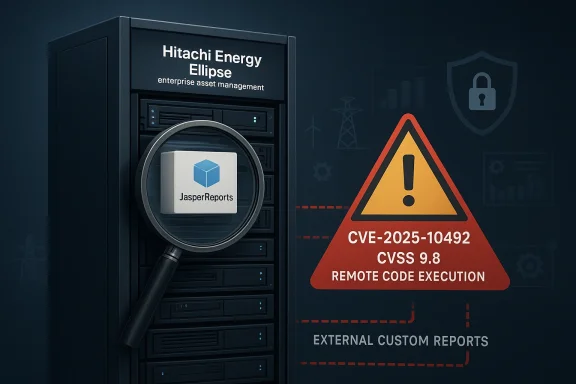
Hitachi Energy’s Ellipse enterprise asset management platform is now at the center of a high-severity industrial cybersecurity warning, after CISA republished a vendor advisory describing a critical deserialization flaw in the JasperReports component used for custom reporting. The issue is tracked as CVE-2025-10492 and carries a CVSS 3.1 score of 9.8, reflecting the possibility of remote code execution without authentication or user interaction on affected deployments. The vulnerable range includes Ellipse versions 9.0.50 and earlier, which means a large installed base may need to reassess how custom reports are handled, not just whether the application itself is patched.
Ellipse has long sat in a sensitive position inside utilities, grid operators, and other critical infrastructure environments because it touches asset management, maintenance planning, and operational workflows that bridge IT and OT. That makes any flaw in Ellipse more than a routine enterprise software bug; it is a potential pathway into environments that are deliberately segmented and tightly governed. When a vulnerability lands in a reporting subsystem, the instinct may be to treat it as peripheral, but reporting tools often ingest data from multiple business units, external users, and automated pipelines, which can broaden the attack surface in ways operators underestimate.
The advisory matters because it involves a third-party Java library, JasperReports, rather than a defect in Ellipse’s core business logic. That distinction is important, but it should not create a false sense of security. In industrial software, external components are frequently embedded deeply enough that a library vulnerability can become a platform vulnerability, especially when the component is used to render custom content or process untrusted report definitions.
CISA’s republication also signals the normal ICS playbook: minimize exposure, isolate systems, and reduce the chance that an attacker can deliver malicious inputs in the first place. For control-system-adjacent applications, the most effective defense is often architectural rather than reactive. If external users can load custom Jasper reports, or if report upload paths are loosely governed, the risk profile changes sharply even before a patch is available.
The broader context is that industrial vendors continue to publish advisories involving Java, XML, authentication, certificate validation, and deserialization weaknesses across product families. That pattern is not unique to Hitachi Energy, but it is especially consequential in its ecosystem because Ellipse and related products are used by organizations that cannot simply take a system offline for experimentation. In practice, the operational burden of mitigation can be just as significant as the vulnerability itself.
The affected versions are listed as Ellipse 9.0.50 and earlier, with Hitachi Energy identifying the product status as known affected. The vendor’s immediate mitigation is not framed as a full software fix in the republished text, but as a control measure: restrict the loading of external custom reports and allow only trusted Jasper reports generated by the system administrator. That language strongly suggests the vendor is urging customers to reduce exposure at the input layer while remediation is confirmed or rolled out.
This is not the first time industrial vendors have had to use mitigation-first guidance when third-party libraries are involved. In some cases, the underlying component sits inside a product release cycle that is slower than the vulnerability timeline, so operators are asked to enforce compensating controls while waiting for a vendor update. For critical infrastructure teams, that means security work often becomes a question of how much trust can be safely preserved in report generation, file uploads, and internal user privileges.
The timing also matters. The advisory was initially released by Hitachi Energy PSIRT on February 24, 2026, then republished by CISA on April 2, 2026. That gap is a reminder that, in ICS cybersecurity, visibility often increases only after multiple channels have validated and redistributed the same underlying risk. Organizations that rely on a single source for vulnerability awareness can miss the early window for containment.
In an enterprise reporting stack, that risk is amplified by convenience features. Custom reports are often intended to be flexible, shareable, and easy to import, which makes them productive for legitimate users but also attractive to attackers hunting for a low-friction execution path. The more a system values extensibility, the more carefully it has to police trust boundaries.
The CISA language reinforces this concern by pairing the advisory with standard control-system mitigation guidance: limit internet exposure, place systems behind firewalls, and use VPNs only as part of a layered defense. The advice is generic, but in ICS settings generic advice often exists because the underlying risk is structural. A system that was never meant to accept broad external traffic should not be made to do so simply because a report feature is convenient.
The wording around “custom reports created by end users” is especially important. That suggests the attack path may depend less on a complex exploit chain and more on how report assets are accepted, stored, and rendered. In operational terms, this means organizations need to look at their report lifecycle: who can upload reports, who can approve them, where they are stored, and whether old artifacts remain callable long after they should have been retired.
A second issue is trust inheritance. If an administrator-generated report can be modified, replaced, or masqueraded as a legitimate template, the mitigation becomes weaker than it sounds. Security teams should treat any workflow that allows import, migration, synchronization, or automated deployment of Jasper artifacts as a possible exposure point, not just the obvious user-facing upload screen.
It is also worth noting that the score can understate operational disruption. A reporting server compromised in a regulated environment may trigger password resets, service restarts, forensic preservation, network segmentation reviews, and validation of downstream data integrity. In other words, the real cost is not only exploitation; it is the cleanup, the scrutiny, and the loss of confidence that follows. That is often the bigger bill.
CISA’s republication adds the broader ICS context, including defensive advice about firewalls, isolation, minimized internet exposure, and careful use of VPNs. Those recommendations are not novel, but they are practical because they reduce the likelihood that an attacker can reach the vulnerable path in the first place. In critical infrastructure, a well-segmented environment can be the difference between a theoretical RCE and a field event.
In the near term, administrators should inventory custom report workflows, identify where Jasper artifacts originate, and lock down any process that accepts user-supplied report definitions. In the longer term, they should validate whether an updated Ellipse release or a patched JasperReports component is available through the vendor. The longer a compensating control remains in place, the more it can become part of the production workflow—and the harder it is to unwind safely.
Ellipse’s role in enterprise asset management makes it especially sensitive because asset records are not merely administrative records; they shape real-world work. If an attacker can compromise the reporting stack, the result may not be dramatic movie-style sabotage, but it can still be highly disruptive: false data, altered reports, credential theft, or a foothold for broader intrusion. That kind of compromise is often quieter, and therefore more dangerous in the first stages.
That split matters when deciding who owns the response. If the issue is handled only by application administrators, some downstream consequences may be missed. If it is handled only by security teams, the practical constraints of reporting and operations may be overlooked. The best response is joint ownership, with clear operational sign-off before disabling any report ingestion path.
It also raises the bar for competitors. Vendors selling asset management or operational software into utilities and heavy industry have an incentive to prove that embedded libraries are tracked as aggressively as their own code. That means SBOM-style inventory, secure update channels, hardening guidance, and narrower default privileges are no longer optional extras; they are part of the product story.
There is also a reputational angle. Hitachi Energy has publicly highlighted cybersecurity maturity in recent communications, including a 2025 CyberVadis Platinum rating that placed the company among the top tier of assessed organizations. That does not lessen the seriousness of the Ellipse issue, but it does show how modern industrial vendors must live with a dual narrative: security investment on one hand, and unavoidable exposure through complex software dependencies on the other.
The more mature response will be the one that treats this as a governance problem as much as a vulnerability problem. That means validating report provenance, checking service exposure, reviewing external access, and ensuring that the Ellipse instance is not quietly serving as a bridge into more sensitive systems. The organizations that come through this cleanly will be the ones that use the incident to tighten process, not just to tick a patch box.
Source: CISA Hitachi Energy Ellipse | CISA
 Overview
Ellipse has long sat in a sensitive position inside utilities, grid operators, and other critical infrastructure environments because it touches asset management, maintenance planning, and operational workflows that bridge IT and OT. That makes any flaw in Ellipse more than a routine enterprise software bug; it is a potential pathway into environments that are deliberately segmented and tightly governed. When a vulnerability lands in a reporting subsystem, the instinct may be to treat it as peripheral, but reporting tools often ingest data from multiple business units, external users, and automated pipelines, which can broaden the attack surface in ways operators underestimate.The advisory matters because it involves a third-party Java library, JasperReports, rather than a defect in Ellipse’s core business logic. That distinction is important, but it should not create a false sense of security. In industrial software, external components are frequently embedded deeply enough that a library vulnerability can become a platform vulnerability, especially when the component is used to render custom content or process untrusted report definitions.
CISA’s republication also signals the normal ICS playbook: minimize exposure, isolate systems, and reduce the chance that an attacker can deliver malicious inputs in the first place. For control-system-adjacent applications, the most effective defense is often architectural rather than reactive. If external users can load custom Jasper reports, or if report upload paths are loosely governed, the risk profile changes sharply even before a patch is available.
The broader context is that industrial vendors continue to publish advisories involving Java, XML, authentication, certificate validation, and deserialization weaknesses across product families. That pattern is not unique to Hitachi Energy, but it is especially consequential in its ecosystem because Ellipse and related products are used by organizations that cannot simply take a system offline for experimentation. In practice, the operational burden of mitigation can be just as significant as the vulnerability itself.
Background
The relevant advisory describes a vulnerability in the Jasper Reports third-party component used by Ellipse to create custom reports. According to the notice, improper handling of externally supplied data may let an attacker execute arbitrary code remotely, and the weakness is categorized as CWE-502: Deserialization of Untrusted Data. That class of bug is especially dangerous in Java ecosystems because object deserialization can trigger unintended code paths before a system has a chance to validate what it received.The affected versions are listed as Ellipse 9.0.50 and earlier, with Hitachi Energy identifying the product status as known affected. The vendor’s immediate mitigation is not framed as a full software fix in the republished text, but as a control measure: restrict the loading of external custom reports and allow only trusted Jasper reports generated by the system administrator. That language strongly suggests the vendor is urging customers to reduce exposure at the input layer while remediation is confirmed or rolled out.
This is not the first time industrial vendors have had to use mitigation-first guidance when third-party libraries are involved. In some cases, the underlying component sits inside a product release cycle that is slower than the vulnerability timeline, so operators are asked to enforce compensating controls while waiting for a vendor update. For critical infrastructure teams, that means security work often becomes a question of how much trust can be safely preserved in report generation, file uploads, and internal user privileges.
The timing also matters. The advisory was initially released by Hitachi Energy PSIRT on February 24, 2026, then republished by CISA on April 2, 2026. That gap is a reminder that, in ICS cybersecurity, visibility often increases only after multiple channels have validated and redistributed the same underlying risk. Organizations that rely on a single source for vulnerability awareness can miss the early window for containment.
Why deserialization remains so dangerous
Deserialization flaws are persistent because they collapse the distance between data and executable behavior. If an application accepts crafted serialized objects from an untrusted source, the attacker may be able to shape the program’s control flow before ordinary validation logic is applied. In plain terms, the application may end up running the attacker’s intent instead of merely reading the attacker’s data.In an enterprise reporting stack, that risk is amplified by convenience features. Custom reports are often intended to be flexible, shareable, and easy to import, which makes them productive for legitimate users but also attractive to attackers hunting for a low-friction execution path. The more a system values extensibility, the more carefully it has to police trust boundaries.
The critical infrastructure angle
Ellipse is not consumer software. It sits in the workflow of industrial operators whose uptime, maintenance history, and planning processes can influence physical infrastructure performance. That means a successful compromise may have consequences well beyond the application instance itself, especially if the reporting server has connectivity to identity systems, shared file stores, or back-end business databases.The CISA language reinforces this concern by pairing the advisory with standard control-system mitigation guidance: limit internet exposure, place systems behind firewalls, and use VPNs only as part of a layered defense. The advice is generic, but in ICS settings generic advice often exists because the underlying risk is structural. A system that was never meant to accept broad external traffic should not be made to do so simply because a report feature is convenient.
What the Vulnerability Means in Practice
At a technical level, the flaw is serious because it is both remote and pre-authentication in character. The CVSS vector listed by the advisory is AV:N/AC:L/PR:N/UI:N/S:U/C:H/I:H/A:H, which is the classic profile for a wormable or internet-reachable severe flaw if exposed services are present. Even if Ellipse is not usually exposed directly to the internet, internal exposure can still be enough for a compromised endpoint, contractor laptop, or lateral movement step to turn the weakness into an incident.The wording around “custom reports created by end users” is especially important. That suggests the attack path may depend less on a complex exploit chain and more on how report assets are accepted, stored, and rendered. In operational terms, this means organizations need to look at their report lifecycle: who can upload reports, who can approve them, where they are stored, and whether old artifacts remain callable long after they should have been retired.
Attack surface considerations
Not every Ellipse installation will face the same risk exposure. A tightly controlled environment with no external report ingestion is materially different from a shared system supporting multiple business units or third-party integrators. The problem is that many organizations only discover those distinctions during incident response, when the question is no longer can this happen? but how far could it spread?A second issue is trust inheritance. If an administrator-generated report can be modified, replaced, or masqueraded as a legitimate template, the mitigation becomes weaker than it sounds. Security teams should treat any workflow that allows import, migration, synchronization, or automated deployment of Jasper artifacts as a possible exposure point, not just the obvious user-facing upload screen.
- Internet exposure is the clearest amplifier of risk.
- Internal-only access still leaves room for lateral movement.
- Shared report libraries can preserve malicious artifacts longer than expected.
- Over-permissive roles may turn a reporting issue into a broader compromise.
- Legacy integrations can quietly reintroduce untrusted input paths.
Why the CVSS score is so high
A score of 9.8 does not mean every deployment is equally vulnerable, but it does indicate the flaw is severe enough to deserve urgent handling. The score reflects no required privileges, no user interaction, network reachability, and potentially complete compromise of confidentiality, integrity, and availability. In an industrial setting, that combination tends to drive emergency triage even when the vulnerable component is “just” a reporting engine.It is also worth noting that the score can understate operational disruption. A reporting server compromised in a regulated environment may trigger password resets, service restarts, forensic preservation, network segmentation reviews, and validation of downstream data integrity. In other words, the real cost is not only exploitation; it is the cleanup, the scrutiny, and the loss of confidence that follows. That is often the bigger bill.
Vendor and CISA Response
Hitachi Energy’s main immediate recommendation is straightforward: restrict the loading of external custom reports and permit only trusted Jasper reports created by the system administrator. That is a classic compensating control, and it makes sense because it narrows the set of inputs that can reach the vulnerable component. The downside is obvious: it may constrain collaboration, reporting flexibility, or delegated operations in environments that have grown used to open report workflows.CISA’s republication adds the broader ICS context, including defensive advice about firewalls, isolation, minimized internet exposure, and careful use of VPNs. Those recommendations are not novel, but they are practical because they reduce the likelihood that an attacker can reach the vulnerable path in the first place. In critical infrastructure, a well-segmented environment can be the difference between a theoretical RCE and a field event.
Immediate mitigation versus long-term remediation
The advisory text emphasizes mitigation more than a formal patch instruction, which usually means one of two things: either remediation is still being coordinated, or the vendor wants customers to apply an interim control before making code changes. For security teams, that distinction matters because mitigations can be reversible workarounds, while remediation is the durable fix. Both are necessary, but they solve different problems.In the near term, administrators should inventory custom report workflows, identify where Jasper artifacts originate, and lock down any process that accepts user-supplied report definitions. In the longer term, they should validate whether an updated Ellipse release or a patched JasperReports component is available through the vendor. The longer a compensating control remains in place, the more it can become part of the production workflow—and the harder it is to unwind safely.
What operators should check first
- Whether Ellipse version 9.0.50 or earlier is deployed anywhere in production or staging.
- Whether end users can upload, import, or modify Jasper reports directly.
- Whether report files are shared over network drives, ticket attachments, or automation pipelines.
- Whether the Ellipse server has broader network visibility than strictly required.
- Whether there is a documented rollback plan if report functionality must be temporarily disabled.
- Map all report sources.
- Disable untrusted imports.
- Audit administrator permissions.
- Review service account privileges.
- Confirm segmentation controls.
- Preserve logs for forensic review.
Why This Matters for Industrial Customers
Industrial customers tend to evaluate software risk through a different lens than ordinary enterprises. For them, uptime, safety, maintenance scheduling, and regulatory continuity can outweigh convenience features. A vulnerability that lives inside reporting may still be business-critical because those reports feed maintenance planning, asset status visibility, and executive decision-making.Ellipse’s role in enterprise asset management makes it especially sensitive because asset records are not merely administrative records; they shape real-world work. If an attacker can compromise the reporting stack, the result may not be dramatic movie-style sabotage, but it can still be highly disruptive: false data, altered reports, credential theft, or a foothold for broader intrusion. That kind of compromise is often quieter, and therefore more dangerous in the first stages.
Enterprise versus operational impact
For IT teams, the immediate concern is typically server compromise, data exfiltration, and service stability. For operational teams, the concern is whether a compromised system can affect maintenance workflows, change management, or trust in the asset data itself. The same vulnerability can therefore have two different blast radii, depending on how deeply Ellipse is integrated into the organization.That split matters when deciding who owns the response. If the issue is handled only by application administrators, some downstream consequences may be missed. If it is handled only by security teams, the practical constraints of reporting and operations may be overlooked. The best response is joint ownership, with clear operational sign-off before disabling any report ingestion path.
The role of third-party components
This advisory is also a reminder that supply-chain exposure is not limited to large frameworks or common web servers. A reporting library can become the most dangerous part of an otherwise mature product if it accepts untrusted input. The lesson for buyers is simple: ask not just whether the vendor patched the main application, but whether the embedded components were reviewed, updated, and isolated with equal care.- Embedded libraries matter as much as core application code.
- Third-party components may outlive the assumptions made when they were integrated.
- Reporting features are often underestimated attack surfaces.
- Operational trust can be damaged even when no physical process is directly touched.
Competitive and Market Implications
This advisory will likely influence buying conversations in industrial software in a way that extends beyond Ellipse itself. Critical-infrastructure buyers increasingly expect vendors to demonstrate not only feature depth but also secure component governance, rapid disclosure, and practical mitigations. A public 9.8-rated RCE tied to a reporting component is the kind of event that procurement and security teams remember during renewal cycles.It also raises the bar for competitors. Vendors selling asset management or operational software into utilities and heavy industry have an incentive to prove that embedded libraries are tracked as aggressively as their own code. That means SBOM-style inventory, secure update channels, hardening guidance, and narrower default privileges are no longer optional extras; they are part of the product story.
How rivals may respond
Competitors may use this moment to emphasize safer report handling, more restrictive default permissions, or reduced reliance on serializable objects. Some will highlight cloud-hosted controls, others will stress zero-trust architectures or stronger content validation pipelines. The market pressure is clear: customers do not just want a reporting feature; they want a reporting feature that can survive hostile input.There is also a reputational angle. Hitachi Energy has publicly highlighted cybersecurity maturity in recent communications, including a 2025 CyberVadis Platinum rating that placed the company among the top tier of assessed organizations. That does not lessen the seriousness of the Ellipse issue, but it does show how modern industrial vendors must live with a dual narrative: security investment on one hand, and unavoidable exposure through complex software dependencies on the other.
What customers may now demand
- Faster disclosure of embedded component vulnerabilities.
- Clearer version mapping between product releases and library versions.
- Hardening guidance that is specific, not generic.
- More restrictive defaults for custom content and imports.
- Patch timelines that distinguish between workaround and true fix.
- Independent validation of mitigation effectiveness.
Strengths and Opportunities
The good news is that the advisory gives administrators a concrete mitigation path, and that matters because many industrial vulnerabilities remain nebulous for too long. The combination of a known affected range, a clear component name, and an explicit input restriction strategy gives security teams a place to start immediately. It also offers an opportunity to tighten governance around custom reports, which can improve security well beyond this specific incident.- Clear affected scope for Ellipse 9.0.50 and earlier.
- Practical mitigation guidance centered on trusted reports only.
- Strong visibility from CISA republication.
- Opportunity to review report workflows and clean up legacy permissions.
- Chance to implement tighter asset and dependency inventories.
- A forcing function for segmentation and least privilege.
- Potential to modernize custom reporting governance.
Risks and Concerns
The most obvious risk is that organizations may treat this as a simple reporting bug and underestimate its execution potential. That would be a mistake because a deserialization flaw with remote code execution potential can become a full foothold, especially where report upload paths are exposed or poorly controlled. The second risk is that compensating controls will be adopted unevenly, leaving shadow workflows and unauthorized report sources in place.- Remote code execution if untrusted content reaches the vulnerable component.
- Shadow IT report workflows that bypass approved controls.
- Inconsistent mitigation across plants, regions, or subsidiaries.
- Overreliance on VPNs without proper segmentation.
- Delayed remediation if organizations wait for a perfect patch.
- Audit blind spots where report artifacts are not inventoried.
- Operational disruption if controls are imposed without business coordination.
Looking Ahead
The next phase will be defined less by headlines and more by execution. Organizations will need to determine whether they can safely continue using custom reports while mitigating the risk, or whether the safer path is to pause untrusted report ingestion altogether until a vendor update is available. In many industrial environments, the answer will vary by site, because no two deployments have the same network boundaries, user roles, or integration sprawl.The more mature response will be the one that treats this as a governance problem as much as a vulnerability problem. That means validating report provenance, checking service exposure, reviewing external access, and ensuring that the Ellipse instance is not quietly serving as a bridge into more sensitive systems. The organizations that come through this cleanly will be the ones that use the incident to tighten process, not just to tick a patch box.
- Confirm exact Ellipse versions in every environment.
- Disable untrusted Jasper report loading wherever possible.
- Monitor for anomalous report activity and unexpected executions.
- Review network segmentation around Ellipse servers.
- Track vendor remediation notices and release timing.
- Coordinate IT, OT, and application owners before changing controls.
Source: CISA Hitachi Energy Ellipse | CISA
