

Microsoft and Anthropic’s recent moves make plain a defining pattern of the current AI Tech Wave: powerful vertical AI capabilities — specialized, agentic applications that can do work — are being harnessed horizontally into cloud and productivity platforms, then repackaged and priced as bundled enterprise offerings. That “horizontal harness” is not a metaphor for incremental change; it describes how task-specific AI (the verticals) and distribution/governance platforms (the horizontals) combine to reshape product economics, procurement, and risk in large organizations. Michael Parekh’s “AI: Reset to Zero” framing captures this pattern and is visible in how Copilot Cowork, Anthropic’s Claude Cowork, Agent 365, and the new Microsoft 365 E7 bundle have been rolled out. verview
The last two decades of cloud and SaaS evolution teach one lesson loudly: distribution matters as much as capability. General-purpose infrastructure or productivity platforms become the “horizontal” rails through which vertical capabilities find scale. In the AI era, verticals are agentic applications — AI systems designed to plan, execute, call tools, and follow through on multi-step workflows in domains such as legal review, sales prospecting, financial analysis, and coding. Horizontals are cloud platforms, identity + governance stacks, and ubiquitous productivity suites that provide identity, compliance, tenant isolation, billing, and a frictionless route to millions of seats.
Microsoft’s March 9, 2026 announcements crystallize this dynamic. The company detailed a Wave‑3 Copilot refresh that surfaces agentic capabilities (branded Copilot Cowork), expands model diversity to include Anthropic’s Claude models inside Copilot experiences, introduces Agent 365 — a control plane for agent governance — and launches a premium package, Microsoft 365 E7: The Frontier Suite, priced and timed as a single deal to simplify procurement for enterprise AI. Microsoft’s own blog lists Agent 365 general availability (May 1) and the E7 pricing targets, and it reports adoption signals such as “tens of millions of agents” appearing in the Agent 365 Registry during preview.
Anthropic, for its part, has pushed agentic products of its own — notably Claude Cowork and “Claude for Excel” — targeting non‑developer knowledge workers with tools that can read files, act across a desktop, and orchestrate multi‑step tasks. Major outlets covered Anthropic’s Cowork releases and Mac/Windows desktop launches, and Anthropic’s integrations (and the launch of partner marketplace-like flows) helped make its vertical agent capabilities attractive for horizontal platforms to adopt.
What makes these vertical agents appealing to horizontals like Microsoft?
The short-term result: customers face choices that were previously orthogonal — which model(s) to use, how to provision agentic workflows, and whether to buy governance as a platform add-on or to stitch together their own governance stack.
The long-term result: vertical vendors that once sold point solutions may see their economics compressed if horizontal platforms package equivalent agentic experiences and include them in bundled enterprise SKUs.
The strategic lesson for enterprises is straightforward: adopt fast, but govern faster. Horizontals will continue to make agentic AI accessible. Your control plane — the policies, telemetry, and procurement guardrails you build now — will determine whether those agents become assets or liability.
For IT leaders, the answer is not to block these trends but to manage them: inventory agent usage, map subprocessors and data flows, pilot low‑risk automations, require portability where feasible, and treat agents like new digital employees that need onboarding, measurement, and oversight. The horizontal harness is here; treat it as a structural shift rather than a passing fad, and invest now in the governance, procurement literacy, and architecture needed to turn agentic AI into durable business advantage.
Source: AI: Reset to Zero AI Ramblings: Episode 46
The last two decades of cloud and SaaS evolution teach one lesson loudly: distribution matters as much as capability. General-purpose infrastructure or productivity platforms become the “horizontal” rails through which vertical capabilities find scale. In the AI era, verticals are agentic applications — AI systems designed to plan, execute, call tools, and follow through on multi-step workflows in domains such as legal review, sales prospecting, financial analysis, and coding. Horizontals are cloud platforms, identity + governance stacks, and ubiquitous productivity suites that provide identity, compliance, tenant isolation, billing, and a frictionless route to millions of seats.
Microsoft’s March 9, 2026 announcements crystallize this dynamic. The company detailed a Wave‑3 Copilot refresh that surfaces agentic capabilities (branded Copilot Cowork), expands model diversity to include Anthropic’s Claude models inside Copilot experiences, introduces Agent 365 — a control plane for agent governance — and launches a premium package, Microsoft 365 E7: The Frontier Suite, priced and timed as a single deal to simplify procurement for enterprise AI. Microsoft’s own blog lists Agent 365 general availability (May 1) and the E7 pricing targets, and it reports adoption signals such as “tens of millions of agents” appearing in the Agent 365 Registry during preview.
Anthropic, for its part, has pushed agentic products of its own — notably Claude Cowork and “Claude for Excel” — targeting non‑developer knowledge workers with tools that can read files, act across a desktop, and orchestrate multi‑step tasks. Major outlets covered Anthropic’s Cowork releases and Mac/Windows desktop launches, and Anthropic’s integrations (and the launch of partner marketplace-like flows) helped make its vertical agent capabilities attractive for horizontal platforms to adopt.
 What the “Horizontal Harness” Means in Practice
The two-layer model: vertical capability + horizontal distribution
- Vertical layer: domain-aware agents with planning logic, tool use, and domain models (examples: Claude Cowork for office tasks, specialized legal or finance agents).
- Horizontal layer: platform distribution + governance (examples: Microsoft 365, Azure, identity and compliance tooling, tenant billing, marketplace horizontal platform integrates high‑quality vertical agents, customers purchase an integrated product: the agent plus the platform’s governance, SLAs, security controls, and billing. That combination is often more valuable to enterprise buyers than the standalone agent and it creates different competitive dynamics than selling a vertical app in isolation. This pattern is precisely the “harness” Michael Parekh highlights: vertical specialization gets channelled widely by a horizontal stack, and incumbents monetize the union.
Why this matters now
- Agents can execute multi‑step workflows and long‑running tasks — not just generate text. That capability is transformative for knowledge work.
- Platforms provide identity, tenant isolation, auditability, and governance — features enterprises require before they scale any AI capability.
- Bundling creates predictable procurement paths and recurring revenue models for vendors: seat-based pricing + governance features become the unit of sale.
Microsoft’s Play: Copilot Cowork, Agent 365, and Microsoft 365 E7
What Microsoft announced (key factual claims)
- Copilot Wave 3 adds Copilot Cowork, an agentic experience designed to complete multi‑step work across Word, Excel, PowerPoint, Outlook, and Teams. Microsoft said this builds on Anthropic’s Cowork technology in close technical collaboration.
- Microsoft expanded model diversity so Copilot can surface Anthropic’s Claude models alongside OpenAI models in scenarios where they fit best. This change flows from earlier September 2025 integrations and a January 2026 move that enabled Anthropic models as a default subprocessor for many commercial tenants.
- Microsoft introduced Agent 365, a control plane for discovering, securing, monitoring, and governing agents, with a stated GA price and May 1 availability. Microsoft reported adoption telemetry (tens of millions of agents appearing in the Agent 365 Registry during preview).
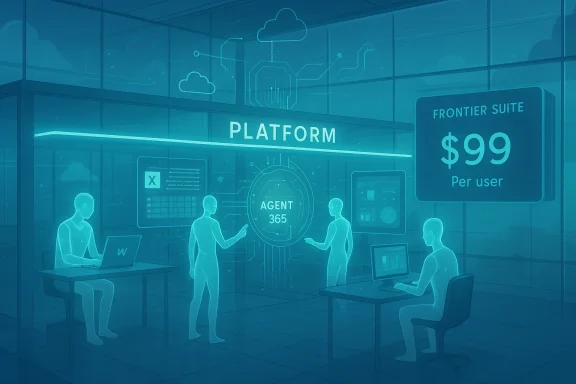
- Microsoft packaged these capabilities (Copilot + Agent 365 + E5 security baseline) into Microsoft 365 E7: The Frontier Suite, with list pricing positioned at about $99 per user per month. Microsoft framed E7 as cheaper than assembling those capabilities à la carte.
Why Microsoft bundles (strategic rationale)
- Simplifies procurement: one contract, consolidated billing.
- Lowers enterprise friction by providing governance + security by default.
- Locks value into the platform: if agents depend on Fabric/OneLake and directory/identity, it's harder for customers to unbundle.
- Allows Microsoft to monetize agent usage as a predictable seat‑based line item rather than unpredictable per‑API spend.
Anthropic’s Play: Claude Cowork and Vertical Agentization
Anthropic’s Claude Cowork is an exemplar vertical agent: a desktop and cloud agent that can access files, call plugins, and perform complex workflows for non‑technical users. Anthropic positioned Cowork as “Claude Code for the rest of your work,” and it has seen rapid press coverage and adoption among paid subscribers and enterprise previews. Anthropic also expanded Claude integrations (e.g., Claude for Excel) that directly target the most common productivity friction point for enterprises — spreadsheets.What makes these vertical agents appealing to horizontals like Microsoft?
- They can be slotted into workflow automation inside Office apps.
- They provide differentiated reasoning and tool‑use capabilities (Anthropic emphasizes safety and alignment).
- They accelerate the value proposition of “Copilot that does the work” — which is attractive for enterprise admins who need measurable outcomes.
Pricing, Procurement, and the New Economics
Microsoft’s announcements are not only technical: they are explicitly economic. Agent 365 pricing and the E7 bundle convert agent experiences into recurring, seat-based line items, with Microsoft claiming the bundle is cheaper than purchasing components separately. The specific prices Microsoft published (Agent 365 at approximately $15/user, Microsoft 365 E7 at ~$99/user) changed the procurement conversation: AI becomes a line-item within established license management systems rather than a standalone API or project budget.The short-term result: customers face choices that were previously orthogonal — which model(s) to use, how to provision agentic workflows, and whether to buy governance as a platform add-on or to stitch together their own governance stack.
The long-term result: vertical vendors that once sold point solutions may see their economics compressed if horizontal platforms package equivalent agentic experiences and include them in bundled enterprise SKUs.
Strengths: What’s Good About the Horizontal Harness
- Faster enterprise adoption: Platforms remove procurement and governance blockers, making it easier for IT to approve agentic deployments.
- Integrated governance: When governance, identity, logging, and DLP are provided by the platform, enterprises can adopt agentic workflows with better visibility and control.
- Model diversity for fit: Multi‑model orchestration lets platforms route tasks to the model that fits best (e.g., Claude for reasoning-heavy Researcher agent, OpenAI for other frontier scenarios).
- Operational simplicity: Bundles reduce vendor sprawl and the operational overhead of managing separate contracts for models, agents, and governance.
- Rapid innovation on endpoints: Vertical vendors and startups can reach millions of seats by integrating with horizontals instead of building distribution themselves.
Risks and Critical Concerns
The horizontal harness is powerful — but it concentrates risk in new ways.1) Data flow and subprocessors
When a horizontal platform surfaces a third‑party model (e.g., Anthropic’s Claude inside Copilot), enterprises must map data flows and update legal/contractual terms. Microsoft’s move to make Anthropic a subprocessor under Microsoft’s product terms (for many tenant types) reduces procurement friction, but it also means enterprises need to validate where data moves, how long it’s retained, and whether vendor commitments meet regulatory needs. Admins and compliance teams must verify the data‑processing relationships for each model option.2) Governance blind spots and “double agents”
Rapid adoption of agents has produced a governance gap: unsanctioned agents can proliferate in organizations. Microsoft itself coined the notion of “double agents” — AI systems that operate on behalf of an organization but can be manipulated to act against it. Agent 365 is a platform response to that risk, but it’s a reactive control; security teams must still prepare for prompt injection, model poisoning, exfiltration risk, and tool misuse. Microsoft’s own reports and industry coverage underscore that many agents exist without IT approval.3) Vendor lock‑in and reduced buyer optionality
When a horizontal platform bundles agent capabilities with tenant identity, storage, and governance, migrating away becomes materially more expensive. The union of platform + agent creates stickiness — good for the platform vendor, risky for customers who prefer modular choice or want to avoid dependence on a single provider.4) Competitive pressure on vertical SaaS margins
Vertical vendors that historically sold specialized workflows may be forced to compete against platform‑native agents included in horizontal bundles. Unless verticals can offer deeper domain moats (specialized data, compliance attestations, industry workflows), they risk margin pressure or becoming a thin integration inside a platform marketplace. This is the perceived “SaaSpocalypse” that observers discussed after Anthropic’s Cowork debut — not a mass extinction, but a structural re‑pricing of the market.5) Procurement, compliance, and pricing opacity
The new bundles make it easier to get agentic features in production, but they also complicate cost accounting. Is AI now a fixed per‑seat OPEX cost, or is there a hidden variable API bill under the hood? Microsoft mixes seat pricing with usage meters and token‑level costs in Azure — a combination that can make total cost of ownership hard to forecast without careful vendor conversations. Multiple analysts warned that the intersection of seat fees, per‑message fees, and existing licences creates a complex TCO picture.Practical Guidance for IT Leaders
If you run enterprise IT or security, the current horizontal harness cycle demands concrete actions.- Inventory current AI usage:
- Discover which agentic tools and automations exist inside your tenant and shadow environments.
- Use the platform’s agent registry or telemetry API where available (Agent 365-style tools help).
- Map data flows and subprocessors:
- For each model option surfaced in your platform (OpenAI, Anthropic, Google, internal models), document where inference and training-data retention occur and whether data leaves the tenant boundary.
- Update procurement and legal templates:
- Ensure DPA/subprocessor language covers model providers surfaced inside horizontal platforms and that your corporate policy reflects multi‑model sourcing.
- Start with risk-tolerant pilots:
- Identify low-risk, high-value workflows to test agent automation. Measure failures and remediation costs.
- Architect for portability:
- Store canonical data in neutral formats (e.g., OneLake/Fabric or equivalent) and decouple orchestration logic where possible, so you can rewire agents to alternative models without a forklift replatform.
- Budget for hybrid economics:
- Maintain separate budget lines for seat-based vendor bundles and for metered API compute; insist on tools that offer transparent billing breakdowns.
- Mandate training and playbooks:
- Treat agents like new digital employees: require onboarding, performance KPIs, and escalation procedures when agents act unexpectedly.
Winners, Losers, and Market Dynamics
- Winners
- Big horizontals (Microsoft, Google, AWS) that control identity, storage, and billing will capture more value and become the primary distribution channels.
- Integrated sohip deep vertical value and can plug into platform marketplaces.
- Security and governance tooling companies that help monitor, audit, and secure agent fleets.
- Losers (or at risk)
- Commodity vertical SaaS providers without deep data or workflow moats.
- Organizations that fail to adopt governance quickly and accumulate compliance debt or data exposure.
- Buyers unfamiliar with the blended pricing models who receive surprise invoices.
Fact checks, caveats, and unverifiable claims
- Microsoft’s March 9, 2026 product blog and related press coverage confirm the Copilot Cowork wave, Agent 365, and the Microsoft 365 E7 packaging/pricing details (Agent 365 GA May 1, E7 priced near $99/user). These are vendor disclosures and widely reported by industry outlets.
- Anthropic’s Cowork and Claude for Excel launches and desktop availability are covered by multiple outlets (TechCrunch, Engadget, Computerworld); these reports confirm Anthropic’s vertical agent strategy and product launches.
- Claims about extremely large compute commitments or multi‑billion dollar financing pacts (e.g., an alleged $30B Azure compute purchase or specific investment tranches linking Anthropic, Microsoft, and NVIDIA) have circulated in forums and equity research leaks. They are consequential if true, but they require primary confirmation from official corporate filings or direct vendor statements. Treat those large‑scale commercial claims as reported rumors unless you can locate official, verifiable disclosures. I flag these as unverified until confirmed by an authoritative source.
- Telemetry numbers such as “tens of millions of agents in the Agent 365 Registry” come from Microsoft’s published statements in the March announcements. Telemetry claims are useful signals, but they require context (what qualifies as an “agent,” how many are meaningful, repeat usage, etc.).
The Big Picture: Horizontal Harness as a His is not the first time technological innovation followed a vertical‑to‑horizontal pattern. The PC era saw specialized software become mass market after horizontal distribution (the PC) and commercial bundling reached scale. The web era repeated the pattern. In the AI Tech Wave, the mechanics are similar but faster and more complex: models, agents, and governance must all operate at cloud scale, and regulatory pressure is higher.
What’s unique this cycle is the degree of immediacy: agents are not merely faster tools — they can autonomously manipulate corporate data, execute business processes, and create durable artifacts (contracts, analyses, code). That both accelerates value capture and increases systemic risk.The strategic lesson for enterprises is straightforward: adopt fast, but govern faster. Horizontals will continue to make agentic AI accessible. Your control plane — the policies, telemetry, and procurement guardrails you build now — will determine whether those agents become assets or liability.
Conclusion
Microsoft and Anthropic’s recent product moves illustrate the core thesis Michael Parekh articulated in “AI: Reset to Zero”: vertical AI capabilities are being rapidly harnessed horizontally by platforms that offer identity, governance, and distribution at scale. The practical consequence is an industry pivot toward bundled, seat-based enterprise AI offerings that combine agentic functionality and platform controls. That pivot brings real benefits — faster adoption, integrated governance, and simpler procurement — but it also concentrates risk in new ways: data flows, governance blind spots, vendor lock‑in, and competitive pressure on vertical SaaS economics.For IT leaders, the answer is not to block these trends but to manage them: inventory agent usage, map subprocessors and data flows, pilot low‑risk automations, require portability where feasible, and treat agents like new digital employees that need onboarding, measurement, and oversight. The horizontal harness is here; treat it as a structural shift rather than a passing fad, and invest now in the governance, procurement literacy, and architecture needed to turn agentic AI into durable business advantage.
Source: AI: Reset to Zero AI Ramblings: Episode 46
