

HostGator remains a major web-hosting contender in 2026 because its shared, WordPress, VPS, and dedicated server plans cover most small-business needs, but its strongest case is still low-friction shared hosting rather than cutting-edge cloud infrastructure. That distinction matters more than the marketing copy suggests. HostGator is not trying to be the most modern hosting platform on the market; it is trying to be the default answer for people who need a website to exist, behave, and not require a systems administrator on day one. In that lane, it is still formidable — but the trade-offs are increasingly visible.
The hosting market has spent the last decade trying to make basic web hosting sound like an advanced computing discipline. Every provider now wants to talk about edge networks, AI builders, container-like scaling, and enterprise-grade observability. HostGator’s pitch is more old-fashioned: buy a plan, install WordPress, attach a domain, and get on with your business.
That may sound uninspiring, but it is also why HostGator continues to survive in a crowded market. Most small businesses do not need Kubernetes, multi-region failover, or a developer platform. They need a stable place to put a site, an email address attached to a domain, SSL, a dashboard that does not terrify them, and a support channel when something breaks.
The recent PCMag review frames HostGator as a stacked provider, but the real story is narrower. HostGator is strongest where web hosting is still a commodity service: shared hosting, managed WordPress, and traditional VPS or dedicated servers. It is weaker where the industry has moved toward elastic cloud infrastructure and developer-first tooling.
That is not necessarily a flaw. It is a product bet. HostGator is betting that the median customer still wants hosting, not a platform.
HostGator’s shared lineup gives buyers a familiar ladder. Hatchling is the entry point, Baby opens the door to more sites and storage, Business adds operational extras such as malware detection and removal, SEO tools, a dedicated IP, and CDN integration, while Pro stretches the limits for customers who want many websites and more SSD capacity. The exact promotional pricing can change, but the structure is clear: HostGator wants beginners to start low and climb when the site becomes important enough to justify the jump.
The most important detail is not the price printed in the largest font. It is the gap between introductory pricing, monthly billing, and renewal economics. HostGator, like much of the hosting industry, nudges buyers hard toward long-term commitments, often defaulting to multi-year terms while making shorter-term costs less obvious until later in checkout.
That behavior is not unique to HostGator, but it is exactly the kind of thing small businesses routinely underestimate. A website that begins as a weekend project can become a recurring operational expense with add-ons, renewal hikes, domain fees, backup services, security tools, and email dependencies attached. The cheapest plan is rarely the true cost of ownership.
But the absence of Windows-based shared hosting still matters for a WindowsForum audience. If your site depends on ASP.NET, Microsoft SQL Server, or Windows-specific hosting assumptions, HostGator’s shared tier is not your lane. You would need to look elsewhere or move up into dedicated hosting where HostGator does offer Windows server options.
This split illustrates HostGator’s broader philosophy. The company supports Windows where customers are paying for heavier infrastructure, but not where the margins are thinnest and the support complexity is highest. That is commercially rational, but it means HostGator’s most affordable plans are not truly platform-neutral.
For most buyers, that limitation will be invisible. For IT pros advising a small business, it is one of the first requirements to check.
HostGator’s VPS plans follow the familiar Snappy branding, scaling from lower-RAM configurations up to larger NVMe-backed options. The key technical upgrade is isolation. A small e-commerce site, a busier WordPress installation, or a business with compliance concerns may not want to sit on the same shared server pool as hundreds of unrelated sites.
The catch is that HostGator’s VPS story is still conventional. It is Linux-based, cPanel is not necessarily included by default, and prices rise meaningfully once management tools are added. That matters because many customers moving from shared hosting to VPS are not actually trying to become server administrators; they are trying to buy performance and stability.
A VPS can solve the wrong problem if the buyer misunderstands the trade. You gain more control, but you also inherit more of the operational surface area. Patching, configuration, backups, resource monitoring, and application tuning become more important. A managed WordPress plan may be a better fit for many users than a VPS they are technically free to mismanage.
HostGator is credible here, but not unusually aggressive. Competitors such as Hostwinds and others often push harder on low-end VPS pricing, broader configuration ranges, or Windows availability. HostGator’s VPS tier is less a disruptive offer than a reasonable upgrade path for customers already in its ecosystem.
HostGator’s dedicated server tiers now lean on modern-sounding hardware language: DDR5 memory, NVMe storage, and large RAM ceilings. The lower tier already starts at a level far beyond what a basic brochure site needs, while the higher tiers are aimed at traffic-heavy sites, custom applications, agencies, and businesses with stricter isolation requirements.
The notable point is Windows support. Many mainstream hosts are Linux-first to the point of indifference toward Windows workloads. HostGator’s dedicated plans offering both Linux and Windows makes the service more relevant for organizations with legacy Microsoft workloads, Windows Server familiarity, or application stacks that were never designed for a LAMP environment.
That does not make HostGator an enterprise infrastructure provider in the Azure or AWS sense. It makes HostGator a traditional host that still recognizes the long tail of Windows hosting needs. For some businesses, that is exactly the niche they need filled.
The managed WordPress tiers mirror the shared-hosting logic: start small, add more sites, more storage, and more performance as the business grows. HostGator also includes WordPress-oriented features such as caching and an optimized environment. That matters because many small-business WordPress problems are not philosophical; they are caused by slow pages, plugin bloat, bad caching, and owners who do not know where the bottleneck is.
What is interesting is that HostGator is not presented as racing toward AI site generation with the same intensity as some rivals. That may look like a gap in 2026, but it can also be read as restraint. AI builders are useful for getting a placeholder site online quickly, but they do not eliminate the long-term work of content, navigation, search visibility, security, and conversion.
The better case for HostGator is not that it will invent your web presence for you. It is that it gives you a familiar WordPress runway. For many businesses, that is more durable than a proprietary builder that looks clever on day one and confining on day 300.
This is where traditional hosting either feels comforting or maddening. A good dashboard lowers the number of support tickets and gives nontechnical users enough confidence to make changes. A bad one turns every ordinary task into a search-engine expedition.
The inclusion of cPanel remains important because it is still a lingua franca for shared hosting and small-site administration. Plenty of modern platforms have cleaner interfaces, but cPanel’s endurance is not accidental. It maps well to the mental model of users who want files, databases, domains, email, SSL, and backups in recognizable places.
HostGator’s file manager also matters in the same old-school way. For users who need to upload files, edit HTML, or make small corrections without a full developer workflow, browser-based file access is useful. It is not glamorous, but neither is keeping a small business website alive.
A small merchant can absolutely build an online store on HostGator. They can install software, choose a theme, add products, configure shipping and payment methods, and operate independently. That independence is part of the appeal for technically confident users or businesses that want control over their stack.
But e-commerce hosting raises the stakes. Performance, backups, security, PCI-related concerns, plugin maintenance, and checkout reliability become business-critical. A site outage is no longer an inconvenience; it is lost revenue. A broken plugin is no longer cosmetic; it can interrupt sales.
This is where HostGator’s appeal depends heavily on the buyer’s tolerance for assembly. If you want a hosted commerce appliance, a dedicated e-commerce platform may be a better fit. If you want a general-purpose hosting account that can run commerce software, HostGator remains in the conversation.
For a small blog, this may not matter. For a campaign site, seasonal retailer, media project, or software business with unpredictable traffic, it can matter quickly. The promise of cloud hosting is not magic uptime; it is that the site is less tightly bound to one machine’s limits.
HostGator’s lack of a cloud hosting option means some growing customers will eventually hit a fork in the road. They can move from shared hosting to VPS, then perhaps to dedicated hardware, but that path is still built around fixed infrastructure. Competitors such as DreamHost, Ionos, and others have clearer cloud narratives for buyers who want scale without owning the shape of the server.
The same is true for reseller hosting. HostGator historically had mindshare among reseller and agency users, but the supplied review says reseller hosting is not part of the current picture under discussion. For agencies that want to package hosting for clients, that omission sends them elsewhere.
The review’s support experience was positive: fast phone response, quick live-chat engagement, and representatives who could explain plan differences and pricing. That is exactly the kind of interaction that makes a host feel safe to nontechnical customers. A business owner does not necessarily need the world’s fastest server if the support experience prevents panic.
But support anecdotes are inherently limited. Hosting support quality can vary by time, issue complexity, and whether the problem sits inside the provider’s responsibility boundary. A representative can explain shared hosting tiers quickly; restoring a corrupted database, diagnosing plugin conflicts, or resolving a mail deliverability issue is a different test.
That is why backups, portability, and administrative access remain essential even when support is good. Trust support, but do not design your business so that support is your only disaster-recovery plan.
Introductory pricing is psychologically powerful because it makes a hosting plan feel cheaper than the real operating cost. The buyer sees a low monthly number, then later discovers that the commitment length, renewal rate, add-ons, and billing cycle materially change the economics. A one-year or three-year discount can be rational, but only if the customer understands what happens afterward.
This is especially important for small businesses because hosting decisions tend to accumulate dependencies. Once a site is live, email is configured, DNS is pointed, WordPress is customized, and customers know the domain, switching hosts becomes a project. Providers understand that inertia has value.
The smart buyer should evaluate HostGator not by the first invoice but by the second year, the renewal term, and the cost of the features they will actually use. Malware protection, backups, domain privacy, cPanel licensing, email needs, CDN features, and storage limits all belong in that calculation.
That is where HostGator’s breadth helps. Shared hosting, managed WordPress, VPS, and dedicated servers cover a lot of ground. The dashboard is approachable, WordPress setup is straightforward, support is accessible, and Windows dedicated hosting gives it a useful edge for certain traditional workloads.
The case against HostGator is that the industry is moving faster than its core model. Cloud elasticity, transparent pricing, developer workflows, integrated staging, automated backups, stronger security defaults, and AI-assisted site creation are becoming part of the competitive baseline. HostGator has pieces of that story, but not the whole story.
This makes HostGator neither a dinosaur nor a category killer. It is a durable incumbent in a market where incumbency still counts. That is less exciting than a startup pitch, but perhaps more relevant to the millions of sites that simply need to run.
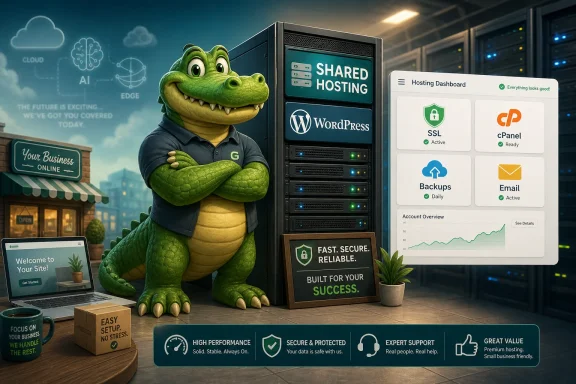 HostGator Wins by Refusing to Be Exotic
The hosting market has spent the last decade trying to make basic web hosting sound like an advanced computing discipline. Every provider now wants to talk about edge networks, AI builders, container-like scaling, and enterprise-grade observability. HostGator’s pitch is more old-fashioned: buy a plan, install WordPress, attach a domain, and get on with your business.That may sound uninspiring, but it is also why HostGator continues to survive in a crowded market. Most small businesses do not need Kubernetes, multi-region failover, or a developer platform. They need a stable place to put a site, an email address attached to a domain, SSL, a dashboard that does not terrify them, and a support channel when something breaks.
The recent PCMag review frames HostGator as a stacked provider, but the real story is narrower. HostGator is strongest where web hosting is still a commodity service: shared hosting, managed WordPress, and traditional VPS or dedicated servers. It is weaker where the industry has moved toward elastic cloud infrastructure and developer-first tooling.
That is not necessarily a flaw. It is a product bet. HostGator is betting that the median customer still wants hosting, not a platform.
Shared Hosting Is Still the Center of Gravity
Shared hosting is where HostGator makes its cleanest argument. The category is simple: multiple websites live on the same server and share its resources. That means it is cheaper than VPS or dedicated hosting, but it also means one noisy neighbor can affect performance if the provider’s resource management is poor.HostGator’s shared lineup gives buyers a familiar ladder. Hatchling is the entry point, Baby opens the door to more sites and storage, Business adds operational extras such as malware detection and removal, SEO tools, a dedicated IP, and CDN integration, while Pro stretches the limits for customers who want many websites and more SSD capacity. The exact promotional pricing can change, but the structure is clear: HostGator wants beginners to start low and climb when the site becomes important enough to justify the jump.
The most important detail is not the price printed in the largest font. It is the gap between introductory pricing, monthly billing, and renewal economics. HostGator, like much of the hosting industry, nudges buyers hard toward long-term commitments, often defaulting to multi-year terms while making shorter-term costs less obvious until later in checkout.
That behavior is not unique to HostGator, but it is exactly the kind of thing small businesses routinely underestimate. A website that begins as a weekend project can become a recurring operational expense with add-ons, renewal hikes, domain fees, backup services, security tools, and email dependencies attached. The cheapest plan is rarely the true cost of ownership.
The Linux-Only Shared Tier Is a Quiet Line in the Sand
HostGator’s shared hosting is Linux-only, which will not bother most WordPress users. WordPress, PHP, MySQL, and the usual CMS ecosystem are perfectly at home on Linux servers. For the overwhelming majority of small-business sites, that is the expected stack.But the absence of Windows-based shared hosting still matters for a WindowsForum audience. If your site depends on ASP.NET, Microsoft SQL Server, or Windows-specific hosting assumptions, HostGator’s shared tier is not your lane. You would need to look elsewhere or move up into dedicated hosting where HostGator does offer Windows server options.
This split illustrates HostGator’s broader philosophy. The company supports Windows where customers are paying for heavier infrastructure, but not where the margins are thinnest and the support complexity is highest. That is commercially rational, but it means HostGator’s most affordable plans are not truly platform-neutral.
For most buyers, that limitation will be invisible. For IT pros advising a small business, it is one of the first requirements to check.
VPS Hosting Gives HostGator More Muscle, but Not More Imagination
The VPS tier is HostGator’s bridge between beginner hosting and serious infrastructure. A virtual private server still shares physical hardware, but it gives the customer a more defined slice of compute resources. That means more control, more predictable performance, and more responsibility.HostGator’s VPS plans follow the familiar Snappy branding, scaling from lower-RAM configurations up to larger NVMe-backed options. The key technical upgrade is isolation. A small e-commerce site, a busier WordPress installation, or a business with compliance concerns may not want to sit on the same shared server pool as hundreds of unrelated sites.
The catch is that HostGator’s VPS story is still conventional. It is Linux-based, cPanel is not necessarily included by default, and prices rise meaningfully once management tools are added. That matters because many customers moving from shared hosting to VPS are not actually trying to become server administrators; they are trying to buy performance and stability.
A VPS can solve the wrong problem if the buyer misunderstands the trade. You gain more control, but you also inherit more of the operational surface area. Patching, configuration, backups, resource monitoring, and application tuning become more important. A managed WordPress plan may be a better fit for many users than a VPS they are technically free to mismanage.
HostGator is credible here, but not unusually aggressive. Competitors such as Hostwinds and others often push harder on low-end VPS pricing, broader configuration ranges, or Windows availability. HostGator’s VPS tier is less a disruptive offer than a reasonable upgrade path for customers already in its ecosystem.
Dedicated Servers Are Where Windows Comes Back
Dedicated hosting is the part of HostGator’s catalog that feels most relevant to traditional IT buyers. A dedicated server gives the customer the whole machine, not just a virtual slice or a shared account. That brings cost, but also clarity: the CPU, RAM, storage, and operating system are yours to shape.HostGator’s dedicated server tiers now lean on modern-sounding hardware language: DDR5 memory, NVMe storage, and large RAM ceilings. The lower tier already starts at a level far beyond what a basic brochure site needs, while the higher tiers are aimed at traffic-heavy sites, custom applications, agencies, and businesses with stricter isolation requirements.
The notable point is Windows support. Many mainstream hosts are Linux-first to the point of indifference toward Windows workloads. HostGator’s dedicated plans offering both Linux and Windows makes the service more relevant for organizations with legacy Microsoft workloads, Windows Server familiarity, or application stacks that were never designed for a LAMP environment.
That does not make HostGator an enterprise infrastructure provider in the Azure or AWS sense. It makes HostGator a traditional host that still recognizes the long tail of Windows hosting needs. For some businesses, that is exactly the niche they need filled.
WordPress Is the Product Even When It Is Not the Plan
HostGator can talk about hosting categories all day, but the practical center of the service is WordPress. The review describes WordPress installation as straightforward, with the dashboard making it easy to choose a path, create an administrator account, and get the site running. That is the experience most buyers will judge.The managed WordPress tiers mirror the shared-hosting logic: start small, add more sites, more storage, and more performance as the business grows. HostGator also includes WordPress-oriented features such as caching and an optimized environment. That matters because many small-business WordPress problems are not philosophical; they are caused by slow pages, plugin bloat, bad caching, and owners who do not know where the bottleneck is.
What is interesting is that HostGator is not presented as racing toward AI site generation with the same intensity as some rivals. That may look like a gap in 2026, but it can also be read as restraint. AI builders are useful for getting a placeholder site online quickly, but they do not eliminate the long-term work of content, navigation, search visibility, security, and conversion.
The better case for HostGator is not that it will invent your web presence for you. It is that it gives you a familiar WordPress runway. For many businesses, that is more durable than a proprietary builder that looks clever on day one and confining on day 300.
The Dashboard Matters More Than the Spec Sheet
Hosting reviews often over-index on RAM, storage, and bandwidth. Those numbers matter, but only after the customer can actually operate the service. HostGator’s dashboard appears to be one of its more important strengths because it consolidates routine tasks: cPanel access, SSL certificate management, database access, CMS installation, and file management.This is where traditional hosting either feels comforting or maddening. A good dashboard lowers the number of support tickets and gives nontechnical users enough confidence to make changes. A bad one turns every ordinary task into a search-engine expedition.
The inclusion of cPanel remains important because it is still a lingua franca for shared hosting and small-site administration. Plenty of modern platforms have cleaner interfaces, but cPanel’s endurance is not accidental. It maps well to the mental model of users who want files, databases, domains, email, SSL, and backups in recognizable places.
HostGator’s file manager also matters in the same old-school way. For users who need to upload files, edit HTML, or make small corrections without a full developer workflow, browser-based file access is useful. It is not glamorous, but neither is keeping a small business website alive.
E-Commerce Is Possible, but HostGator Is Not Shopify
HostGator supports e-commerce through installable applications and marketplace integrations rather than a single integrated commerce product. The source review notes options such as Magento and other commerce tools, along with themes, templates, graphics, and supporting design assets. That gives users flexibility, but flexibility is not the same thing as simplicity.A small merchant can absolutely build an online store on HostGator. They can install software, choose a theme, add products, configure shipping and payment methods, and operate independently. That independence is part of the appeal for technically confident users or businesses that want control over their stack.
But e-commerce hosting raises the stakes. Performance, backups, security, PCI-related concerns, plugin maintenance, and checkout reliability become business-critical. A site outage is no longer an inconvenience; it is lost revenue. A broken plugin is no longer cosmetic; it can interrupt sales.
This is where HostGator’s appeal depends heavily on the buyer’s tolerance for assembly. If you want a hosted commerce appliance, a dedicated e-commerce platform may be a better fit. If you want a general-purpose hosting account that can run commerce software, HostGator remains in the conversation.
The Missing Cloud Story Is a Real Strategic Gap
The most obvious hole in HostGator’s current positioning is cloud hosting. Traditional shared, VPS, and dedicated hosting map cleanly to older buying patterns, but they do not fully match how modern traffic patterns behave. Cloud hosting spreads resources across multiple servers and can offer more elastic scaling than a single physical or virtual host.For a small blog, this may not matter. For a campaign site, seasonal retailer, media project, or software business with unpredictable traffic, it can matter quickly. The promise of cloud hosting is not magic uptime; it is that the site is less tightly bound to one machine’s limits.
HostGator’s lack of a cloud hosting option means some growing customers will eventually hit a fork in the road. They can move from shared hosting to VPS, then perhaps to dedicated hardware, but that path is still built around fixed infrastructure. Competitors such as DreamHost, Ionos, and others have clearer cloud narratives for buyers who want scale without owning the shape of the server.
The same is true for reseller hosting. HostGator historically had mindshare among reseller and agency users, but the supplied review says reseller hosting is not part of the current picture under discussion. For agencies that want to package hosting for clients, that omission sends them elsewhere.
Support Is the Product When Something Breaks
HostGator promises 99.9 percent uptime and 24/7 phone and live chat support. Those are standard claims in the hosting business, but they are still central to the buying decision. Small businesses rarely choose a host because everything is going well; they judge the host when email stops working, SSL breaks, DNS changes do not propagate as expected, or a WordPress update detonates the homepage.The review’s support experience was positive: fast phone response, quick live-chat engagement, and representatives who could explain plan differences and pricing. That is exactly the kind of interaction that makes a host feel safe to nontechnical customers. A business owner does not necessarily need the world’s fastest server if the support experience prevents panic.
But support anecdotes are inherently limited. Hosting support quality can vary by time, issue complexity, and whether the problem sits inside the provider’s responsibility boundary. A representative can explain shared hosting tiers quickly; restoring a corrupted database, diagnosing plugin conflicts, or resolving a mail deliverability issue is a different test.
That is why backups, portability, and administrative access remain essential even when support is good. Trust support, but do not design your business so that support is your only disaster-recovery plan.
The Pricing Table Is the Real Fine Print
The most consumer-hostile part of the hosting industry is not the server technology. It is pricing presentation. HostGator is hardly alone here, but its habit of pushing longer commitments and obscuring shorter-term pricing until checkout deserves scrutiny.Introductory pricing is psychologically powerful because it makes a hosting plan feel cheaper than the real operating cost. The buyer sees a low monthly number, then later discovers that the commitment length, renewal rate, add-ons, and billing cycle materially change the economics. A one-year or three-year discount can be rational, but only if the customer understands what happens afterward.
This is especially important for small businesses because hosting decisions tend to accumulate dependencies. Once a site is live, email is configured, DNS is pointed, WordPress is customized, and customers know the domain, switching hosts becomes a project. Providers understand that inertia has value.
The smart buyer should evaluate HostGator not by the first invoice but by the second year, the renewal term, and the cost of the features they will actually use. Malware protection, backups, domain privacy, cPanel licensing, email needs, CDN features, and storage limits all belong in that calculation.
HostGator Is Best Understood as a Competent Default
The case for HostGator is strongest when the buyer’s needs are ordinary and immediate. A local business needs a site. A blogger wants WordPress. A small agency needs several client sites. A growing project wants to graduate from shared hosting to VPS or dedicated infrastructure without changing vendors.That is where HostGator’s breadth helps. Shared hosting, managed WordPress, VPS, and dedicated servers cover a lot of ground. The dashboard is approachable, WordPress setup is straightforward, support is accessible, and Windows dedicated hosting gives it a useful edge for certain traditional workloads.
The case against HostGator is that the industry is moving faster than its core model. Cloud elasticity, transparent pricing, developer workflows, integrated staging, automated backups, stronger security defaults, and AI-assisted site creation are becoming part of the competitive baseline. HostGator has pieces of that story, but not the whole story.
This makes HostGator neither a dinosaur nor a category killer. It is a durable incumbent in a market where incumbency still counts. That is less exciting than a startup pitch, but perhaps more relevant to the millions of sites that simply need to run.
Where the Gator Still Bites
HostGator’s practical value comes from matching the right customer to the right tier, not from pretending every plan is suitable for every workload. The service is most appealing when its limits are understood before the credit card comes out.- HostGator is strongest for users who want conventional shared hosting or WordPress hosting with a familiar dashboard and accessible support.
- Buyers who need Windows hosting should skip the shared tier and look at dedicated options or competing hosts with Windows shared plans.
- VPS plans offer more power than shared hosting, but they also introduce more administrative responsibility and may require paid control-panel licensing.
- Dedicated servers are the most compelling advanced tier because they combine modern hardware specifications with both Linux and Windows choices.
- The absence of cloud hosting makes HostGator less attractive for projects that need elastic scaling or a modern infrastructure growth path.
- The advertised monthly price should be treated as the start of the investigation, not the final cost of running the site.
References
- Primary source: PCMag Australia
Published: 2026-06-17T21:40:09.288527
HostGator Web Hosting - Review 2026 - PCMag Australia
HostGator is a terrific web hosting service that offers excellent shared plans, helpful customer service, and powerful tools for bloggers and small businesses.au.pcmag.com - Related coverage: hostgator.com
Shared Web Hosting Plans - Easy & Affordable | HostGator
Shared web hosting plans from HostGator get your site off the ground quickly & affordably. Get your business online with a shared plan now!www.hostgator.com
- Related coverage: forbes.com
- Related coverage: hostadvice.com
- Related coverage: allaboutcookies.org
- Related coverage: hostalog.com
HostGator Review (2026) – Pricing, Performance & Features
Thinking about using HostGator? Read our in-depth HostGator review covering pricing, uptime, speed, support, and features. Find out if it's the right hosting provider for you! hostalog.com
- Related coverage: buy-hosting.net
HostGator Pricing 2026 | All Plans and Renewal Prices
All HostGator Plans on one clean Page. Includes Pricing and Renewal Prices.www.buy-hosting.net - Related coverage: tomsguide.com
HostGator web hosting review | Tom's Guide
In our HostGator review, we take a close look at this popular web hosting provider, explaining why it isn’t as good as it appears.www.tomsguide.com - Related coverage: techradar.com
HostGator Web Hosting review | TechRadar
Great value and feature-packed hosting for home and business userswww.techradar.com - Related coverage: checkthat.ai
HostGator Pricing 2026: Plans, Costs & Renewal Rates - HostGator | CheckThat.ai
Compare HostGator hosting plans, pricing, and renewal costs. Learn what you'll actually pay after promotional rates end with detailed price breakdowns.checkthat.ai
- Related coverage: judgehost.com
HostGator Review and ratings by editor and users.
HostGator review 2026: Affordable shared hosting with unlimited sites, 24/7 support & free domain. Pros, cons, pricing & real performance.www.judgehost.com - Related coverage: priceworld.com
HostGator Pricing 2026 — True Renewal Cost & 3-Year TCO | PriceWorld
What HostGator Hatchling really costs: a $135.00 3-year total at the $3.75/mo intro rate, with a recorded $3.75 → $10.99/mo renewal jump (+193%) that lands in year 4, after the intro term. A dated reading from 2026-02-19, not a live quote. priceworld.com
- Related coverage: ai-cmo.net
HostGator Review 2026: Web Hosting That Scales From First
HostGator: Newfold sibling to Bluehost—shared from ~$3.75/mo intro (36-mo), steep renewals, checkout upsells. 2M+ sites, 24/7 phone/chat. Fine for first sites;ai-cmo.net
