

Australia’s electricity sector is being pushed to use AI not merely to serve new data-centre demand, but to manage a fast-changing grid where renewables supplied 47 percent of the National Electricity Market in the first quarter of 2026. Microsoft Asia, citing a new Mandala report it commissioned, argues that Australia’s energy transition has reached the point where software is no longer optional infrastructure. That is the right debate, even if Microsoft is not a neutral observer. The uncomfortable truth is that Australia’s grid is becoming too distributed, too weather-dependent, and too data-rich to run on yesterday’s operating model.
The public argument about AI and energy has mostly been stuck on one side of the ledger: data centres consume electricity, and AI makes that consumption grow. That framing is not wrong, but it is incomplete. Microsoft’s new Asia post, written by Jim Bullock, Will Hudson, and Liz Fitch, tries to flip the lens by asking whether AI can also make the electricity system itself more productive.
That is a self-interested argument from a hyperscaler spending heavily on cloud and AI infrastructure. Microsoft has every reason to present data centres as part of the energy transition rather than a burden on it. But self-interest does not make the argument false.
The Australian grid is a useful test case because the transition is already well past the PowerPoint stage. According to Energy Minister Chris Bowen’s office, the National Electricity Market hit a record first-quarter renewables share of 47 percent in Q1 2026, based on Australian Energy Market Operator data. The Climate Change Authority has also pointed to the rapid spread of consumer energy resources, with more than 40 percent of households owning assets such as rooftop solar, home batteries, or smart devices.
That means Australia is no longer simply adding clean generation to an old system. It is trying to operate a fundamentally different machine.
Australia’s emerging grid is something else. Rooftop solar pushes supply from the edge of the network. Batteries charge and discharge according to household economics, retailer programs, wholesale prices, and weather. Electric vehicles will add flexible but potentially enormous load. Heat pumps, smart appliances, and commercial demand response all turn passive consumers into active participants.
That is why the phrase consumer energy resources matters. It sounds like bureaucratic jargon, but it marks a change in power-system physics and power-system politics. The customer is no longer just the endpoint of the system; the customer is now part of the system.
A grid like that cannot be optimized once a year in a planning document or once a day in a control room. It needs constant inference. It needs to know where capacity exists, where voltage is stressed, where batteries can help, where demand can move, and where the next fault is likely to occur. That is exactly the kind of operational environment where AI moves from novelty to infrastructure.
Those are real use cases, but they are mostly local optimizations. They make a process cheaper, faster, or more accurate. They do not yet amount to a system-wide operating layer for a grid with millions of active devices.
That distinction matters because the biggest prize is not a better chatbot for a power retailer or a more accurate inspection model for a transmission line. The bigger prize is orchestration: using AI to coordinate generation, storage, demand, and network capacity in something closer to real time.
The International Energy Agency has made a similar point globally. Its Energy and AI work estimates that AI and digital grid-enhancing technologies could unlock up to 175 gigawatts of transmission capacity without building new lines. It also says wider adoption of AI in the electricity sector could save up to US$110 billion annually.
Those are global estimates, not Australia-specific guarantees. But they explain why the debate is shifting. If AI can squeeze more usefulness out of existing wires, transformers, batteries, and customer devices, then it becomes a way to buy time while the slow work of building new transmission and generation continues.
That should worry the sector more than if there were a single bad rule to repeal. A hard barrier can be named, attacked, amended, and celebrated. A soft barrier is more difficult because it lives inside procurement habits, regulatory incentives, risk committees, data governance, and institutional muscle memory.
Microsoft and Mandala identify three such barriers: unclear strategy, weak investment incentives, and poor data access. All three are familiar to anyone who has watched critical infrastructure sectors try to modernize. The technology is rarely the only problem, and often not the hardest one.
Utilities are conservative for good reasons. They operate essential services. Their failures are public, expensive, and sometimes dangerous. In Australia, critical infrastructure obligations under the Security of Critical Infrastructure framework reinforce a culture in which uncontrolled experimentation is unacceptable.
But the risk calculus is changing. In a simpler grid, doing nothing could look prudent. In a high-renewables, high-CER, high-data-centre grid, doing nothing becomes its own operational risk.
Software does not always fit so neatly. AI systems, cloud platforms, analytics tools, and data-sharing environments may produce reliability and efficiency gains, but they do not look like traditional network assets. They may be updated continuously. They may involve operating expenditure. Their benefits may be distributed across market participants rather than captured by the organization making the investment.
That creates a familiar trap. The system says it wants innovation, but the regulated business case still rewards the old kind of asset. If a network can earn a predictable return on a substation but faces uncertainty recovering the cost of software that defers that substation, the incentive is obvious.
Microsoft points to the United Kingdom’s TotEx approach as one possible model. The broader lesson is not that Australia should copy Britain line by line. It is that regulatory frameworks need to value outcomes rather than fetishize asset categories.
A megawatt of avoided peak demand can be as real as a megawatt of new supply. A transmission constraint relieved by dynamic line rating can be as valuable as steel in the ground, at least for a period. A fault prevented by better predictive maintenance is not imaginary just because nobody held a ribbon-cutting ceremony for it.
Some of that fragmentation is technical. Old operational technology was not designed for cloud-native analytics or cross-system sharing. Some of it is commercial. Market participants have little incentive to share data if they believe it weakens their competitive position. Some of it is cultural. Critical infrastructure operators are rightly cautious about expanding access to operational information.
Yet the result is a paradox: Australia may have one of the world’s most dynamic distributed energy systems while lacking the shared digital foundations needed to fully coordinate it. Rooftop solar, household batteries, and flexible loads create enormous potential value. Without trusted data infrastructure, much of that value remains trapped at the edge.
This is where responsible AI governance stops being a corporate slogan. Privacy, cybersecurity, explainability, auditability, and access control are not add-ons in an energy system. They are prerequisites for trust.
A badly governed AI layer in the grid would be more than a software failure. It could become a resilience risk. The answer is not to avoid AI, but to build the secure data environments, accountability models, and operational guardrails that make AI usable in critical infrastructure.
That is the polished version of the story. The rougher version is that data centres are large new loads arriving at a moment when grids around the world are already struggling with connections, transmission constraints, and electrification. The IEA has warned that data-centre electricity demand is growing quickly, and that grid connection timelines and power availability are becoming strategic constraints for the AI industry.
Australia will not escape that tension. A hyperscale data centre can be valuable for economic development and digital resilience, but it can also concentrate demand in places where the grid is not ready. If the costs of connection, reinforcement, or reliability are socialized badly, households and smaller businesses will rightly object.
The best version of Microsoft’s argument is that data centres should help pay for, stabilize, and digitally modernize the grid they depend on. The worst version is that AI infrastructure consumes scarce capacity while selling the promise that AI will someday optimize the scarcity it helped create.
The policy challenge is to force the best version into reality. That means transparent connection rules, credible renewable procurement, demand flexibility where technically feasible, and investment structures that do not leave ordinary consumers underwriting private growth.
AI projects fail when they are bolted onto brittle data estates. If meter data, asset data, outage data, weather data, market data, and customer data live in incompatible systems, the organization cannot build reliable intelligence on top. It can build pilots. It can produce demos. It cannot run the grid differently.
Cloud is not magic, and it is not automatically safer, cheaper, or more sovereign than well-run on-premises infrastructure. But modern AI needs elastic compute, standardized data pipelines, monitoring, identity controls, and rapid deployment practices. Most legacy utility environments were not built for that.
For WindowsForum readers, the analogy to enterprise IT is hard to miss. AI is being sold as the next application layer, but the real work is lower in the stack: identity, data governance, endpoint security, observability, platform engineering, and procurement reform. The energy sector is discovering what every large enterprise discovers. You do not get transformational AI by sprinkling models over technical debt.
The next phase is about coordination. A grid with vast renewable supply and millions of consumer devices needs an operating system, not in the literal Microsoft Windows sense, but in the institutional and technical sense: common rules, shared data, trusted automation, and real-time feedback.
That operating system will not be built by Microsoft alone, nor by any single vendor. It will involve AEMO, the Australian Energy Regulator, state governments, networks, retailers, technology providers, consumer advocates, and cybersecurity authorities. It will also involve households, whether or not they think of themselves as market participants.
This is where the rhetoric of a “virtuous cycle” can either become meaningful or collapse into marketing. The cycle works only if AI improves grid efficiency, which enables more renewables and electrification, which supports cleaner data-centre growth, which funds better digital infrastructure, which then improves the grid again. Break any link, and the cycle becomes a subsidy chain or a bottleneck machine.
That is a harder problem than buying software. It requires market bodies to provide clearer guidance on responsible AI use within existing frameworks. It requires regulators to reward efficient digital alternatives where they produce measurable reliability or affordability benefits. It requires governments to create trusted data-sharing arrangements without turning critical infrastructure into an open buffet for attackers.
It also requires vendors to be more honest about limitations. AI forecasting can fail. Optimization models can encode bad assumptions. Automated decisions can be opaque. Cybersecurity threats can scale with connectivity. The answer is not techno-panic, but neither is it techno-triumphalism.
Energy systems have always depended on models. The question is whether the new models are tested, governed, monitored, and accountable enough to deserve operational trust.
The near-term opportunity is not to replace transmission, generation, or storage. It is to use AI to stretch them. That means predicting failures before they cascade, identifying spare network capacity where static ratings are too conservative, forecasting renewable output more precisely, and coordinating distributed assets before they become a liability.
For IT pros, the lesson is equally direct. Energy is becoming a software-mediated industry, and software is becoming an energy-constrained industry. The two sectors can no longer pretend to be separate.
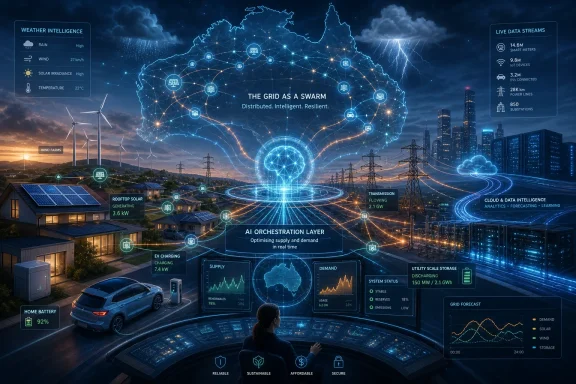 Microsoft Wants AI to Be Seen as Grid Infrastructure, Not Just Grid Load
The public argument about AI and energy has mostly been stuck on one side of the ledger: data centres consume electricity, and AI makes that consumption grow. That framing is not wrong, but it is incomplete. Microsoft’s new Asia post, written by Jim Bullock, Will Hudson, and Liz Fitch, tries to flip the lens by asking whether AI can also make the electricity system itself more productive.That is a self-interested argument from a hyperscaler spending heavily on cloud and AI infrastructure. Microsoft has every reason to present data centres as part of the energy transition rather than a burden on it. But self-interest does not make the argument false.
The Australian grid is a useful test case because the transition is already well past the PowerPoint stage. According to Energy Minister Chris Bowen’s office, the National Electricity Market hit a record first-quarter renewables share of 47 percent in Q1 2026, based on Australian Energy Market Operator data. The Climate Change Authority has also pointed to the rapid spread of consumer energy resources, with more than 40 percent of households owning assets such as rooftop solar, home batteries, or smart devices.
That means Australia is no longer simply adding clean generation to an old system. It is trying to operate a fundamentally different machine.
The Old Grid Was a Machine; the New Grid Is a Swarm
The traditional electricity grid was built around a small number of large generators pushing power in one direction. It was complex, but the complexity was centralized. Forecasting demand, dispatching generation, and maintaining system stability were hard problems, but they were problems suited to institutions, control rooms, and rules designed around predictable peaks.Australia’s emerging grid is something else. Rooftop solar pushes supply from the edge of the network. Batteries charge and discharge according to household economics, retailer programs, wholesale prices, and weather. Electric vehicles will add flexible but potentially enormous load. Heat pumps, smart appliances, and commercial demand response all turn passive consumers into active participants.
That is why the phrase consumer energy resources matters. It sounds like bureaucratic jargon, but it marks a change in power-system physics and power-system politics. The customer is no longer just the endpoint of the system; the customer is now part of the system.
A grid like that cannot be optimized once a year in a planning document or once a day in a control room. It needs constant inference. It needs to know where capacity exists, where voltage is stressed, where batteries can help, where demand can move, and where the next fault is likely to occur. That is exactly the kind of operational environment where AI moves from novelty to infrastructure.
The First Wave of AI Is Useful but Too Small
Microsoft and Mandala are careful to note that AI is already present across the electricity value chain. Generators use predictive maintenance to detect equipment problems before they become outages. Renewable operators use machine learning to improve wind and solar forecasting. Network operators analyze drone, satellite, and sensor data to spot vegetation risks, asset degradation, and faults. Retailers use AI for customer service and consumption insights.Those are real use cases, but they are mostly local optimizations. They make a process cheaper, faster, or more accurate. They do not yet amount to a system-wide operating layer for a grid with millions of active devices.
That distinction matters because the biggest prize is not a better chatbot for a power retailer or a more accurate inspection model for a transmission line. The bigger prize is orchestration: using AI to coordinate generation, storage, demand, and network capacity in something closer to real time.
The International Energy Agency has made a similar point globally. Its Energy and AI work estimates that AI and digital grid-enhancing technologies could unlock up to 175 gigawatts of transmission capacity without building new lines. It also says wider adoption of AI in the electricity sector could save up to US$110 billion annually.
Those are global estimates, not Australia-specific guarantees. But they explain why the debate is shifting. If AI can squeeze more usefulness out of existing wires, transformers, batteries, and customer devices, then it becomes a way to buy time while the slow work of building new transmission and generation continues.
Australia’s Bottleneck Is Not Imagination
The most interesting claim in Microsoft’s piece is not that AI can help the grid. That is now close to consensus. The more revealing claim is that Mandala found no hard regulatory barrier stopping AI adoption across Australia’s electricity market.That should worry the sector more than if there were a single bad rule to repeal. A hard barrier can be named, attacked, amended, and celebrated. A soft barrier is more difficult because it lives inside procurement habits, regulatory incentives, risk committees, data governance, and institutional muscle memory.
Microsoft and Mandala identify three such barriers: unclear strategy, weak investment incentives, and poor data access. All three are familiar to anyone who has watched critical infrastructure sectors try to modernize. The technology is rarely the only problem, and often not the hardest one.
Utilities are conservative for good reasons. They operate essential services. Their failures are public, expensive, and sometimes dangerous. In Australia, critical infrastructure obligations under the Security of Critical Infrastructure framework reinforce a culture in which uncontrolled experimentation is unacceptable.
But the risk calculus is changing. In a simpler grid, doing nothing could look prudent. In a high-renewables, high-CER, high-data-centre grid, doing nothing becomes its own operational risk.
Regulated Networks Still Think in Concrete and Copper
The investment barrier may be the hardest to solve because it cuts into the economic model of electricity networks. Regulated monopolies are good at building and recovering the cost of physical infrastructure. Poles, wires, substations, and transformers fit neatly into a capital expenditure worldview.Software does not always fit so neatly. AI systems, cloud platforms, analytics tools, and data-sharing environments may produce reliability and efficiency gains, but they do not look like traditional network assets. They may be updated continuously. They may involve operating expenditure. Their benefits may be distributed across market participants rather than captured by the organization making the investment.
That creates a familiar trap. The system says it wants innovation, but the regulated business case still rewards the old kind of asset. If a network can earn a predictable return on a substation but faces uncertainty recovering the cost of software that defers that substation, the incentive is obvious.
Microsoft points to the United Kingdom’s TotEx approach as one possible model. The broader lesson is not that Australia should copy Britain line by line. It is that regulatory frameworks need to value outcomes rather than fetishize asset categories.
A megawatt of avoided peak demand can be as real as a megawatt of new supply. A transmission constraint relieved by dynamic line rating can be as valuable as steel in the ground, at least for a period. A fault prevented by better predictive maintenance is not imaginary just because nobody held a ribbon-cutting ceremony for it.
Data Is the Grid’s New Fuel, and It Is Still Locked in Cupboards
The data barrier is the most obvious and the most stubborn. AI systems need timely, high-quality, interoperable data. Electricity systems produce mountains of it, but much of it is fragmented across networks, retailers, generators, market bodies, vendors, customers, and legacy systems.Some of that fragmentation is technical. Old operational technology was not designed for cloud-native analytics or cross-system sharing. Some of it is commercial. Market participants have little incentive to share data if they believe it weakens their competitive position. Some of it is cultural. Critical infrastructure operators are rightly cautious about expanding access to operational information.
Yet the result is a paradox: Australia may have one of the world’s most dynamic distributed energy systems while lacking the shared digital foundations needed to fully coordinate it. Rooftop solar, household batteries, and flexible loads create enormous potential value. Without trusted data infrastructure, much of that value remains trapped at the edge.
This is where responsible AI governance stops being a corporate slogan. Privacy, cybersecurity, explainability, auditability, and access control are not add-ons in an energy system. They are prerequisites for trust.
A badly governed AI layer in the grid would be more than a software failure. It could become a resilience risk. The answer is not to avoid AI, but to build the secure data environments, accountability models, and operational guardrails that make AI usable in critical infrastructure.
Data Centres Are Both Customer and Character Witness
Microsoft’s argument becomes more complicated when it turns to data centres. The company wants large-scale digital infrastructure to be understood as part of the future grid: a predictable, consistent load that can support investment and operate within government expectations. Microsoft also notes that it was the first hyperscaler to sign up to the Australian Government’s data centre expectations.That is the polished version of the story. The rougher version is that data centres are large new loads arriving at a moment when grids around the world are already struggling with connections, transmission constraints, and electrification. The IEA has warned that data-centre electricity demand is growing quickly, and that grid connection timelines and power availability are becoming strategic constraints for the AI industry.
Australia will not escape that tension. A hyperscale data centre can be valuable for economic development and digital resilience, but it can also concentrate demand in places where the grid is not ready. If the costs of connection, reinforcement, or reliability are socialized badly, households and smaller businesses will rightly object.
The best version of Microsoft’s argument is that data centres should help pay for, stabilize, and digitally modernize the grid they depend on. The worst version is that AI infrastructure consumes scarce capacity while selling the promise that AI will someday optimize the scarcity it helped create.
The policy challenge is to force the best version into reality. That means transparent connection rules, credible renewable procurement, demand flexibility where technically feasible, and investment structures that do not leave ordinary consumers underwriting private growth.
The Cloud Migration Is Not a Side Quest
Microsoft’s piece says moving to the cloud is an essential first step for AI at scale. That claim will sound convenient coming from Microsoft, and it is. But in many utilities, it is also true in the boring operational sense.AI projects fail when they are bolted onto brittle data estates. If meter data, asset data, outage data, weather data, market data, and customer data live in incompatible systems, the organization cannot build reliable intelligence on top. It can build pilots. It can produce demos. It cannot run the grid differently.
Cloud is not magic, and it is not automatically safer, cheaper, or more sovereign than well-run on-premises infrastructure. But modern AI needs elastic compute, standardized data pipelines, monitoring, identity controls, and rapid deployment practices. Most legacy utility environments were not built for that.
For WindowsForum readers, the analogy to enterprise IT is hard to miss. AI is being sold as the next application layer, but the real work is lower in the stack: identity, data governance, endpoint security, observability, platform engineering, and procurement reform. The energy sector is discovering what every large enterprise discovers. You do not get transformational AI by sprinkling models over technical debt.
The Operating System for the Energy Transition Is Still Being Written
There is a deeper political point here. Australia’s energy transition is often described in terms of things that can be photographed: wind farms, solar panels, batteries, transmission towers, electric vehicles. Those assets are essential, but they are not sufficient.The next phase is about coordination. A grid with vast renewable supply and millions of consumer devices needs an operating system, not in the literal Microsoft Windows sense, but in the institutional and technical sense: common rules, shared data, trusted automation, and real-time feedback.
That operating system will not be built by Microsoft alone, nor by any single vendor. It will involve AEMO, the Australian Energy Regulator, state governments, networks, retailers, technology providers, consumer advocates, and cybersecurity authorities. It will also involve households, whether or not they think of themselves as market participants.
This is where the rhetoric of a “virtuous cycle” can either become meaningful or collapse into marketing. The cycle works only if AI improves grid efficiency, which enables more renewables and electrification, which supports cleaner data-centre growth, which funds better digital infrastructure, which then improves the grid again. Break any link, and the cycle becomes a subsidy chain or a bottleneck machine.
The Mandala Report Is Really a Governance Challenge
The Mandala report, as summarized by Microsoft, appears less like a technology forecast than a governance diagnosis. It says the tools exist, the use cases are visible, and the legal environment is not the main obstacle. What is missing is confidence: confidence to invest, confidence to share data, confidence to automate, and confidence that regulators will recognize digital capability as real infrastructure.That is a harder problem than buying software. It requires market bodies to provide clearer guidance on responsible AI use within existing frameworks. It requires regulators to reward efficient digital alternatives where they produce measurable reliability or affordability benefits. It requires governments to create trusted data-sharing arrangements without turning critical infrastructure into an open buffet for attackers.
It also requires vendors to be more honest about limitations. AI forecasting can fail. Optimization models can encode bad assumptions. Automated decisions can be opaque. Cybersecurity threats can scale with connectivity. The answer is not techno-panic, but neither is it techno-triumphalism.
Energy systems have always depended on models. The question is whether the new models are tested, governed, monitored, and accountable enough to deserve operational trust.
The Practical Lessons for a Grid Running Out of Slack
Australia’s situation is specific, but the lessons travel. Any advanced economy adding renewables, batteries, electric vehicles, heat pumps, and data centres will face the same basic problem: physical infrastructure cannot be built fast enough to make digital coordination optional.The near-term opportunity is not to replace transmission, generation, or storage. It is to use AI to stretch them. That means predicting failures before they cascade, identifying spare network capacity where static ratings are too conservative, forecasting renewable output more precisely, and coordinating distributed assets before they become a liability.
For IT pros, the lesson is equally direct. Energy is becoming a software-mediated industry, and software is becoming an energy-constrained industry. The two sectors can no longer pretend to be separate.
Australia’s AI Grid Bet Comes Down to Five Hard Commitments
The Microsoft-Mandala argument is strongest when stripped of vendor gloss and reduced to operational commitments. If Australia wants AI to improve the grid rather than merely add load to it, the next phase has to be concrete.- Australia needs regulatory settings that reward verified efficiency, reliability, and capacity gains from software, not only new physical assets.
- Energy agencies and market bodies need to give utilities clearer guidance on how AI can be deployed responsibly inside existing critical infrastructure obligations.
- Data-sharing environments must be secure enough for operational trust while still useful enough to support real-time coordination across the electricity system.
- Hyperscale data-centre growth must come with transparent grid impacts, credible clean-energy procurement, and a fair allocation of connection and reinforcement costs.
- Utilities need to modernize cloud, identity, telemetry, and data platforms before expecting AI pilots to become system-wide capability.
- Policymakers should treat AI-enabled grid optimization as a bridge while new transmission, generation, and storage are built, not as an excuse to delay them.
References
- Primary source: Microsoft Source
Published: 2026-07-07T23:42:07.804995
- Related coverage: minister.dcceew.gov.au
- Related coverage: aemo.com.au
- Related coverage: dcceew.gov.au
- Related coverage: energy.gov.au
- Related coverage: climatechangeauthority.gov.au


- Related coverage: iea.org
Executive summary – Energy and AI – Analysis - IEA
Energy and AI - Analysis and key findings. A report by the International Energy Agency.www.iea.org
- Related coverage: liveaiwire.com
AI Is Accelerating Renewable Energy Faster Than Any Policy - LiveAIWire
IEA analysis shows AI could unlock 175 GW of grid capacity and save $110bn in power costs. Here is what it means for the energy transition.liveaiwire.com - Related coverage: brookings.edu
Global energy demands within the AI regulatory landscape | Brookings
This background guide on energy demands and AI was distributed to participants ahead of the FCAI dialogue on Nov. 18, 2025.www.brookings.edu - Related coverage: nsenergybusiness.com
- Related coverage: enline.energy
Data Center Grid Limitations: The Power Bottleneck Holding Back the AI Era
AI data center electricity demand is outpacing grid build-out. Learn what is causing data center grid limitations, the five success factors for navigating them, and how digital twin technology unlocks hidden transmission capacity. The race to build artificial intelligence infrastructure has... enline.energy
- Related coverage: iea-4e.org
- Related coverage: legalectric.org