

Artificial intelligence is now being used in India by tax professionals, businesses, and software vendors to prepare income tax returns, reconcile AIS and Form 26AS data, support tax audits, automate TDS compliance, and review large volumes of financial and legal documents before filing or assessment. The change is not that tax software suddenly became smarter; it is that the tax system itself has become more machine-readable. Once the Income Tax Department began matching taxpayer claims against bank, securities, GST, property, payroll, and withholding data, human-only compliance started looking dangerously slow. AI is becoming the new middle layer between taxpayers and a tax administration that already thinks in datasets.
For years, tax compliance in India was framed as a form-filling exercise. A taxpayer or professional collected Form 16, Form 26AS, capital gains statements, bank interest certificates, and business accounts, then assembled them into the correct ITR. That model still exists, but it no longer describes the real risk.
The real risk now sits in mismatches. The Annual Information Statement, Taxpayer Information Summary, Form 26AS, TDS returns, GST data, securities transactions, property reports, and foreign financial information have turned a taxpayer’s PAN into a constantly expanding data profile. A return is no longer judged only on what it says; it is judged against what the system already knows.
That is why AI has arrived with such force in ITR preparation, tax audit, and TDS compliance. The value is not merely speed. The value is pattern recognition across records that no professional can manually compare at scale without missing something.
This is also where the hype needs discipline. AI can classify, summarize, reconcile, flag, and draft. It cannot carry professional responsibility, interpret every legal nuance, or decide whether a tax position is commercially defensible. The future belongs not to the firm that “uses AI,” but to the firm that knows where AI ends.
That sounds mundane until one considers how many ITR errors come from routine handling failures. Interest income omitted from one bank account, TDS credit claimed in the wrong year, a capital gains report not aligned with AIS, or a duplicate entry in investment income can all trigger notices. AI does not remove the legal obligation, but it can make these inconsistencies visible before filing.
Income classification is another useful area. Salary, business income, house property income, capital gains, and income from other sources each carry different tax treatment. AI-assisted tools can examine transaction descriptions, source documents, and prior-year patterns to suggest classification, though the final call remains a professional one.
Capital gains computation is especially well-suited to automation. Equity, mutual fund, crypto, and property transactions can involve FIFO rules, holding periods, indexation questions, exemption claims, and transaction-wise schedules. A good system can process the arithmetic quickly; a good professional still reviews whether the inputs and assumptions are correct.
AI-driven reconciliation engines can compare reported income with AIS entries, match TDS credits with Form 26AS, identify missing deductor records, flag duplicated transactions, and separate timing differences from genuine omissions. That is not glamorous work, but it is exactly the work that prevents avoidable notices.
The important shift is from after-the-fact correction to pre-filing review. A traditional workflow might discover a mismatch only after the Centralized Processing Centre issues an intimation or after a notice arrives. AI-assisted workflows aim to surface those differences before the return is submitted.
This does not mean AIS is always perfect. Taxpayers still encounter incorrect reporting, duplicated entries, delayed updates, and cases where the taxpayer’s books tell a more accurate story than the portal. AI helps organize the dispute, but it cannot magically decide which source is legally correct.
AI changes the audit posture. Instead of beginning with random or limited sampling, auditors can use analytics to identify exceptions. Unusual expense spikes, repeated round-number payments, backdated journal entries, related-party flows, unexplained reversals, or payments that appear to breach threshold-based provisions can be flagged early.
Form 3CD reporting is another natural use case. AI-assisted systems can check ledgers and supporting documents against disclosure areas such as cash payment restrictions, statutory dues under Section 43B, loans and deposits, TDS defaults, depreciation records, MSME disclosures, and related-party transactions. The tool does not sign the report; it helps the auditor see where the report may be exposed.
Document review is equally important. Agreements, loan papers, lease deeds, invoices, board resolutions, and vendor contracts often contain the tax implications that ledgers conceal. Large-language-model tools can summarize documents and highlight clauses involving withholding, reimbursements, related-party terms, interest, indemnities, permanent establishment risk, or capital-versus-revenue treatment.
The risk is overconfidence. An AI system may identify an unusual transaction without understanding commercial context. Conversely, it may miss a legally significant issue if the document is poorly scanned, badly drafted, or structured in a way the model does not parse well. Audit evidence still needs a human chain of reasoning.
AI-assisted platforms can analyze the nature of a payment, vendor profile, contract description, historical deduction pattern, and invoice language to suggest whether Section 192, 194C, 194J, 194Q, 194R, 194S, or another provision may apply. That suggestion can reduce classification errors, especially in high-volume vendor environments.
The stronger use case is short-deduction detection. By comparing invoice values, payment records, TDS ledgers, and return data, a system can identify cases where tax was not deducted, was deducted late, or was deducted under the wrong section. That matters because TDS errors can create interest, penalties, disallowances, and vendor disputes.
Automated TDS return preparation also has obvious appeal. Payroll systems, ERP records, challan data, and vendor ledgers can be reconciled before generating Form 24Q, Form 26Q, Form 27Q, or Form 27EQ. The less glamorous the task, the stronger the case for automation.
But the professional issue remains the same: TDS law is not merely a code table. It turns on the character of a transaction. Software can propose the section; someone still has to understand the contract.
The department’s advantage is scale. It can compare reported income with information from banks, stock exchanges, mutual funds, property registries, GST filings, TDS statements, and international reporting frameworks. That makes under-reporting easier to detect and harder to explain away as a clerical oversight.
This changes the relationship between taxpayer and system. In the past, compliance often began with the taxpayer’s records. Now, in many cases, compliance begins with the department’s data trail. The taxpayer’s return must either agree with that trail or explain why it does not.
AI tools are therefore not just productivity upgrades. They are defensive infrastructure. If the department is matching data at machine speed, the taxpayer’s side needs comparable tools to identify mismatches before the state does.
ChatGPT is the most widely recognized general-purpose AI assistant. Tax professionals use it to draft notice replies, summarize assessment orders, prepare client notes, explain provisions, create checklists, and simplify dense legal material. Its strength is language; its weakness is authority. It can produce a plausible answer even when the law, citation, or interpretation needs verification.
Microsoft Copilot matters because tax work lives in Excel, Word, Outlook, and PowerPoint. For firms already embedded in Microsoft 365, Copilot can help analyze spreadsheets, summarize documents, draft reports, and pull structure out of messy working papers. Its practical advantage is proximity to the workflow, not tax specialization.
Google Gemini and Perplexity AI sit closer to the research layer. They can help professionals track developments, summarize public material, and explore legal or procedural issues. Perplexity’s source-forward style is useful for professionals who want a starting point for verification rather than an unsupported paragraph of AI confidence.
Claude has gained traction among legal and tax users because of its ability to handle long documents. That makes it useful for assessment orders, appellate submissions, contracts, financial statements, and large judicial decisions. The best use is not to “decide the case,” but to compress a large record into reviewable issues.
Zoho Books, with its Zia assistant and AI-enabled accounting features, is more relevant to businesses that want cleaner bookkeeping before the tax professional ever sees the file. Expense categorization, invoice processing, report insights, and business trend analysis may sound like accounting features, but clean books are the raw material of clean tax compliance.
TallyPrime remains central to Indian accounting practice, even though its AI story is more integration-led than native chatbot-led. The practical opportunity is to connect Tally data with analytics, reconciliation, and exception-reporting tools. For many small and mid-sized businesses, the audit starts where the Tally ledger ends.
Power BI occupies a different space. It is not tax software in the narrow sense, but it is becoming a powerful audit and compliance visualization layer. A tax auditor can use it to spot revenue trends, vendor concentration, expense anomalies, related-party flows, and unusual period-end adjustments.
IDEA and ACL Analytics, now commonly associated with audit analytics and forensic testing, are also part of this ecosystem. They can process large transaction sets, detect duplicates, test gaps, identify suspicious payments, and support audit evidence. In serious audit environments, these tools often matter more than fashionable generative AI demos.
Legal research platforms such as SCC Online and Manupatra are also moving into AI-assisted research. For tax litigation, that means faster precedent discovery, citation tracking, judgment summarization, and issue mapping. The danger is that faster research can still be shallow research if the professional does not read the underlying authority.
That does not make professionals irrelevant. It raises the standard for what human review must add. A professional who merely repeats what software generated is exposed; a professional who uses software to reach the judgment stage faster is more valuable.
Client expectations will change as well. If a mismatch report can be generated in minutes, clients will not accept week-long delays for basic reconciliation. If a notice reply can be drafted quickly, clients will expect the professional’s time to be spent on strategy, evidence, and risk assessment.
Firms will need process discipline. AI outputs should be logged, reviewed, and version-controlled. Sensitive documents should not be uploaded casually to consumer AI tools. Staff should know which systems are approved, what data can be shared, and when a partner-level review is mandatory.
Firms need to ask where data is stored, whether it is used for model training, who can access it, how long it is retained, whether encryption is applied, and whether the platform supports enterprise controls. A cheap AI shortcut can become an expensive confidentiality failure.
Hallucination is the second major risk. Generative AI can invent case law, misstate statutory provisions, confuse assessment years, or produce outdated interpretations. In tax, a confident wrong answer is worse than no answer because it can enter a filing, notice reply, audit note, or client memo before anyone notices.
Regulatory uncertainty compounds the problem. India’s AI governance landscape is still evolving, and professional bodies have not fully resolved how liability should be allocated when AI contributes to defective compliance. Until that becomes clearer, the safest rule is simple: AI may assist, but the professional signs.
Predictive tax risk scoring is the logical extension. Instead of asking whether a return is ready to file, systems will estimate which clients, vendors, transactions, or positions are likely to attract scrutiny. That will push tax work closer to enterprise risk management.
Litigation support will also mature. AI tools will summarize records, map grounds of appeal, compare fact patterns with precedent, and help prepare chronologies. But the best litigators will use those tools as acceleration, not substitution. Courts and authorities still respond to evidence, statutory interpretation, and credibility.
Voice-based tax assistants and natural-language compliance dashboards will make the technology more accessible. A business owner may soon ask, “Which vendors have TDS risk this quarter?” and receive a usable answer. The deeper question is whether the underlying data is clean enough to trust the response.
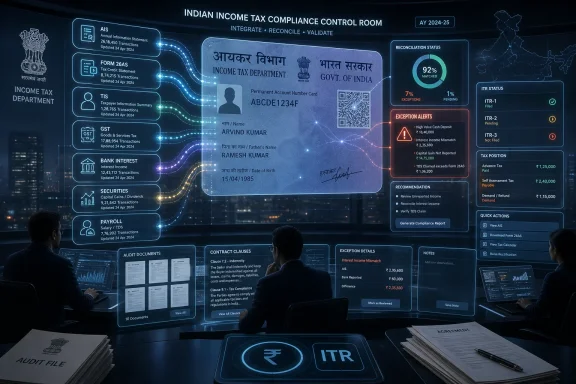 India’s Tax System Has Become a Data Machine, and AI Is the Natural Response
For years, tax compliance in India was framed as a form-filling exercise. A taxpayer or professional collected Form 16, Form 26AS, capital gains statements, bank interest certificates, and business accounts, then assembled them into the correct ITR. That model still exists, but it no longer describes the real risk.The real risk now sits in mismatches. The Annual Information Statement, Taxpayer Information Summary, Form 26AS, TDS returns, GST data, securities transactions, property reports, and foreign financial information have turned a taxpayer’s PAN into a constantly expanding data profile. A return is no longer judged only on what it says; it is judged against what the system already knows.
That is why AI has arrived with such force in ITR preparation, tax audit, and TDS compliance. The value is not merely speed. The value is pattern recognition across records that no professional can manually compare at scale without missing something.
This is also where the hype needs discipline. AI can classify, summarize, reconcile, flag, and draft. It cannot carry professional responsibility, interpret every legal nuance, or decide whether a tax position is commercially defensible. The future belongs not to the firm that “uses AI,” but to the firm that knows where AI ends.
The ITR Workflow Is Being Rebuilt Around Reconciliation
The most visible use of AI in direct tax practice is income tax return preparation. Modern systems can ingest Form 16, bank statements, AIS downloads, TIS summaries, Form 26AS, broker reports, mutual fund statements, capital gains schedules, and financial statements. Instead of keying every figure manually, the software extracts, maps, and classifies the underlying data.That sounds mundane until one considers how many ITR errors come from routine handling failures. Interest income omitted from one bank account, TDS credit claimed in the wrong year, a capital gains report not aligned with AIS, or a duplicate entry in investment income can all trigger notices. AI does not remove the legal obligation, but it can make these inconsistencies visible before filing.
Income classification is another useful area. Salary, business income, house property income, capital gains, and income from other sources each carry different tax treatment. AI-assisted tools can examine transaction descriptions, source documents, and prior-year patterns to suggest classification, though the final call remains a professional one.
Capital gains computation is especially well-suited to automation. Equity, mutual fund, crypto, and property transactions can involve FIFO rules, holding periods, indexation questions, exemption claims, and transaction-wise schedules. A good system can process the arithmetic quickly; a good professional still reviews whether the inputs and assumptions are correct.
AIS and Form 26AS Have Made “Good Enough” Filing Too Risky
The rise of AIS and Form 26AS reconciliation is arguably the strongest practical case for AI in Indian tax compliance. These statements are not just informational conveniences. They are the mirror against which the department, the taxpayer, and the professional all compare the return.AI-driven reconciliation engines can compare reported income with AIS entries, match TDS credits with Form 26AS, identify missing deductor records, flag duplicated transactions, and separate timing differences from genuine omissions. That is not glamorous work, but it is exactly the work that prevents avoidable notices.
The important shift is from after-the-fact correction to pre-filing review. A traditional workflow might discover a mismatch only after the Centralized Processing Centre issues an intimation or after a notice arrives. AI-assisted workflows aim to surface those differences before the return is submitted.
This does not mean AIS is always perfect. Taxpayers still encounter incorrect reporting, duplicated entries, delayed updates, and cases where the taxpayer’s books tell a more accurate story than the portal. AI helps organize the dispute, but it cannot magically decide which source is legally correct.
Tax Audit Is Moving From Sampling to Exception Hunting
Tax audits have always involved judgment, but much of the work has historically been laborious ledger scrutiny. The auditor examined purchases, sales, expenses, journal entries, loans, related-party balances, cash payments, statutory dues, and depreciation schedules. In a large business, that meant thousands or millions of entries.AI changes the audit posture. Instead of beginning with random or limited sampling, auditors can use analytics to identify exceptions. Unusual expense spikes, repeated round-number payments, backdated journal entries, related-party flows, unexplained reversals, or payments that appear to breach threshold-based provisions can be flagged early.
Form 3CD reporting is another natural use case. AI-assisted systems can check ledgers and supporting documents against disclosure areas such as cash payment restrictions, statutory dues under Section 43B, loans and deposits, TDS defaults, depreciation records, MSME disclosures, and related-party transactions. The tool does not sign the report; it helps the auditor see where the report may be exposed.
Document review is equally important. Agreements, loan papers, lease deeds, invoices, board resolutions, and vendor contracts often contain the tax implications that ledgers conceal. Large-language-model tools can summarize documents and highlight clauses involving withholding, reimbursements, related-party terms, interest, indemnities, permanent establishment risk, or capital-versus-revenue treatment.
The risk is overconfidence. An AI system may identify an unusual transaction without understanding commercial context. Conversely, it may miss a legally significant issue if the document is poorly scanned, badly drafted, or structured in a way the model does not parse well. Audit evidence still needs a human chain of reasoning.
TDS Compliance Is Becoming a Continuous Control System
TDS is one of the best candidates for AI because it is repetitive, rule-heavy, and operationally messy. Organizations must determine the correct section, apply the correct rate, validate PAN details, consider lower deduction certificates, track vendor status, monitor thresholds, and file quarterly returns. Errors are common because the workflow often spans finance, payroll, procurement, and tax teams.AI-assisted platforms can analyze the nature of a payment, vendor profile, contract description, historical deduction pattern, and invoice language to suggest whether Section 192, 194C, 194J, 194Q, 194R, 194S, or another provision may apply. That suggestion can reduce classification errors, especially in high-volume vendor environments.
The stronger use case is short-deduction detection. By comparing invoice values, payment records, TDS ledgers, and return data, a system can identify cases where tax was not deducted, was deducted late, or was deducted under the wrong section. That matters because TDS errors can create interest, penalties, disallowances, and vendor disputes.
Automated TDS return preparation also has obvious appeal. Payroll systems, ERP records, challan data, and vendor ledgers can be reconciled before generating Form 24Q, Form 26Q, Form 27Q, or Form 27EQ. The less glamorous the task, the stronger the case for automation.
But the professional issue remains the same: TDS law is not merely a code table. It turns on the character of a transaction. Software can propose the section; someone still has to understand the contract.
The Department Is Already Using the Same Logic
It would be a mistake to treat AI as something only taxpayers and professionals are adopting. The Indian tax administration has been moving in the same direction for years through faceless assessment, e-verification, pre-filled return data, AIS, TIS, risk-based scrutiny selection, and data analytics.The department’s advantage is scale. It can compare reported income with information from banks, stock exchanges, mutual funds, property registries, GST filings, TDS statements, and international reporting frameworks. That makes under-reporting easier to detect and harder to explain away as a clerical oversight.
This changes the relationship between taxpayer and system. In the past, compliance often began with the taxpayer’s records. Now, in many cases, compliance begins with the department’s data trail. The taxpayer’s return must either agree with that trail or explain why it does not.
AI tools are therefore not just productivity upgrades. They are defensive infrastructure. If the department is matching data at machine speed, the taxpayer’s side needs comparable tools to identify mismatches before the state does.
The Software Market Is Splitting Into Assistants, Platforms, and Audit Engines
The phrase “AI tax software” hides several very different categories. Some tools are general-purpose assistants. Some are compliance platforms with AI features. Others are audit analytics systems that predate the current generative AI boom but are now being marketed in AI language.ChatGPT is the most widely recognized general-purpose AI assistant. Tax professionals use it to draft notice replies, summarize assessment orders, prepare client notes, explain provisions, create checklists, and simplify dense legal material. Its strength is language; its weakness is authority. It can produce a plausible answer even when the law, citation, or interpretation needs verification.
Microsoft Copilot matters because tax work lives in Excel, Word, Outlook, and PowerPoint. For firms already embedded in Microsoft 365, Copilot can help analyze spreadsheets, summarize documents, draft reports, and pull structure out of messy working papers. Its practical advantage is proximity to the workflow, not tax specialization.
Google Gemini and Perplexity AI sit closer to the research layer. They can help professionals track developments, summarize public material, and explore legal or procedural issues. Perplexity’s source-forward style is useful for professionals who want a starting point for verification rather than an unsupported paragraph of AI confidence.
Claude has gained traction among legal and tax users because of its ability to handle long documents. That makes it useful for assessment orders, appellate submissions, contracts, financial statements, and large judicial decisions. The best use is not to “decide the case,” but to compress a large record into reviewable issues.
India’s Compliance Platforms Are Where the Work Gets Real
For day-to-day Indian compliance, specialist platforms matter more than chatbots. ClearTax, for example, offers income tax, TDS, GST, AIS, and Form 26AS reconciliation capabilities for individuals, professionals, and enterprises. Its value lies in mapping compliance data to statutory workflows rather than merely generating text.Zoho Books, with its Zia assistant and AI-enabled accounting features, is more relevant to businesses that want cleaner bookkeeping before the tax professional ever sees the file. Expense categorization, invoice processing, report insights, and business trend analysis may sound like accounting features, but clean books are the raw material of clean tax compliance.
TallyPrime remains central to Indian accounting practice, even though its AI story is more integration-led than native chatbot-led. The practical opportunity is to connect Tally data with analytics, reconciliation, and exception-reporting tools. For many small and mid-sized businesses, the audit starts where the Tally ledger ends.
Power BI occupies a different space. It is not tax software in the narrow sense, but it is becoming a powerful audit and compliance visualization layer. A tax auditor can use it to spot revenue trends, vendor concentration, expense anomalies, related-party flows, and unusual period-end adjustments.
IDEA and ACL Analytics, now commonly associated with audit analytics and forensic testing, are also part of this ecosystem. They can process large transaction sets, detect duplicates, test gaps, identify suspicious payments, and support audit evidence. In serious audit environments, these tools often matter more than fashionable generative AI demos.
Legal research platforms such as SCC Online and Manupatra are also moving into AI-assisted research. For tax litigation, that means faster precedent discovery, citation tracking, judgment summarization, and issue mapping. The danger is that faster research can still be shallow research if the professional does not read the underlying authority.
AI Makes the Junior Work Faster, but It Also Raises the Standard
The uncomfortable truth for the profession is that AI attacks the traditional pyramid of tax work. Data entry, first-draft replies, reconciliation, ledger scanning, document summaries, and checklist preparation have long been training grounds for junior staff. Those tasks are not disappearing, but they are being compressed.That does not make professionals irrelevant. It raises the standard for what human review must add. A professional who merely repeats what software generated is exposed; a professional who uses software to reach the judgment stage faster is more valuable.
Client expectations will change as well. If a mismatch report can be generated in minutes, clients will not accept week-long delays for basic reconciliation. If a notice reply can be drafted quickly, clients will expect the professional’s time to be spent on strategy, evidence, and risk assessment.
Firms will need process discipline. AI outputs should be logged, reviewed, and version-controlled. Sensitive documents should not be uploaded casually to consumer AI tools. Staff should know which systems are approved, what data can be shared, and when a partner-level review is mandatory.
Privacy and Liability Are the Costs Hidden Behind the Productivity Pitch
Tax data is among the most sensitive information a person or business can share. It includes income, investments, bank details, payroll, vendor relationships, property transactions, foreign assets, family arrangements, and litigation history. Uploading that data to an AI service is not a trivial technology choice.Firms need to ask where data is stored, whether it is used for model training, who can access it, how long it is retained, whether encryption is applied, and whether the platform supports enterprise controls. A cheap AI shortcut can become an expensive confidentiality failure.
Hallucination is the second major risk. Generative AI can invent case law, misstate statutory provisions, confuse assessment years, or produce outdated interpretations. In tax, a confident wrong answer is worse than no answer because it can enter a filing, notice reply, audit note, or client memo before anyone notices.
Regulatory uncertainty compounds the problem. India’s AI governance landscape is still evolving, and professional bodies have not fully resolved how liability should be allocated when AI contributes to defective compliance. Until that becomes clearer, the safest rule is simple: AI may assist, but the professional signs.
The Winning Tax Practice Will Look More Like a Control Room
The next stage of AI in taxation will not be an annual scramble before due dates. It will be continuous monitoring. Businesses will increasingly want systems that detect TDS exposure, AIS mismatches, GST-direct tax inconsistencies, abnormal ledgers, and documentation gaps throughout the year.Predictive tax risk scoring is the logical extension. Instead of asking whether a return is ready to file, systems will estimate which clients, vendors, transactions, or positions are likely to attract scrutiny. That will push tax work closer to enterprise risk management.
Litigation support will also mature. AI tools will summarize records, map grounds of appeal, compare fact patterns with precedent, and help prepare chronologies. But the best litigators will use those tools as acceleration, not substitution. Courts and authorities still respond to evidence, statutory interpretation, and credibility.
Voice-based tax assistants and natural-language compliance dashboards will make the technology more accessible. A business owner may soon ask, “Which vendors have TDS risk this quarter?” and receive a usable answer. The deeper question is whether the underlying data is clean enough to trust the response.
The Useful AI Tax Stack Is Smaller Than the Hype Suggests
The practical software list for Indian tax professionals should be organized by job, not by marketing category. A firm does not need every AI tool. It needs a controlled stack that covers drafting, research, reconciliation, accounting, audit analytics, and legal verification.- ChatGPT, Claude, Gemini, Perplexity, and Microsoft Copilot are useful as general AI assistants for drafting, summarizing, spreadsheet analysis, research support, and document review.
- ClearTax and similar direct tax compliance platforms are more suitable for ITR filing, AIS and Form 26AS reconciliation, TDS workflows, and enterprise compliance automation.
- Zoho Books with Zia and TallyPrime with analytics integrations are valuable when the goal is cleaner accounting data before tax computation begins.
- Power BI, IDEA, and ACL Analytics are better understood as audit and forensic analytics tools than as simple tax filing software.
- SCC Online AI, Manupatra AI, and other legal research systems are most useful for litigation support, precedent discovery, and judgment analysis.
- No AI tool should be treated as a substitute for statutory interpretation, professional skepticism, client-specific advice, or final review before filing.
References
- Primary source: Juris Hour
Published: 2026-06-20T09:50:18.144237
AI in Income Tax Returns, Tax Audit & TDS Compliance: List Of AI Softwares
Artificial Intelligence (AI) is no longer a futuristic concept in taxation. It has rapidly emerged as one of the most disruptive technologies impacting tax administration, compliance, audits, and litigation across the globe. In India, where tax laws are becoming increasingly data-driven and... www.jurishour.in
- Related coverage: cleartax.in
AI-Powered Direct Tax Compliance Platform & TDS Automation for Enterprises
Clear’s direct tax compliance platform automates end-to-end TDS workflows, return filing, certificate distribution, 26AS reconciliations, and Clause 34/44 exceptions for seamless enterprise compliance. cleartax.in
