

Microsoft’s Jessica Hawk, corporate vice president of Azure Product Marketing and a former founder, told Red Bull Basement readers in a May 11, 2026, interview that first-time founders should combine personal conviction with persistent execution while using Microsoft-backed AI tools and mentorship to turn early ideas into products. The quote is founder advice, but it is also a useful window into Microsoft’s larger startup strategy. Hawk is not merely telling young entrepreneurs to “keep the faith”; she is arguing that AI has changed the cost of persistence. For Windows developers, Azure shops, and IT pros watching the next generation of software companies form, that is the more consequential story.
Hawk’s central message is deliberately plain: founders should not quit too early. She talks about pressure, doubt, and the pull of doing something “more expected,” then frames endurance as the practical advantage that separates abandoned concepts from viable companies. That is familiar startup folklore, but in Microsoft’s telling it has been modernized for the AI era.
The new ingredient is not simply that founders can ask a chatbot for advice. It is that Microsoft wants AI to sit beside the founder from the first application form through prototype, pitch, and minimum viable product. In the Red Bull Basement program, that means Azure-powered application support, GitHub Copilot for writing code, and Foundry for building agentic systems.
That positioning matters because Microsoft is making a long-term bet: if students and first-time founders learn to build with Microsoft’s AI stack at the very beginning, Azure becomes not just infrastructure but muscle memory. The company has spent decades winning developers through operating systems, IDEs, runtimes, and enterprise agreements. This is the same playbook, updated for a world where the first product demo may be generated before the first engineer is hired.
Hawk’s language is warm, but the strategy is coldly rational. Startups do not merely consume cloud credits; they become future case studies, procurement beachheads, and acquisition targets. Teaching founders to persist with Azure tools is both empowerment and ecosystem capture.
That distinction is important. The real advantage of AI for first-time founders is not omniscience; it is cheaper uncertainty. A student founder can now test messaging, draft code, explore user personas, generate pitch materials, simulate workflows, and build a rough prototype at a speed that would have seemed implausible a few years ago.
For WindowsForum readers, this is the practical hinge. AI does not eliminate architecture, security, supportability, or market risk. But it compresses the distance between “I wonder if this could work” and “here is a rough implementation we can criticize.” That compression is why Microsoft wants Copilot and Foundry in the hands of young builders early.
Hawk describes AI as an “infinitely patient teacher,” which is a polished marketing phrase but not an empty one. Anyone who has mentored junior developers knows that the bottleneck is often not intelligence but the willingness to ask the tenth naïve question. An AI assistant is always available for that tenth question, even if its answer still needs verification.
The danger is that patience can be mistaken for correctness. AI will keep responding long after it has wandered into fabrication, insecure defaults, or architectural nonsense. That makes Hawk’s other advice — listen, adjust, talk to people, keep networks healthy — more than folksy founder wisdom. It is the necessary human counterweight to machine-generated momentum.
That makes the partnership look less like a vendor campaign and more like a launchpad. Microsoft can present itself as a mentor and enabler, not just the company that sends the bill when inference costs spike. Red Bull supplies the cultural packaging; Microsoft supplies the technical substrate.
The arrangement also reflects a broader shift in startup formation. First-time founders no longer need to begin with a traditional software team, a formal accelerator, or a fully scoped engineering plan. They can start with a problem, an AI-assisted application process, a cloud credit pool, and a set of tools that turn intent into something demoable.
This is good for experimentation and messy for quality. The same tooling that helps a serious founder prototype a useful product also helps flood the world with thin wrappers, half-baked agents, and apps that fail the moment they meet real users. Microsoft’s challenge is to make its startup pipeline look like disciplined creation rather than automated noise.
Hawk seems aware of that tension. Her advice repeatedly returns to execution rather than inspiration. The founder must remain agile, listen, adjust, and keep making progress. In other words, the AI stack can accelerate the work, but it cannot supply the founder’s judgment.
The catch is that credits do not remove complexity. Azure is powerful precisely because it is broad, and that breadth can overwhelm first-time builders. A founder who wants to build an AI agent may suddenly need to understand identity, permissions, model selection, telemetry, data handling, storage, rate limits, cost controls, and deployment pipelines.
That is where the Red Bull Basement mentorship layer becomes more important than the marketing copy suggests. Credits without guidance can produce runaway bills, brittle demos, and insecure prototypes. Credits with experienced review can teach founders the habits they will need if their project becomes a real service.
For IT pros, this is the familiar story of cloud democratization. The tools become easier to access before the operational discipline becomes easier to learn. Every generation of platform abstraction promises to make development more approachable, and every generation eventually rediscovers logging, governance, identity, backup, compliance, and incident response.
Microsoft’s startup pitch is strongest when it acknowledges that reality. Foundry and Copilot can help a small team move faster, but the difference between a clever demo and a trustworthy product still lives in the boring parts: access control, monitoring, data boundaries, rollback plans, and cost visibility.
That is a profound shift. The first engineer in a startup used to be a scarce resource because so much early progress depended on hand-building the basics. With AI assistance, one capable builder can appear larger than they are, at least long enough to test whether the idea deserves more investment.
But Copilot does not turn a founder into a company. It cannot decide which customer pain is real, which workflow deserves automation, which data should never be collected, or which feature will create support burden later. It can accelerate code production, and code production is not the same as product formation.
This is where Hawk’s emphasis on talking to everyone — even a barista or grocery checker — cuts against the worst tendencies of AI-native building. Founders can now spend too much time in synthetic conversation with a model and too little time in awkward conversation with humans. The model will always engage; the market may simply shrug.
The best founders will use AI to prepare for human contact, not replace it. They will simulate objections, draft prototypes, and refine explanations, then take those artifacts into the real world where customers misunderstand, complain, negotiate, and reveal what they actually value.
For established enterprises, Foundry is pitched as a way to build, evaluate, secure, and govern AI applications. For first-time founders, the appeal is different: it offers a shortcut into the kind of tooling that would otherwise require specialized infrastructure knowledge. A small team can begin experimenting with multi-step AI systems before it has a mature platform team.
That is powerful, and it is also where risk compounds. Agentic systems can make calls, retrieve data, invoke tools, and chain decisions in ways that are harder to audit than a conventional web app. A student founder building an agent may learn quickly that the demo is easy and the trust boundary is hard.
Microsoft has an incentive to make this feel approachable, but IT professionals should keep the distinction clear. Easy access to agent-building tools does not make agentic applications inherently reliable. It simply moves the reliability problem earlier in the founder journey.
The healthiest version of Microsoft’s strategy would teach founders evaluation and governance as first-class startup skills, not enterprise chores to be postponed until after success. If tomorrow’s founders learn that testing prompts, monitoring outputs, and constraining permissions are part of building, the ecosystem benefits. If they learn only that agents are exciting, sysadmins and security teams will inherit the mess.
It also makes her a useful bridge between two worlds Microsoft is trying to connect. On one side are students and first-time founders who think in ideas, prototypes, and ambition. On the other side are enterprise buyers who think in controls, outcomes, integration, and support. Hawk’s career runs through both.
That dual identity explains why her advice avoids the fantasy that startups succeed on inspiration alone. She talks about passion, but she gives equal weight to execution. She talks about faith, but immediately follows with agility, listening, adjustment, and daily progress.
This is the part of the interview that feels least like vendor positioning and most like actual founder memory. Many startups do not die from one dramatic failure. They die because the team stops making small, credible progress. AI can help sustain that progress, but only if the founder remains disciplined enough to convert outputs into learning.
The strategic question is whether first-time founders will see that bundle as empowerment or gravity. The more Microsoft’s tools help them move, the harder it becomes to leave. Early architecture decisions have a way of becoming company destiny.
This is not inherently sinister. Developers have always chosen ecosystems, and ecosystems have always rewarded early familiarity. The difference now is that AI tools may guide architectural choices at the moment founders are least equipped to evaluate long-term tradeoffs.
That puts more responsibility on Microsoft than the cheerful Red Bull framing suggests. If the company wants to be the default platform for AI-native startups, it should make portability, cost transparency, responsible AI practices, and security defaults part of the pitch from day one. Otherwise the “magic” may look, in hindsight, like lock-in with better lighting.
For WindowsForum’s IT audience, the development is worth watching because today’s student startup is tomorrow’s SaaS vendor in the procurement queue. The tooling choices made in incubators will eventually surface as integration requirements, compliance questionnaires, and support tickets.
A model can help a founder refine a pitch indefinitely. It will not roll its eyes, ask who would pay for the product, or point out that the workflow already exists in three competing tools. Humans do that, and founders need it.
The best startup programs create collision: mentors, peers, judges, users, skeptics, and people with completely different assumptions. Red Bull Basement appears to understand that, which is why Microsoft’s tools are paired with mentorship and a global competition structure. The social pressure is not a decorative add-on; it is part of the product.
This is also where first-time founders may have an advantage over incumbents. They often have less institutional fear and fewer internal politics. Hawk’s “magic” line is really about that openness: young builders do not yet know all the reasons something is supposed to be impossible.
But ignorance is useful only for a while. Eventually, founders must learn the constraints without being crushed by them. The right mix of AI assistance and human correction can make that learning curve less brutal.
If AI lowers the cost of producing demos, the world will get more demos. The scarce skill will be deciding which demos should become durable software. Founders will need to learn not only how to build quickly but how to abandon responsibly.
This is where Hawk’s persistence message requires nuance. Persistence is not the same as stubbornness. The founder who “keeps the faith” must still be willing to change the idea, narrow the market, rewrite the product, or admit that the need was not as unmet as it first appeared.
Microsoft benefits when founders keep building, but founders benefit when they keep learning. Those goals overlap most of the time, but not always. A platform company wants usage; a founder needs truth.
That is why the best reading of Hawk’s advice is not “never stop.” It is “do not let friction alone decide whether you stop.” AI can reduce some of that friction, but it cannot determine whether the destination is worth reaching.
That does not mean every student project becomes a company. It does mean the barrier between idea and evidence is lower. More people can test more concepts with less money and fewer gatekeepers.
For the Windows ecosystem, this is another sign that the center of gravity is moving from the desktop app to the AI-assisted workflow. The next wave of founders may still build for Windows users, enterprise customers, and cloud administrators, but they will increasingly do so through AI-native development environments and agent platforms.
The practical take is neither cynicism nor cheerleading. Microsoft is offering real leverage, and it is also building a pipeline. Founders should take the leverage with their eyes open.
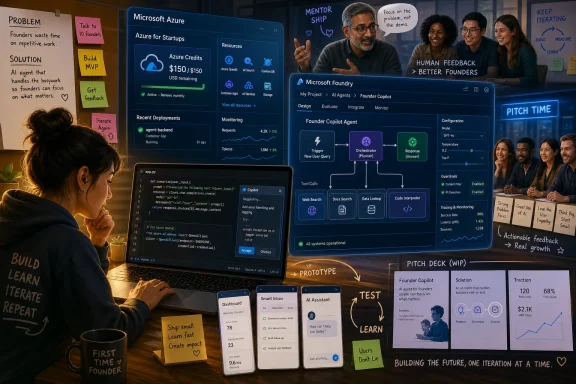 Microsoft Sells Persistence as a Platform Feature
Hawk’s central message is deliberately plain: founders should not quit too early. She talks about pressure, doubt, and the pull of doing something “more expected,” then frames endurance as the practical advantage that separates abandoned concepts from viable companies. That is familiar startup folklore, but in Microsoft’s telling it has been modernized for the AI era.The new ingredient is not simply that founders can ask a chatbot for advice. It is that Microsoft wants AI to sit beside the founder from the first application form through prototype, pitch, and minimum viable product. In the Red Bull Basement program, that means Azure-powered application support, GitHub Copilot for writing code, and Foundry for building agentic systems.
That positioning matters because Microsoft is making a long-term bet: if students and first-time founders learn to build with Microsoft’s AI stack at the very beginning, Azure becomes not just infrastructure but muscle memory. The company has spent decades winning developers through operating systems, IDEs, runtimes, and enterprise agreements. This is the same playbook, updated for a world where the first product demo may be generated before the first engineer is hired.
Hawk’s language is warm, but the strategy is coldly rational. Startups do not merely consume cloud credits; they become future case studies, procurement beachheads, and acquisition targets. Teaching founders to persist with Azure tools is both empowerment and ecosystem capture.
The “Magic” Is Really About Lowering the Cost of Being Wrong
The most interesting part of Hawk’s argument is her insistence that AI helps founders keep moving when the first idea hits resistance. She does not promise that AI will make the idea good. She says it can help founders iterate, learn, adjust, and continue.That distinction is important. The real advantage of AI for first-time founders is not omniscience; it is cheaper uncertainty. A student founder can now test messaging, draft code, explore user personas, generate pitch materials, simulate workflows, and build a rough prototype at a speed that would have seemed implausible a few years ago.
For WindowsForum readers, this is the practical hinge. AI does not eliminate architecture, security, supportability, or market risk. But it compresses the distance between “I wonder if this could work” and “here is a rough implementation we can criticize.” That compression is why Microsoft wants Copilot and Foundry in the hands of young builders early.
Hawk describes AI as an “infinitely patient teacher,” which is a polished marketing phrase but not an empty one. Anyone who has mentored junior developers knows that the bottleneck is often not intelligence but the willingness to ask the tenth naïve question. An AI assistant is always available for that tenth question, even if its answer still needs verification.
The danger is that patience can be mistaken for correctness. AI will keep responding long after it has wandered into fabrication, insecure defaults, or architectural nonsense. That makes Hawk’s other advice — listen, adjust, talk to people, keep networks healthy — more than folksy founder wisdom. It is the necessary human counterweight to machine-generated momentum.
Red Bull Basement Gives Microsoft a Startup Funnel With Better Optics
Red Bull Basement is an unusually convenient venue for Microsoft’s message. It is student-friendly, global, energetic, and explicitly tied to innovation rather than enterprise procurement. The program’s winner package includes equity-free funding and Azure credits, making it attractive to young founders who may not yet know what cloud platform they would otherwise choose.That makes the partnership look less like a vendor campaign and more like a launchpad. Microsoft can present itself as a mentor and enabler, not just the company that sends the bill when inference costs spike. Red Bull supplies the cultural packaging; Microsoft supplies the technical substrate.
The arrangement also reflects a broader shift in startup formation. First-time founders no longer need to begin with a traditional software team, a formal accelerator, or a fully scoped engineering plan. They can start with a problem, an AI-assisted application process, a cloud credit pool, and a set of tools that turn intent into something demoable.
This is good for experimentation and messy for quality. The same tooling that helps a serious founder prototype a useful product also helps flood the world with thin wrappers, half-baked agents, and apps that fail the moment they meet real users. Microsoft’s challenge is to make its startup pipeline look like disciplined creation rather than automated noise.
Hawk seems aware of that tension. Her advice repeatedly returns to execution rather than inspiration. The founder must remain agile, listen, adjust, and keep making progress. In other words, the AI stack can accelerate the work, but it cannot supply the founder’s judgment.
Azure Credits Are a Gift With a Learning Curve
Cloud credits are a classic startup incentive because they feel generous and practical at the same time. For a young team, $25,000 in Azure credits can be the difference between a slide deck and a working prototype. For Microsoft, the credits are a customer acquisition cost with a long tail.The catch is that credits do not remove complexity. Azure is powerful precisely because it is broad, and that breadth can overwhelm first-time builders. A founder who wants to build an AI agent may suddenly need to understand identity, permissions, model selection, telemetry, data handling, storage, rate limits, cost controls, and deployment pipelines.
That is where the Red Bull Basement mentorship layer becomes more important than the marketing copy suggests. Credits without guidance can produce runaway bills, brittle demos, and insecure prototypes. Credits with experienced review can teach founders the habits they will need if their project becomes a real service.
For IT pros, this is the familiar story of cloud democratization. The tools become easier to access before the operational discipline becomes easier to learn. Every generation of platform abstraction promises to make development more approachable, and every generation eventually rediscovers logging, governance, identity, backup, compliance, and incident response.
Microsoft’s startup pitch is strongest when it acknowledges that reality. Foundry and Copilot can help a small team move faster, but the difference between a clever demo and a trustworthy product still lives in the boring parts: access control, monitoring, data boundaries, rollback plans, and cost visibility.
Copilot Turns the First Engineer Into a Team, But Not a Company
GitHub Copilot is the most obvious tool in Microsoft’s founder story because it changes the daily experience of writing software. A solo technical founder can generate scaffolding, tests, documentation, scripts, and exploratory code without waiting for a second hire. A non-expert can get closer to a working implementation than before, though not necessarily to a safe or maintainable one.That is a profound shift. The first engineer in a startup used to be a scarce resource because so much early progress depended on hand-building the basics. With AI assistance, one capable builder can appear larger than they are, at least long enough to test whether the idea deserves more investment.
But Copilot does not turn a founder into a company. It cannot decide which customer pain is real, which workflow deserves automation, which data should never be collected, or which feature will create support burden later. It can accelerate code production, and code production is not the same as product formation.
This is where Hawk’s emphasis on talking to everyone — even a barista or grocery checker — cuts against the worst tendencies of AI-native building. Founders can now spend too much time in synthetic conversation with a model and too little time in awkward conversation with humans. The model will always engage; the market may simply shrug.
The best founders will use AI to prepare for human contact, not replace it. They will simulate objections, draft prototypes, and refine explanations, then take those artifacts into the real world where customers misunderstand, complain, negotiate, and reveal what they actually value.
Foundry Moves the Startup Pitch From Apps to Agents
The mention of Microsoft Foundry is not incidental. Microsoft wants founders thinking not just in terms of apps, but in terms of agents, orchestrated systems, model routing, and AI-native workflows. That is the frontier Microsoft is trying to normalize.For established enterprises, Foundry is pitched as a way to build, evaluate, secure, and govern AI applications. For first-time founders, the appeal is different: it offers a shortcut into the kind of tooling that would otherwise require specialized infrastructure knowledge. A small team can begin experimenting with multi-step AI systems before it has a mature platform team.
That is powerful, and it is also where risk compounds. Agentic systems can make calls, retrieve data, invoke tools, and chain decisions in ways that are harder to audit than a conventional web app. A student founder building an agent may learn quickly that the demo is easy and the trust boundary is hard.
Microsoft has an incentive to make this feel approachable, but IT professionals should keep the distinction clear. Easy access to agent-building tools does not make agentic applications inherently reliable. It simply moves the reliability problem earlier in the founder journey.
The healthiest version of Microsoft’s strategy would teach founders evaluation and governance as first-class startup skills, not enterprise chores to be postponed until after success. If tomorrow’s founders learn that testing prompts, monitoring outputs, and constraining permissions are part of building, the ecosystem benefits. If they learn only that agents are exciting, sysadmins and security teams will inherit the mess.
The Former Founder Persona Gives Microsoft’s Message Credibility
Hawk’s founder background matters because it gives the interview a credibility that a generic cloud executive would struggle to claim. She co-founded Capax Global, helped grow it into an Azure-focused services company, and later saw it merge into Hitachi Solutions. That experience lets her speak about persistence without sounding like she is reading from a startup-marketing script.It also makes her a useful bridge between two worlds Microsoft is trying to connect. On one side are students and first-time founders who think in ideas, prototypes, and ambition. On the other side are enterprise buyers who think in controls, outcomes, integration, and support. Hawk’s career runs through both.
That dual identity explains why her advice avoids the fantasy that startups succeed on inspiration alone. She talks about passion, but she gives equal weight to execution. She talks about faith, but immediately follows with agility, listening, adjustment, and daily progress.
This is the part of the interview that feels least like vendor positioning and most like actual founder memory. Many startups do not die from one dramatic failure. They die because the team stops making small, credible progress. AI can help sustain that progress, but only if the founder remains disciplined enough to convert outputs into learning.
First-Time Founders Are Becoming the New Developer Relations Battlefield
Microsoft is not alone in chasing young builders, but its approach is unusually comprehensive. It can offer code assistance through GitHub, cloud infrastructure through Azure, AI development through Foundry, productivity integration through Microsoft 365, and enterprise credibility through decades of corporate relationships. That bundle is difficult for smaller competitors to match.The strategic question is whether first-time founders will see that bundle as empowerment or gravity. The more Microsoft’s tools help them move, the harder it becomes to leave. Early architecture decisions have a way of becoming company destiny.
This is not inherently sinister. Developers have always chosen ecosystems, and ecosystems have always rewarded early familiarity. The difference now is that AI tools may guide architectural choices at the moment founders are least equipped to evaluate long-term tradeoffs.
That puts more responsibility on Microsoft than the cheerful Red Bull framing suggests. If the company wants to be the default platform for AI-native startups, it should make portability, cost transparency, responsible AI practices, and security defaults part of the pitch from day one. Otherwise the “magic” may look, in hindsight, like lock-in with better lighting.
For WindowsForum’s IT audience, the development is worth watching because today’s student startup is tomorrow’s SaaS vendor in the procurement queue. The tooling choices made in incubators will eventually surface as integration requirements, compliance questionnaires, and support tickets.
Human Networks Remain the Only Reality Check That Scales
Hawk’s strongest counterbalance to AI enthusiasm is her insistence on human connection. She tells founders to keep their networks healthy and to discuss their ideas outside formal business settings. That advice sounds quaint until you consider how easy AI makes it to avoid uncomfortable feedback.A model can help a founder refine a pitch indefinitely. It will not roll its eyes, ask who would pay for the product, or point out that the workflow already exists in three competing tools. Humans do that, and founders need it.
The best startup programs create collision: mentors, peers, judges, users, skeptics, and people with completely different assumptions. Red Bull Basement appears to understand that, which is why Microsoft’s tools are paired with mentorship and a global competition structure. The social pressure is not a decorative add-on; it is part of the product.
This is also where first-time founders may have an advantage over incumbents. They often have less institutional fear and fewer internal politics. Hawk’s “magic” line is really about that openness: young builders do not yet know all the reasons something is supposed to be impossible.
But ignorance is useful only for a while. Eventually, founders must learn the constraints without being crushed by them. The right mix of AI assistance and human correction can make that learning curve less brutal.
The Real Test Comes After the Demo Works
Startup programs tend to celebrate the pitch, because the pitch is visible, dramatic, and easy to judge. But the harder test comes later, after the demo works and the founder must decide whether the product deserves maintenance. That is where Microsoft’s involvement becomes more than a branding exercise.If AI lowers the cost of producing demos, the world will get more demos. The scarce skill will be deciding which demos should become durable software. Founders will need to learn not only how to build quickly but how to abandon responsibly.
This is where Hawk’s persistence message requires nuance. Persistence is not the same as stubbornness. The founder who “keeps the faith” must still be willing to change the idea, narrow the market, rewrite the product, or admit that the need was not as unmet as it first appeared.
Microsoft benefits when founders keep building, but founders benefit when they keep learning. Those goals overlap most of the time, but not always. A platform company wants usage; a founder needs truth.
That is why the best reading of Hawk’s advice is not “never stop.” It is “do not let friction alone decide whether you stop.” AI can reduce some of that friction, but it cannot determine whether the destination is worth reaching.
The Practical Lesson Is Smaller Than the Hype and More Useful
The Red Bull interview is wrapped in the language of inspiration, but the operational lesson is concrete. First-time founders now have access to tools that can help them think, write, code, prototype, and rehearse at a pace that changes early-stage company formation. Microsoft wants those tools to be Azure, Copilot, and Foundry.That does not mean every student project becomes a company. It does mean the barrier between idea and evidence is lower. More people can test more concepts with less money and fewer gatekeepers.
For the Windows ecosystem, this is another sign that the center of gravity is moving from the desktop app to the AI-assisted workflow. The next wave of founders may still build for Windows users, enterprise customers, and cloud administrators, but they will increasingly do so through AI-native development environments and agent platforms.
The practical take is neither cynicism nor cheerleading. Microsoft is offering real leverage, and it is also building a pipeline. Founders should take the leverage with their eyes open.
Where Hawk’s Founder Advice Becomes Microsoft’s Platform Argument
The most concrete reading of Hawk’s message is that Microsoft wants persistence to feel technically supported, not merely emotionally encouraged. That is a meaningful shift for first-time founders who may have ambition before they have infrastructure, but it also changes what early startup discipline must include.- Founders should treat AI as a way to accelerate iteration, not as proof that an idea is viable.
- Azure credits can be valuable, but only if teams learn cost control, identity, security, and monitoring early.
- GitHub Copilot can make a small team look larger, but it cannot replace customer discovery or product judgment.
- Microsoft Foundry gives young teams access to agent-building patterns that require serious evaluation and governance.
- Mentorship and peer feedback remain essential because AI systems are more agreeable than markets.
- Microsoft’s support is both an opportunity for founders and a strategic bet on making Azure the default home for AI-native startups.
References
- Primary source: Red Bull
Published: 2026-05-26T18:30:08.005937
Microsoft’s Jessica Hawk on “magic” opportunities for first-time founders
A former founder herself, the corporate vice president of Microsoft Azure Product Marketing talks technology, offers advice and explains why she’s so excited about Red Bull Basement. www.redbull.com
- Related coverage: windowsforum.com

Microsoft and Red Bull Basement: Azure AI Tools as a Founder First Infrastructure Stack
Microsoft Azure product marketing chief Jessica Hawk told Red Bull on May 8, 2026, that first-time founders should pair persistence with practical AI tools as Microsoft again supports the Red Bull Basement student innovation program in 2026. The interview is framed as founder advice, but the... windowsforum.com
- Related coverage: windowsnews.ai
Microsoft and Red Bull Basement: Azure AI Tools as a Founder First Infrastructure Stack
On May 8, 2026, Microsoft’s Jessica Hawk revealed that Red Bull Basement founders will get Azure AI tools, including GitHub Copilot and agent frameworks, to...windowsnews.ai
- Official source: azure.microsoft.com
Microsoft Foundry | Microsoft Azure
Kickstart innovation with Microsoft Foundry, the AI app and agent factory designed to accelerate AI-driven, cloud-native development across industries.azure.microsoft.com
- Related coverage: techcrunch.com

How AI changes the math for startups, according to a Microsoft VP | TechCrunch
Amanda Silver is a corporate vice president at Microsoft’s CoreAI division, where she works on tools for deploying apps and agentic systems within enterprises. techcrunch.com
- Official source: cdn-dynmedia-1.microsoft.com
- Related coverage: news.cognizant.com
