

Microsoft Azure product marketing chief Jessica Hawk told Red Bull on May 8, 2026, that first-time founders should pair persistence with practical AI tools as Microsoft again supports the Red Bull Basement student innovation program in 2026. The interview is framed as founder advice, but the more interesting story is Microsoft’s attempt to turn Azure, GitHub Copilot, and agent-building platforms into the default operating environment for the next generation of startups. Red Bull gets a technology halo around its incubator; Microsoft gets early proximity to builders before they have procurement departments, cloud bills, or platform loyalties. For WindowsForum readers, the useful signal is not the motivational language — it is how Microsoft is packaging AI as a founder’s first infrastructure stack.
The modern cloud platform fight no longer begins when a company has a CIO, a security team, and a purchasing committee. It begins when a student has an idea, an AI prompt, and just enough credits to turn a sketch into a demo. That is why Microsoft’s role in Red Bull Basement matters more than a standard sponsorship notice would suggest.
Hawk’s message is deliberately human: keep going, stay agile, listen, adjust, and keep faith with a problem you believe is unmet. But surrounding that advice is a very specific product funnel. Participants are steered through an AI-assisted application experience built on Azure, encouraged to use GitHub Copilot, and pointed toward Microsoft’s platform for building intelligent agents and systems.
That makes the Red Bull interview a neat snapshot of Microsoft’s current AI strategy. The company is not merely selling compute or productivity software; it is trying to become the place where a half-formed idea becomes a minimum viable product. The founder’s journey is being recast as a cloud-native, AI-mediated workflow, with Azure waiting at every handoff.
There is nothing inherently sinister about that. Startups have always needed platforms, tools, mentors, and capital. But the more Microsoft can insert itself at the moment when a founder first learns how to build with AI, the more likely it becomes that “startup infrastructure” and “Azure infrastructure” feel like the same thing.
A first-time founder no longer needs to assemble a full engineering team before testing a workflow, generating code, mocking up a product flow, or building a pitchable prototype. AI tools can help generate application copy, produce code scaffolding, summarize market research, and explain technical concepts without the social friction of asking a mentor every basic question. Hawk calls AI an “infinitely patient teacher,” and that phrase captures both the promise and the risk.
The promise is obvious. The founder who lacks a technical co-founder, a friendly investor, or a local startup network can still iterate quickly. AI can reduce the intimidation factor around cloud services, programming frameworks, and product design.
The risk is that patience can be mistaken for judgment. AI will keep helping long after a bad idea should have been challenged. It will produce plausible answers even when the user needs market validation, regulatory advice, security review, or an uncomfortable conversation with real customers.
That is why Hawk’s parallel emphasis on human networks is important. She recalls pitching ideas casually to people outside formal business settings, including service workers and everyday contacts. That kind of messy, human feedback loop is still something AI cannot replace, because product-market fit is not discovered inside a chat window.
That matters because developer loyalty is often set early. The first cloud console a founder understands, the first AI coding assistant they rely on, the first credits that let them ship a demo — these can become defaults long after the startup has outgrown its student origins. Cloud migration is possible, but architectural inertia is real.
Microsoft knows this because Azure’s rise has depended not only on enterprise relationships but also on making its developer ecosystem feel unavoidable. Visual Studio Code, GitHub, Copilot, Azure, and now AI agent tooling form a ladder from individual tinkering to commercial deployment. Red Bull Basement gives that ladder a public, youth-oriented stage.
For Microsoft, this is a more appealing posture than simply shouting about model benchmarks or cloud regions. The company can appear as mentor, enabler, and infrastructure partner all at once. It can wrap Azure consumption inside a narrative of empowerment.
For Red Bull, the value is equally clear. The incubator can claim relevance in the AI startup moment without having to become a cloud company itself. Microsoft supplies the technical credibility; Red Bull supplies the audience, event machinery, and cultural packaging.
The beginner-friendly story is that AI lowers barriers. The platform story is that the lowered barrier leads users directly into managed services. A founder who starts with an AI-assisted one-pager may next need a prototype, then authentication, storage, deployment, monitoring, compliance, and billing. At each step, the platform that made the first step easy has a chance to become the default answer.
This is where Azure credits play a familiar strategic role. Free or subsidized credits reduce early friction, but they also normalize a platform’s architecture and pricing model. Once a prototype becomes a product, the founder’s “free” technical choices become operational commitments.
That does not make credits bad. For a cash-strapped founder, credits can be the difference between an idea dying in a slide deck and becoming a working service. But experienced IT pros will recognize the pattern: today’s startup enablement is tomorrow’s cloud dependency.
The most important question, then, is not whether Microsoft is helping founders. It is whether founders understand the trade they are making. They gain speed, tooling, mentorship, and infrastructure; they may also inherit assumptions about architecture, data, cost, identity, and governance before they know enough to question them.
For novice builders, the value is easy to understand. Copilot can suggest code, explain errors, translate intent into syntax, and accelerate repetitive implementation work. It can make software development feel less like a gatekept discipline and more like a conversation with an assistant that has seen countless patterns before.
But Copilot also changes what early founders need to know. It reduces the penalty for not remembering syntax, but it does not remove the need to understand architecture, security, data modeling, licensing, or maintainability. The danger is not that AI writes code; the danger is that it writes enough code to convince a team it has built a product when it has mostly built a demo.
That distinction matters in startup programs. A polished demo can win attention, but a resilient product has to survive users, bad inputs, outages, abuse, privacy obligations, and cost growth. AI-assisted coding can accelerate the first half of that journey while leaving the second half dangerously underexamined.
The best founder programs will therefore teach Copilot as an amplifier, not an autopilot. The lesson should not be “AI can build it for you.” It should be “AI can help you build faster, but you are still accountable for what ships.”
For founders, agents are seductive because they promise leverage. A tiny team can imagine building a product that automates work once reserved for departments. Customer support, scheduling, analytics, procurement, research, compliance prep, and internal operations all become candidates for AI-assisted workflows.
For platform companies, agents are attractive because they sit close to data, identity, permissions, logging, and business process integration. Once an agent architecture is built around a particular cloud provider’s orchestration layer, model access pattern, security model, and tool-calling framework, switching platforms becomes far more complex than moving a simple web app.
That is why Microsoft’s founder outreach around agents deserves scrutiny. It is not just giving students access to shiny AI features. It is introducing them to a way of building software in which the cloud platform is not merely hosting the application but coordinating the intelligence inside it.
This shift will matter for Windows shops, too. Many organizations are already trying to understand where Copilot, Azure AI services, Microsoft 365 data, Entra identity, and custom agents intersect. The startup world often previews patterns that enterprise IT later has to govern. What begins as a student innovation demo can become tomorrow’s procurement request.
Her advice reflects that background. Persistence matters, but not in the abstract. She emphasizes execution, agility, listening, and adjusting — the disciplines that separate durable businesses from clever concepts.
The AI subsidy model changes the early phase of that discipline. With cloud credits, coding assistants, and AI-guided application workflows, founders can do more before they raise money or hire specialists. That is empowering, but it can also delay hard prioritization. When experimentation feels cheap, teams may avoid deciding what they truly are.
The best founders will use AI to shorten the distance between hypothesis and evidence. They will build prototypes to learn, not merely to impress. They will treat generated code, pitch text, and AI-assisted strategy as drafts that demand reality checks.
The weaker founders will use AI to create motion without traction. They will produce more artifacts, more mockups, more summaries, and more demos, while still lacking a painful customer problem and a defensible answer. In that sense, AI does not abolish startup failure; it may simply make failure look more professional for longer.
That duality is not new. Windows empowered personal computing while anchoring users to Microsoft’s ecosystem. Office empowered knowledge work while defining file formats, workflows, and organizational habits. Azure empowers cloud transformation while creating deep operational dependencies.
The AI era continues that pattern. Microsoft can genuinely help young builders access powerful tools while also shaping their assumptions about where intelligence should live, how it should be billed, and who should mediate it. The two truths coexist.
For IT pros, this is familiar territory. Vendor ecosystems are not charities; they are strategic environments. Good vendors create real value, but they also create gravity. The job is not to reject gravity, but to understand it before building mission-critical systems inside it.
That is why founder education should include cloud literacy alongside motivational coaching. Students should learn not only how to prototype with Azure credits, but also how to estimate costs, protect data, document dependencies, design for portability where appropriate, and understand the security responsibilities that remain theirs.
Startup culture often romanticizes the solitary genius, and AI tools can intensify that myth. A founder can now brainstorm alone, code alone, design alone, and pitch-practice alone. The feedback loop is always available, always polite, and always willing to continue.
But markets are made of people who are impatient, inconsistent, budget-constrained, distracted, and often unable to describe what they need until they see it. A model can simulate feedback, but it cannot become a real buyer with a real procurement process and a real reason to say no.
This is especially true for founders building tools for businesses. Enterprise pain points are rarely isolated technical problems. They are tangled in compliance, workflow politics, legacy systems, training gaps, and security constraints. A founder who does not talk to actual users will build for an imaginary organization that approves purchases instantly and integrates cleanly with everything.
Red Bull Basement’s mentor and peer network may therefore be as important as the Azure credits. The value is not merely access to experts; it is forced contact with other humans who can challenge the story a founder is telling themselves.
A bad product idea does not become good because it has a chatbot interface. A thin business model does not become durable because the pitch deck invokes agents. A poorly secured app does not become enterprise-ready because Copilot helped write it.
This is where Microsoft’s partnership with a founder program faces a subtle responsibility. If the message is simply “AI unlocks magic,” participants may overestimate what the tools can safely do. If the message is “AI gives you leverage, but leverage magnifies both competence and error,” the program becomes more useful.
For WindowsForum’s audience, this distinction is not academic. Many admins and developers are already being asked to evaluate AI-generated internal tools, low-code automations, and prototype agents built by business units outside traditional IT governance. The founder mindset is entering the enterprise from the side door.
Organizations need to prepare for that reality. They will see more small teams building more software-like systems with less formal engineering background. The right response is not to ban experimentation, but to establish review paths, identity controls, data boundaries, logging expectations, and cost visibility before prototypes become production dependencies.
That positioning reflects the broader direction of cloud platforms. The cloud used to be where software was deployed after development. Increasingly, the cloud is where development, AI assistance, data access, testing, deployment, and operations blur together. The platform becomes the workshop, the supply chain, and the showroom.
If Microsoft can make Azure feel like the natural place to brainstorm, prototype, deploy, and scale, it wins more than workloads. It wins mental models. A generation of founders may come to see AI-native building as something that happens inside a cloud provider’s integrated stack.
There are advantages to that model. Integration reduces friction. Security features can be standardized. Identity can be centralized. Monitoring and deployment can be simplified. For inexperienced founders, a coherent platform may prevent the chaos of stitching together random services with unclear responsibilities.
But coherence has a price. Platform-native thinking can narrow imagination. Founders may design around the services in front of them rather than the architecture their product actually requires. They may confuse convenience with strategy.
That is when the hidden work appears. Someone has to know where the data lives. Someone has to understand what the AI model is allowed to see. Someone has to manage secrets, permissions, audit logs, incident response, customer support, and cloud spend. Someone has to decide whether the system can be trusted when it acts on behalf of a user.
AI can help with many of those tasks, but it cannot assume accountability for them. The founder remains responsible. So does the organization that eventually deploys the product.
This is why the best interpretation of Hawk’s advice is not “believe harder.” It is “persist through execution.” Faith may get a founder through the lonely early phase, but execution is where belief becomes a system that other people can rely on.
Microsoft’s opportunity is to make that execution easier without making it opaque. If Azure’s AI tooling helps founders understand what they are building, the ecosystem gets stronger. If it merely hides complexity until the bill or breach arrives, the industry will rediscover old cloud lessons under new AI branding.
That has practical consequences for anyone who builds, buys, secures, or supports software. The startup pipeline is becoming more accessible, more automated, and more platform-shaped. That is exciting, but it is not neutral.
Source: Red Bull Microsoft’s Jessica Hawk on “magic” opportunities for first-time founders
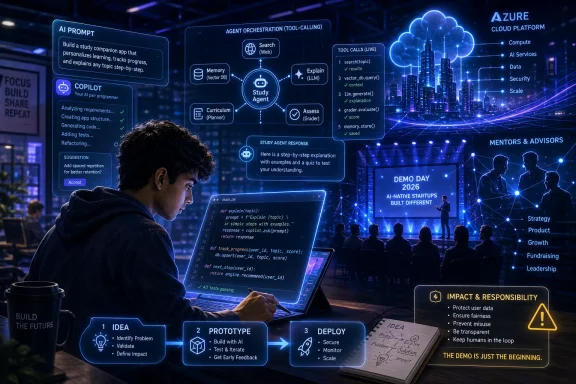 Microsoft Is Selling the Startup Dream Before the Startup Exists
The modern cloud platform fight no longer begins when a company has a CIO, a security team, and a purchasing committee. It begins when a student has an idea, an AI prompt, and just enough credits to turn a sketch into a demo. That is why Microsoft’s role in Red Bull Basement matters more than a standard sponsorship notice would suggest.Hawk’s message is deliberately human: keep going, stay agile, listen, adjust, and keep faith with a problem you believe is unmet. But surrounding that advice is a very specific product funnel. Participants are steered through an AI-assisted application experience built on Azure, encouraged to use GitHub Copilot, and pointed toward Microsoft’s platform for building intelligent agents and systems.
That makes the Red Bull interview a neat snapshot of Microsoft’s current AI strategy. The company is not merely selling compute or productivity software; it is trying to become the place where a half-formed idea becomes a minimum viable product. The founder’s journey is being recast as a cloud-native, AI-mediated workflow, with Azure waiting at every handoff.
There is nothing inherently sinister about that. Startups have always needed platforms, tools, mentors, and capital. But the more Microsoft can insert itself at the moment when a founder first learns how to build with AI, the more likely it becomes that “startup infrastructure” and “Azure infrastructure” feel like the same thing.
The Founder Advice Is Familiar, but the Tooling Around It Has Changed
Hawk’s advice to founders sits in a long tradition of startup counsel: persistence matters, execution matters, and ideas must survive contact with reality. She talks about pressures that push people toward safer, more expected choices, and about the need to keep moving when the first concept hits barriers. That is not new wisdom, but it lands differently in 2026 because the early cost of experimentation has collapsed.A first-time founder no longer needs to assemble a full engineering team before testing a workflow, generating code, mocking up a product flow, or building a pitchable prototype. AI tools can help generate application copy, produce code scaffolding, summarize market research, and explain technical concepts without the social friction of asking a mentor every basic question. Hawk calls AI an “infinitely patient teacher,” and that phrase captures both the promise and the risk.
The promise is obvious. The founder who lacks a technical co-founder, a friendly investor, or a local startup network can still iterate quickly. AI can reduce the intimidation factor around cloud services, programming frameworks, and product design.
The risk is that patience can be mistaken for judgment. AI will keep helping long after a bad idea should have been challenged. It will produce plausible answers even when the user needs market validation, regulatory advice, security review, or an uncomfortable conversation with real customers.
That is why Hawk’s parallel emphasis on human networks is important. She recalls pitching ideas casually to people outside formal business settings, including service workers and everyday contacts. That kind of messy, human feedback loop is still something AI cannot replace, because product-market fit is not discovered inside a chat window.
Red Bull Basement Gives Microsoft a Softer Route Into the Developer Pipeline
Red Bull Basement is pitched as a global innovation incubator for students and first-time founders, with a winner’s package that includes equity-free funding, Azure credits, mentorship, and access to AI tools. The branding is energetic and founder-friendly, but the structure resembles a practical developer acquisition channel. Microsoft is not waiting for startups to graduate into enterprise customers; it is meeting them at the application form.That matters because developer loyalty is often set early. The first cloud console a founder understands, the first AI coding assistant they rely on, the first credits that let them ship a demo — these can become defaults long after the startup has outgrown its student origins. Cloud migration is possible, but architectural inertia is real.
Microsoft knows this because Azure’s rise has depended not only on enterprise relationships but also on making its developer ecosystem feel unavoidable. Visual Studio Code, GitHub, Copilot, Azure, and now AI agent tooling form a ladder from individual tinkering to commercial deployment. Red Bull Basement gives that ladder a public, youth-oriented stage.
For Microsoft, this is a more appealing posture than simply shouting about model benchmarks or cloud regions. The company can appear as mentor, enabler, and infrastructure partner all at once. It can wrap Azure consumption inside a narrative of empowerment.
For Red Bull, the value is equally clear. The incubator can claim relevance in the AI startup moment without having to become a cloud company itself. Microsoft supplies the technical credibility; Red Bull supplies the audience, event machinery, and cultural packaging.
The “Magic” Framing Hides a Very Concrete Platform Bet
Hawk uses the language of magic to describe what happens when young innovators combine creativity with AI. That is useful marketing language, but the actual bet is not magical at all. Microsoft is betting that AI will make application development more accessible while simultaneously increasing dependence on integrated cloud platforms.The beginner-friendly story is that AI lowers barriers. The platform story is that the lowered barrier leads users directly into managed services. A founder who starts with an AI-assisted one-pager may next need a prototype, then authentication, storage, deployment, monitoring, compliance, and billing. At each step, the platform that made the first step easy has a chance to become the default answer.
This is where Azure credits play a familiar strategic role. Free or subsidized credits reduce early friction, but they also normalize a platform’s architecture and pricing model. Once a prototype becomes a product, the founder’s “free” technical choices become operational commitments.
That does not make credits bad. For a cash-strapped founder, credits can be the difference between an idea dying in a slide deck and becoming a working service. But experienced IT pros will recognize the pattern: today’s startup enablement is tomorrow’s cloud dependency.
The most important question, then, is not whether Microsoft is helping founders. It is whether founders understand the trade they are making. They gain speed, tooling, mentorship, and infrastructure; they may also inherit assumptions about architecture, data, cost, identity, and governance before they know enough to question them.
GitHub Copilot Is Becoming the New Founder’s Pair Programmer
The mention of GitHub Copilot is not incidental. Copilot has become one of Microsoft’s strongest bridges between individual developer behavior and enterprise AI adoption. If a first-time founder learns to write, debug, and reason about code with Copilot at their side, that workflow may become part of their technical identity.For novice builders, the value is easy to understand. Copilot can suggest code, explain errors, translate intent into syntax, and accelerate repetitive implementation work. It can make software development feel less like a gatekept discipline and more like a conversation with an assistant that has seen countless patterns before.
But Copilot also changes what early founders need to know. It reduces the penalty for not remembering syntax, but it does not remove the need to understand architecture, security, data modeling, licensing, or maintainability. The danger is not that AI writes code; the danger is that it writes enough code to convince a team it has built a product when it has mostly built a demo.
That distinction matters in startup programs. A polished demo can win attention, but a resilient product has to survive users, bad inputs, outages, abuse, privacy obligations, and cost growth. AI-assisted coding can accelerate the first half of that journey while leaving the second half dangerously underexamined.
The best founder programs will therefore teach Copilot as an amplifier, not an autopilot. The lesson should not be “AI can build it for you.” It should be “AI can help you build faster, but you are still accountable for what ships.”
Agent Building Is the New Cloud Lock-In Frontier
Hawk’s reference to orchestrating intelligent agents and systems points to the next stage of the platform contest. The first wave of cloud competition revolved around virtual machines, databases, storage, and developer frameworks. The AI wave is increasingly about agents: systems that can reason across tasks, call tools, interact with data, and operate inside business workflows.For founders, agents are seductive because they promise leverage. A tiny team can imagine building a product that automates work once reserved for departments. Customer support, scheduling, analytics, procurement, research, compliance prep, and internal operations all become candidates for AI-assisted workflows.
For platform companies, agents are attractive because they sit close to data, identity, permissions, logging, and business process integration. Once an agent architecture is built around a particular cloud provider’s orchestration layer, model access pattern, security model, and tool-calling framework, switching platforms becomes far more complex than moving a simple web app.
That is why Microsoft’s founder outreach around agents deserves scrutiny. It is not just giving students access to shiny AI features. It is introducing them to a way of building software in which the cloud platform is not merely hosting the application but coordinating the intelligence inside it.
This shift will matter for Windows shops, too. Many organizations are already trying to understand where Copilot, Azure AI services, Microsoft 365 data, Entra identity, and custom agents intersect. The startup world often previews patterns that enterprise IT later has to govern. What begins as a student innovation demo can become tomorrow’s procurement request.
The Old Startup Gospel Meets the New AI Subsidy Model
Hawk’s founder biography gives the interview credibility. Before Microsoft, she co-founded Capax Global, helped grow it from a regional systems integrator into an Azure-focused global services company, and later saw it merge with Hitachi Solutions. That is a very Microsoft-era founder story: services, cloud transformation, enterprise customers, and eventual consolidation into a larger partner ecosystem.Her advice reflects that background. Persistence matters, but not in the abstract. She emphasizes execution, agility, listening, and adjusting — the disciplines that separate durable businesses from clever concepts.
The AI subsidy model changes the early phase of that discipline. With cloud credits, coding assistants, and AI-guided application workflows, founders can do more before they raise money or hire specialists. That is empowering, but it can also delay hard prioritization. When experimentation feels cheap, teams may avoid deciding what they truly are.
The best founders will use AI to shorten the distance between hypothesis and evidence. They will build prototypes to learn, not merely to impress. They will treat generated code, pitch text, and AI-assisted strategy as drafts that demand reality checks.
The weaker founders will use AI to create motion without traction. They will produce more artifacts, more mockups, more summaries, and more demos, while still lacking a painful customer problem and a defensible answer. In that sense, AI does not abolish startup failure; it may simply make failure look more professional for longer.
Microsoft’s Empowerment Language Still Carries Enterprise Gravity
Microsoft’s mission statement — empowering every person and organization to achieve more — appears in Hawk’s comments because it fits the program neatly. It sounds broad, optimistic, and non-threatening. But Microsoft’s empowerment pitch has always been inseparable from its platform ambitions.That duality is not new. Windows empowered personal computing while anchoring users to Microsoft’s ecosystem. Office empowered knowledge work while defining file formats, workflows, and organizational habits. Azure empowers cloud transformation while creating deep operational dependencies.
The AI era continues that pattern. Microsoft can genuinely help young builders access powerful tools while also shaping their assumptions about where intelligence should live, how it should be billed, and who should mediate it. The two truths coexist.
For IT pros, this is familiar territory. Vendor ecosystems are not charities; they are strategic environments. Good vendors create real value, but they also create gravity. The job is not to reject gravity, but to understand it before building mission-critical systems inside it.
That is why founder education should include cloud literacy alongside motivational coaching. Students should learn not only how to prototype with Azure credits, but also how to estimate costs, protect data, document dependencies, design for portability where appropriate, and understand the security responsibilities that remain theirs.
The Human Network Is the Part Microsoft Cannot Productize
The strongest part of Hawk’s advice may be the least technical: talk to people. She argues that human connections remain vital, and that founders should keep their networks healthy. That advice cuts against the temptation to treat AI as an all-purpose substitute for uncertainty.Startup culture often romanticizes the solitary genius, and AI tools can intensify that myth. A founder can now brainstorm alone, code alone, design alone, and pitch-practice alone. The feedback loop is always available, always polite, and always willing to continue.
But markets are made of people who are impatient, inconsistent, budget-constrained, distracted, and often unable to describe what they need until they see it. A model can simulate feedback, but it cannot become a real buyer with a real procurement process and a real reason to say no.
This is especially true for founders building tools for businesses. Enterprise pain points are rarely isolated technical problems. They are tangled in compliance, workflow politics, legacy systems, training gaps, and security constraints. A founder who does not talk to actual users will build for an imaginary organization that approves purchases instantly and integrates cleanly with everything.
Red Bull Basement’s mentor and peer network may therefore be as important as the Azure credits. The value is not merely access to experts; it is forced contact with other humans who can challenge the story a founder is telling themselves.
AI Makes First-Time Founders Faster, Not Automatically Better
The central misconception around AI entrepreneurship is that speed and quality move together. Sometimes they do. A founder can test more variants, learn more tools, and produce working prototypes faster than before. But speed can also amplify weak judgment.A bad product idea does not become good because it has a chatbot interface. A thin business model does not become durable because the pitch deck invokes agents. A poorly secured app does not become enterprise-ready because Copilot helped write it.
This is where Microsoft’s partnership with a founder program faces a subtle responsibility. If the message is simply “AI unlocks magic,” participants may overestimate what the tools can safely do. If the message is “AI gives you leverage, but leverage magnifies both competence and error,” the program becomes more useful.
For WindowsForum’s audience, this distinction is not academic. Many admins and developers are already being asked to evaluate AI-generated internal tools, low-code automations, and prototype agents built by business units outside traditional IT governance. The founder mindset is entering the enterprise from the side door.
Organizations need to prepare for that reality. They will see more small teams building more software-like systems with less formal engineering background. The right response is not to ban experimentation, but to establish review paths, identity controls, data boundaries, logging expectations, and cost visibility before prototypes become production dependencies.
The Red Bull Stage Shows Where Microsoft Wants Azure to Sit
The interesting thing about this partnership is not that Microsoft wants students to use Azure. Of course it does. The interesting thing is where Azure is positioned in the founder journey: not as a back-end procurement choice, but as part of the creative process itself.That positioning reflects the broader direction of cloud platforms. The cloud used to be where software was deployed after development. Increasingly, the cloud is where development, AI assistance, data access, testing, deployment, and operations blur together. The platform becomes the workshop, the supply chain, and the showroom.
If Microsoft can make Azure feel like the natural place to brainstorm, prototype, deploy, and scale, it wins more than workloads. It wins mental models. A generation of founders may come to see AI-native building as something that happens inside a cloud provider’s integrated stack.
There are advantages to that model. Integration reduces friction. Security features can be standardized. Identity can be centralized. Monitoring and deployment can be simplified. For inexperienced founders, a coherent platform may prevent the chaos of stitching together random services with unclear responsibilities.
But coherence has a price. Platform-native thinking can narrow imagination. Founders may design around the services in front of them rather than the architecture their product actually requires. They may confuse convenience with strategy.
The Real Test Comes After the Demo
Startup programs naturally emphasize the pitch moment. There is a final, a stage, a winner, a package, and a story. But the real test for AI-assisted founders begins after the applause, when the prototype has to become reliable, secure, understandable, and financially sustainable.That is when the hidden work appears. Someone has to know where the data lives. Someone has to understand what the AI model is allowed to see. Someone has to manage secrets, permissions, audit logs, incident response, customer support, and cloud spend. Someone has to decide whether the system can be trusted when it acts on behalf of a user.
AI can help with many of those tasks, but it cannot assume accountability for them. The founder remains responsible. So does the organization that eventually deploys the product.
This is why the best interpretation of Hawk’s advice is not “believe harder.” It is “persist through execution.” Faith may get a founder through the lonely early phase, but execution is where belief becomes a system that other people can rely on.
Microsoft’s opportunity is to make that execution easier without making it opaque. If Azure’s AI tooling helps founders understand what they are building, the ecosystem gets stronger. If it merely hides complexity until the bill or breach arrives, the industry will rediscover old cloud lessons under new AI branding.
The Useful Lesson Buried Inside the Founder Pep Talk
Hawk’s Red Bull interview is promotional, but it still tells us something concrete about where AI development is heading. The next wave of founders will not learn cloud, coding, and AI as separate disciplines. They will encounter them as one continuous assisted workflow.That has practical consequences for anyone who builds, buys, secures, or supports software. The startup pipeline is becoming more accessible, more automated, and more platform-shaped. That is exciting, but it is not neutral.
- Microsoft is using Red Bull Basement to reach first-time founders before their technology choices harden into company architecture.
- Azure credits and AI-assisted application workflows reduce early friction, but they also introduce platform assumptions at the prototype stage.
- GitHub Copilot can help new builders move faster, but it does not remove the need for engineering judgment, security review, or maintainable design.
- Agent-building tools are likely to deepen cloud dependency because they sit close to identity, data, permissions, and business workflows.
- Human feedback remains the critical counterweight to AI-assisted iteration because customers, mentors, and peers can challenge assumptions that a model may simply refine.
- The most successful founders will use AI to learn faster, not to avoid the hard work of validation, execution, and accountability.
Source: Red Bull Microsoft’s Jessica Hawk on “magic” opportunities for first-time founders
