

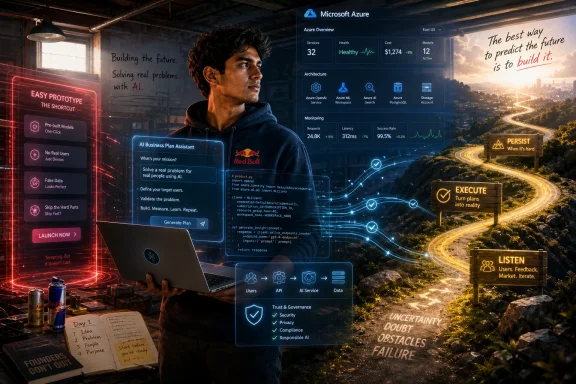
Microsoft Sells the Dream, but the Hard Part Still Belongs to Founders
Hawk’s advice to new founders has the texture of someone who has lived through the unglamorous middle of company-building. “Keep the faith” is not a technical architecture, a go-to-market plan, or a funding strategy. It is the thing people say when the spreadsheet looks bad, the prototype is late, and more sensible adults are suggesting a safer path.
That matters because Red Bull Basement is not being pitched merely as a student innovation contest with better branding. It is being framed as an on-ramp into the modern AI startup stack, with Microsoft’s cloud and AI infrastructure positioned as the enabling layer. The founder is still the protagonist, but the platform vendor is trying to become the stage, the lighting rig, and the road crew.
This is the Microsoft of the AI era in miniature. The company does not need every participant to become the next unicorn. It needs ambitious builders to internalize the idea that serious AI experimentation begins on Azure, that startup formation and cloud adoption are now adjacent rituals, and that the next generation of businesses should be born inside an ecosystem Microsoft already understands how to monetize.
That does not make the pitch cynical. It makes it strategic. The most successful platform companies have always tried to meet developers and founders at the moment of formation, before habits harden and before procurement departments turn every technology decision into a multi-quarter negotiation.
Red Bull Basement Turns the Startup Origin Story Into a Platform Moment
Red Bull Basement has long leaned into the cultural side of innovation: students, creators, social impact, live events, and a certain amount of high-energy mythology. The current AI framing gives that mythology a more practical edge. It says that the gap between idea and prototype is shrinking, and that first-time founders no longer need to wait for permission from a technical co-founder, an accelerator, or a venture firm before testing a concept.
That is a powerful idea because it flatters the outsider. It suggests that the next useful product may not come from the most credentialed engineer in the room, but from the person closest to an unmet need. Hawk’s comments fit squarely into this frame: if the founder can connect personal passion to a real problem, and if the problem is felt deeply enough to survive discouragement, then the startup has at least the emotional raw material required to continue.
But Red Bull Basement’s AI angle also reveals a subtle shift in how startup ecosystems are being packaged. The accelerator used to be the place where founders got introductions, mentorship, and a deadline. Now the accelerator is also a distribution channel for AI tools, cloud credits, model access, business-plan assistants, and template-driven product development.
The result is a more compressed founder journey. Ideation, validation, pitch creation, and prototype development are increasingly presented as activities that can happen in days rather than months. That compression is exciting, but it also raises the standard for what counts as progress. If everyone can generate a business plan and mock up an AI-powered workflow, the differentiator moves from starting to staying.
Hawk’s Founder Biography Gives the Pitch Its Weight
Hawk is not speaking only as a Microsoft marketing executive. Before joining Microsoft, she co-founded Capax Global, an Azure-focused technology company that later merged with Hitachi Solutions. That background gives her comments a useful duality: she has stood on the founder side of the table, and she now works inside one of the largest platform companies courting founders at scale.
That duality is important because her advice is unusually resistant to the fantasy that early-stage startups are solved by tools. She talks about pressure, doubt, persistence, agility, listening, adjustment, and the daily discipline of execution. Those are not the glamorous nouns of the generative AI boom, but they are the nouns that decide whether a startup becomes a company or a demo.
Her emphasis on lived experience also cuts against a common weakness in vendor-led startup messaging. Big technology companies often describe founders as if they are primarily resource-allocation problems: give them credits, APIs, cloud services, documentation, and partner access, and more companies will emerge. Hawk’s quote suggests a more human view. Resources matter, but the founder must still endure the psychological drag of ambiguity.
That is where the “magic” language becomes more interesting than it first appears. In the Red Bull idiom, magic could easily mean spectacle. In Hawk’s version, it is closer to alignment: the rare moment when a founder’s personal conviction, market need, and execution rhythm point in the same direction.
AI Lowers the Floor, Not the Ceiling
The most defensible claim in the modern AI-startup pitch is that the floor has dropped. A solo founder or small team can now do things that previously required a larger technical staff: generate product copy, sketch workflows, analyze user feedback, build rough interfaces, draft pitch materials, and experiment with code. For first-time founders, that is not trivial. It means less time staring at a blank page and more time confronting whether the idea survives contact with reality.
Microsoft and Red Bull are leaning into exactly that change. The AI Application Tool associated with Red Bull Basement is described as a way to help participants shape ideas, identify challenges, and create business plans. That is a sensible use of generative AI: not as an oracle, but as a structured thinking partner that can force a founder to clarify assumptions.
The trap is believing that lowering the floor is the same as raising the ceiling. AI can help a founder begin, but it does not guarantee taste, timing, distribution, defensibility, or trust. It can produce the shape of a company long before the founder has earned the substance of one.
This is where Hawk’s insistence on persistence matters. In a world where prototypes are cheap, perseverance becomes less about brute stubbornness and more about disciplined iteration. The founder who wins is not the one who prompts the most impressive first draft, but the one who keeps learning after the novelty wears off.
The New Founder Stack Is Emotional, Technical, and Commercial
The classic startup stack was technical: language, framework, database, cloud provider, analytics, payments, and deployment. The AI-era founder stack is broader. It includes emotional resilience, narrative clarity, user research, automated assistance, and the ability to make fast decisions under uncertainty.
That is why Red Bull Basement’s partnership model makes sense. Red Bull supplies the cultural wrapper and founder-facing energy. Microsoft supplies the credibility of cloud infrastructure, AI services, and startup tooling. AMD’s involvement around AI infrastructure reinforces the point that even the most accessible generative AI experience still depends on an expensive and highly engineered hardware-and-cloud supply chain.
For founders, this can feel democratizing. They get access to tools and language that once belonged mostly to larger companies. They can present themselves as AI-native from the first pitch deck. They can test concepts without waiting for a full engineering organization to materialize.
For platform companies, it is also a funnel. Today’s student founder using a guided AI application tool may become tomorrow’s startup customer, partner, acquisition target, or enterprise case study. The magic may be real, but the business model is not mysterious.
Microsoft Has Learned That Startups Are a Long Game
Microsoft’s posture toward startups has changed dramatically over the past two decades. The company that once seemed most comfortable selling to CIOs and enterprise procurement departments now competes aggressively for builders at the earliest stages. Azure credits, Founders Hub, AI templates, OpenAI-related services, GitHub, Visual Studio Code, and the broader developer ecosystem all serve the same strategic purpose: make Microsoft feel like a default before the founder has to choose a default.
That is not just about revenue. Startups create legitimacy. When the next wave of AI companies builds on your cloud, your cloud looks like the place where the future is happening. When early founders learn your tools, they carry those preferences into later companies, larger teams, and enterprise buying decisions.
The Red Bull Basement partnership gives Microsoft a softer and more culturally fluent way to make that case. Instead of leading with enterprise architecture diagrams, it leads with ambition. Instead of selling Azure as infrastructure, it presents Azure as possibility.
That is a smart move because first-time founders rarely begin with a procurement mindset. They begin with urgency, identity, and some mix of confidence and terror. Microsoft is trying to meet them there, then gently route that energy toward its stack.
“Keep Going” Is More Radical Than It Sounds
The most quotable part of Hawk’s advice is also the least fashionable: keep going. In the current AI climate, where product demos can go viral overnight and new model releases can alter entire roadmaps, persistence can sound almost quaint. But it may be the most countercultural advice available.
Founders are now surrounded by signals that encourage rapid abandonment. If a competitor launches a similar tool, pivot. If a model update changes the economics, pivot. If investors cool on a category, pivot. If users do not immediately understand the product, pivot. Agility is valuable, but permanent reaction mode is not strategy.
Hawk’s formulation is more nuanced. She tells founders to stay agile and listen, but also to remain persistent in execution. That distinction is the difference between adapting the path and surrendering the mission. Many early ideas do hit barriers; the founder’s job is to determine whether the barrier invalidates the need or merely exposes a weaker version of the proposed solution.
This is where AI can be both helpful and dangerous. It can accelerate experiments, but it can also make every alternative look seductively easy. The discipline is not merely to generate options, but to choose which options deserve another week of attention.
The First-Time Founder Is Now the Prize Customer
There is a reason Microsoft’s startup messaging often emphasizes the first-time founder. Experienced founders already have preferences, scars, investor networks, and strong opinions about infrastructure. First-time founders are still forming their mental model of what building a company looks like.
That makes them valuable, but also vulnerable. A well-designed program can genuinely help them avoid avoidable mistakes. A poorly understood toolchain can also lock them into complexity before they understand the trade-offs. The same AI services that make early development easier can create cost, governance, privacy, and reliability questions later.
For a WindowsForum audience, this is where the story intersects with the world of administrators and IT pros. Today’s Red Bull Basement participant may not be thinking about identity management, compliance boundaries, data retention, model governance, or cloud spend controls. If the project becomes a real company, those questions arrive quickly.
Microsoft’s advantage is that it can tell a continuity story. Start with approachable AI tools, then grow into Azure, Microsoft Entra, GitHub, Microsoft 365, Fabric, Power Platform, security tooling, and enterprise integration. The founder hears convenience; the CIO hears manageability. That is the platform play.
The Demo Economy Still Has a Trust Problem
Generative AI has made demos more impressive and less conclusive. A founder can now show something that looks polished long before the underlying system is robust. The pitch deck, landing page, prototype, chatbot, and market analysis may all have the sheen of maturity, even when the company is still little more than a hypothesis.
This is not a condemnation of AI-assisted building. Early-stage work has always involved theater. Founders have always had to sell a version of the future before it fully exists. The difference now is that the theater is cheaper, faster, and easier to mistake for traction.
That creates a harder job for judges, mentors, investors, and enterprise buyers. They must look past the generated artifacts and ask old-fashioned questions. Who is the user? What painful job is being solved? What happens when the model is wrong? What data is being used? Why will this survive when the underlying AI capability becomes a commodity?
Hawk’s advice implicitly points founders back to those fundamentals. Personal passion is useful only if it is attached to an unmet need. Execution matters because the idea itself is rarely enough. Persistence matters because the market is not obligated to reward a polished first attempt.
Windows Veterans Have Seen This Movie Before
For long-time Microsoft watchers, there is something familiar about this moment. Every major platform shift has produced a new wave of people declaring that the old constraints no longer apply. The PC lowered barriers. The web lowered barriers. Mobile lowered barriers. Cloud lowered barriers. Low-code and no-code lowered barriers. Now AI lowers barriers again.
Each wave really did expand who could build. Each wave also produced a graveyard of projects that confused access with advantage. The lesson is not that the hype was false. The lesson is that platforms redistribute difficulty rather than eliminating it.
In the Windows ecosystem, this has played out repeatedly. Easier development tools created more applications, but not necessarily better maintenance. Cloud services simplified deployment, but introduced new operational dependencies. AI assistants can accelerate coding, but they can also accelerate the production of code nobody fully understands.
For first-time founders, the practical message is clear: use the leverage, but do not outsource comprehension. If your product depends on AI, you must understand where the model fits, where it fails, what it costs, and how users will recover when it behaves unpredictably. Faith may keep a founder moving, but operational literacy keeps the product alive.
Red Bull’s Cultural Machine Meets Microsoft’s Enterprise Machine
The Red Bull and Microsoft pairing works because the two brands solve different problems for each other. Red Bull gives Microsoft access to a founder audience that does not want to feel like it is attending an enterprise software webinar. Microsoft gives Red Bull Basement technical substance at a time when every innovation program needs a credible AI story.
This is not an accidental convergence. AI has become the shared language of youth entrepreneurship, corporate strategy, and developer tooling. A student with a social-impact idea, a cloud vendor selling infrastructure, and a hardware company promoting AI compute can all plausibly occupy the same narrative.
The risk is that the narrative becomes too tidy. Not every founder needs to build an AI company. Not every unmet need is best served by a chatbot, a generated workflow, or a model-driven application. The healthiest version of this ecosystem will help participants use AI where it creates leverage, not where it merely adds fashion.
That distinction will matter more as AI fatigue grows. Users are already learning to distinguish between products that solve problems and products that simply announce that they contain AI. First-time founders who understand that difference will have an advantage over those who treat AI as a pitch-deck adjective.
The Real Opportunity Is Not Magic, but Compression
The word “magic” is irresistible in technology marketing because it describes the feeling of a tool working before the user understands how. But for founders, the more important word is compression. AI compresses the time between idea and artifact, between confusion and a first draft, between market hunch and testable pitch.
That compression changes founder behavior. It encourages more attempts, faster feedback, and broader participation. A non-technical founder can explore product logic before hiring an engineer. A technical founder can produce narrative and market materials without waiting for a marketing hire. A small team can simulate work that once required a larger staff.
But compression also increases noise. If more people can produce credible-looking startup materials, then the ecosystem must become better at judging substance. The scarce resource shifts from creation to discernment.
This is why Hawk’s emphasis on gut-level conviction is not sentimental fluff. In a noisy market, founders need a reason to stay with a problem long enough to understand it deeply. Without that, AI acceleration simply makes it easier to wander.
The Founder’s New Homework Is to Know When Not to Automate
One of the quiet dangers of AI tooling for first-time founders is that it can make premature abstraction feel productive. Instead of talking to users, the founder asks a model to summarize a market. Instead of wrestling with positioning, the founder generates ten variants. Instead of making a hard product decision, the founder produces a roadmap.
Those activities are not useless, but they can become substitutes for contact with reality. The best founders will use AI to prepare for the hard conversation, not to avoid it. They will generate hypotheses, then test them with humans. They will draft plans, then revise them against evidence.
Hawk’s advice to listen and adjust belongs here. Listening is not passive. It is a founder skill, and it becomes more important when tools can produce plausible answers instantly. The founder has to know which answers came from the market and which came from the machine.
This is also where mentors and accelerator programs still matter. AI can provide structure, but humans are often better at detecting self-deception. A good mentor can tell when a founder is polishing the wrong thing. A good program can force deadlines, external feedback, and accountability.
The WindowsForum Read Is That Azure Wants the Next Generation Early
For this community, the Microsoft angle is not incidental. Red Bull Basement is a youth innovation story on the surface, but underneath it is part of the competition to define where AI-native businesses begin. Azure is not merely hosting workloads; it is being presented as the natural environment for turning ambition into software.
That has downstream consequences. If these founders mature inside Microsoft’s ecosystem, they may bring Azure assumptions into future workplaces. They may choose Microsoft identity services, developer tools, data platforms, and AI governance frameworks by habit as much as by evaluation. The early founder relationship becomes a long-tail enterprise strategy.
Administrators should recognize the pattern. The tools that enter through experimentation often become production dependencies. A prototype built quickly for a founder program can become a customer-facing service, then a compliance concern, then an integration project. The glamour of startup formation eventually meets the ticket queue.
That does not mean IT should resist the wave. It means IT should understand it earlier. AI-assisted startup creation is going to produce more small teams with real cloud footprints, real data flows, and real security obligations before they have mature operational practices.
Where the Hype Ends and the Work Begins
The practical story is less about whether AI can help founders and more about what kind of help it provides. It can accelerate the blank-page phase. It can make business planning less intimidating. It can help non-specialists speak the language of product development, market research, and technical experimentation.
It cannot decide whether a founder is solving the right problem. It cannot manufacture trust with users. It cannot guarantee that a product has a viable business model. It cannot replace the judgment required to know when to pivot and when to persist.
That is why Hawk’s comments land better than a standard corporate AI pitch. She does not say that the tool is enough. She says founders need faith, passion, agility, listening, and daily execution. In other words, she describes AI as an accelerant for the founder’s work, not a replacement for the founder’s burden.
The best reading of the Red Bull Basement message is therefore not “AI makes everyone a founder.” It is “AI gives more people the chance to find out whether they are founders.” That is a smaller claim, but a much more credible one.
The Basement Pitch Leaves Founders With a Sharper Test
The useful lesson from Hawk’s advice is that first-time founders should welcome the new leverage without mistaking it for destiny. Red Bull Basement can provide structure, Microsoft can provide tools, and AI can provide acceleration. The founder still has to supply judgment.
- First-time founders now have unusually accessible tools for shaping ideas, building prototypes, and preparing pitches, but accessibility does not remove the need for market discipline.
- Microsoft’s role in Red Bull Basement is both supportive and strategic, giving new builders resources while introducing them early to the Azure-centered AI ecosystem.
- Hawk’s founder background makes her advice more grounded than ordinary platform marketing because she emphasizes persistence, agility, and execution over tool worship.
- AI is most useful when it helps founders clarify assumptions and test faster, not when it becomes a substitute for user conversations or product judgment.
- The next operational challenge for promising AI-assisted startups will be moving from impressive demos to secure, reliable, governable systems that real customers can trust.
The opportunity for first-time founders is real, but it is not magic in the fairy-tale sense. It is the more demanding kind of magic: a temporary opening created by better tools, lower barriers, and a market newly willing to believe that small teams can build consequential things. Microsoft and Red Bull are offering a doorway; the founders who matter will be the ones still walking after the music, the credits, and the first easy prototype fade.