

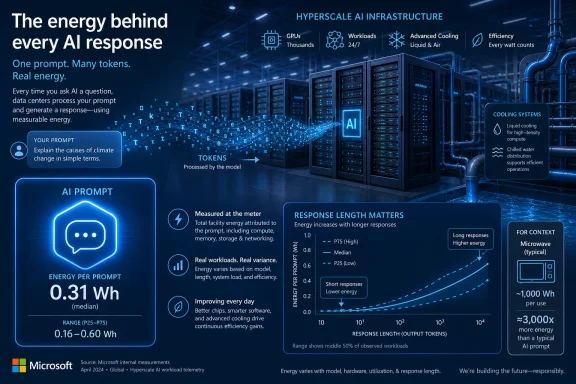
Microsoft said on June 15, 2026, that a typical large-language-model query in production consumes roughly 0.16 to 0.60 watt-hours of electricity, with a median near 0.31 Wh, comparable to running a 1,000-watt microwave for well under three seconds. That is the company’s answer to a question that has hovered over Copilot, ChatGPT, and the rest of the AI stack: how expensive is a single prompt, really? The answer is smaller than many popular estimates, but not small enough to make the infrastructure debate go away. Microsoft has not ended the argument over AI’s energy appetite; it has moved the argument from the chatbot window to the scale plan.
The headline number is deliberately disarming. A fraction of a watt-hour is not the sort of unit that sounds like a crisis, especially when Microsoft compares it to a microwave running for a few seconds or a desktop PC idling for less than a minute. For an individual user asking Copilot to summarize an email, that framing is useful: the act of asking one normal question is not equivalent to leaving a space heater on overnight.
But the individual prompt was never the whole story. Microsoft’s analysis matters because it tries to replace a fuzzy public talking point with a production-scale estimate: not a lone GPU in a lab, not a back-of-the-envelope comparison to search, but a model of how inference behaves when many users are hitting a large system at once. The company’s claim is that earlier estimates overstated the cost of ordinary AI queries because they failed to account for batching, high utilization, modern accelerators, and hyperscale data-center efficiency.
That is plausible, and it is also convenient. Microsoft sells AI services, leases AI capacity, builds AI data centers, and is trying to persuade enterprises that Copilot should become a normal layer of office work rather than a guilty indulgence. Showing that a normal prompt costs a sliver of a watt-hour helps neutralize one of the most intuitive objections to AI adoption: the feeling that every summary, rewrite, or code suggestion is secretly burning through a disproportionate amount of electricity.
The more interesting admission is buried in the same analysis. Microsoft’s estimate does not say AI is free; it says AI is highly sensitive to workload shape. A normal answer is cheap. A long reasoning chain, multi-step agent task, or generated code block can be much more expensive. In other words, the environmental and grid impact of AI will not be determined by whether users ask chatbots cute questions. It will be determined by whether software quietly turns one visible request into dozens of invisible model calls.
Search is not one thing. AI inference is not one thing. A query that retrieves a short answer from a small model is not comparable to a request that asks a frontier model to inspect a long document, reason over context, call tools, draft code, revise it, and explain its choices. The same is true on the infrastructure side: a partially loaded GPU running an isolated benchmark is not the same as a production fleet that batches requests and keeps expensive silicon busy.
Microsoft’s critique of earlier estimates is strongest here. If you calculate energy per query by assuming poor utilization, measuring only a narrow slice of the system, or ignoring batch processing, you can arrive at numbers that are technically defensible in a specific test but misleading as a general claim. Hyperscalers do not make money by letting H100s sit idle between prompts. Their entire economic incentive is to pack requests together, route jobs efficiently, and squeeze more tokens out of each watt.
That does not make Microsoft a neutral observer. The company is arguing from inside the business model it wants normalized. Still, the technical point is important: public debate about AI energy use has often treated inference like a fixed physical constant, when it is closer to a negotiated outcome among model size, prompt length, output length, hardware, scheduling, cooling, and utilization.
The better mental model is not “one AI query equals X searches.” It is “one AI query starts a meter, and the meter runs faster when the model thinks longer, reads more, writes more, or calls other systems.” That is less catchy, but it is closer to how the infrastructure actually works.
That sounds obvious until you apply it to the products Microsoft is selling. A short Copilot response in Outlook is one workload. A Teams recap of a long meeting is another. A software agent that reads a repository, proposes changes, runs tests, interprets failures, and revises code is another thing entirely. They may all be presented to the user as “AI,” but they are not equal energy events.
Microsoft’s median case assumes a fairly ordinary response of around 300 tokens. Under those conditions, the company’s figure lands near 0.31 Wh, with a middle range of 0.16 to 0.60 Wh. That is the number behind the microwave comparison, and it is the number that will inevitably appear in slide decks meant to reassure executives, regulators, and customers.
The heavier case is more revealing. When answers stretch toward 5,000 tokens because the model is reasoning longer or generating substantial code, Microsoft’s median estimate rises to about 3.91 Wh. That is still not enormous in household terms, but it is roughly an order of magnitude higher than the ordinary prompt. At enterprise scale, that distinction matters.
This is where WindowsForum readers should pay attention. The future of AI in Windows, Microsoft 365, Azure, GitHub, and Edge is not just a chat box. It is background summarization, local-and-cloud hybrid inference, document understanding, code completion, security triage, help-desk automation, and agentic workflows stitched into everyday software. The energy question follows the architecture.
The company’s own chip strategy points in that direction. Microsoft has been investing in Maia accelerators for inference, while continuing to use NVIDIA GPUs across Azure. The logic is simple: training may get the headlines, but inference is the recurring bill. Once AI becomes a feature embedded in office suites, browsers, operating systems, developer tools, and security products, the daily economics of token generation become more important than the one-time spectacle of training a giant model.
Efficiency gains should be welcomed, but they are not the same as absolute reductions. In computing, cheaper operations tend to invite more operations. Faster CPUs did not reduce software demand; they enabled heavier applications. Cheaper storage did not make people store less data; it made retention the default. More efficient inference may reduce the cost of each prompt while increasing the number of prompts, the number of background tasks, and the ambition of agentic systems.
That is the rebound problem. If Microsoft cuts energy per ordinary query by 20 times but product teams increase the number of AI calls by 50 times, the grid still feels the growth. The company’s own scenario hints at this: a billion ordinary queries per day may be manageable under the modeled conditions, but introducing a meaningful share of long reasoning workloads sharply raises total consumption.
For IT planners, the lesson is not to reject AI because it uses energy. It is to stop pretending that “AI” is a single class of workload. A tenant full of short summarization requests will not look like a tenant full of coding agents. A help desk bot that answers from cached documentation will not look like an autonomous workflow that fans out across mailboxes, SharePoint, databases, and ticketing systems.
But water accounting for data centers is even more location-sensitive than electricity accounting. A facility using closed-loop liquid cooling in a cool region has a different profile from one using evaporative cooling in a stressed watershed. A corporate average can obscure the local impact, and a per-query average can obscure the fact that infrastructure is built in large, concentrated chunks.
This is the gap between consumer metaphor and grid reality. A prompt may look tiny when compared to a microwave. A data center campus does not look tiny to a utility trying to connect hundreds of megawatts of new load. The public debate often jumps between those scales as if one disproves the other. It does not.
Microsoft’s per-query estimate can be true while communities still face real fights over substations, transmission lines, backup generation, water rights, and land use. The unit of political conflict is rarely the prompt. It is the data center, the power contract, the cooling system, and the infrastructure queue.
That distinction will become more important as AI workloads spread from centralized cloud products into hybrid architectures. On-device models in Windows PCs and browsers may reduce some cloud calls, but they also create new demand for NPUs, memory bandwidth, battery life, and local thermal budgets. The energy does not vanish; it moves around the stack.
That is the point Microsoft rarely emphasizes in the microwave comparison. AI is not being sold as a novelty feature that users invoke a few times per day. It is being sold as a general-purpose layer that sits across work. The more successful the product strategy, the less visible each individual model call becomes.
For administrators, this creates a governance problem that looks a lot like cost management but extends beyond the bill. Organizations will need to understand which AI features are enabled, which users and workflows are generating long-context requests, where data is being retrieved from, and whether agents are multiplying calls behind the scenes. Energy use may not appear as a line item in the Microsoft 365 admin center, but compute intensity will show up indirectly in licensing, throttling, latency, and capacity planning.
Developers face a similar discipline problem. A coding assistant that produces a short suggestion is one thing. A code agent that loops through plan, edit, test, debug, and retry is another. The energy delta follows the token delta, and the token delta follows product design. Good UX can hide a lot of computation.
The industry’s next argument will be about whether AI systems should disclose more about their own resource use. Token counts, model class, latency, and approximate energy bands could become useful signals, especially for enterprise admins trying to compare vendors or enforce policies. Microsoft’s paper gives the market a vocabulary; now customers need instrumentation.
The weakness is that hyperscale efficiency is also what makes massive deployment possible. Microsoft can say, credibly, that it is reducing per-query consumption through batching, model routing, better hardware, and improved data-center design. It can also be true that the company’s aggregate AI demand is rising because Copilot, Azure AI, GitHub, Windows, and partner workloads are expanding.
This is the uncomfortable duality of cloud sustainability claims. Efficiency is necessary, measurable, and real. But the public consequences are measured in total load, not just per-unit improvement. Utilities do not build transmission lines for median prompts; they build for campuses, peaks, redundancy, and growth curves.
Microsoft’s sustainability story has therefore shifted from “we will make AI efficient” to “we can make AI scale without energy growing at the same rate.” That is a more defensible claim, but also a more modest one. It concedes that demand will grow, while promising that engineering can bend the curve.
For Windows users, the practical takeaway is not shame over asking an AI to summarize a document. It is skepticism toward any product pitch that treats AI as ambient and costless. The responsible future is not one where users count every prompt like carbon penance. It is one where vendors design systems that route simple tasks to small models, cache repeated work, run locally when sensible, and reserve expensive reasoning for cases that actually need it.
But metaphors have a short shelf life. The microwave comparison makes ordinary inference sound trivial, and in isolation it often is. Yet AI’s infrastructure problem is not made of isolated prompts. It is made of billions of prompts, longer contexts, reasoning models, agent loops, duplicated features, speculative product design, and a business race in which every major platform vendor wants AI to become the default interface.
The most honest reading of Microsoft’s analysis is neither panic nor absolution. A normal prompt is probably less energy-intensive than many people assumed. A future full of invisible, long-running AI agents could still become a major source of new electricity demand. Both statements can be true, and the second one matters more for planning.
That dual reality should shape how enterprises adopt AI. The useful question is no longer “Is one query bad?” The useful question is “Which workloads are worth scaling, and which ones are just automated waste?”
 Microsoft Shrinks the Prompt, but Not the Data Center
The headline number is deliberately disarming. A fraction of a watt-hour is not the sort of unit that sounds like a crisis, especially when Microsoft compares it to a microwave running for a few seconds or a desktop PC idling for less than a minute. For an individual user asking Copilot to summarize an email, that framing is useful: the act of asking one normal question is not equivalent to leaving a space heater on overnight.But the individual prompt was never the whole story. Microsoft’s analysis matters because it tries to replace a fuzzy public talking point with a production-scale estimate: not a lone GPU in a lab, not a back-of-the-envelope comparison to search, but a model of how inference behaves when many users are hitting a large system at once. The company’s claim is that earlier estimates overstated the cost of ordinary AI queries because they failed to account for batching, high utilization, modern accelerators, and hyperscale data-center efficiency.
That is plausible, and it is also convenient. Microsoft sells AI services, leases AI capacity, builds AI data centers, and is trying to persuade enterprises that Copilot should become a normal layer of office work rather than a guilty indulgence. Showing that a normal prompt costs a sliver of a watt-hour helps neutralize one of the most intuitive objections to AI adoption: the feeling that every summary, rewrite, or code suggestion is secretly burning through a disproportionate amount of electricity.
The more interesting admission is buried in the same analysis. Microsoft’s estimate does not say AI is free; it says AI is highly sensitive to workload shape. A normal answer is cheap. A long reasoning chain, multi-step agent task, or generated code block can be much more expensive. In other words, the environmental and grid impact of AI will not be determined by whether users ask chatbots cute questions. It will be determined by whether software quietly turns one visible request into dozens of invisible model calls.
The Old “Ten Searches” Rule Was Always Too Neat
For years, one of the stickiest claims about generative AI was that a chatbot query used about ten times as much electricity as a web search. It was memorable, easy to repeat, and emotionally satisfying for critics of AI hype. It also compressed an absurdly variable technical process into a single moral comparison.Search is not one thing. AI inference is not one thing. A query that retrieves a short answer from a small model is not comparable to a request that asks a frontier model to inspect a long document, reason over context, call tools, draft code, revise it, and explain its choices. The same is true on the infrastructure side: a partially loaded GPU running an isolated benchmark is not the same as a production fleet that batches requests and keeps expensive silicon busy.
Microsoft’s critique of earlier estimates is strongest here. If you calculate energy per query by assuming poor utilization, measuring only a narrow slice of the system, or ignoring batch processing, you can arrive at numbers that are technically defensible in a specific test but misleading as a general claim. Hyperscalers do not make money by letting H100s sit idle between prompts. Their entire economic incentive is to pack requests together, route jobs efficiently, and squeeze more tokens out of each watt.
That does not make Microsoft a neutral observer. The company is arguing from inside the business model it wants normalized. Still, the technical point is important: public debate about AI energy use has often treated inference like a fixed physical constant, when it is closer to a negotiated outcome among model size, prompt length, output length, hardware, scheduling, cooling, and utilization.
The better mental model is not “one AI query equals X searches.” It is “one AI query starts a meter, and the meter runs faster when the model thinks longer, reads more, writes more, or calls other systems.” That is less catchy, but it is closer to how the infrastructure actually works.
Tokens Are the New Clock Cycles
Microsoft’s analysis centers on inference, the process that happens after a model has already been trained and is being used to answer requests. Inference turns text into tokens, processes those tokens through the model, and generates new tokens in response. The more tokens the system consumes and produces, the more work the accelerator has to do.That sounds obvious until you apply it to the products Microsoft is selling. A short Copilot response in Outlook is one workload. A Teams recap of a long meeting is another. A software agent that reads a repository, proposes changes, runs tests, interprets failures, and revises code is another thing entirely. They may all be presented to the user as “AI,” but they are not equal energy events.
Microsoft’s median case assumes a fairly ordinary response of around 300 tokens. Under those conditions, the company’s figure lands near 0.31 Wh, with a middle range of 0.16 to 0.60 Wh. That is the number behind the microwave comparison, and it is the number that will inevitably appear in slide decks meant to reassure executives, regulators, and customers.
The heavier case is more revealing. When answers stretch toward 5,000 tokens because the model is reasoning longer or generating substantial code, Microsoft’s median estimate rises to about 3.91 Wh. That is still not enormous in household terms, but it is roughly an order of magnitude higher than the ordinary prompt. At enterprise scale, that distinction matters.
This is where WindowsForum readers should pay attention. The future of AI in Windows, Microsoft 365, Azure, GitHub, and Edge is not just a chat box. It is background summarization, local-and-cloud hybrid inference, document understanding, code completion, security triage, help-desk automation, and agentic workflows stitched into everyday software. The energy question follows the architecture.
Efficiency Is Real, and So Is the Rebound
Microsoft says the same kind of workload could become 8 to 20 times more energy efficient through a mix of smaller model routing, better serving infrastructure, improved hardware, and purpose-built AI chips. That is not fantasy. The AI industry has already shown that inference can get dramatically cheaper when models are compressed, quantized, distilled, cached, and routed more intelligently.The company’s own chip strategy points in that direction. Microsoft has been investing in Maia accelerators for inference, while continuing to use NVIDIA GPUs across Azure. The logic is simple: training may get the headlines, but inference is the recurring bill. Once AI becomes a feature embedded in office suites, browsers, operating systems, developer tools, and security products, the daily economics of token generation become more important than the one-time spectacle of training a giant model.
Efficiency gains should be welcomed, but they are not the same as absolute reductions. In computing, cheaper operations tend to invite more operations. Faster CPUs did not reduce software demand; they enabled heavier applications. Cheaper storage did not make people store less data; it made retention the default. More efficient inference may reduce the cost of each prompt while increasing the number of prompts, the number of background tasks, and the ambition of agentic systems.
That is the rebound problem. If Microsoft cuts energy per ordinary query by 20 times but product teams increase the number of AI calls by 50 times, the grid still feels the growth. The company’s own scenario hints at this: a billion ordinary queries per day may be manageable under the modeled conditions, but introducing a meaningful share of long reasoning workloads sharply raises total consumption.
For IT planners, the lesson is not to reject AI because it uses energy. It is to stop pretending that “AI” is a single class of workload. A tenant full of short summarization requests will not look like a tenant full of coding agents. A help desk bot that answers from cached documentation will not look like an autonomous workflow that fans out across mailboxes, SharePoint, databases, and ticketing systems.
The Water Number Is Small, but the Geography Is Not
Microsoft also estimates that cooling and related water use per normal query can be tiny, with a median below a hundredth of a teaspoon and a range that may include zero depending on facility design and cooling method. On the face of it, that is another calming number. It says a user should not imagine a visible gulp of water disappearing every time Copilot rewrites a paragraph.But water accounting for data centers is even more location-sensitive than electricity accounting. A facility using closed-loop liquid cooling in a cool region has a different profile from one using evaporative cooling in a stressed watershed. A corporate average can obscure the local impact, and a per-query average can obscure the fact that infrastructure is built in large, concentrated chunks.
This is the gap between consumer metaphor and grid reality. A prompt may look tiny when compared to a microwave. A data center campus does not look tiny to a utility trying to connect hundreds of megawatts of new load. The public debate often jumps between those scales as if one disproves the other. It does not.
Microsoft’s per-query estimate can be true while communities still face real fights over substations, transmission lines, backup generation, water rights, and land use. The unit of political conflict is rarely the prompt. It is the data center, the power contract, the cooling system, and the infrastructure queue.
That distinction will become more important as AI workloads spread from centralized cloud products into hybrid architectures. On-device models in Windows PCs and browsers may reduce some cloud calls, but they also create new demand for NPUs, memory bandwidth, battery life, and local thermal budgets. The energy does not vanish; it moves around the stack.
Copilot’s Real Cost Is the Work It Automates Into Existence
The most important product question is not whether one Copilot answer costs 0.31 Wh. It is whether Copilot turns previously occasional tasks into continuous ones. If every meeting can be summarized, every inbox can be scanned, every document can be drafted, every pull request can be reviewed, and every security alert can be explained, the volume of inference rises because software has lowered the friction of asking.That is the point Microsoft rarely emphasizes in the microwave comparison. AI is not being sold as a novelty feature that users invoke a few times per day. It is being sold as a general-purpose layer that sits across work. The more successful the product strategy, the less visible each individual model call becomes.
For administrators, this creates a governance problem that looks a lot like cost management but extends beyond the bill. Organizations will need to understand which AI features are enabled, which users and workflows are generating long-context requests, where data is being retrieved from, and whether agents are multiplying calls behind the scenes. Energy use may not appear as a line item in the Microsoft 365 admin center, but compute intensity will show up indirectly in licensing, throttling, latency, and capacity planning.
Developers face a similar discipline problem. A coding assistant that produces a short suggestion is one thing. A code agent that loops through plan, edit, test, debug, and retry is another. The energy delta follows the token delta, and the token delta follows product design. Good UX can hide a lot of computation.
The industry’s next argument will be about whether AI systems should disclose more about their own resource use. Token counts, model class, latency, and approximate energy bands could become useful signals, especially for enterprise admins trying to compare vendors or enforce policies. Microsoft’s paper gives the market a vocabulary; now customers need instrumentation.
Microsoft’s Best Defense Is Also Its Biggest Vulnerability
The strongest part of Microsoft’s case is that hyperscale infrastructure is usually more efficient than improvised infrastructure. If enterprises are going to use frontier-scale AI anyway, it may be better to run those workloads on optimized fleets than on underutilized clusters with poor cooling and little scheduling sophistication. That is the cloud argument, translated into watts.The weakness is that hyperscale efficiency is also what makes massive deployment possible. Microsoft can say, credibly, that it is reducing per-query consumption through batching, model routing, better hardware, and improved data-center design. It can also be true that the company’s aggregate AI demand is rising because Copilot, Azure AI, GitHub, Windows, and partner workloads are expanding.
This is the uncomfortable duality of cloud sustainability claims. Efficiency is necessary, measurable, and real. But the public consequences are measured in total load, not just per-unit improvement. Utilities do not build transmission lines for median prompts; they build for campuses, peaks, redundancy, and growth curves.
Microsoft’s sustainability story has therefore shifted from “we will make AI efficient” to “we can make AI scale without energy growing at the same rate.” That is a more defensible claim, but also a more modest one. It concedes that demand will grow, while promising that engineering can bend the curve.
For Windows users, the practical takeaway is not shame over asking an AI to summarize a document. It is skepticism toward any product pitch that treats AI as ambient and costless. The responsible future is not one where users count every prompt like carbon penance. It is one where vendors design systems that route simple tasks to small models, cache repeated work, run locally when sensible, and reserve expensive reasoning for cases that actually need it.
The Microwave Metaphor Gets Microsoft Only So Far
Microsoft has earned some credit for replacing vague folklore with a more concrete estimate. The 0.31 Wh median figure is useful because it gives the industry a better starting point than “AI is ten searches” or “AI is melting the grid one prompt at a time.” It reminds critics that production systems are optimized and that naive benchmark extrapolations can mislead.But metaphors have a short shelf life. The microwave comparison makes ordinary inference sound trivial, and in isolation it often is. Yet AI’s infrastructure problem is not made of isolated prompts. It is made of billions of prompts, longer contexts, reasoning models, agent loops, duplicated features, speculative product design, and a business race in which every major platform vendor wants AI to become the default interface.
The most honest reading of Microsoft’s analysis is neither panic nor absolution. A normal prompt is probably less energy-intensive than many people assumed. A future full of invisible, long-running AI agents could still become a major source of new electricity demand. Both statements can be true, and the second one matters more for planning.
That dual reality should shape how enterprises adopt AI. The useful question is no longer “Is one query bad?” The useful question is “Which workloads are worth scaling, and which ones are just automated waste?”
The Numbers Windows Shops Should Actually Remember
Microsoft’s estimate gives IT teams a better baseline, but the operational lesson is about variance rather than absolutes. The same AI brand name can hide radically different compute profiles depending on prompt length, output length, model choice, and whether an agent is looping through multiple steps.- A typical large-language-model response in Microsoft’s analysis lands around 0.31 Wh, with a middle range of roughly 0.16 to 0.60 Wh.
- Long reasoning or code-generation outputs can push median energy use several watt-hours per request, roughly an order of magnitude above a short answer.
- Batch processing, high GPU utilization, and data-center efficiency are central to Microsoft’s claim that older public estimates were too high.
- Per-query water estimates can be tiny, but local cooling design and data-center geography still determine real community impact.
- Smaller models, better routing, custom silicon, and improved serving software may cut energy per query substantially, but broader deployment can erase some of those gains.
- Admins should treat AI usage as a workload-management problem, not merely a licensing feature toggle.
References
- Primary source: GIGAZINE
Published: 2026-06-16T05:50:07.849008
Microsoft claims that 'the power consumption of a single question to the AI is about the same as running a microwave oven for a few seconds,' up to 1/20th of previous estimates. - GIGAZINE
On June 15, 2026, Microsoft announced analysis results indicating that the estimated power consumption when sending a single question to a large-scale language model is approximately 0.16 to 0.60 Wh, equivalent to the power consumption of a 40W PC running for about 15 to 60 seconds. This is...gigazine.net - Official source: microsoft.com
Energy Use of AI Inference: Efficiency Pathways and Test-Time Compute - Microsoft Research
As AI inference scales to billions of queries and emerging reasoning and agentic workflows substantially increase token demand, reliable estimates of per-query energy use are increasingly important for capacity planning, emissions accounting, and efficiency prioritization. Yet many public...www.microsoft.com - Official source: blogs.microsoft.com
Maia 200: The AI accelerator built for inference - The Official Microsoft Blog
Today, we’re proud to introduce Maia 200, a breakthrough inference accelerator engineered to dramatically improve the economics of AI token generation. Maia 200 is an AI inference powerhouse: an accelerator built on TSMC’s 3nm process with native FP8/FP4 tensor cores, a redesigned memory system...blogs.microsoft.com - Official source: techcommunity.microsoft.com
Deep dive into the Maia 200 architecture | Microsoft Community Hub
Maia 200 is a breakthrough inference architecture engineered to dramatically shift the economics of large-scale token generation. As... techcommunity.microsoft.com
- Related coverage: datacenterdynamics.com
Microsoft unveils Maia 200 inferencing chip - DCD
Designed using TSMC’s 3nm process technology, company has already deployed chip in its US Central data center regionwww.datacenterdynamics.com - Related coverage: devsustainability.com
- Related coverage: spheron.network
AI Inference Power Consumption and GPU Electricity Costs: 2026 Guide | Spheron Blog
GPU electricity costs are the hidden variable in AI inference TCO. This guide covers GPU TDP, electricity price variance, cooling overhead, and how cloud pricing eliminates the power bill mystery.www.spheron.network
- Official source: azure.microsoft.com
- Official source: blogs.windows.com
Expanding on‑device AI in Microsoft Edge: New models and APIs for the web
At Build 2025, we introduced the Prompt and Writing Assistance APIs in Microsoft Edge with the Phi-4-mini language model. Since then, we'blogs.windows.com - Official source: adoption.microsoft.com
- Official source: cdn-dynmedia-1.microsoft.com
- Related coverage: iea.org
Executive summary – Energy and AI – Analysis - IEA
Energy and AI - Analysis and key findings. A report by the International Energy Agency.www.iea.org
- Related coverage: axis-intelligence.com
AI Data Center Energy Consumption Statistics 2026: The Definitive Data Report - Axis Intelligence
Global data center electricity hit 460–490 TWh in 2025, up 17% YoY. IEA, DOE, and Epoch AI primary-source data on AI energy demand, water use, capex, and our original AEII™ metric. AI Data Center Energy Consumption Statistics 2026 [Updated].axis-intelligence.com - Related coverage: aitooldiscovery.com
AI Data Center Power: 415 TWh in 2024, 945 TWh by 2030
Global data centers consumed 415 TWh in 2024 and will reach 945 TWh by 2030. AI rack power density, PUE explained, and what the energy surge means.www.aitooldiscovery.com - Related coverage: theatlantic.com
Inside the Dirty, Dystopian World of AI Data Centers - The Atlantic
The race to power AI is already remaking the physical world.www.theatlantic.com
- Related coverage: iea-4e.org
- Related coverage: axios.com
AI power costs: Demand to grow tenfold by 2030, new report says
The finding has giant implications for the billions of dollars going into AI startups.www.axios.com
