

Nigerian universities are grading artificial intelligence in the classroom all wrong because many still judge student work by finished outputs in 2026, while the strongest evidence from Edo State shows AI improves learning only when teachers assess process, reasoning, retention, and transfer. The mistake is not that students are using Copilot, ChatGPT, Gemini, or coding assistants. The mistake is that universities keep treating AI as either a cheating device to be hunted or a productivity tool to be celebrated, when in education it is neither. It is an amplifier, and what it amplifies depends almost entirely on what the classroom rewards.
The six-week Edo State experiment has quickly become the kind of result that education technology companies dream about. Roughly 800 senior secondary students used Microsoft Copilot in computer labs twice a week for English-language learning, and the World Bank’s randomized trial found gains that were described as roughly equivalent to one-and-a-half to two years of conventional learning. Girls, who began behind boys, reportedly closed the gap.
That is a remarkable result, especially in a country where classrooms are often overcrowded, learning materials are unevenly distributed, and teachers are asked to perform miracles with thin institutional support. But the headline version is also dangerous. If the lesson becomes “AI produced two years of learning,” Nigerian universities will import the wrong conclusion.
The more accurate lesson is that guided AI use produced learning. The teachers did not abandon the room to a chatbot. They opened the session, framed the task, shaped the prompts, watched the students work, intervened when necessary, and closed the loop with reflection. The World Bank’s description of teachers as “orchestra conductors” is not a decorative metaphor; it is the mechanism.
Copilot was not magically transformed into a curriculum. It was placed inside one. That distinction matters because the same general-purpose AI model that can support a student through a difficult passage can also produce a fluent essay the student barely understands. The tool did not determine the educational outcome. The classroom design did.
This is not a Nigerian peculiarity. It is now a global condition of higher education. A student can paste in a programming assignment, ask for Python or Java code, request debugging, ask for comments, and refine the output until it passes enough tests to look legitimate. The old boundary between help and authorship has collapsed into a gray zone that most course policies still describe in black and white.
For programming education, the collapse is especially severe because code has always been easy to evaluate superficially. It compiles or it does not. It passes the unit tests or it fails. It produces the expected output or it crashes. These are necessary measures in software engineering, but they are dangerously incomplete measures in education.
A professional developer using AI to accelerate a routine task is judged by reliability, maintainability, security, and fitness for purpose. A student learning recursion, pointers, loops, data structures, or algorithmic thinking must be judged by something else: whether the idea has actually entered the mind. The same piece of code can be evidence of competence in one context and evidence of almost nothing in another.
That is the trap. AI makes the student’s artifact look more like professional work while making it harder to know whether the student’s understanding has grown at all.
But the cheating frame is too narrow because it treats the central harm as dishonesty rather than missed learning. A student who copies a chatbot’s code and passes the assignment has not merely broken a rule. They have also skipped the cognitive struggle that the assignment was designed to provoke.
This is why AI detectors have become such a disappointing comfort blanket. Even when they appear to work, they do not tell lecturers what matters most. They cannot reliably distinguish between a student who used AI to clarify an error and a student who used AI to write the whole solution. They cannot measure whether the student can explain the code under pressure. They cannot say whether the concept will survive next month’s exam or next year’s internship.
The detector mindset also creates perverse incentives. Students learn to paraphrase outputs, remove tell-tale phrases, and use AI more covertly. Lecturers spend time policing style instead of redesigning assessment. The university ends up fighting the last war: trying to preserve the appearance of pre-AI coursework in a world where the production conditions have already changed.
If the only institutional question is “Did AI touch this work?”, the answer will often be yes, no, or unknowable. The better question is harder and more useful: “What did the student learn through this work, and how do we know?”
That is a rational response to a broken scoreboard. If a lecturer grades only the submitted code, the code becomes the target. If a department grades only the finished essay, the essay becomes the target. If the system rewards correctness without inspecting reasoning, students will optimize for correctness.
This is not moral failure by a generation of students. It is predictable behavior under pressure. Nigerian undergraduates face crowded classes, heavy course loads, unstable power and connectivity, high family expectations, and a labor market that increasingly demands credentials and practical skills at the same time. When a tool promises speed, fluency, and confidence, many will use it.
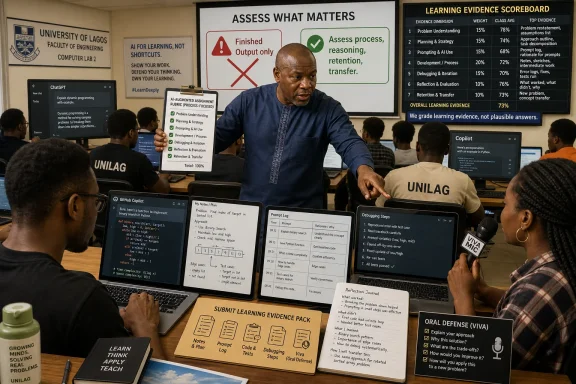
The university’s job is not to pretend this pressure does not exist. It is to design assessments that make the shortcut less valuable than the learning path. That means rewarding attempts, explanations, revisions, debugging trails, oral defense, and the ability to adapt knowledge to new cases.
A student who uses AI to ask, “Why does my loop never terminate?” is doing something educationally different from a student who asks, “Write the answer.” A grading system that cannot distinguish between those two students is not a grading system fit for the AI era.
That should be obvious, but the education technology market has spent decades selling the fantasy that the next platform will route around weak institutions. First it was tablets, then MOOCs, then adaptive learning dashboards, now generative AI tutors. The recurring promise is scale without the messiness of people.
In low-resource environments, that promise is seductive. Nigeria has real educational constraints, and AI can help stretch scarce expertise. It can offer immediate explanations, translation, examples, practice questions, and patient repetition at a scale no human staff can match. But it cannot decide what a university should certify, what a course should emphasize, or when a student is merely fluent in borrowed language.
The teacher’s role therefore becomes more important, not less. In an AI-rich classroom, lecturers are not just deliverers of content. They are designers of tasks, auditors of reasoning, coaches of judgment, and interpreters of student work. They decide when AI should answer, when it should ask, and when it should stay out of the way.
That is why the “orchestra conductor” metaphor travels so well from secondary English to university programming. The conductor does not play every instrument. The conductor makes the performance coherent.
In a first-year programming course, the same helpfulness can be destructive. The friction is often the point. Struggling to trace a variable, misreading an error message, writing a clumsy first solution, and discovering why it fails are not bugs in the learning process. They are the learning process.
That does not mean students should be denied AI assistance. It means the assistance must be shaped differently. A teaching assistant should prefer hints over answers, questions over completions, diagnosis over substitution, and reflection over polish. It should help the student think rather than help the assignment disappear.
This is why educationally designed coding assistants, including research tools such as CodeHelp and newer AI tutors that use Socratic prompting, are more interesting than general chatbots pasted into coursework. Their design assumption is different. They begin from the idea that the student’s confusion is not an obstacle to be removed as quickly as possible but a signal to be worked with.
The distinction may sound philosophical, but it has practical consequences. A chatbot that gives a full solution after one prompt changes the assignment. A tutor that asks the student to predict the next value of a variable preserves the assignment while making it more teachable.
But strategy documents do not grade assignments. Departmental practice does. On many campuses, the operative policy is still improvisation: one lecturer bans AI outright, another quietly tolerates it, a third permits it if disclosed, and a fourth has no rule until a suspicious submission appears. Students learn the policy by rumor.
This creates inequity. Students in one course may be punished for using a tool that students in another course are encouraged to use. Students with better devices, better internet, and better prompt literacy can quietly outperform classmates who are not less intelligent, only less technologically advantaged. Lecturers with smaller classes may run oral defenses, while lecturers handling hundreds of scripts may fall back on brittle written submissions.
A national university system cannot eliminate these differences, but it can reduce the chaos. It can require departments to classify AI use by task, publish explicit rules, redesign assessment formats, and train lecturers to evaluate process. It can also insist that institutions distinguish between AI as a writing aid, AI as a coding assistant, AI as a research tool, and AI as an unauthorized substitute for student work.
The worst outcome would be a policy that merely says “AI is allowed” or “AI is banned.” Both statements are too crude. The real work is specifying when, how, with what disclosure, and with what evidence of learning.
Can the student explain why a solution works? Can they identify a hallucinated library call? Can they spot a security flaw in generated code? Can they simplify a needlessly clever answer? Can they adapt a solution when the requirements change? Can they debug without simply asking the model to try again?
These are not soft skills. They are central computing skills. In many workplaces, AI will produce more code, not less, and that means human developers will spend more time reviewing, integrating, testing, and taking responsibility for machine-suggested output. Universities that continue to assess only production will graduate students into a world where production is increasingly automated.
The danger for Nigerian universities is not that AI will make students too powerful. It is that it will make weak understanding look strong enough to pass. Employers will then discover the gap later, in interviews, internships, production outages, and failed projects.
That would be bad for students and bad for the reputation of the degrees that certified them. A university credential should not mean “this person can obtain a plausible answer from a chatbot.” It should mean “this person can reason with tools, challenge outputs, and carry knowledge into unfamiliar problems.”
A programming assignment can require a short design note before implementation and a reflection after debugging. A lab can include a five-minute viva in which the student explains one function chosen by the lecturer. A course can include unseen in-class modifications to previously submitted work. A final grade can include process logs, commit history, peer explanation, and timed exercises where AI is either explicitly allowed or explicitly excluded.
The point is not to create a surveillance regime. It is to restore alignment between the assessment and the learning objective. If the objective is syntax familiarity, the test should reveal syntax familiarity. If the objective is algorithmic reasoning, the test should reveal reasoning. If the objective is professional AI-assisted development, then the student should be asked to disclose prompts, critique outputs, and justify edits.
This also means universities should stop pretending that one assessment mode can do everything. AI-free exams still have a role, especially in foundational courses where students must internalize core concepts. AI-permitted projects also have a role, especially in advanced courses where tool use resembles professional practice. The integrity comes from clarity, not nostalgia.
The classroom should not be a courtroom in which every student is presumed guilty. It should be a workshop in which students must show their hands, their tools, and their thinking.
That is why the burden cannot be left to individual lecturers acting alone. If universities want AI-aware assessment, departments need templates, shared rubrics, approved disclosure language, and realistic workload models. Faculties need guidance on when oral exams are appropriate, how to sample students fairly, and how to handle appeals. Institutions need to decide what evidence counts.
There is also a training gap. Many lecturers did not grow up with these tools and may reasonably distrust them. Others use them privately but have no shared academic vocabulary for explaining acceptable use. A serious institutional response would treat AI literacy for lecturers as part of quality assurance, not as an optional workshop for enthusiasts.
The goal should not be to turn every lecturer into an AI researcher. It should be to give every lecturer enough practical fluency to design assignments that cannot be trivially outsourced, to recognize productive AI use, and to challenge suspicious work without relying on unreliable detector scores.
Students need rules. Lecturers need backing. Departments need standards. Without all three, the policy will live on paper while the real classroom continues by improvisation.
Edo State’s reported gains for girls are especially important because they suggest that guided AI may help close gaps rather than widen them. In a system where gender, geography, income, and school quality already shape outcomes, that possibility deserves serious attention. AI should not be dismissed simply because it comes from the same technology industry that has oversold many previous fixes.
But equity is not automatic. The student with a better phone, paid subscription, stable power, and sophisticated prompting habits may gain far more than the student using a shared device on an unstable connection. English-dominant models may help some students while flattening local language contexts. AI can lower barriers, but it can also reward those who already know how to extract value from it.
Universities therefore need to treat AI access as part of educational infrastructure. If a course permits AI use, the institution should think about whether all students can access comparable tools. If AI is required for an assignment, the university must provide a pathway that does not depend on private spending. If AI is banned for a task, the ban must be enforceable and pedagogically justified.
Otherwise, AI becomes another hidden fee in a system already full of hidden costs.
If universities respond to AI by banning it reflexively, they risk graduating students who are unprepared for modern development workflows. If they respond by allowing it lazily, they risk graduating students whose apparent productivity masks weak fundamentals. Either path weakens the talent pipeline.
The right path is more demanding. Students should learn to code without AI before being asked to code responsibly with AI. They should learn data structures deeply enough to reject a bad generated answer. They should learn software engineering practices that make AI output reviewable. They should learn that prompt skill is not a substitute for domain knowledge.
This is where Nigerian universities can turn a threat into an advantage. Many institutions around the world are still stuck between panic and permissiveness. A Nigerian university system that makes AI-assisted learning rigorous, transparent, and assessment-driven would not be catching up. It would be setting a standard.
But that requires abandoning the fantasy that the final answer tells the whole story. In the AI era, the final answer may be the least informative part of the work.
Nigeria does not need to choose between fear of AI and surrender to it. Edo State showed that the technology can lift learning when teachers frame it, guide it, and measure the right thing. The next test is whether universities can apply that lesson before a generation of students is graded on outputs that say less and less about what they actually know.
 Edo State Did Not Prove That AI Teaches Children
The six-week Edo State experiment has quickly become the kind of result that education technology companies dream about. Roughly 800 senior secondary students used Microsoft Copilot in computer labs twice a week for English-language learning, and the World Bank’s randomized trial found gains that were described as roughly equivalent to one-and-a-half to two years of conventional learning. Girls, who began behind boys, reportedly closed the gap.That is a remarkable result, especially in a country where classrooms are often overcrowded, learning materials are unevenly distributed, and teachers are asked to perform miracles with thin institutional support. But the headline version is also dangerous. If the lesson becomes “AI produced two years of learning,” Nigerian universities will import the wrong conclusion.
The more accurate lesson is that guided AI use produced learning. The teachers did not abandon the room to a chatbot. They opened the session, framed the task, shaped the prompts, watched the students work, intervened when necessary, and closed the loop with reflection. The World Bank’s description of teachers as “orchestra conductors” is not a decorative metaphor; it is the mechanism.
Copilot was not magically transformed into a curriculum. It was placed inside one. That distinction matters because the same general-purpose AI model that can support a student through a difficult passage can also produce a fluent essay the student barely understands. The tool did not determine the educational outcome. The classroom design did.
The University Lab Has Become a Factory for Plausible Answers
Move from Edo State’s secondary-school English labs to a university computer science lab in Lagos, Ibadan, Nsukka, Zaria, Benin City, Port Harcourt, or Akure, and the problem changes shape but not substance. Students are not merely asking AI to explain concepts. Many are using it to manufacture submissions.This is not a Nigerian peculiarity. It is now a global condition of higher education. A student can paste in a programming assignment, ask for Python or Java code, request debugging, ask for comments, and refine the output until it passes enough tests to look legitimate. The old boundary between help and authorship has collapsed into a gray zone that most course policies still describe in black and white.
For programming education, the collapse is especially severe because code has always been easy to evaluate superficially. It compiles or it does not. It passes the unit tests or it fails. It produces the expected output or it crashes. These are necessary measures in software engineering, but they are dangerously incomplete measures in education.
A professional developer using AI to accelerate a routine task is judged by reliability, maintainability, security, and fitness for purpose. A student learning recursion, pointers, loops, data structures, or algorithmic thinking must be judged by something else: whether the idea has actually entered the mind. The same piece of code can be evidence of competence in one context and evidence of almost nothing in another.
That is the trap. AI makes the student’s artifact look more like professional work while making it harder to know whether the student’s understanding has grown at all.
The Old Anti-Cheating Frame Is Too Small for the Problem
Universities have naturally reached for the language they already know: plagiarism, misconduct, unauthorized assistance, academic integrity. That language is not useless. A student who submits AI-generated work as entirely their own is misrepresenting authorship, and institutions need enforceable rules for that.But the cheating frame is too narrow because it treats the central harm as dishonesty rather than missed learning. A student who copies a chatbot’s code and passes the assignment has not merely broken a rule. They have also skipped the cognitive struggle that the assignment was designed to provoke.
This is why AI detectors have become such a disappointing comfort blanket. Even when they appear to work, they do not tell lecturers what matters most. They cannot reliably distinguish between a student who used AI to clarify an error and a student who used AI to write the whole solution. They cannot measure whether the student can explain the code under pressure. They cannot say whether the concept will survive next month’s exam or next year’s internship.
The detector mindset also creates perverse incentives. Students learn to paraphrase outputs, remove tell-tale phrases, and use AI more covertly. Lecturers spend time policing style instead of redesigning assessment. The university ends up fighting the last war: trying to preserve the appearance of pre-AI coursework in a world where the production conditions have already changed.
If the only institutional question is “Did AI touch this work?”, the answer will often be yes, no, or unknowable. The better question is harder and more useful: “What did the student learn through this work, and how do we know?”
Output-Based Grading Rewards the Weakest Use of AI
The worst use of generative AI in education is also the use that many grading systems reward most directly. If the mark depends mainly on a polished final product, the student has every incentive to ask the system for a polished final product. The model becomes a vending machine: insert assignment, receive answer.That is a rational response to a broken scoreboard. If a lecturer grades only the submitted code, the code becomes the target. If a department grades only the finished essay, the essay becomes the target. If the system rewards correctness without inspecting reasoning, students will optimize for correctness.
This is not moral failure by a generation of students. It is predictable behavior under pressure. Nigerian undergraduates face crowded classes, heavy course loads, unstable power and connectivity, high family expectations, and a labor market that increasingly demands credentials and practical skills at the same time. When a tool promises speed, fluency, and confidence, many will use it.
The university’s job is not to pretend this pressure does not exist. It is to design assessments that make the shortcut less valuable than the learning path. That means rewarding attempts, explanations, revisions, debugging trails, oral defense, and the ability to adapt knowledge to new cases.
A student who uses AI to ask, “Why does my loop never terminate?” is doing something educationally different from a student who asks, “Write the answer.” A grading system that cannot distinguish between those two students is not a grading system fit for the AI era.
The Copilot Lesson Is That Teachers Still Matter More Than Tools
Edo State’s result cuts against two lazy narratives at once. It undermines the claim that AI is inherently corrosive to learning, and it undermines the opposite claim that AI can simply replace human instruction. The intervention worked because human teachers shaped the interaction.That should be obvious, but the education technology market has spent decades selling the fantasy that the next platform will route around weak institutions. First it was tablets, then MOOCs, then adaptive learning dashboards, now generative AI tutors. The recurring promise is scale without the messiness of people.
In low-resource environments, that promise is seductive. Nigeria has real educational constraints, and AI can help stretch scarce expertise. It can offer immediate explanations, translation, examples, practice questions, and patient repetition at a scale no human staff can match. But it cannot decide what a university should certify, what a course should emphasize, or when a student is merely fluent in borrowed language.
The teacher’s role therefore becomes more important, not less. In an AI-rich classroom, lecturers are not just deliverers of content. They are designers of tasks, auditors of reasoning, coaches of judgment, and interpreters of student work. They decide when AI should answer, when it should ask, and when it should stay out of the way.
That is why the “orchestra conductor” metaphor travels so well from secondary English to university programming. The conductor does not play every instrument. The conductor makes the performance coherent.
Coding Assistants Built for Work Are Poor Teachers by Default
A productivity assistant is trained, tuned, and marketed to finish tasks. That is precisely why developers find it useful. It completes boilerplate, proposes functions, translates snippets, explains errors, and reduces friction. In the workplace, that can be valuable.In a first-year programming course, the same helpfulness can be destructive. The friction is often the point. Struggling to trace a variable, misreading an error message, writing a clumsy first solution, and discovering why it fails are not bugs in the learning process. They are the learning process.
That does not mean students should be denied AI assistance. It means the assistance must be shaped differently. A teaching assistant should prefer hints over answers, questions over completions, diagnosis over substitution, and reflection over polish. It should help the student think rather than help the assignment disappear.
This is why educationally designed coding assistants, including research tools such as CodeHelp and newer AI tutors that use Socratic prompting, are more interesting than general chatbots pasted into coursework. Their design assumption is different. They begin from the idea that the student’s confusion is not an obstacle to be removed as quickly as possible but a signal to be worked with.
The distinction may sound philosophical, but it has practical consequences. A chatbot that gives a full solution after one prompt changes the assignment. A tutor that asks the student to predict the next value of a variable preserves the assignment while making it more teachable.
Nigeria Has a Chance to Leapfrog the Policy Mistakes Others Made
Nigeria is not entering this debate from nowhere. The country has a national AI strategy, a growing policy conversation around digital skills, and a university regulator with responsibility for academic standards. The National Universities Commission has already had to think about AI in the context of e-learning, quality assurance, and institutional modernization.But strategy documents do not grade assignments. Departmental practice does. On many campuses, the operative policy is still improvisation: one lecturer bans AI outright, another quietly tolerates it, a third permits it if disclosed, and a fourth has no rule until a suspicious submission appears. Students learn the policy by rumor.
This creates inequity. Students in one course may be punished for using a tool that students in another course are encouraged to use. Students with better devices, better internet, and better prompt literacy can quietly outperform classmates who are not less intelligent, only less technologically advantaged. Lecturers with smaller classes may run oral defenses, while lecturers handling hundreds of scripts may fall back on brittle written submissions.
A national university system cannot eliminate these differences, but it can reduce the chaos. It can require departments to classify AI use by task, publish explicit rules, redesign assessment formats, and train lecturers to evaluate process. It can also insist that institutions distinguish between AI as a writing aid, AI as a coding assistant, AI as a research tool, and AI as an unauthorized substitute for student work.
The worst outcome would be a policy that merely says “AI is allowed” or “AI is banned.” Both statements are too crude. The real work is specifying when, how, with what disclosure, and with what evidence of learning.
The Degree Must Certify Judgment, Not Just Production
The deepest issue is not whether a student wrote every line of code unaided. In the age of AI, that may become an increasingly artificial standard outside certain foundational exercises. The deeper issue is whether the student can exercise judgment over code, systems, and consequences.Can the student explain why a solution works? Can they identify a hallucinated library call? Can they spot a security flaw in generated code? Can they simplify a needlessly clever answer? Can they adapt a solution when the requirements change? Can they debug without simply asking the model to try again?
These are not soft skills. They are central computing skills. In many workplaces, AI will produce more code, not less, and that means human developers will spend more time reviewing, integrating, testing, and taking responsibility for machine-suggested output. Universities that continue to assess only production will graduate students into a world where production is increasingly automated.
The danger for Nigerian universities is not that AI will make students too powerful. It is that it will make weak understanding look strong enough to pass. Employers will then discover the gap later, in interviews, internships, production outages, and failed projects.
That would be bad for students and bad for the reputation of the degrees that certified them. A university credential should not mean “this person can obtain a plausible answer from a chatbot.” It should mean “this person can reason with tools, challenge outputs, and carry knowledge into unfamiliar problems.”
Assessment Has to Move Closer to the Student
If universities want to know what students understand, they will have to assess closer to the moment of thinking. That is more labor-intensive than marking a final file, but not every reform requires heroic staffing. Even small changes can expose the difference between borrowed output and learned competence.A programming assignment can require a short design note before implementation and a reflection after debugging. A lab can include a five-minute viva in which the student explains one function chosen by the lecturer. A course can include unseen in-class modifications to previously submitted work. A final grade can include process logs, commit history, peer explanation, and timed exercises where AI is either explicitly allowed or explicitly excluded.
The point is not to create a surveillance regime. It is to restore alignment between the assessment and the learning objective. If the objective is syntax familiarity, the test should reveal syntax familiarity. If the objective is algorithmic reasoning, the test should reveal reasoning. If the objective is professional AI-assisted development, then the student should be asked to disclose prompts, critique outputs, and justify edits.
This also means universities should stop pretending that one assessment mode can do everything. AI-free exams still have a role, especially in foundational courses where students must internalize core concepts. AI-permitted projects also have a role, especially in advanced courses where tool use resembles professional practice. The integrity comes from clarity, not nostalgia.
The classroom should not be a courtroom in which every student is presumed guilty. It should be a workshop in which students must show their hands, their tools, and their thinking.
Lecturers Need Institutional Cover, Not Just Moral Urgency
It is easy to tell lecturers to redesign assessment. It is harder to do that inside Nigerian university conditions. Large classes, limited teaching assistants, unreliable infrastructure, administrative overload, and underfunded labs all make high-touch assessment difficult.That is why the burden cannot be left to individual lecturers acting alone. If universities want AI-aware assessment, departments need templates, shared rubrics, approved disclosure language, and realistic workload models. Faculties need guidance on when oral exams are appropriate, how to sample students fairly, and how to handle appeals. Institutions need to decide what evidence counts.
There is also a training gap. Many lecturers did not grow up with these tools and may reasonably distrust them. Others use them privately but have no shared academic vocabulary for explaining acceptable use. A serious institutional response would treat AI literacy for lecturers as part of quality assurance, not as an optional workshop for enthusiasts.
The goal should not be to turn every lecturer into an AI researcher. It should be to give every lecturer enough practical fluency to design assignments that cannot be trivially outsourced, to recognize productive AI use, and to challenge suspicious work without relying on unreliable detector scores.
Students need rules. Lecturers need backing. Departments need standards. Without all three, the policy will live on paper while the real classroom continues by improvisation.
The Equity Argument Cuts Both Ways
AI in Nigerian education is often framed as a democratizing technology, and there is truth in that. A student without access to private tutoring can get explanations at midnight. A student who is shy in class can ask basic questions without embarrassment. A student learning in a second language can request simpler phrasing, examples, and practice.Edo State’s reported gains for girls are especially important because they suggest that guided AI may help close gaps rather than widen them. In a system where gender, geography, income, and school quality already shape outcomes, that possibility deserves serious attention. AI should not be dismissed simply because it comes from the same technology industry that has oversold many previous fixes.
But equity is not automatic. The student with a better phone, paid subscription, stable power, and sophisticated prompting habits may gain far more than the student using a shared device on an unstable connection. English-dominant models may help some students while flattening local language contexts. AI can lower barriers, but it can also reward those who already know how to extract value from it.
Universities therefore need to treat AI access as part of educational infrastructure. If a course permits AI use, the institution should think about whether all students can access comparable tools. If AI is required for an assignment, the university must provide a pathway that does not depend on private spending. If AI is banned for a task, the ban must be enforceable and pedagogically justified.
Otherwise, AI becomes another hidden fee in a system already full of hidden costs.
The Nigerian Software Talent Pipeline Is at Stake
This debate is not confined to campus ethics committees. Nigeria wants to grow digital talent, attract technology investment, expand software exports, and build local capacity in AI, cybersecurity, data science, cloud computing, and financial technology. Universities sit near the beginning of that pipeline.If universities respond to AI by banning it reflexively, they risk graduating students who are unprepared for modern development workflows. If they respond by allowing it lazily, they risk graduating students whose apparent productivity masks weak fundamentals. Either path weakens the talent pipeline.
The right path is more demanding. Students should learn to code without AI before being asked to code responsibly with AI. They should learn data structures deeply enough to reject a bad generated answer. They should learn software engineering practices that make AI output reviewable. They should learn that prompt skill is not a substitute for domain knowledge.
This is where Nigerian universities can turn a threat into an advantage. Many institutions around the world are still stuck between panic and permissiveness. A Nigerian university system that makes AI-assisted learning rigorous, transparent, and assessment-driven would not be catching up. It would be setting a standard.
But that requires abandoning the fantasy that the final answer tells the whole story. In the AI era, the final answer may be the least informative part of the work.
The New Scoreboard Should Measure the Learning AI Leaves Behind
The practical lesson from Edo State is not that every classroom needs Copilot. It is that the educational value of AI depends on the structure around it. Nigerian universities should now build that structure deliberately rather than waiting for misconduct cases to define it by accident.- Students should be required to disclose meaningful AI use in assessed work, including whether the tool generated code, explained errors, suggested structure, or edited language.
- Foundational courses should preserve some AI-free assessment so departments can verify that students have internalized essential concepts.
- AI-permitted assignments should grade prompt quality, critique of outputs, debugging decisions, and the student’s explanation of the final work.
- Oral defenses, live modifications, and reflective process notes should become normal parts of assessment, especially in programming-heavy courses.
- Universities should provide access to approved tools where AI use is required, so assessment does not reward private purchasing power.
- Departments should prefer learning-oriented AI tutors for teaching tasks instead of relying only on productivity assistants designed to complete work.
Nigeria does not need to choose between fear of AI and surrender to it. Edo State showed that the technology can lift learning when teachers frame it, guide it, and measure the right thing. The next test is whether universities can apply that lesson before a generation of students is graded on outputs that say less and less about what they actually know.
References
- Primary source: Nairametrics
Published: 2026-06-27T12:28:28.683411
Why Nigerian universities are grading AI in the classroom all wrong - Nairametrics
Over six weeks in 2024, about 800 senior secondary students in Edo State sat in computer labs twice a week and learned English with the help of Microsoftnairametrics.com - Related coverage: nuc.edu.ng
Guidelines for e Learning in Nigerian Universities April 2023 Revised FINAL
PDF documentwww.nuc.edu.ng
